
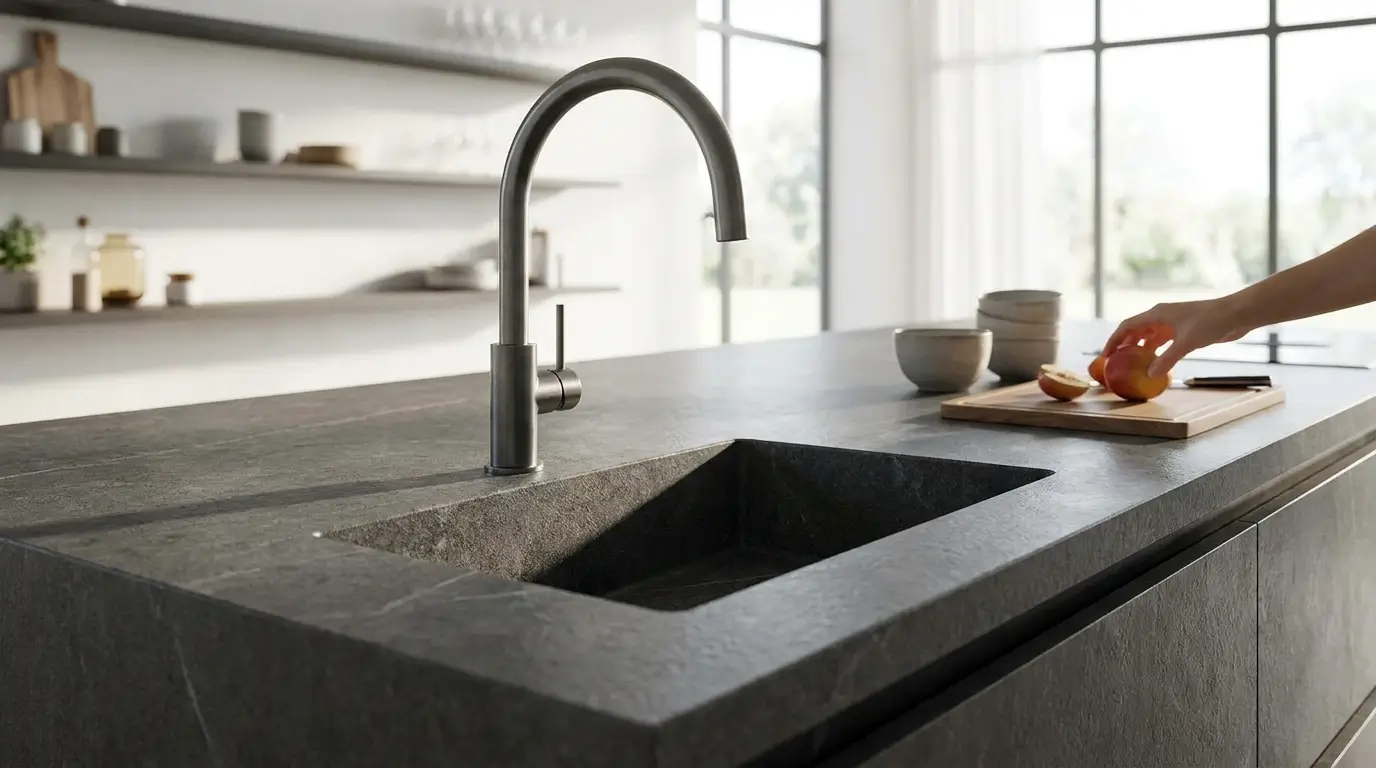
There is a category of kitchen design where the island stops being a piece of furniture. A monolithic kitchen island with an integrated stone sink belongs to this category. It is not assembled from components. It does not expose its construction in the conventional sense of a cabinet base. It presents itself as a single, continuous, unified object carved from or formed in a single material.
The standard kitchen sink has for too long been a deep, cavernous tub designed to hide dirty dishes. The monolithic approach rejects that, utilizing a shallow basin carved directly from a continuous block of stone that is simultaneously the sink. A single architectural surface that treats water management as a design statement. This is a fundamentally different understanding of what a kitchen island can be. It produces a fundamentally different kitchen experience, one where the island is not the most important piece of furniture in the room but the most important piece of architecture.
In 2026, design thinking is shifting away from spotlighting the sink as a standalone fixture. Toward integrating it into the countertop, cabinetry, and workflow. The kitchen sink is becoming part of the architecture, not a decorative add-on. The monolithic stone island with an integrated sink is the fullest.
Monolithic Kitchen Island Design with Integrated Stone Sink
1. Understanding the Monolithic Island Concept
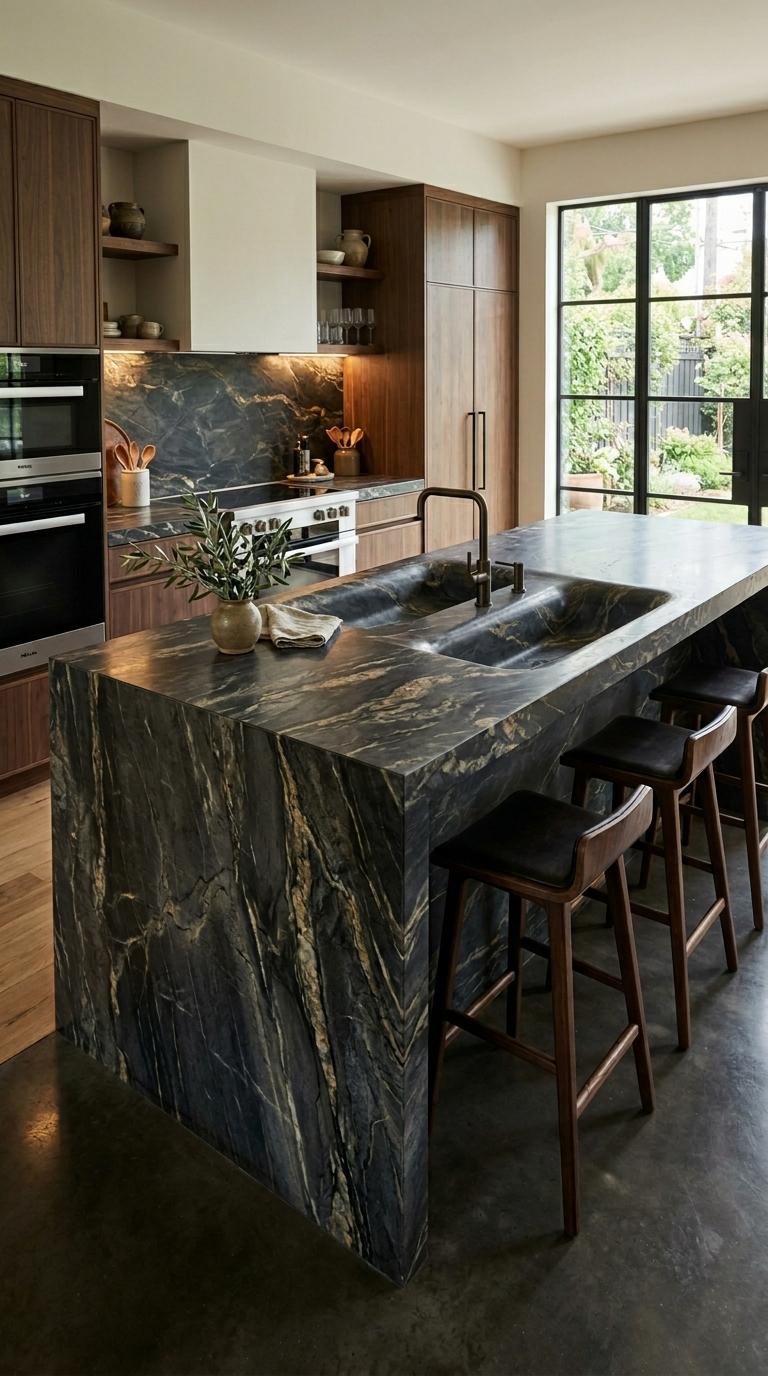
A monolithic object in design is one that presents itself as a single, undivided mass rather than as an assembly of separate components. The monolithic kitchen island achieves this quality through the consistent use of a single material across every visible surface of the island form, countertop, sink basin, waterfall sides, and, in some configurations,s the base as well, creating an object whose visual weight and material completeness communicate permanence and certainty rather than the provisional quality of assembled parts.
The integration of the sink into the stone surface of a monolithic island is what most completely achieves the monolithic effect because the sink is conventionally the point where the material continuity of a kitchen counter is most dramatically interrupted. A standard undermount or drop-in sink requires a cutout in the counter material and the introduction of a separate basin material, whether stainless steel, ceramic, or composite, that breaks the visual continuity of the counter surface at precisely the point where the most activity and the most visual attention is concentrated. The integrated stone sink eliminates this interruption by continuing the counter material into and through the basin form, creating a surface that flows without break from dry counter to wet basin to drain and back to counter with the unhurried continuity of a river bed worn smooth by decades of water.
The technical execution of an integrated stone sink in a kitchen island requires either stone carving from a single thick slab, where the basin is literally carved into the stone, or the fabrication of a stone basin that is bonded to the counter surface with a joint so precisely executed that it is invisible in the finished installation. Both approaches are available through specialist stone fabricators in Indian cities, and both require a level of craft and precision that separates them clearly from standard modular kitchen installation.
2. Stone Material Selection for Maximum Monolithic Impact
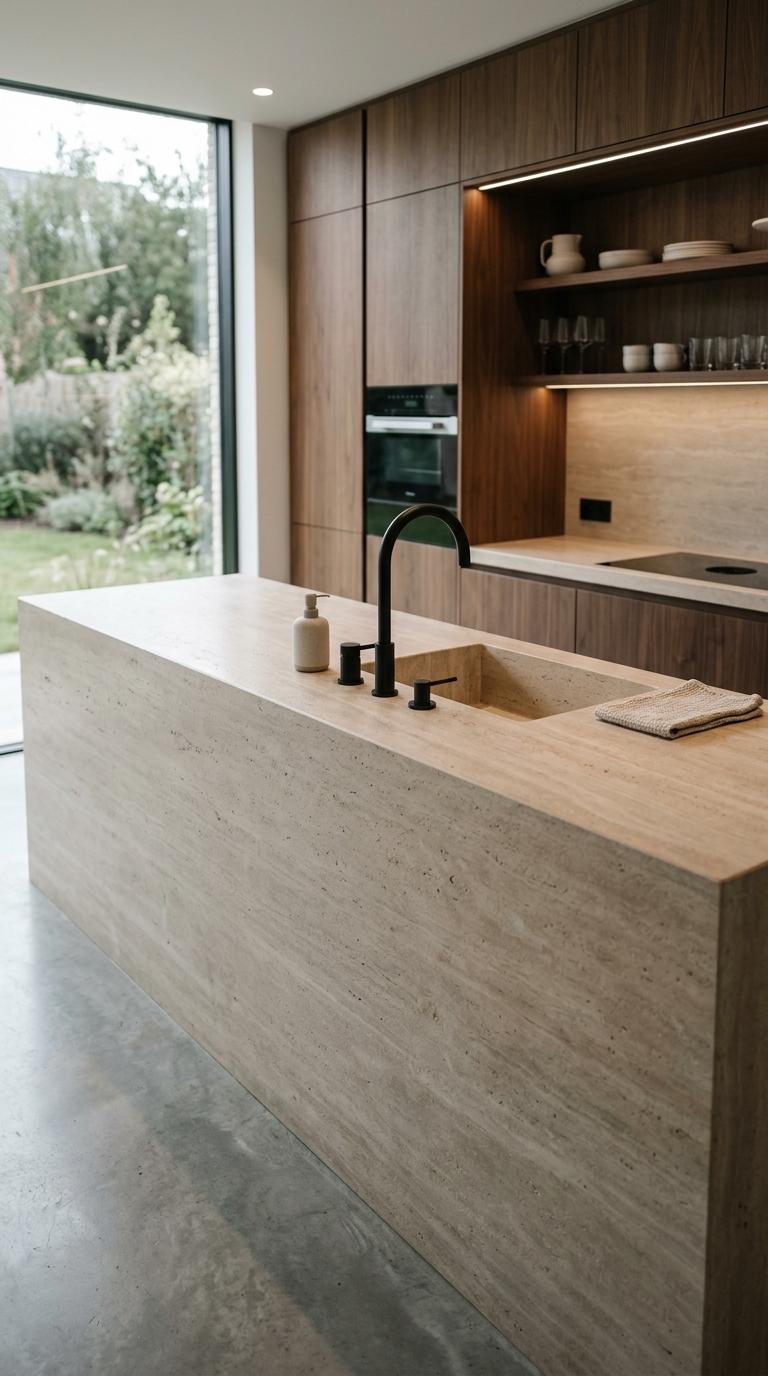
The stone chosen for a monolithic island with integrated sink determines the visual character of the entire kitchen more completely than any other single material decision, and it is a decision that deserves more consideration and more research than any other element of the kitchen design. The stone is not just the counter material or the sink material. It is the island’s entire identity, the material from which every visible surface is formed, and its color, pattern, texture, and veining are the visual content of the kitchen’s most prominent design statement.
The waterfall edge, where the stone continues vertically down one or more sides, creates a seamless monolithic look that feels architectural and grounding, particularly effective in open-plan spaces or darker schemes where the natural pattern reads as a continuous feature rather than just a work surface. In a monolithic island with an integrated sink, the waterfall edge is not merely a design detail but a structural expression of the monolithic philosophy, the stone wrapping from horizontal to vertical in a continuous plane that eliminates every visual interruption in the island’s surface.
Marble in its darker, more dramatically veined varieties creates the most architecturally powerful monolithic island. Nero Marquina black marble with its white veining creates an island of extraordinary visual drama that photographs as a graphic composition of extreme contrast and that in person has a depth and material richness that lighter stones cannot match. Calacatta gold marble, with its warm grey and gold veining, creates an island of more classical luxury that works naturally within the warm earthy palette of contemporary Indian interior design. Pietra grey marble, with its fine, consistent grey tone and subtle veining, creates a monolithic island of maximum restraint and architectural precision that suits the most rigorous contemporary kitchen aesthetic.
Indian natural stone offers some of the most compelling monolithic island materials available anywhere in the world at prices that reflect domestic production rather than import margins. Rajnagar red marble from Rajasthan creates monolithic islands of extraordinary warmth and visual power. Black Galaxy granite from Andhra Pradesh, with its gold flecks visible across a pure black ground, creates an island of almost mineral drama that is unique to Indian stone production and unavailable elsewhere. Katni marble from Madhya Pradesh,h with its warm cream and brown tones, creates a monolithic island of earthy richness perfectly aligned with the 2026 Indian interior design moment.
3. The Carved Stone Sink Basin Design
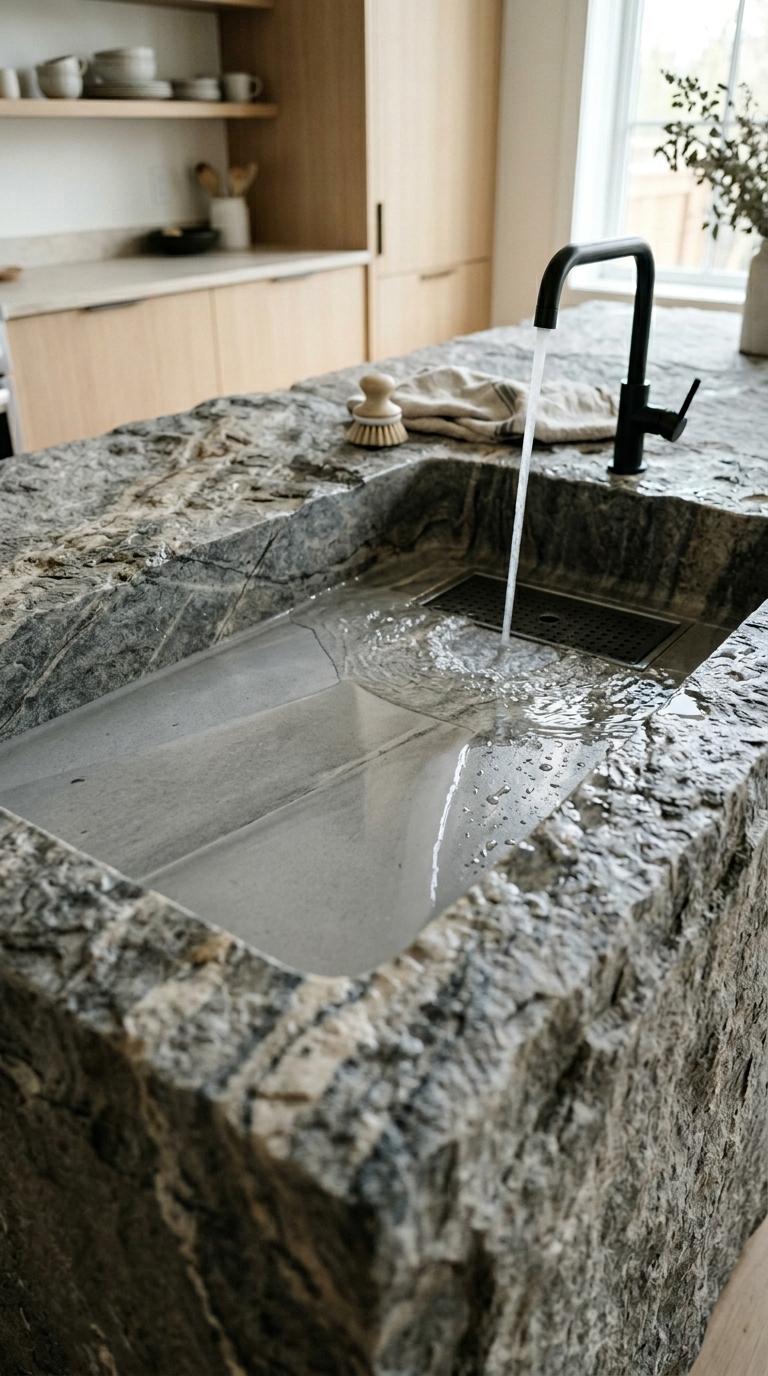
The basin form of an integrated stone sink is a design decision with both functional and aesthetic dimensions that require equal consideration. The depth, width, profile, and drain position of the basin determine how well the sink works for the specific tasks it will be used for, while the relationship between the basin form and the surrounding counter surface determines how the sink integrates visually into the monolithic island composition.
A shallow, wide basin carved into the stone surface creates the most visually resolved integrated sink because it maintains the dominance of the horizontal counter plane rather than interrupting it with a deep vertical depression. A basin depth of fifteen to twenty centimeters is sufficient for most kitchen washing tasks while keeping the basin form shallow enough to read as a carved detail in the counter surface rather than a functional intrusion into it. The wide, shallow profile also makes the basin more comfortable for the specific washing tasks of an Indian kitchen, where large vessels including pressure cooker inserts, large kadais, and thali plates need to be accommodated in the washing zone.
The drain position in an integrated stone sink should be rear-positioned, toward the back of the basin closest to the faucet wall, rather than center-positioned as in most standard sinks. The rear drain position creates a cleaner basin floor that slopes gently toward the back of the sink rather than toward a central point, which keeps the center of the basin surface flat and maximizes the comfortable working area within the sink. It also positions the drain plumbing behind the basin rather than below its center, which simplifies the under-counter plumbing installation and creates more usable storage space in the island base directly below the front section of the sink.
The interior surface finish of the stone basin is one of the most important tactile and functional details in the integrated sink design. A honed finish inside the basin provides a surface that is comfortable to touch, easy to clean, and not prone to showing water marks and scratches in the way that a polished finish would. The slight texture of a honed interior also provides just enough grip to prevent vessels from sliding in the basin during washing, which is a functional benefit that a highly polished interior surface does not provide.
4. Faucet Integration in a Stone Island
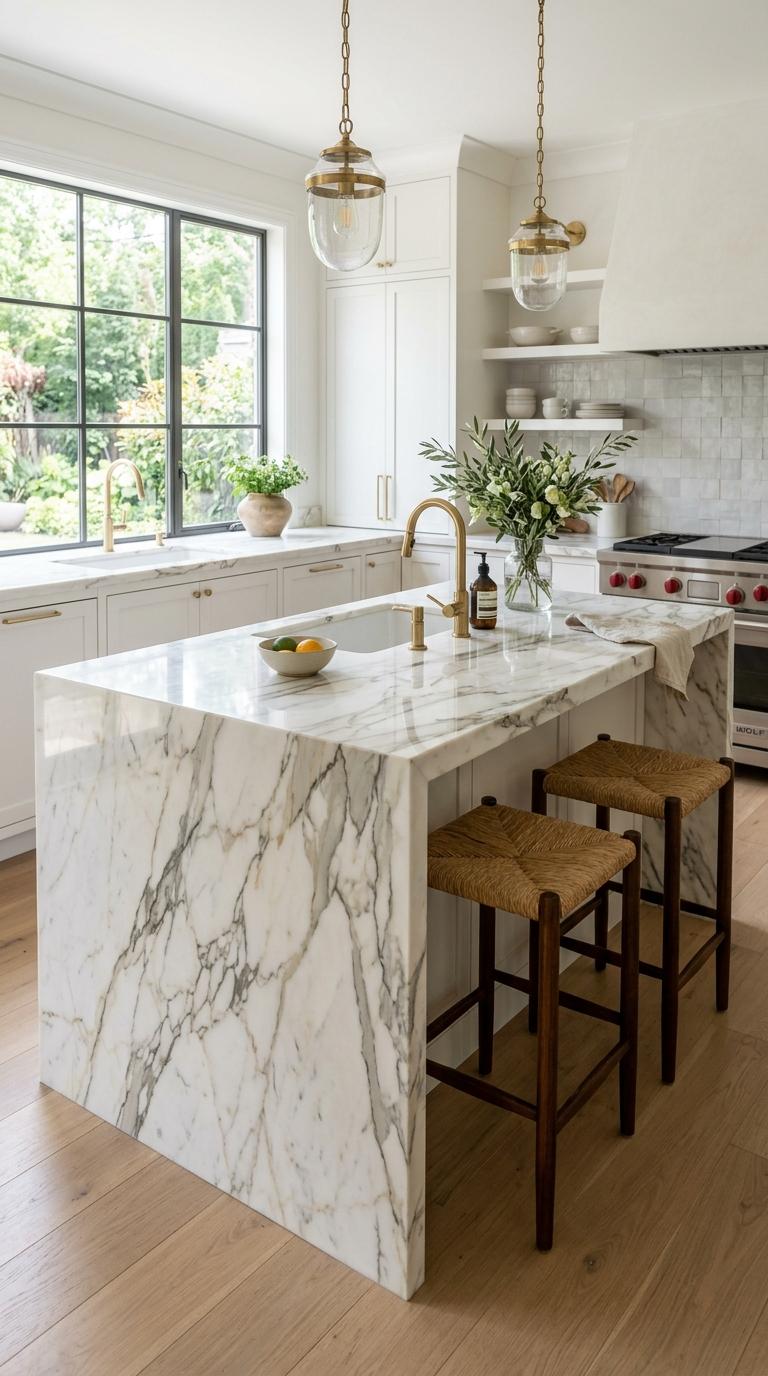
The faucet in a monolithic stone island with an integrated sink is the one element of the kitchen that is necessarily made from a different material and that must therefore be chosen and positioned with the maximum care to ensure that its presence reinforces rather than undermines the material integrity of the monolithic composition. A faucet that is too decorative, too ornate, or too visually prominent becomes a competing focal point that draws attention away from the stone and breaks the unity of the monolithic island form. A faucet that is too minimal, too generic, or too industrial creates a mismatch between the premium material of the island and the commodity quality of its most-used fitting.
The absolute showstopper in the most resolved monolithic stone sink installations is ultra-minimalist hardware paired with the raw material of the stone, bringing architectural precision to the wet zone and making traditional plumbing fixtures look clunky by comparison. A wall-mounted faucet, where the spout and handles are mounted in the wall or in a dedicated stone pillar behind the sink rather than in the counter surface itself, is the most architecturally resolved faucet position for a monolithic island because it keeps the counter and basin surfaces completely free of penetrations that would interrupt their material continuity.
Where a wall-mounted faucet is not structurally possible, a deck-mounted faucet positioned in the stone counter surface at the rear of the basin, in the same stone as the counter rather than in the basin floor, maintains most of the visual integrity of the monolithic surface while providing the standard deck-mount installation that most plumbing configurations support. The faucet hole in the stone counter should be cut by the stone fabricator with the same precision and the same edge detail as every other surface on the island, creating a penetration that looks like a considered architectural detail rather than a practical necessity.
5. Monolithic Island with Waterfall Stone Base
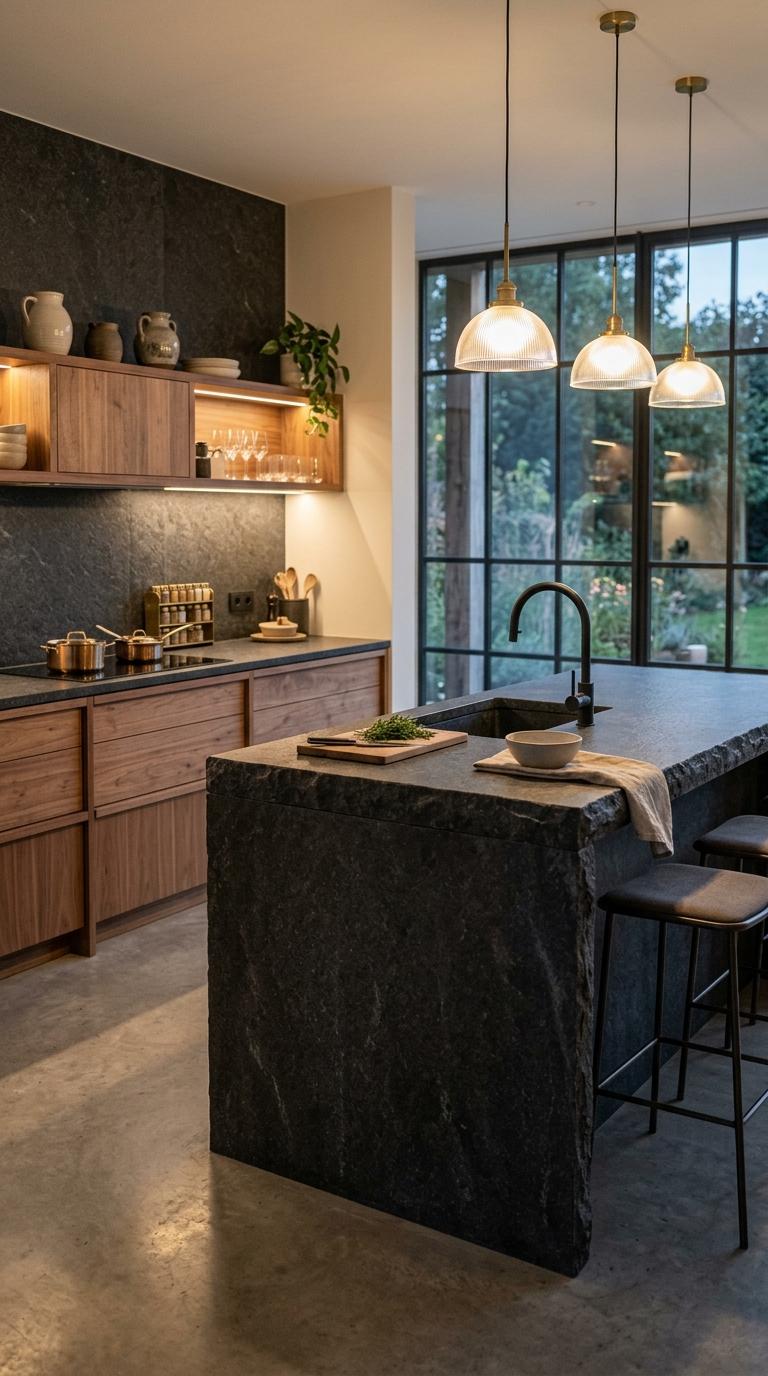
The most complete expression of the monolithic island philosophy extends the stone not just across the counter and basin surfaces but down the sides of the island in a waterfall configuration and across the base panels to the floor, creating an island whose entire visible surface is the same stone material from countertop to floor. This full-stone monolith is the most architecturally powerful kitchen island form available and the one that most completely achieves the geological, elemental quality that the monolithic concept at its most ambitious pursues.
A full stone waterfall island requires a structural base of steel or reinforced concrete within the island form to support the weight of the stone panels, which in a large island can be considerable. The stone panels themselves are typically twelve to twenty millimeters thick, bonded to the structural base with specialist stone adhesive and mechanical fixings, with joints between panels cut and fitted with precision that makes them invisible or nearly invisible in the finished installation. The seamless appearance of the finished stone surface depends entirely on the quality of the joint between panels, and achieving genuine joint invisibility requires a level of stone fabrication skill that is available in India through specialist natural stone fabricators in major stone-producing regions.
The visual weight of a full stone waterfall monolith is significant and must be balanced within the kitchen composition through the choice of cabinet color, floor material, and ceiling treatment that surrounds it. A dark stone monolith in a kitchen with light cabinets and a pale floor creates a composition of maximum contrast that makes the island the absolute visual center of the kitchen. A light stone monolith in a kitchen with warm wood cabinetry and a stone floor in a related tone creates a composition of tonal harmony where the island is distinguished from its surroundings through texture and material density rather than color contrast.
6. Integrated Drainage and Wet Zone Design
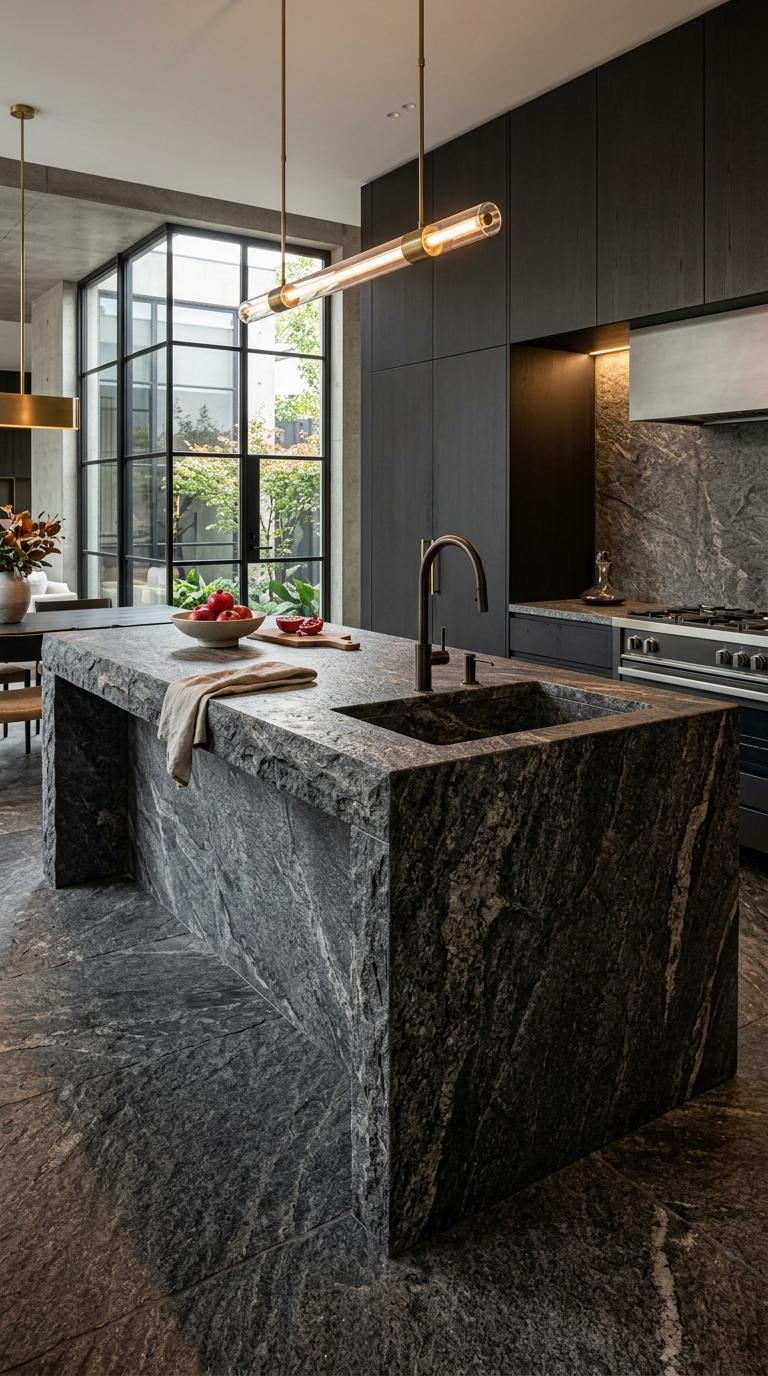
The drainage design of a monolithic stone island with integrated sink is one of the most technically demanding aspects of the installation and one of the most consequential for the daily function of the kitchen. Water management in a stone basin requires a drainage system of sufficient capacity and positioning to move water away from the basin surface quickly and completely, preventing the pooling and standing water that creates both hygiene problems and the surface staining that is one of the most common maintenance challenges associated with natural stone kitchen surfaces.
The drain in an integrated stone sink should be a flush-mount design that sits level with or slightly below the surface of the basin floor, creating a drain opening that is visible as a detail of the stone surface rather than as a separate fitting inserted into it. Precision-cut drain covers in the same stone as the basin, or in a contrasting material like brushed brass or matte black metal, create a drain detail that reads as an intentional design element rather than a utilitarian plumbing component. Brass drain covers in a warm stone basin create a small but significant material accent that references the Indian craft tradition of combining stone and metal in decorative applications.
The slope of the basin floor toward the drain is a fabrication detail that requires precise calculation and execution. A basin floor that slopes too steeply creates a surface that feels uncomfortable and unnatural to use. A basin floor that slopes insufficiently allows water to pool rather than draining completely after use. The correct slope is typically two to three percent, enough to encourage complete drainage without creating a surface angle that is perceptible to the hand washing in the basin.
7. Dark Stone Monolith with Contrasting Wood Island Base
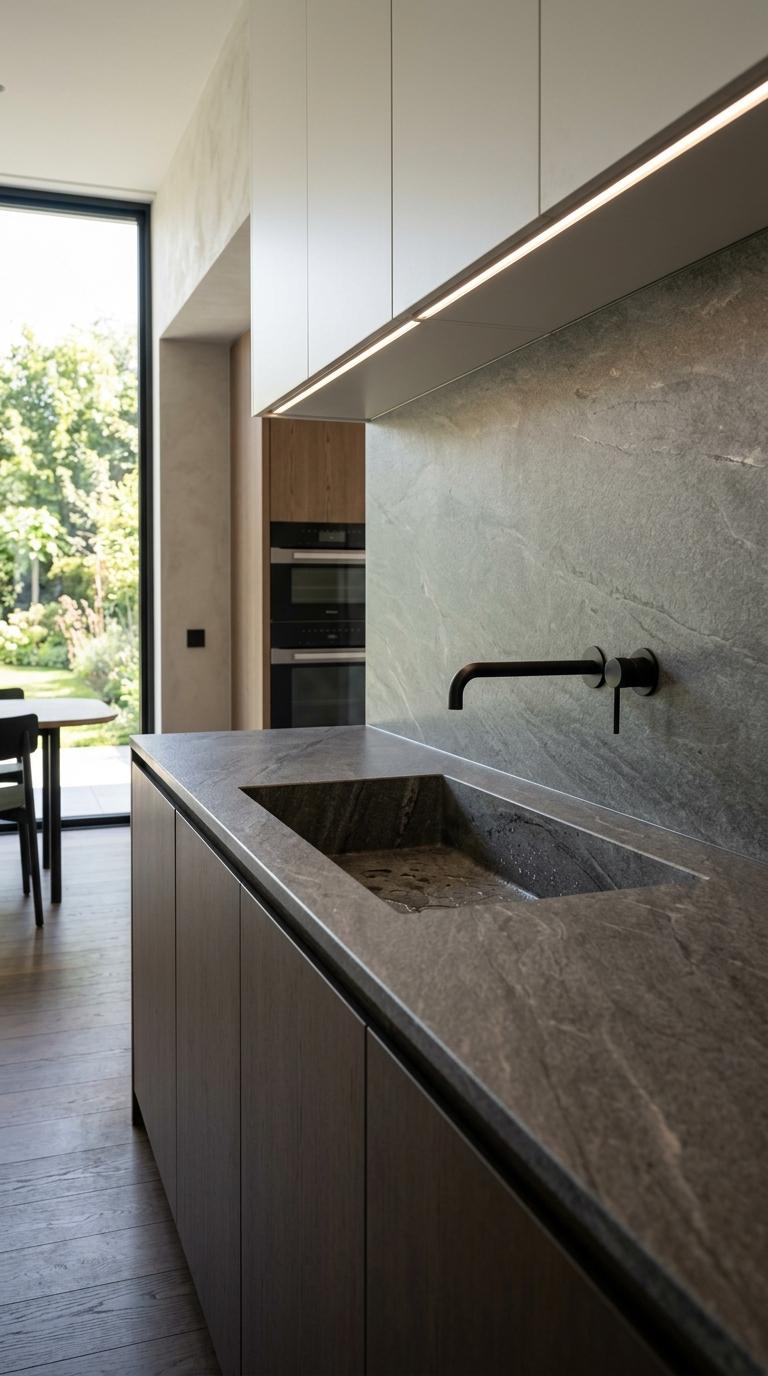
One of the most compelling contemporary monolithic island compositions pairs a dark stone counter and integrated sink with a warm wood base in a combination that uses the contrast between the geological density of the stone and the organic warmth of the wood to create a kitchen island of extraordinary material sophistication. The wood acts as a tactile, warm serving element that contrasts with the slick, engineered stone surfaces, a fearless layering of materials that turns the island into a piece of kinetic sculpture.
In this configuration, the stone occupies the upper portion of the island, the counter surface, the integrated sink basin, and the waterfall edges, while the base cabinetry is executed in natural wood, solid sheesham, teak, or a warm-toned engineered wood veneer that brings a quality of living warmth to the island’s lower portion and prevents the full stone island from feeling too cold or too monolithic in the sense of being too heavy and too undifferentiated.
The junction between the stone counter and the wood base is the critical design detail in this configuration. A clean, precise horizontal line where the stone overhangs the wood base by a consistent amount creates the most architecturally resolved expression of this material combination. The overhang should be between three and five centimeters, enough to create a shadow line between the stone and the wood that visually separates them and clarifies the material change, but not so much that the stone appears to be floating precariously above the base.
8. Monolithic Sink Position Strategy for Workflow
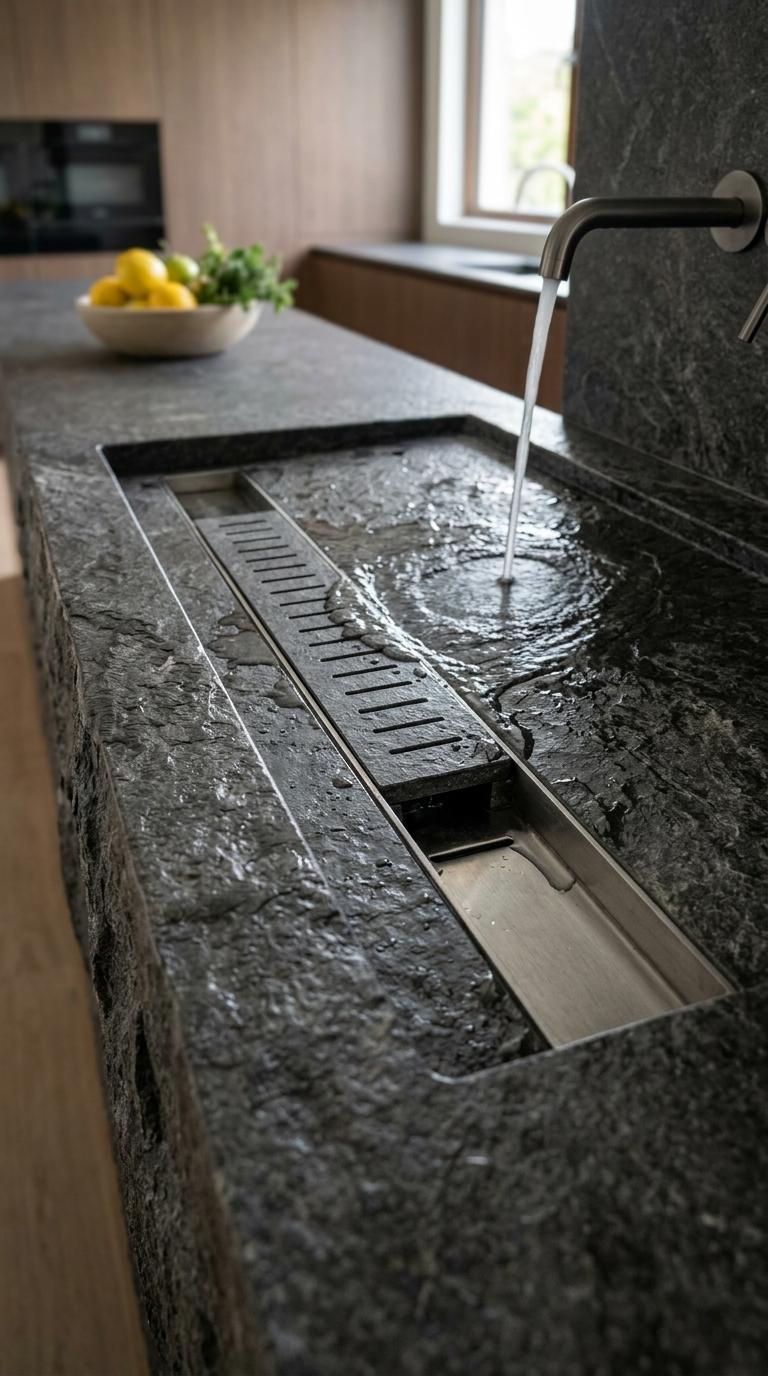
The position of the integrated sink within the monolithic island is a workflow decision that determines the efficiency and the comfort of the kitchen’s primary wet zone for every meal prepared in it. Unlike a separate sink unit that can be repositioned independently, the integrated sink in a monolithic island is fixed at the point of fabrication and cannot be moved without replacing the entire counter surface. This irreversibility makes the positioning decision one of the most important and most consequential design choices in the monolithic island project.
The most ergonomically effective sink position in a kitchen island is the one that places the basin in relation to the primary preparation surface and the primary cooking surface that minimizes unnecessary movement between the three zones. In a standard workflow where ingredients are washed, then prepared on the cutting surface, then cooked on the hob, the sink positioned at one end of the island with the preparation surface immediately adjacent and the hob on the perimeter counter in a clear sightline creates the most efficient workflow triangle.
In an Indian kitchen context where the cooking process involves frequent movement between the preparation zone and the washing zone during meal preparation, the sink and the primary preparation surface should be as close together as the island dimensions allow, ideally within arm’s reach of each other from a single standing position. A sink positioned at the center of the island’s length rather than at one end, with preparation surface on both sides, creates the most flexible Indian kitchen wet zone because it allows the cook to move between washing and preparation on either side without turning or stepping away from the working area.
9. Texture and Surface Finish Combinations
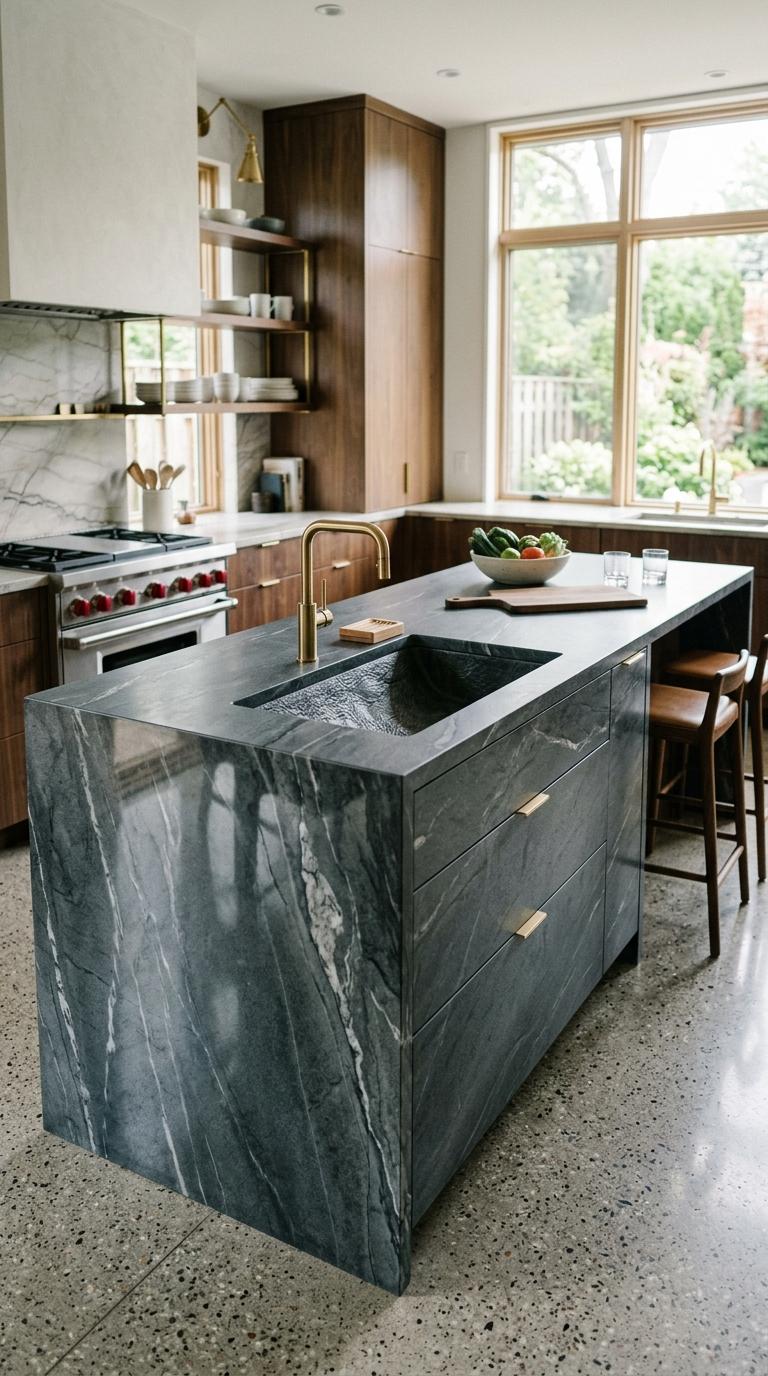
By wrapping both the countertop and the entire backsplash in the same heavily textured stone, a kitchen achieves a flawless monolithic permanence that eliminates the visual fragmentation of mixed materials and creates a surface of unified character that reads as an architectural decision rather than a decorating choice. In a monolithic island, the texture of the stone surface is a design decision that significantly affects both the visual quality and the practical performance of the installation.
A honed or brushed finish on the counter surface creates a matte, slightly tactile surface that shows the natural character of the stone more clearly than a polished finish while being more forgiving of the everyday marks and scratches that kitchen use inevitably creates. In a stone basin, the honed finish is particularly appropriate because it provides comfort of touch and resistance to the slip of wet vessels that a polished surface cannot offer. A leathered or brushed finish, where the stone surface is treated with a wire brush or diamond pad to create a textured, slightly rough surface that emphasizes the natural grain and mineral character of the stone, creates a monolithic island of extraordinary tactile and visual richness that is unlike any other surface treatment available in kitchen design.
The combination of different finishes on different surfaces of the same stone, a polished waterfall edge, a honed counter surface, and a leathered basin interior, creates a monolithic island where the same material is experienced differently at different points of interaction, which adds a dimension of tactile complexity to the material continuity of the monolithic form.
10. Monolithic Island Lighting Strategy
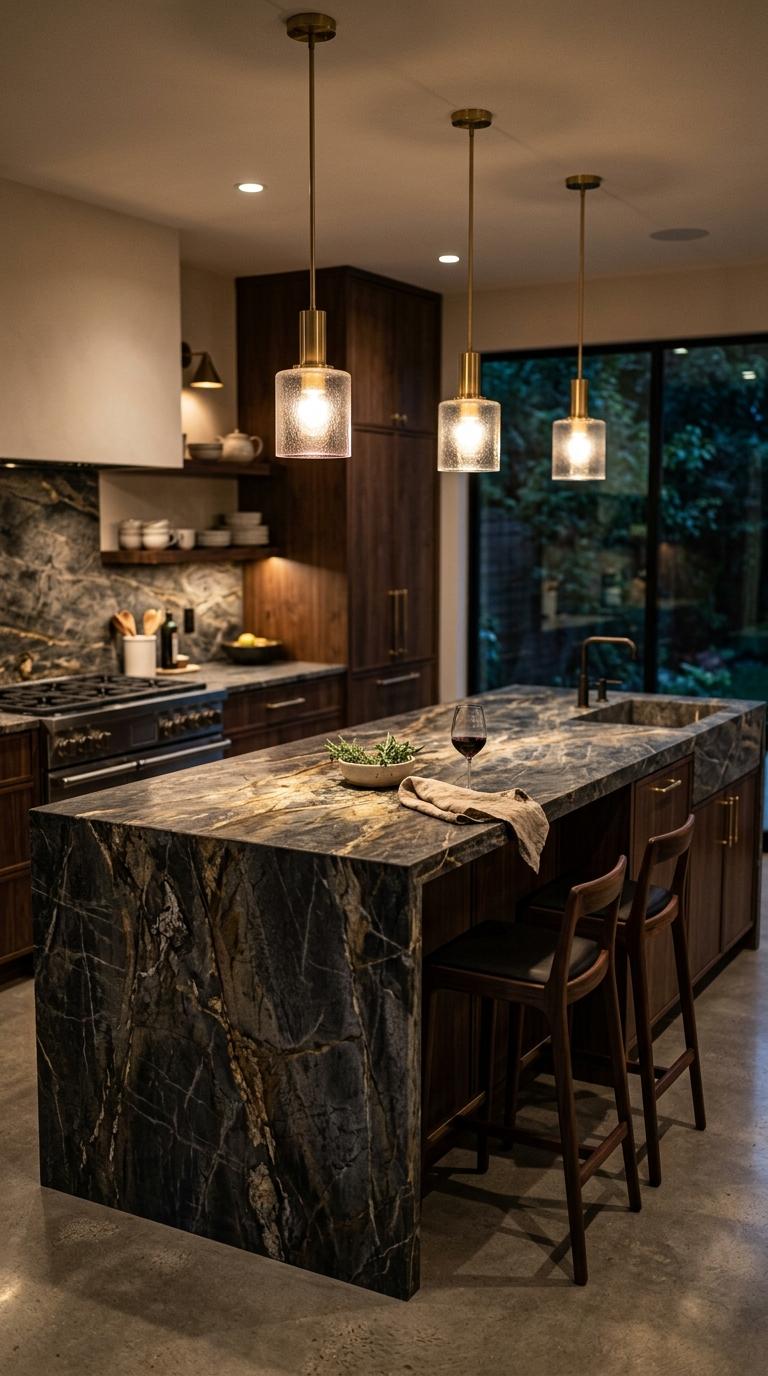
The lighting of a monolithic stone island with integrated sink is one of the most design-critical decisions in the kitchen because the quality of the light that falls on the stone surface determines how much of the stone’s inherent visual richness is actually visible and experienced. Natural stone is one of the most light-responsive materials in interior design, its color, its veining, and its surface texture shifting dramatically under different light sources and from different angles, and a monolithic island that is poorly lit is an investment in material quality that is not being fully realized.
Pendant lights above a monolithic island should be chosen for their beam quality as much as their visual design. A pendant that directs a focused, warm beam of light directly onto the stone surface creates the most dramatic and most revealing illumination of the stone’s natural character. The angle of the light relative to the stone surface affects how much of the surface texture is visible, with light directed at an acute angle to the surface creating stronger shadows in the surface texture and revealing more of the stone’s three-dimensional quality than light directed perpendicular to the surface.
Under-counter lighting within the island base, LED strip lights integrated into the toe kick or behind a recessed base panel, creates a floating quality for the stone upper section by illuminating the gap between the base and the floor with a warm glow that visually separates the stone mass from the floor beneath it. This lighting technique is one of the most effective ways to prevent a full stone monolith from feeling heavy and grounded in a way that compresses the space of a compact kitchen, because the light beneath the island creates the impression that the stone is hovering rather than sitting, which reduces its visual weight considerably without changing its material presence.
The Monolithic Island as Kitchen Architecture
In 2026, the most resolved kitchen design treats the sink not as a standalone fixture but as part of the architecture, integrating it into the countertop and workflow to create a cleaner look, fewer visual breaks, and a system that prioritizes daily use over showroom appeal. The monolithic stone island with integrated sink is the fullest expression of this architectural ambition, an island that does not decorate the kitchen but defines it, that does not display material quality but embodies it, and that does not occupy the center of the kitchen but anchors it in the most literal and most complete way that interior design can achieve.
The investment that a monolithic stone island with integrated sink requires, in material cost, fabrication skill, installation precision, and design development time, is an investment in a kitchen element that will be the defining feature of the space for as long as the kitchen exists. Stone does not date. A well-chosen stone surface does not become fashionable and unfashionable in the way that cabinet colors and hardware finishes do. A monolithic island carved from a beautiful stone in a form that is architecturally resolved and functionally intelligent is a kitchen investment with a time horizon measured not in renovation cycles but in generations, and it is an investment whose daily return, in the quality of the cooking experience it creates and the beauty of the space it anchors, justifies completely the care and the cost that its realization demands.

Aarav Sharma is a passionate home and lifestyle writer. He loves exploring kitchen design, home decoration, and interior styling. With a keen eye for beautiful details and practical design ideas. Aarav Sharma shares inspiration to help readers create comfortable and functional living spaces.