
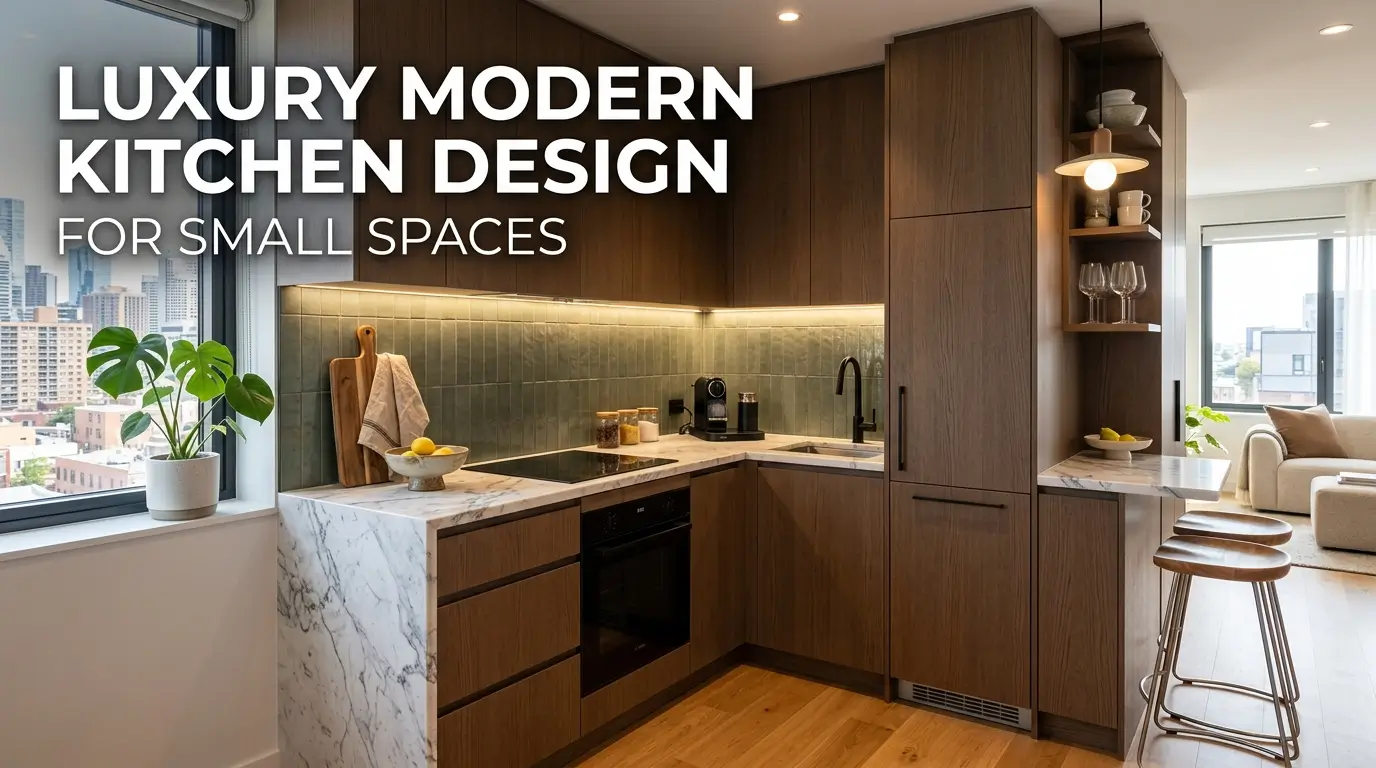
Luxury and small spaces are two concepts that most people instinctively place in opposition to each other. Luxury in the popular imagination is associated with abundance, with generosity of dimension, with the kind of spatial ease that comes from having more room than you strictly need. A luxury kitchen in the conventional sense is a large kitchen, one with generous counter runs, a substantial island, professional-grade appliances set into bespoke cabinetry, and the kind of breathing room between work zones that makes cooking feel unhurried and privileged. The small kitchen, by this logic, is the antithesis of luxury, a constrained, compromised space where every design decision is driven by necessity rather than desire.
This understanding of luxury is both limited and limiting, failing to account for what luxury actually means in the most sophisticated contemporary understanding of the concept. Luxury is not primarily about scale. It is about quality. It is about the precision of the detail, the richness of the material, the intelligence of the design solution, and the quality of the daily experience that the space creates for the person using it. A small kitchen designed with genuine luxury sensibility, where every surface is the best material that can be sourced, every detail is executed with complete precision, every storage solution is exactly calibrated to the cooking habits of its user, and every moment of using the space is informed by the care that went into designing it, is a more luxurious kitchen than a large, poorly designed one filled with expensive appliances that don’t work together as a system.
The luxury small kitchen is not a large kitchen made smaller. It is a design category with its own principles, its own aesthetic intelligence, and its own particular form of excellence that is only available when the discipline of working within spatial constraints forces design decisions to be made at the level of quality and precision that a generous space never demands.
Luxury Modern Kitchen Design Ideas for Small Spaces
1. Handle-Free Cabinetry with Touch-Latch Mechanisms
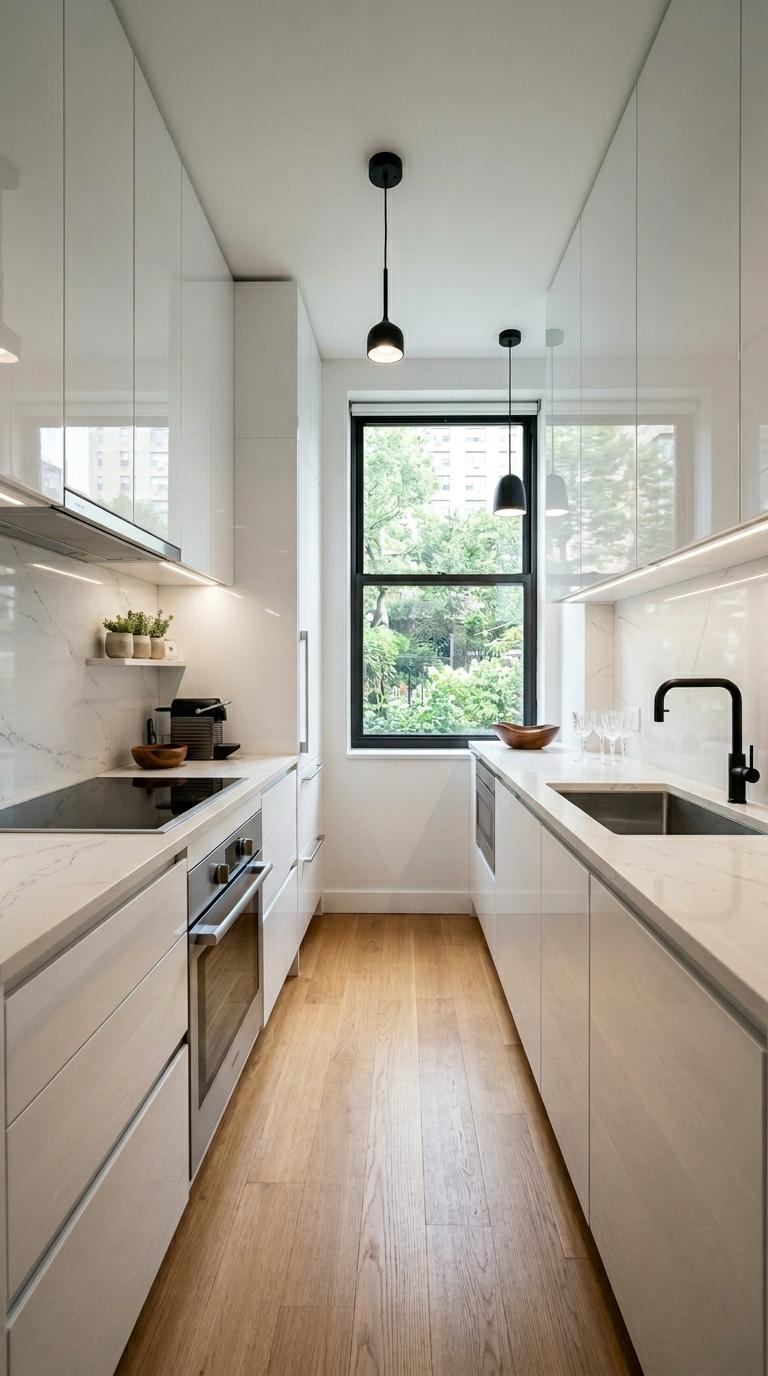
The visual cleanliness of handle-free cabinetry is the single most effective design decision available in a small luxury kitchen because it eliminates the visual interruption of hardware from every cabinet surface, creating an unbroken plane of material that reads as a single continuous surface rather than a collection of individual cabinet doors punctuated by projecting handles. In a small kitchen where the cabinet surface area represents a significant proportion of the total visible surface area, this visual continuity has a dramatically simplifying and enlarging effect on the apparent scale of the space.
Handle-free cabinetry is achieved through several mechanisms, depending on the cabinet design and the budget available. Touch-latch mechanisms, which require only a gentle push on the cabinet front to release the spring-loaded latch and open the door, are the most technically simple and most cost-effective handle-free solution. Integrated groove handles, where a recessed channel cut into the top or bottom edge of the cabinet door provides a finger pull without any projecting hardware, are the most architecturally refined handle-free solution and the one that maintains the flat plane of the cabinet front most completely. Push-to-open drawer systems eliminate the need for drawer pulls in the same way that touch-latch mechanisms eliminate the need for door handles.
In a small luxury kitchen, the choice of cabinet material for a handle-free system determines the character of the entire space. High-gloss lacquer in a warm white or soft off-white creates a surface of almost mirror-like reflectivity that amplifies light and makes a small kitchen feel significantly more luminous and more spacious. Matte lacquer in deep, saturated colours creates a surface of velvety richness that makes the small kitchen feel like a jewel box. Real wood veneer in a handle-free system creates a surface of natural warmth and material authenticity that references the best of contemporary Japandi kitchen design.
2. Natural Stone Surfaces Throughout
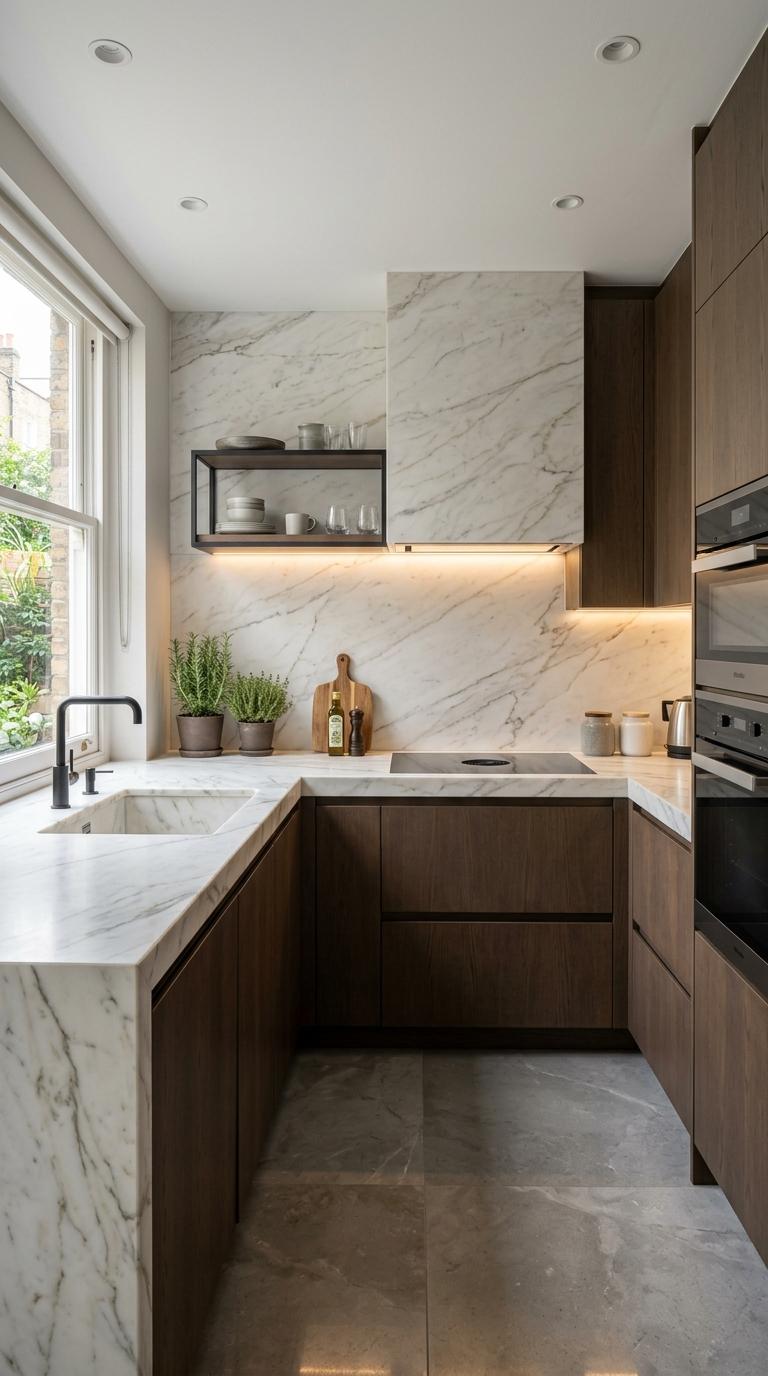
The consistent use of a single natural stone material across all counter surfaces, the splashback, and potentially the island, creates a visual continuity in a small luxury kitchen that makes the space feel larger, more unified, and more materially considered than a kitchen where different surface materials are used in different areas. The stone runs uninterrupted across every horizontal and vertical surface, creating the impression that the kitchen has been carved from a single material rather than assembled from components, which is one of the most architecturally powerful effects available in any kitchen design.
The choice of stone for a small luxury kitchen should be made with the specific light conditions of the space in mind. Marble in its lighter varieties, Statuario, Calacatta, and Carrara, amplifies natural and artificial light through its slightly translucent surface and creates a kitchen of extraordinary luminosity in spaces that receive good natural light. In darker kitchens with limited natural light, warmer stones like Rainforest brown, Golden Milano, or Indian green marble create a kitchen of rich, jewel-toned depth that performs better than white stone in low-light conditions.
Quartzite is increasingly the stone of choice for Indian luxury kitchens that require the visual sophistication of marble with greater durability and lower maintenance requirements. Indian quartzite varieties, including Cambrian black and White Fantas,y have achieved international recognition for their beauty and are available in Indian stone markets at prices that are genuinely competitive with imported alternatives. Using Indian stone in an Indian luxury kitchen is not merely a cost decision. It is a material authenticity decision that connects the kitchen to the natural landscape of the subcontinent in a way that imported materials cannot replicate.
3. Integrated Professional Grade Appliances
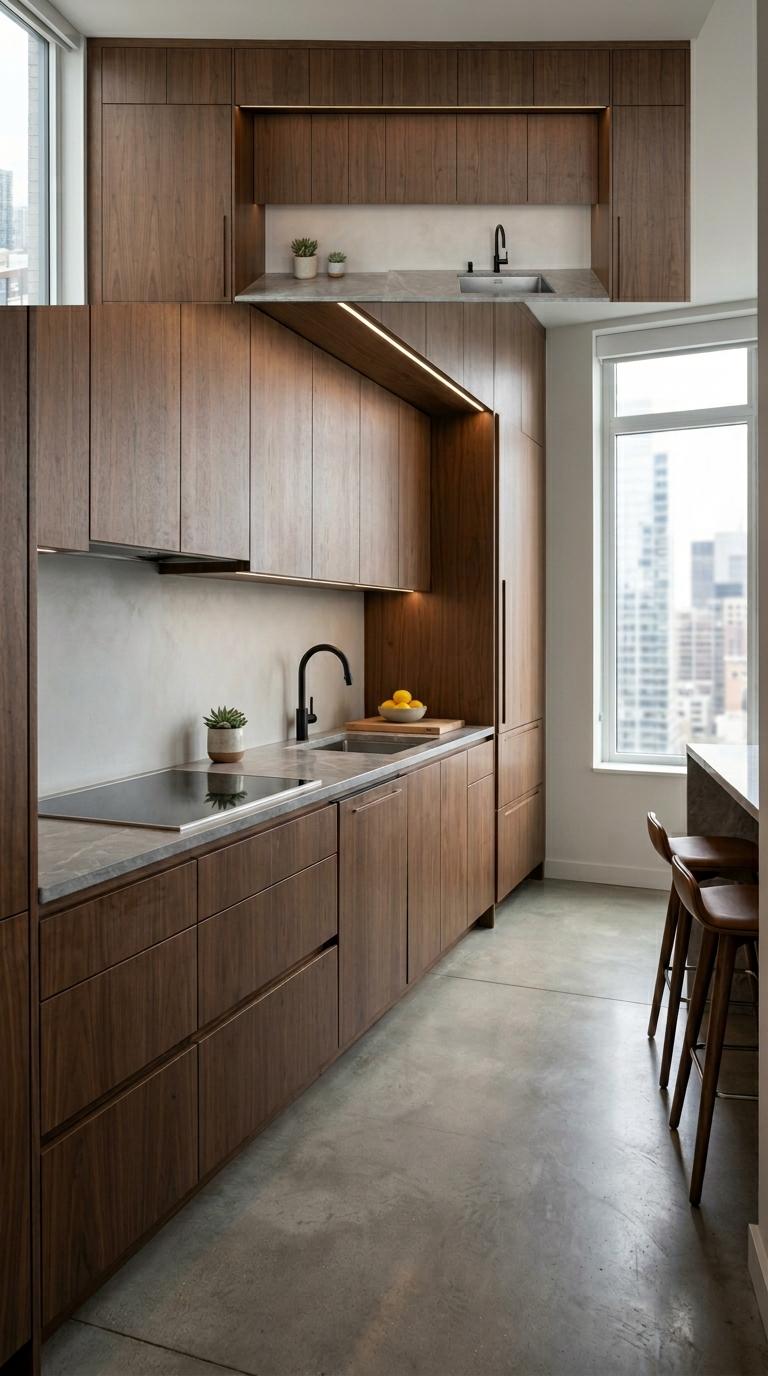
The difference between a luxury kitchen and an expensive kitchen is most clearly visible in the treatment of appliances. An expensive kitchen buys premium branded appliances and displays them prominently as evidence of the investment made. A luxury kitchen integrates those appliances behind cabinet panels that match the surrounding cabinetry, concealing them completely when not in use and creating a visual environment where the kitchen reads as a unified composition of materials and surfaces rather than as a collection of appliances with some cabinetry around them.
Integrated refrigerators, integrated dishwashers, and integrated ovens behind matching cabinet panels are the appliance treatments that most dramatically elevate the visual quality of a small luxury kitchen because they remove the dominant visual presence of appliance surfaces from the kitchen composition entirely. The kitchen appears to be pure cabinet and counter, with the appliances revealed only when needed and concealed as completely as possible at all other times.
In an Indian kitchen context where the mixer-grinder, the induction cooktop, and the various other countertop appliances that Indian cooking requires are a constant presence, the integration of appliance storage into the cabinet design, through appliance garages with tambour doors, pull-out appliance shelves with internal power sockets, and dedicated storage cavities sized to specific appliances, creates a luxury kitchen where every appliance has a precise and concealed home rather than a permanent position on the counter surface.
4. Bespoke Cabinetry with Artisan Details
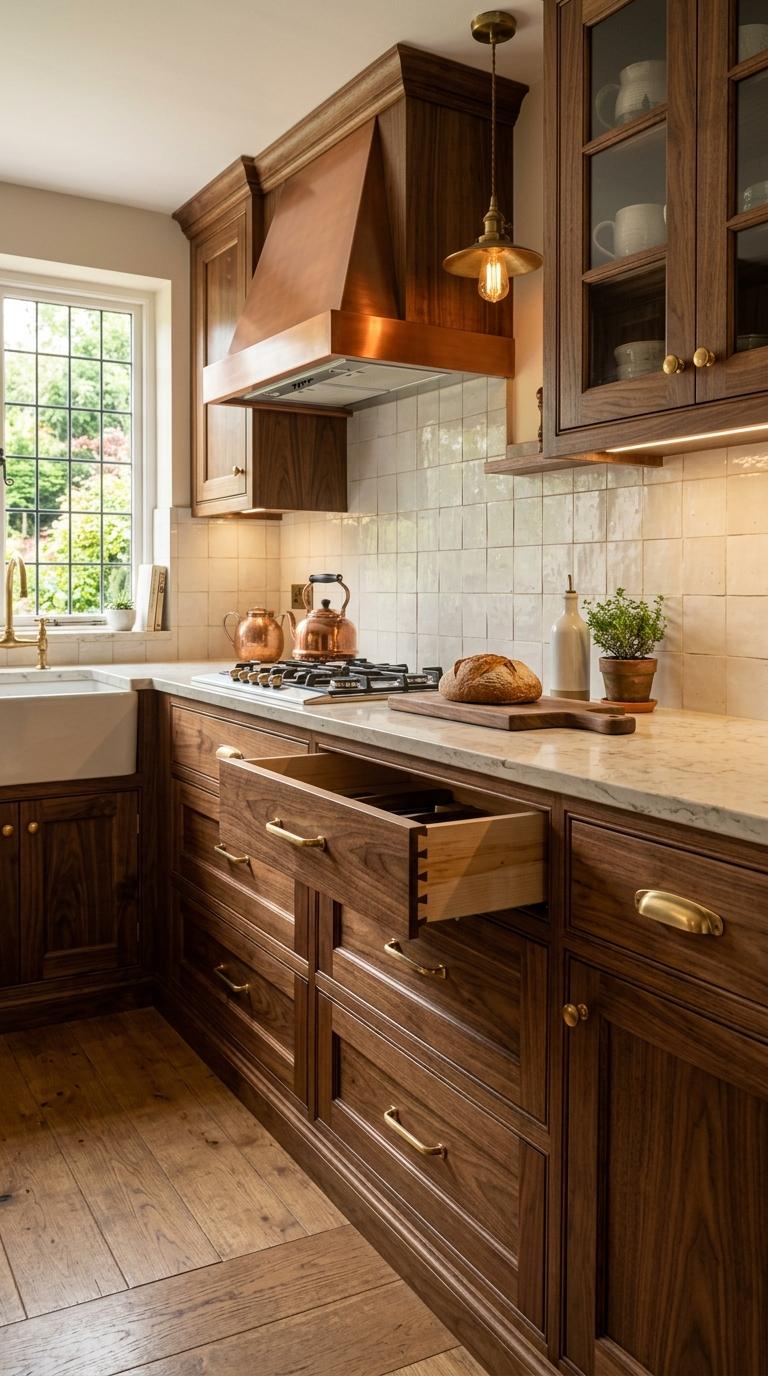
The defining difference between a luxury kitchen and a premium modular kitchen is the quality and precision of the cabinetry, and in a small luxury kitchen, that difference is most visible in the details. Soft-close mechanisms on every drawer and door that operate with the same smooth, controlled quietness regardless of how forcefully the door or drawer is pushed. Full-extension drawer slides that allow every drawer to be opened to its full depth without binding or tilting. Internal drawer organisers are machined to exact tolerances that hold specific items in precise positions. Dovetail joinery in drawer boxes rather than the stapled or glued butt joints of standard modular cabinetry. These are the details that luxury cabinetry delivers and that standard modular kitchens, regardless of their price point, rarely achieve at the level of consistency and precision that makes a kitchen feel genuinely bespoke.
In India, bespoke kitchen cabinetry of genuine luxury quality is available from specialist kitchen manufacturers and from high-quality local carpenters who work with premium materials and fittings. The imported hardware brands that provide the soft-close mechanisms, full-extension slides, and precision internal organisers that luxury cabinetry requires, Hettich, Hafele, Grass, and Blum, among others, are available through hardware distributors in major Indian cities and represent an investment in cabinet functionality that pays dividends through the daily quality of the kitchen experience for the lifetime of the cabinetry.
5. Integrated Lighting Systems
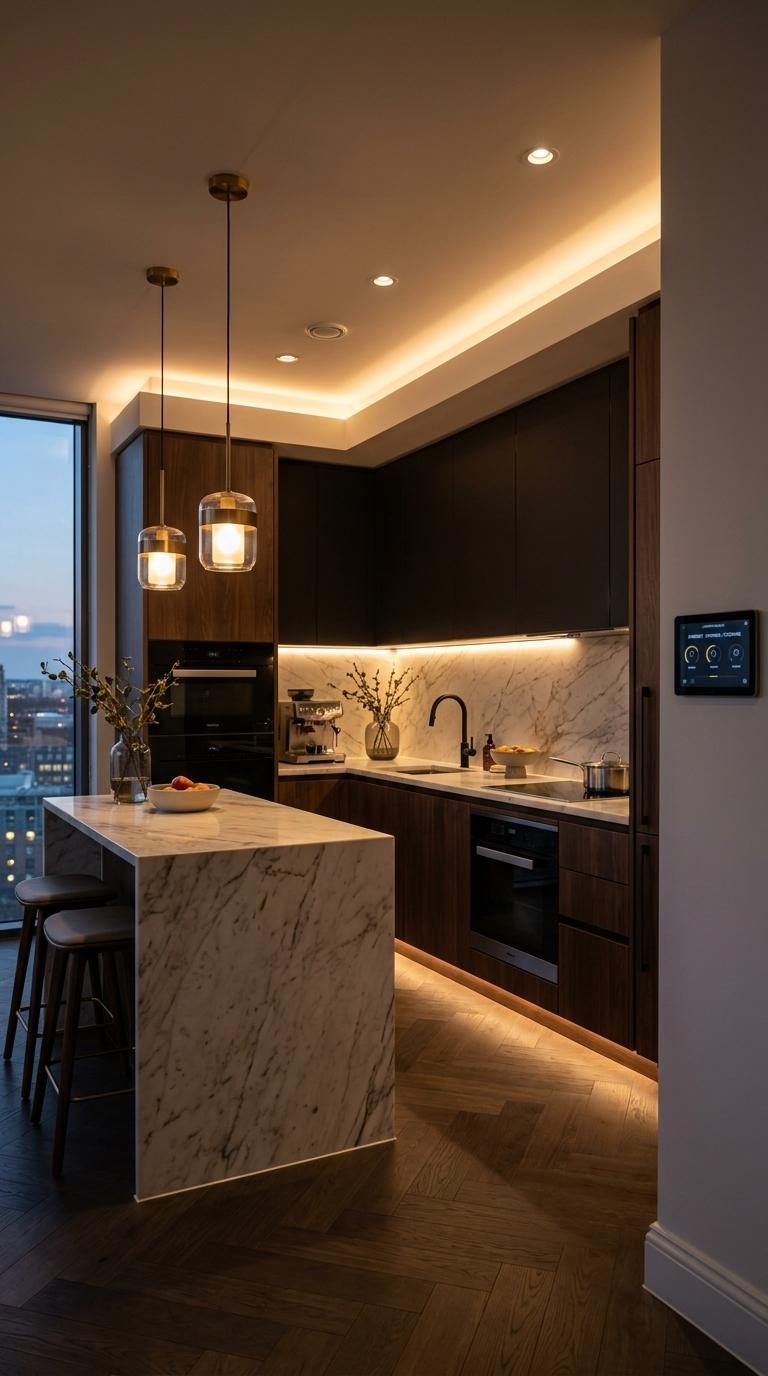
Luxury kitchen lighting is not a single premium fixture above the island. It is a comprehensive, layered system that provides the right quality and intensity of light for every activity in every part of the kitchen at every time of day, and that does so without any visible light source contributing to the visual noise of the kitchen environment. The light appears to come from the kitchen itself, from within the counters, from behind the cabinets, from beneath the upper shelves, and from the ceiling, rather than from identifiable fixtures that interrupt the clean surfaces of a luxury kitchen design.
LED strip lighting integrated into the underside of every upper cabinet provides focused, even task illumination across every section of the counter surface without any visible fixture. Recessed LED downlights in the ceiling, positioned at the perimeter of the kitchen rather than the centre, to wash light down the cabinet fronts and create a quality of ambient illumination that makes the kitchen feel luminous rather than merely lit. Cove lighting above the upper cabinets in a kitchen with ceiling space above the cabinet tops creates a soft upward wash of warm light that fills the upper portion of the kitchen with an indirect glow. And interior cabinet lighting that activates when cabinet doors are opened, making every item on every shelf clearly visible, creates a quality of functional thoroughness that is one of the most appreciated luxury details in daily kitchen use.
Smart control of the kitchen lighting system through a single panel or a phone app that allows different lighting scenes to be recalled with a single command, full brightness for cooking, reduced warmth for dining, minimal ambient for evening, creates a kitchen that actively adapts to the different activities it hosts rather than providing a single fixed lighting environment that serves all of them imperfectly.
6. Luxury Flooring that Connects Kitchen to Living Area
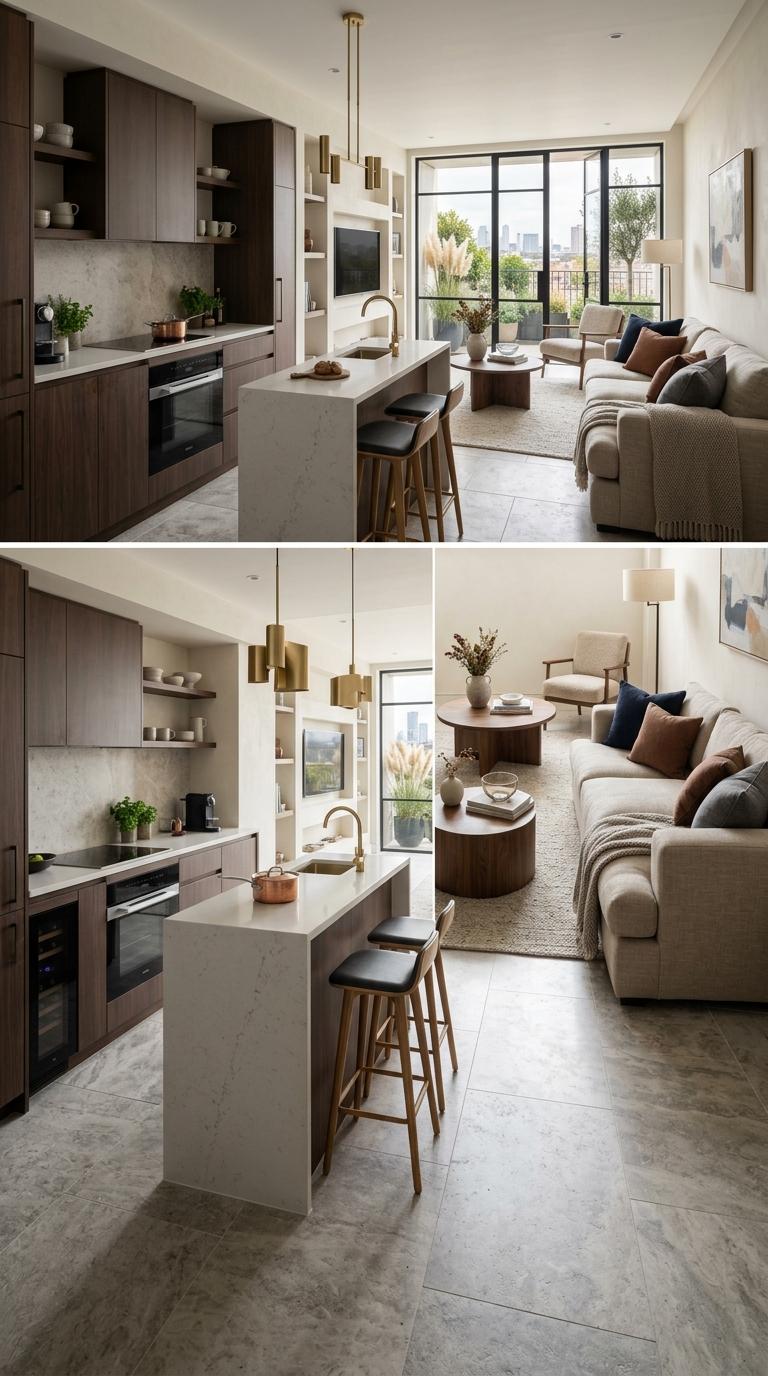
In an open-plan small home where the kitchen connects directly to the living and dining areas, the flooring material that runs continuously through the entire space is one of the most powerful design decisions available because it either creates visual unity between the zones or creates a visual break that makes each zone feel smaller and more isolated than it actually is. A luxury flooring material that runs continuously from the kitchen through the dining area and into the living room unifies the entire open-plan space into a single, generous-feeling environment that is larger and more coherent than the same space with different flooring in each zone.
Large-format stone tiles in a light, warm-toned marble or limestone, laid without grout lines in a continuous book-matched pattern, create a floor surface of extraordinary visual richness and spatial generosity that connects every zone of an open-plan compact home into a single unified space. The large format of the tiles, typically eighty by eighty centimetres or one meter by one meter, reduces the number of grout lines visible in any given area of floor, which makes the floor appear more continuous, and the space appear larger.
Engineered hardwood flooring in a wide plank format is a warm alternative to stone that creates a continuous floor surface with a quality of natural material richness that suits compact homes, where the warmth of wood complements the cooler surfaces of a luxury kitchen more comfortably than additional stone would. The warmth of wood underfoot in a kitchen where one spends significant amounts of time standing is also a genuine practical comfort benefit that stone, regardless of its beauty, consistently fails to provide.
7. Bespoke Range Hood as Sculptural Feature
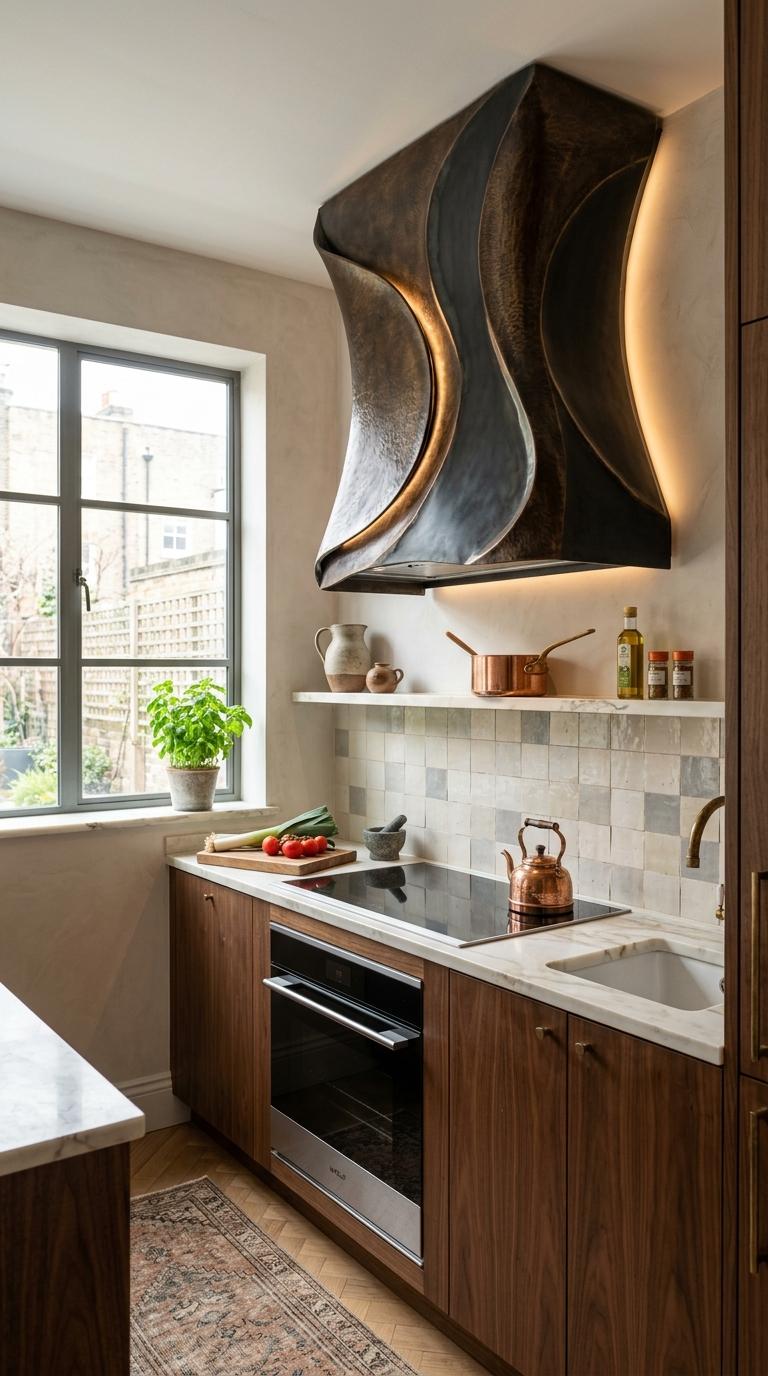
The range hood is the most architecturally prominent element in any kitchen because of its central positioning above the cooking surface and its vertical extent from counter level to ceiling. In a standard kitchen, it is a utilitarian object that performs an essential function and makes no particular design contribution beyond its functional presence. In a luxury small kitchen,n it is one of the most important design decisions available because its scale, its material, and its form determine the visual character of the cooking zone more completely than any other single element.
A bespoke range hood in a material that references the broader design palette of the luxury kitchen, polished or brushed stainless steel in a kitchen with metallic accents, natural stone cladding in a kitchen where stone is the dominant material, or a painted plaster form in a kitchen with a softer, more architectural character, transforms the range hood from a functional necessity into a sculptural feature that anchors the cooking zone and gives it a visual authority that a standard factory hood cannot achieve.
In an Indian kitchen context where the intensity of cooking, with its smoke, steam, and strong aromatic compounds, places genuine demands on the extraction performance of the range hood, the bespoke form must be paired with a genuinely high-performance extraction system that provides the suction capacity and filtration quality that Indian cooking requires. The luxury is not in choosing form over function but in finding a form that expresses function beautifully.
8. Integrated Sink and Counter Detail
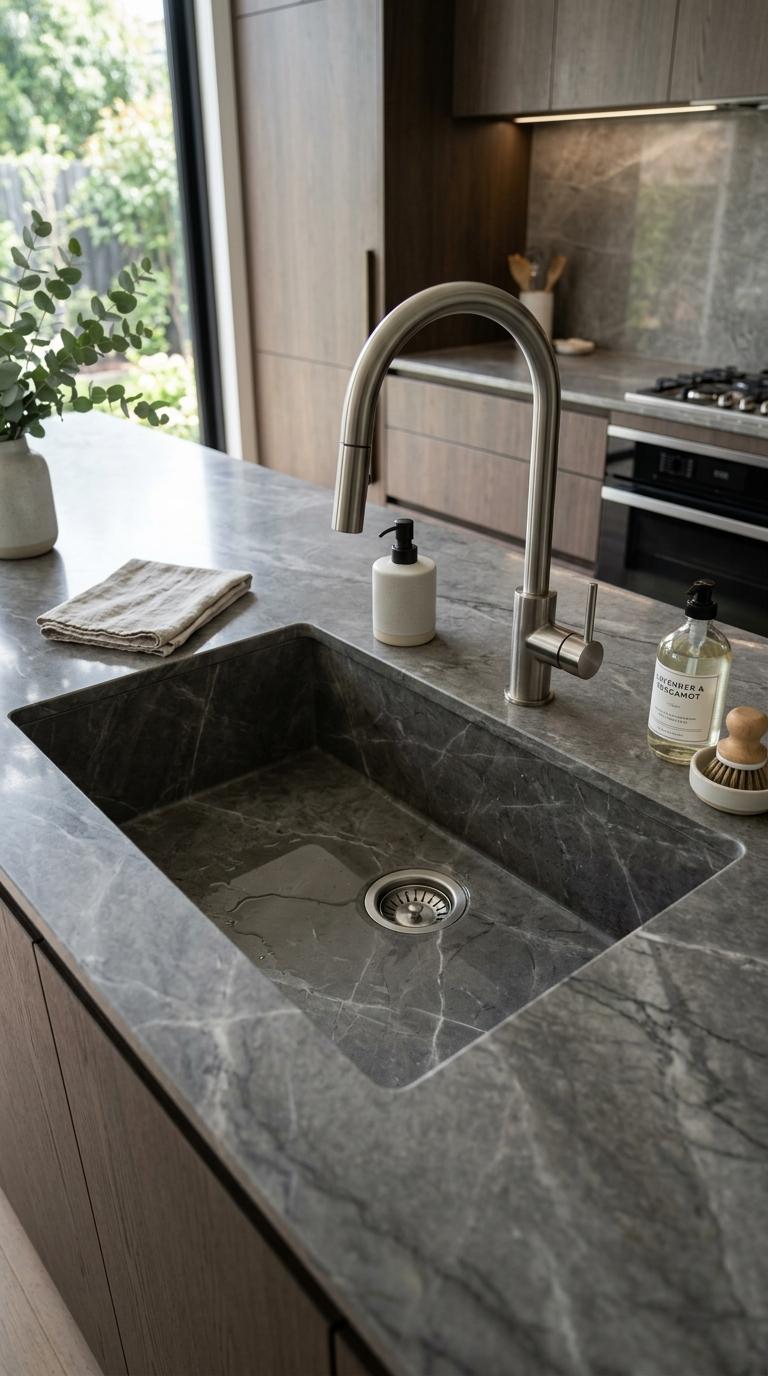
The junction between the kitchen sink and the surrounding counter surface is one of the most used and most visually scrutinized areas of any kitchen, and in a luxury small kitchen the quality of this detail, the precision of the sink-to-counter fit, the choice of sink material and profile, and the quality of the faucet, communicates the overall level of design intention more clearly than almost any other single element.
An undermount sink, where the basin is mounted below the counter surface rather than sitting in a surface-mounted cutout, creates the cleanest possible counter-to-sink transition. The counter surface runs uninterrupted to the edge of the sink opening, which is both visually cleaner and practically more hygienic than a surface-mounted sink where the rim creates a joint that collects water and debris. In a luxury stone counter, the undermount sink allows the stone surface to run to the very edge of the basin, creating a material continuity between counter and sink area that looks precision-crafted because it is.
Integrated sinks, where the sink basin is formed from the same material as the counter, either carved from the same stone slab or formed as a continuous surface in solid surface material, represent the most resolved version of this design detail. The counter and the sink are literally one piece, with no joint, no transition, and no material change between them. In a small luxury kitchen where the visual discipline of the surface composition is one of the primary design values, the integrated sink is the detail that most completely expresses that discipline.
9. Curated Open Display within Closed Kitchen System
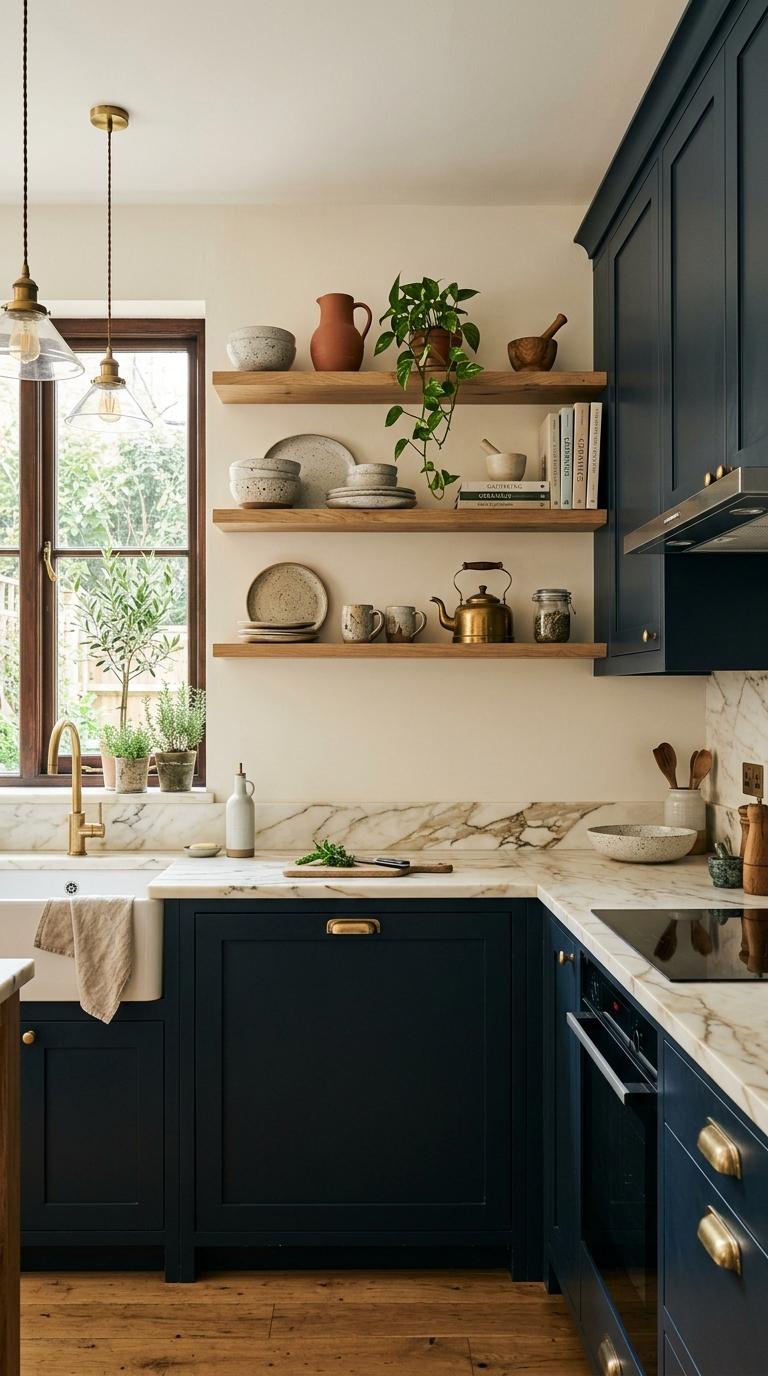
A luxury small kitchen that is entirely closed cabinetry without a single open surface or display element can feel more like a fitted furniture installation than a kitchen with genuine warmth and personality. The strategic introduction of a small number of open display elements within an otherwise closed cabinet system creates the warmth and personal identity that a pure closed-cabinet kitchen consistently lacks without introducing the visual clutter and organisational maintenance demands of extensive open shelving.
A single run of open shelving between two sections of closed upper cabinetry, displaying a carefully chosen selection of ceramic vessels, a few well-chosen cookbooks, a small plant, and perhaps a piece of kitchen equipment that is genuinely beautiful enough to display, creates a visual break in the cabinet surface that adds warmth and character to the luxury kitchen in a controlled and intentional way. The quality of the objects displayed on this open section matters as much as any surface material or hardware choice in a luxury kitchen because they are the human element of the design, the evidence of the specific person who cooks in this kitchen, rather than a generic kitchen user.
In an Indian luxury kitchen context, the objects worth displaying are often the ones that most directly reference Indian craft and culinary traditions. A set of handmade brass measuring cups. A collection of handcrafted ceramic spice bowls. A beautiful masala dabba in brushed steel or hammered copper. A traditional wooden rolling board and pin with a patina of decades of use. These are objects that carry a cultural identity and a history of use that no imported design object can replicate, and in a luxury kitchen where the quality of every material and every detail has been carefully considered, they create a warmth and authenticity that is the most genuinely luxurious quality available in any domestic space.
10. Acoustic and Sensory Quality
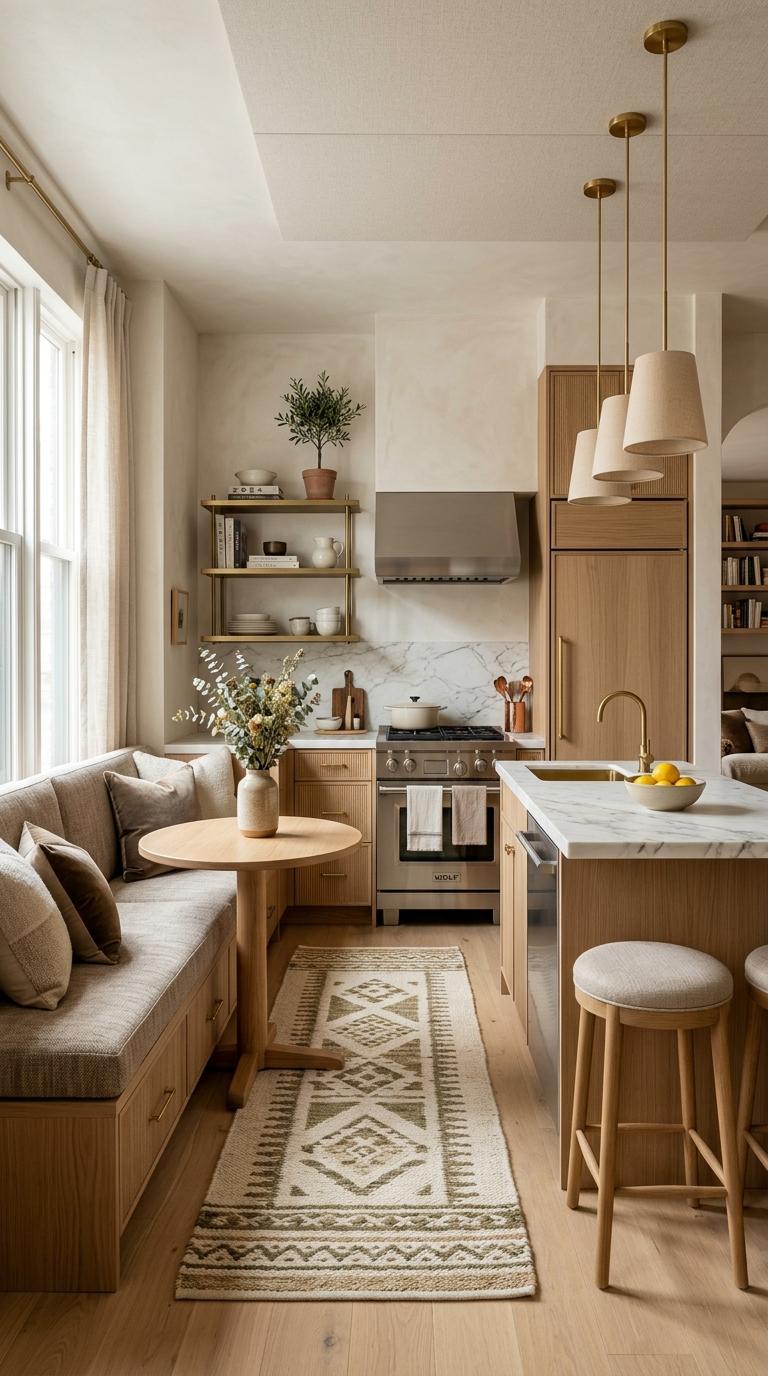
The acoustic quality of a luxury kitchen is a dimension of the space’s design that is rarely discussed in kitchen design literature, and that is nonetheless one of the most significant contributors to the daily experience of using the kitchen. A kitchen with hard, reflective surfaces on every wall, the floor, the ceiling, and the counter produces a harsh, reverberant acoustic environment where every sound, the clink of a vessel being placed on stone, the impact of a chopping board, the sound of water from the tap, is amplified and echoed back into the space with an intensity that creates a cumulative sensory fatigue that most people experience as a vague kitchen unpleasantness without ever identifying its acoustic origin.
Luxury kitchen design addresses this acoustic dimension through the strategic introduction of sound-absorbing surfaces into what is otherwise a very hard material environment. An upholstered banquette or cushioned seating in the kitchen dining area absorbs sound at the level where conversation happens. A woven textile runner on the kitchen floor section absorbs footstep and impact sounds. Timber cabinet fronts, rather than lacquer or glass fronts, absorb more sound than reflective alternatives. A fabric-wrapped acoustic panel concealed within a cabinet door design or positioned as a decorative feature on a non-working wall introduces genuine acoustic treatment into the luxury kitchen in a form that serves a design purpose as well as an acoustic one.
The combined acoustic effect of these soft surface introductions into a small luxury kitchen is a space that sounds as good as it looks, where conversation is comfortable, where the sounds of cooking are present but not overwhelming, and where the sensory experience of being in the kitchen is genuinely pleasurable rather than merely visually impressive.
The Small Luxury Kitchen as a Complete Design Statement
A small luxury kitchen that has been designed with the level of material quality, design precision, and functional intelligence described in this list is not a kitchen that apologises for its size, or that tries to appear larger than it is. It is a kitchen that is completely confident in its scale, that finds its luxury in the quality of every surface, every detail, and every daily interaction, and that creates an experience of cooking and living that a large, poorly designed kitchen of ten times the floor area simply cannot match.
The luxury of a small kitchen designed to this standard is the luxury of precision, of material quality, of functional intelligence, and of the care that went into every decision made about every element of the space. It is a luxury that is experienced every day in the smoothness of a drawer opening, the clarity of light on a stone counter, the warmth of a well-chosen material, and the ease of a storage system designed exactly for the way a specific person cooks. That is what luxury means in its fullest and most genuine sense, and it is entirely available in the smallest kitchen in the smallest apartment in the most constrained urban context, when the design thinking brought to it is genuinely excellent.

Aarav Sharma is a passionate home and lifestyle writer. He loves exploring kitchen design, home decoration, and interior styling. With a keen eye for beautiful details and practical design ideas. Aarav Sharma shares inspiration to help readers create comfortable and functional living spaces.