
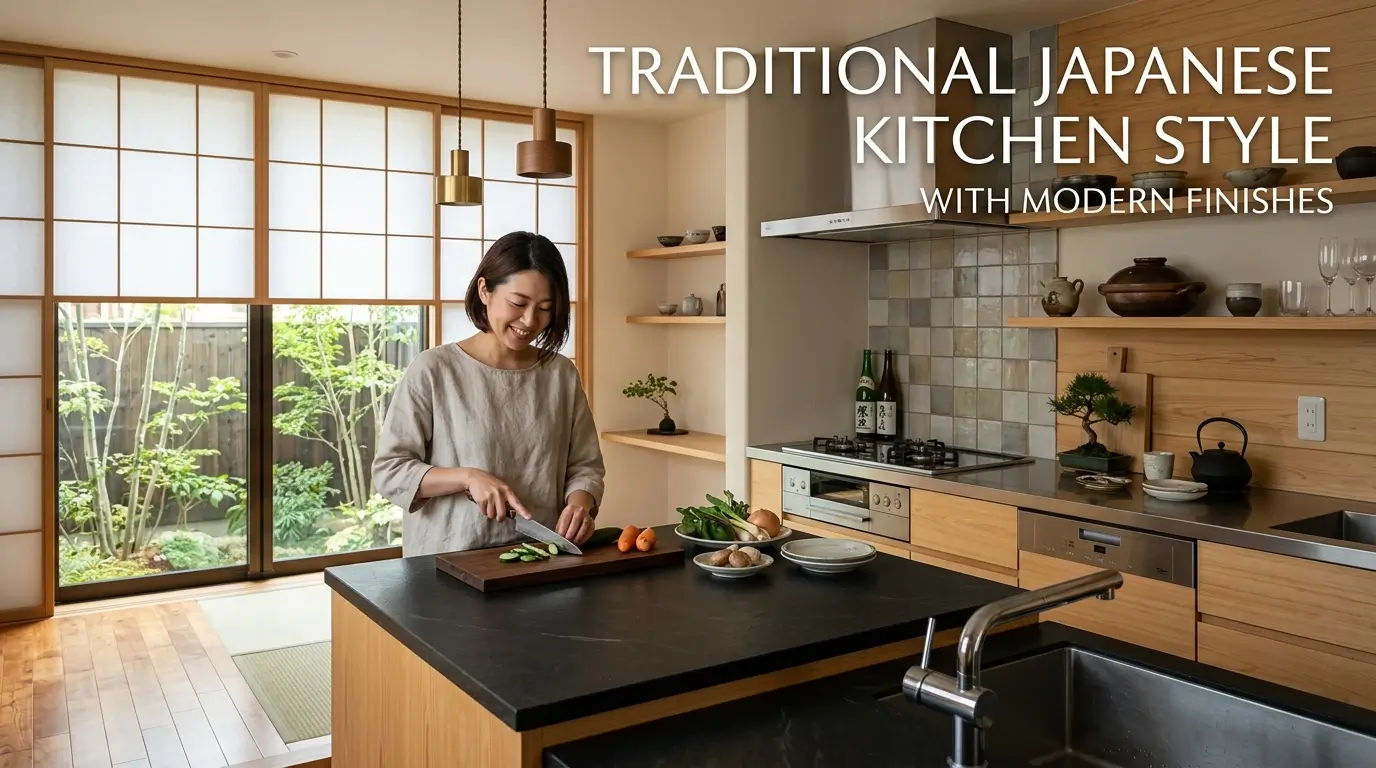
The relationship between tradition and modernity in Japanese design is fundamentally different from the way that relationship is understood in most other design cultures. In Western design, tradition and modernity are frequently positioned as opposing forces, where the contemporary designer must choose between honoring historical precedent and pursuing contemporary relevance, and where combining the two risks the kind of superficial pastiche that satisfies neither the traditionalist nor the modernist. In Japanese design culture, this opposition does not exist in the same way because the Japanese aesthetic tradition is not a historical style to be referenced or rejected but a living set of values and principles that have never stopped evolving and that contain within themselves the seeds of their own contemporary expression.
The principles that govern traditional Japanese kitchen design, the preference for natural materials, the reverence for craft and handwork, the discipline of spatial restraint, the understanding of the relationship between interior and nature, and the belief that beauty is found in the quality of daily objects and daily experiences rather than in exceptional or spectacular ones, are not principles that have been superseded by modernity. They are principles that modernity, in its most thoughtful expressions, continues to rediscover and reaffirm. A kitchen that combines traditional Japanese aesthetic values with the materials, technologies, and spatial intelligence of contemporary design is not a contradiction. It is the most natural possible evolution of a design tradition that has always understood beauty as something that deepens over time rather than something that dates.
For an Indian homeowner considering a kitchen that draws on Japanese traditional aesthetics with modern finishes, the cultural resonance of this approach is particularly significant. Indian design culture shares with Japanese design culture a reverence for natural materials, a tradition of extraordinary craft, a history of domestic spaces organized around the rhythms of daily life rather than the demands of display, and a material vocabulary of wood, stone, clay, and metal that has been refined over centuries of use. A traditional Japanese kitchen with modern finishes is not a foreign aesthetic imposed on an Indian domestic context. It is an encounter between two craft-rich, nature-reverent design traditions that produces something genuinely resonant and genuinely beautiful in both cultural registers.
Traditional Japanese Kitchen Style with Modern Finishes
1. Tokonoma-Inspired Display Alcove in the Modern Kitchen
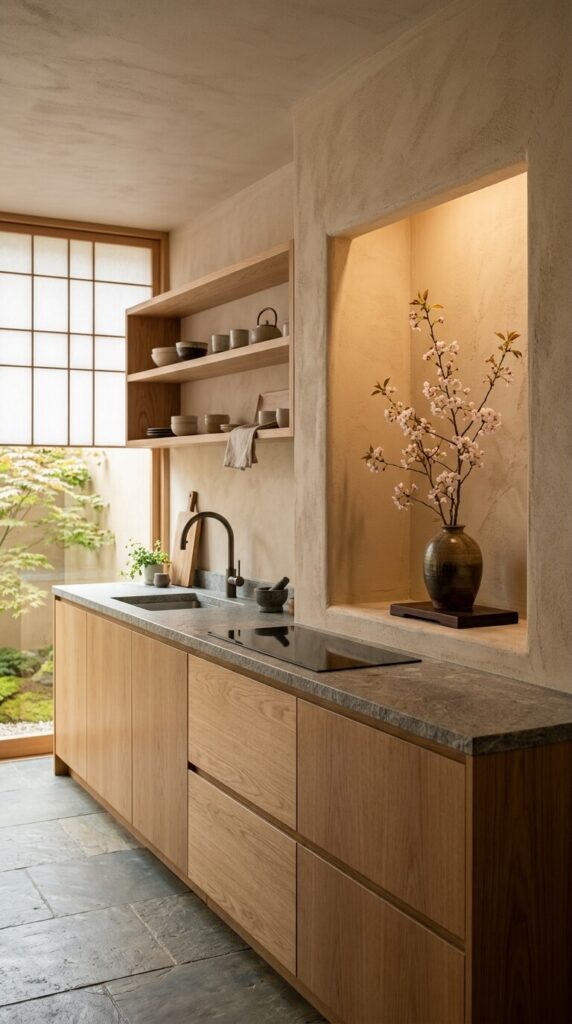
The tokonoma is the raised alcove found in traditional Japanese rooms that serves as the home’s primary display space, holding a single scroll, a seasonal flower arrangement, and perhaps one carefully chosen ceramic or lacquer object. It is the spatial expression of the Japanese belief that a single beautiful thing, given the space and the context to be properly seen, is worth infinitely more than many things competing for attention in a crowded space. The tokonoma is not a shelf. It is a stage, and the objects placed in it are not decorations. They are considered selections that reflect the season, the occasion, and the sensibility of the household.
In a modern kitchen with traditional Japanese influences, the tokonoma principle manifests as a dedicated display alcove within the kitchen design, a recessed section of wall or cabinetry that is specifically designed to hold a small number of objects in conditions that allow them to be properly seen and appreciated. This might be a recessed niche in the kitchen wall lined with a contrasting material, perhaps a section of natural stone within a wood-dominant kitchen, or honed plaster within a stone-dominant one, with its own dedicated lighting and a clear, unobstructed surface on which a few objects are displayed with the kind of intentional spacing that the Japanese aesthetic demands.
The objects displayed in a kitchen tokonoma should be chosen with the same seasonal and sensory awareness that governs the traditional alcove. A ceramic vessel in the color palette of the current season. A small branch of flowering tree in spring. A single large persimmon in autumn. A piece of handmade lacquerware that references both the kitchen’s function and the Japanese craft tradition. These objects change with the seasons, which keeps the kitchen display fresh and prevents the static accumulation of permanent decorations that characterizes most kitchen shelves and that Japanese aesthetic sensibility finds as unsatisfying as an unchanged garden.
2. Urushi Lacquer-Inspired Cabinet Finishes
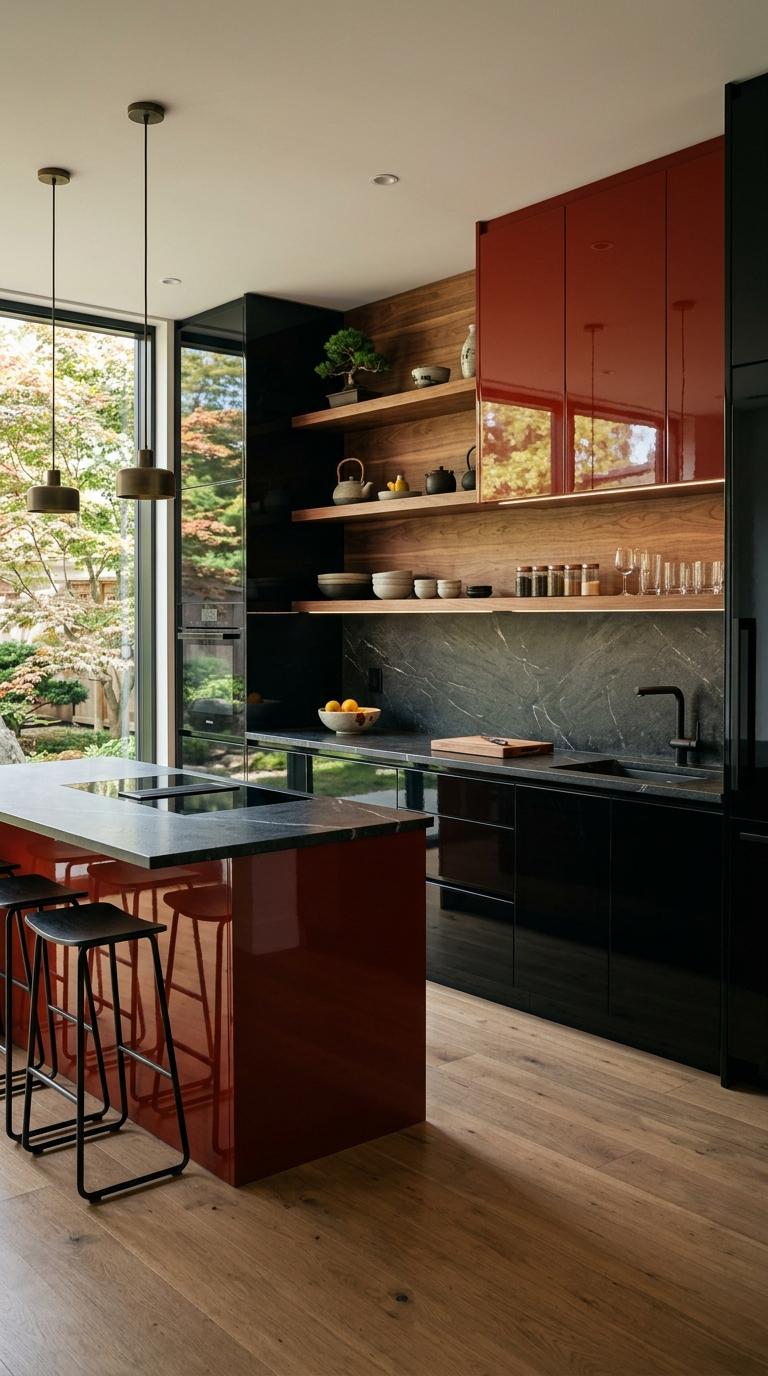
Urushi lacquer, the traditional Japanese surface finish made from the sap of the urushi tree and applied in dozens of thin layers to wooden objects to create a surface of extraordinary depth, richness, and durability, is one of the most technically demanding and most visually beautiful finishing traditions in world craft history. A genuine urushi lacquer surface has a quality of depth that is unlike any other surface, an inner luminosity and a color complexity that comes from the way light penetrates the multiple thin layers of lacquer and reflects back through them, creating the impression that the color is coming from within the surface rather than sitting on it.
In a modern kitchen that references traditional Japanese aesthetics, true urushi lacquer cabinetry is the most authentic and most extraordinary finish available but also the most expensive and the most demanding in terms of craftsperson skill and application time. For most domestic kitchen projects, the visual qualities of urushi lacquer can be referenced through high-quality modern lacquer finishes that use multiple thin coats of catalyzed lacquer applied and hand-sanded between each coat to build up a surface of comparable depth and smoothness. The result is not identical to genuine urushi but it creates a cabinet surface of a quality and visual depth that standard single-coat lacquer finishes cannot approach.
The colors most associated with urushi lacquer in traditional Japanese craft are deep black, known as nuri-tsubushi, and rich vermillion red, known as shu-urushi, and both of these colors translate beautifully into a modern kitchen cabinet finish when applied with the depth and richness that a multi-coat lacquer system provides. A kitchen with deep black lacquer cabinets, warm wood open shelving accents, and a natural stone counter creates a color and material composition of extraordinary sophistication that is simultaneously deeply traditional in its reference and completely contemporary in its execution.
3. Washi Paper and Natural Fiber Wall Treatments
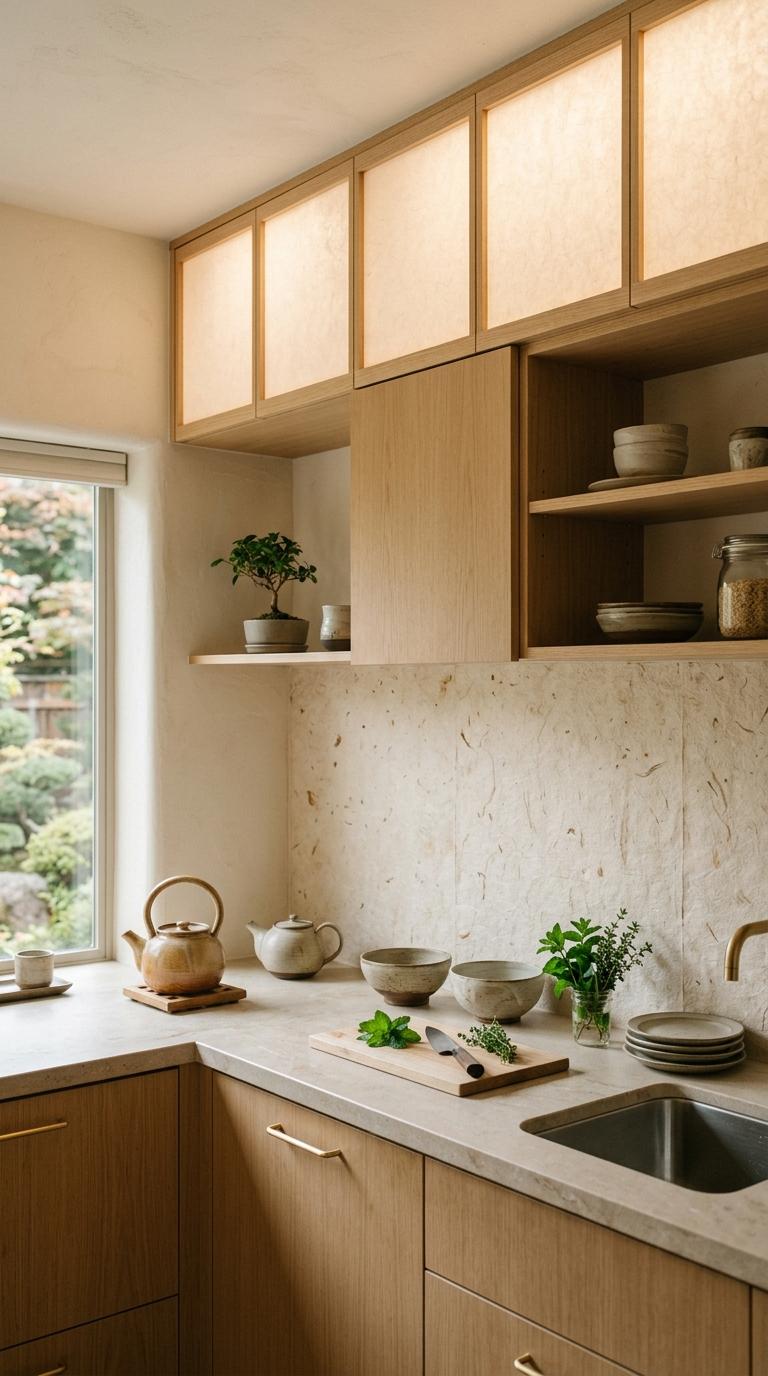
Washi, the traditional Japanese handmade paper produced from the inner bark of the kozo, mitsumata, and gampi plants, is one of the most beautiful and most versatile surface materials in the Japanese design vocabulary. Its surface has a texture of extraordinary fineness and organic variety, each sheet slightly different from every other because the hand-laying process that creates it is inherently variable, and its translucency allows light to pass through it in a way that creates a quality of soft, diffused illumination that is uniquely characteristic of traditional Japanese interior spaces.
In a modern kitchen with traditional Japanese references, washi-inspired wall treatments create a surface of natural texture and warmth that provides a counterpoint to the harder, denser surfaces of stone counters and lacquer cabinetry. Grasscloth wallcovering in a fine natural fiber weave most closely approximates the visual and tactile qualities of washi on a kitchen wall surface, providing a texture of sufficient delicacy and organic variation to reference the Japanese paper tradition while being durable and moisture-resistant enough for the kitchen environment.
The section of wall most suited to a washi-inspired treatment in a Japanese kitchen is the wall above the counter between the upper and lower cabinetry, what is conventionally treated as the splashback zone. In this position, a narrow band of natural fiber wall treatment or a washi-pattern tile creates a visual accent that connects the upper and lower cabinet zones through a surface of natural texture and warmth. The practical requirement for moisture resistance in the splashback zone means that a genuine fiber wallcovering needs to be protected by a clear sealant coating or replaced with a tile or panel that replicates the washi aesthetic in a water-resistant material.
4. Engawa-Inspired Kitchen Threshold Design
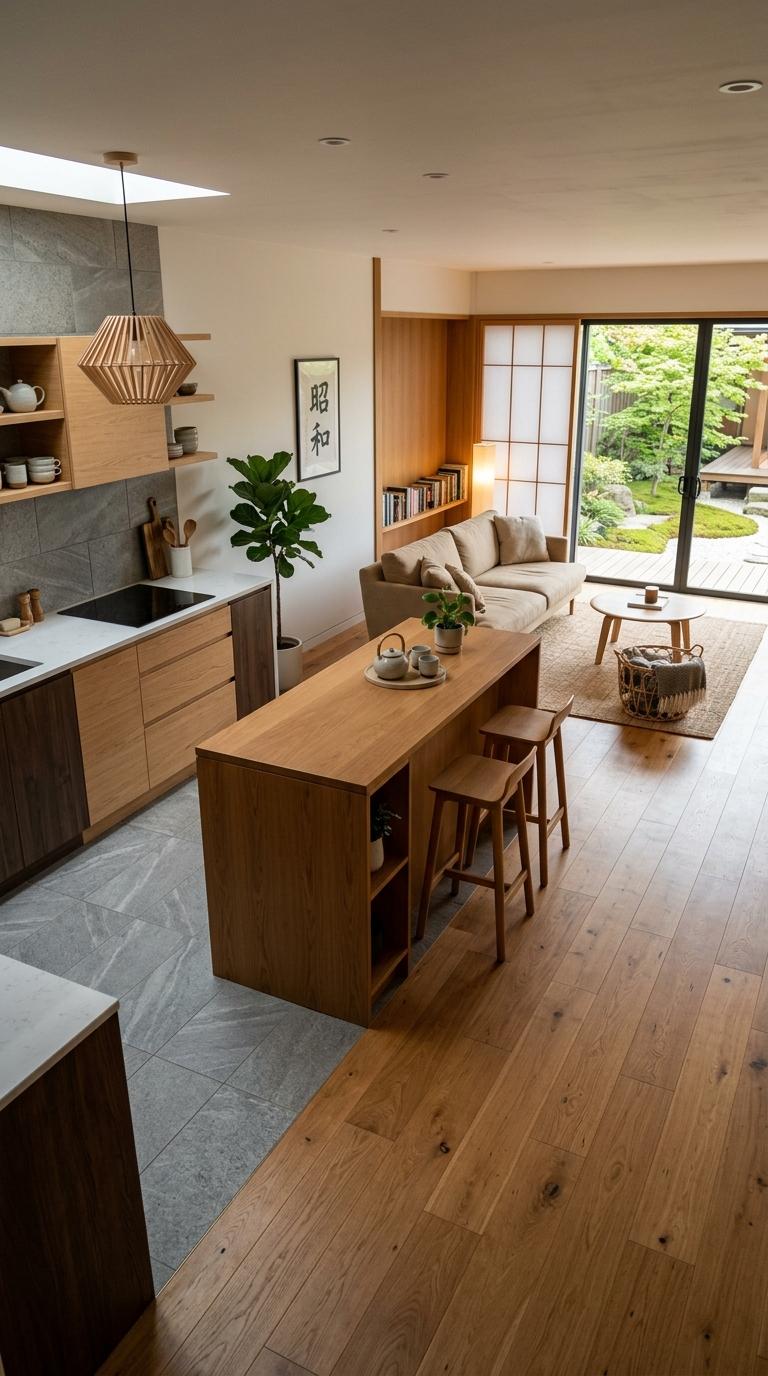
The engawa is the traditional Japanese transitional space, a narrow veranda or corridor at the perimeter of the house that serves as a threshold between the interior and the exterior, between the domestic space and the natural world. It is a space of transition and of in-between-ness, neither fully inside nor fully outside, and it expresses one of the most fundamental principles of Japanese spatial design, that the boundaries between spaces should be transitions rather than barriers, zones of gradual change rather than hard edges.
In a modern open-plan kitchen that opens to a dining area, a living space, or a balcony, the engawa principle manifests as a deliberate treatment of the kitchen threshold that creates a sense of spatial transition rather than a hard boundary between the cooking environment and the adjacent space. This might be expressed through a change in floor material at the kitchen boundary, the warmth of timber replacing the practicality of tile at the point where the kitchen transitions to the living or dining zone. It might be expressed through a change in ceiling treatment, a lower false ceiling section over the kitchen zone giving way to a higher ceiling in the adjacent living area. Or it might be expressed through the positioning of a slim island or peninsula that creates a threshold element at the kitchen boundary, a piece of furniture that belongs to both zones simultaneously and facilitates the spatial and social transition between them.
The engawa principle is particularly relevant to the Indian open-plan apartment context where the boundaries between kitchen, dining, and living areas are often either too sharp, a hard wall dividing kitchen from dining that creates an overly sealed cooking environment, or too nonexistent, an open plan with no spatial definition between cooking and living zones that creates a kitchen without any sense of its own spatial identity. The engawa approach creates a middle path between these two extremes, defining the kitchen zone through a gentle transition rather than a barrier and maintaining the openness of the plan while giving each zone a clear sense of its own character.
5. Irori-Inspired Cooking Zone Design
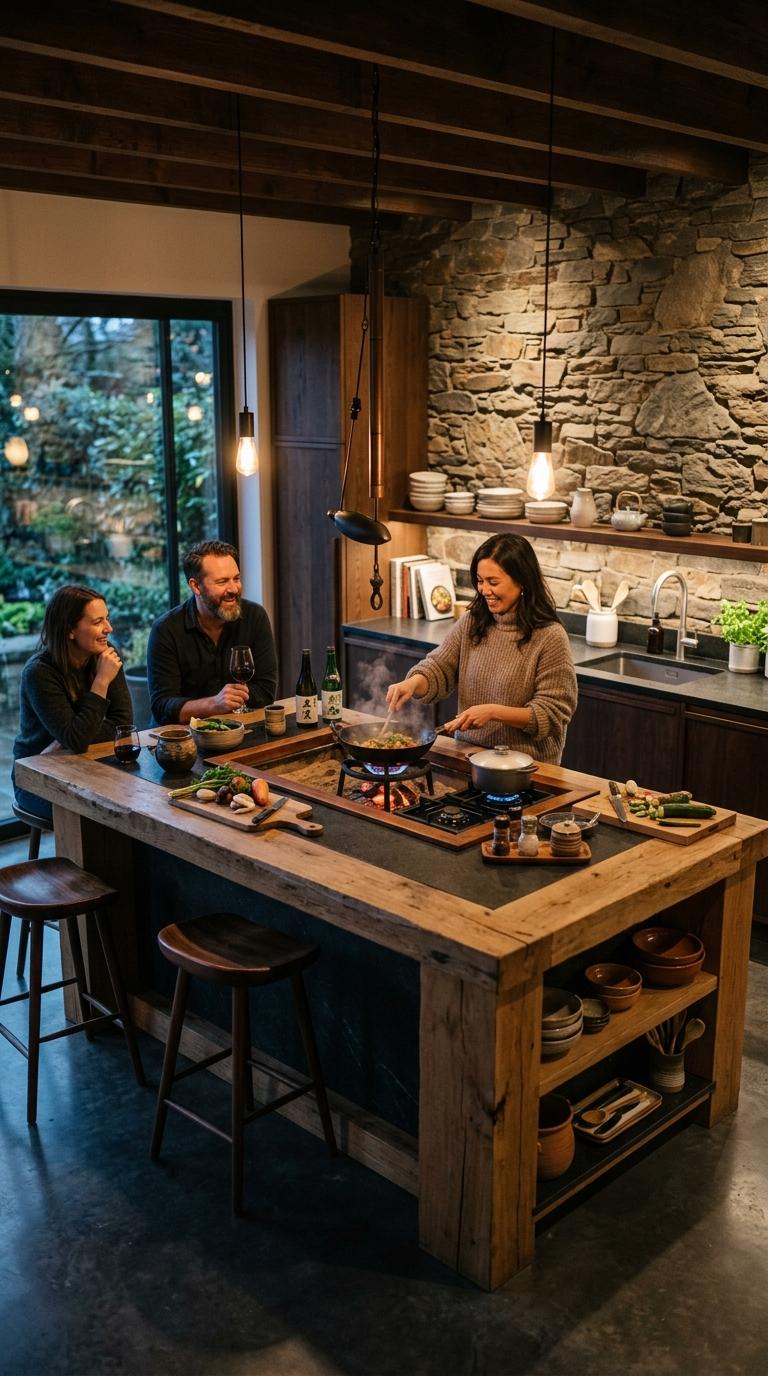
The irori is the traditional Japanese sunken hearth, a square opening in the floor of the main room around which the household gathered for cooking, heating, and social life. It was the spatial and social center of the traditional Japanese home, the source of warmth and food and the organizing principle around which the domestic life of the household revolved. The irori has been replaced by the modern cooking surface in contemporary Japanese homes, but its principle, the cooking zone as the social and spatial heart of the home rather than a utilitarian service space separated from the life of the household, remains one of the most influential ideas in Japanese domestic design.
In a modern kitchen with traditional Japanese references, the irori principle manifests as the deliberate positioning of the cooking surface as the visual and social focal point of the kitchen, surrounded by a zone of material warmth and spatial generosity that invites presence and participation rather than exclusion. A cooking surface positioned at the boundary between the kitchen and the dining area, with the cook facing outward toward the household rather than inward toward the kitchen wall, recreates the social dynamic of the irori in a contemporary open-plan format. An island with an integrated cooking surface in the center of the kitchen, surrounded by counter space on three sides, creates a cooking station of similar spatial centrality and social openness.
The material treatment of the cooking zone in a traditional Japanese modern kitchen should reference the warmth and the elemental quality of the original irori. Natural stone surrounding the induction or gas surface, warm wood on the adjacent counter surfaces, and a range hood in a material that references traditional Japanese craft, perhaps a hand-hammered copper form or a lacquered finish that relates to the cabinet treatment, create a cooking zone of genuine material richness that honors the irori tradition of the cooking surface as something beautiful and significant rather than merely functional.
6. Shunkashu-to Seasonal Material Palette
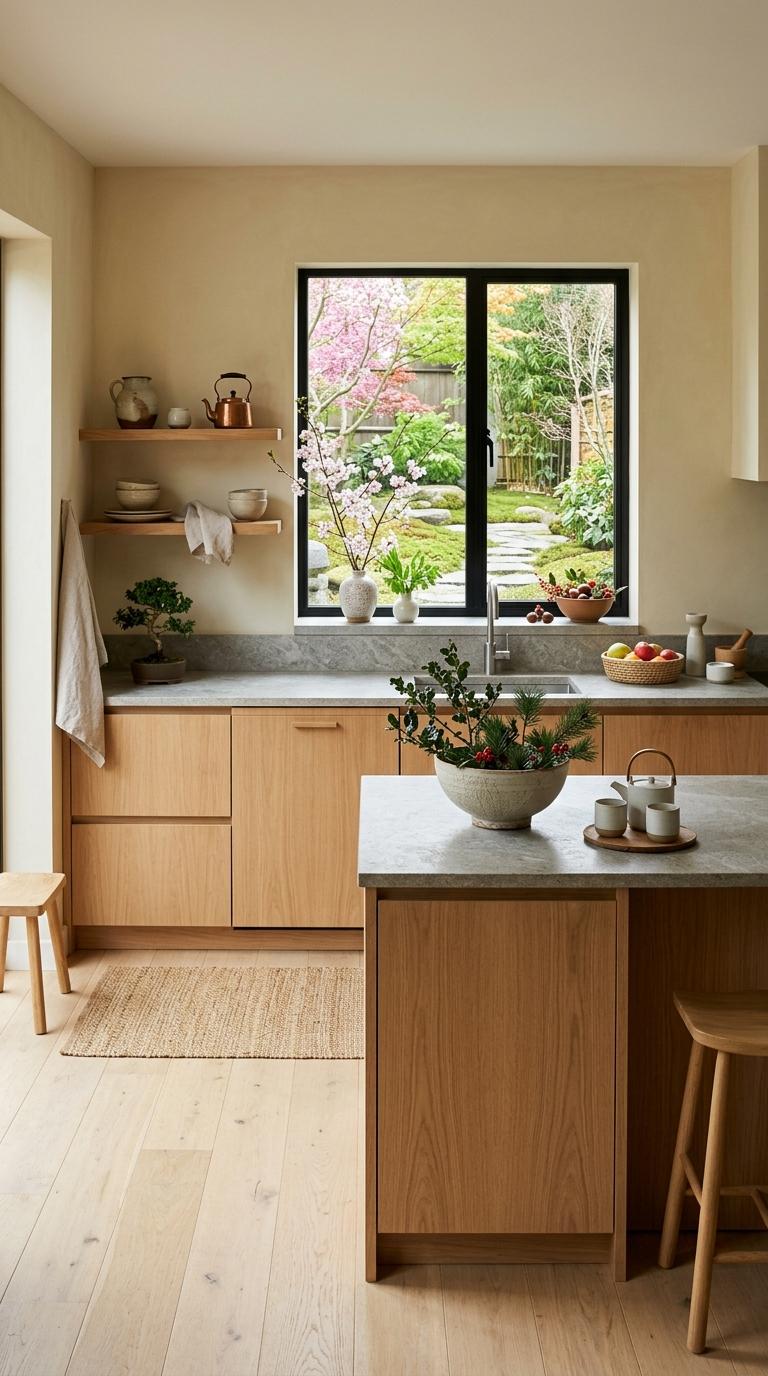
Shunkashu-to, the Japanese concept of the four seasons and their influence on every aspect of Japanese aesthetic and domestic life, is one of the most distinctive and most beautiful dimensions of traditional Japanese culture and one that has immediate application to the material palette and decorative approach of a modern kitchen with Japanese influences. In the Japanese tradition, the domestic interior changes with the seasons not just in its floral arrangements and scroll paintings but in its material palette, its textile choices, and the objects displayed and used within it.
In a modern kitchen with traditional Japanese references, the shunkashu-to principle is expressed through a material palette that is fundamentally warm and natural, capable of supporting the seasonal changes in decoration and object display that the Japanese tradition encourages, without itself being tied to a specific season. The light wood cabinetry, the natural stone counter, the warm ceramic tiles, and the oiled timber floor of a Japanese modern kitchen create a background of permanent natural warmth against which the seasonal foreground of changing flowers, changing ceramics, and changing food is experienced with the full vividness that the contrast between background and foreground provides.
The practical expression of shunkashu-to in an Indian kitchen with Japanese influences might be as simple as changing the single displayed ceramic vessel on the tokonoma shelf with the seasons, introducing marigolds and terracotta in the autumn, fresh greens and white ceramics in the monsoon, and dried botanicals and warm copper in the winter. These are small changes that cost very little and require very little time but that keep the kitchen connected to the natural rhythms of the year in a way that a permanently fixed decoration scheme never can.
7. Mingei Craft Objects in the Modern Kitchen
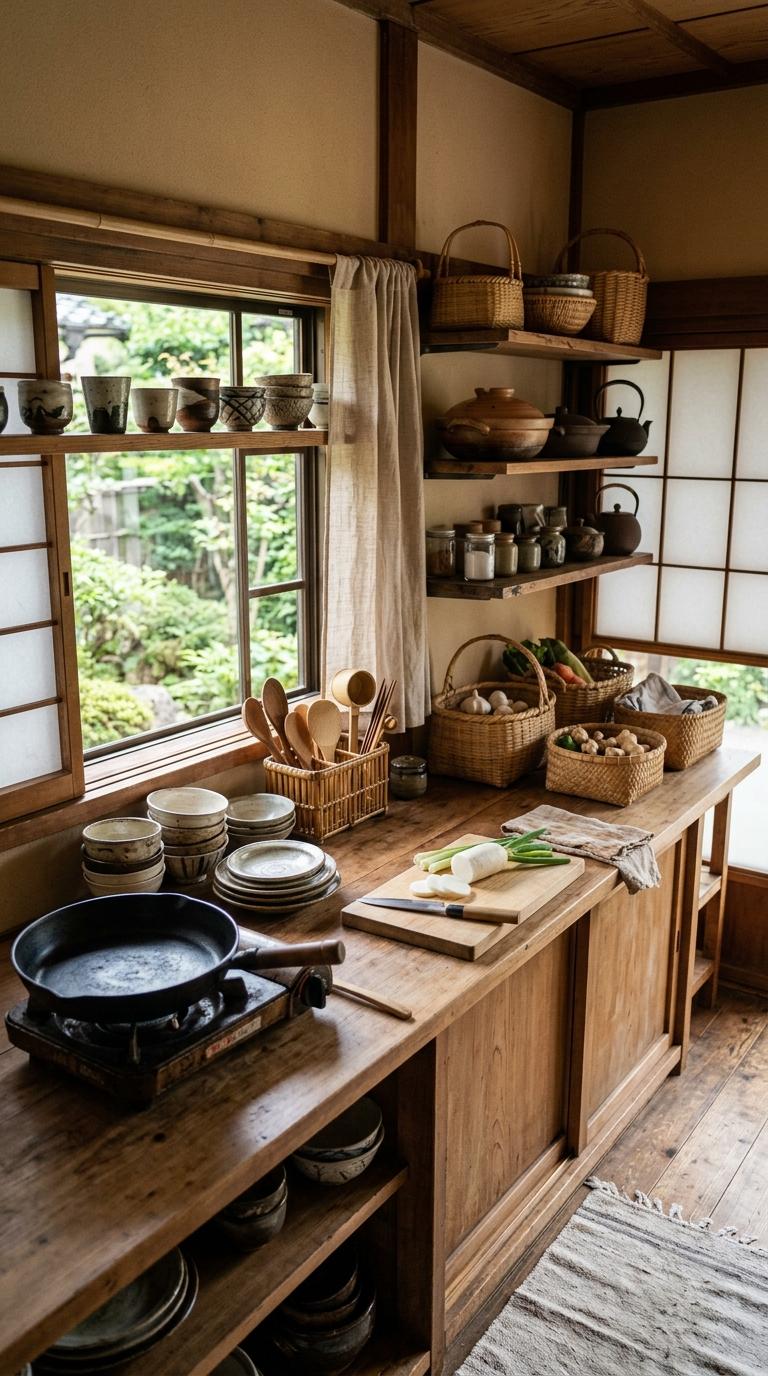
Mingei, the Japanese folk craft movement founded by Soetsu Yanagi in the early twentieth century, was based on the radical proposition that the most beautiful objects in the world are not the rarified products of individual artistic genius but the humble, everyday objects produced by anonymous craftspeople working within traditional techniques for the practical needs of daily life. A well-made rice bowl, a functional wooden spoon, a simple ceramic sake cup, a precisely woven basket, these are, in the mingei philosophy, more genuinely beautiful than any self-consciously artistic creation because their beauty is inseparable from their function and their making is inseparable from the life they serve.
In a modern kitchen with traditional Japanese references, the mingei principle is expressed through the choice of the everyday objects with which the kitchen is furnished and used. Handmade ceramic bowls and plates in simple glazes that show the subtle variations of the kiln. Wooden spoons and spatulas hand-carved from a single piece of wood in a form that fits the hand naturally. A cast iron pan whose surface improves with every use and whose weight communicates the quality of its material. A woven bamboo tray whose pattern is the pattern of its making rather than an applied decoration. These are the objects of a mingei kitchen, and they are available in the Indian context through the same craft traditions that have always produced the Indian equivalents of Japanese folk craft objects.
The Indian mingei object is the brass lota, the kansa thali, the terracotta handi, the bamboo basket from the northeastern markets, and the hand-thrown clay cup from a local potter. These objects, placed in a modern Japanese-influenced kitchen, create a material environment of genuine craft richness that connects two of the world’s great folk craft traditions in a kitchen that is simultaneously deeply Japanese in its aesthetic framework and completely Indian in its cultural specificity.
8. Satoyama Nature Connection in Kitchen Design
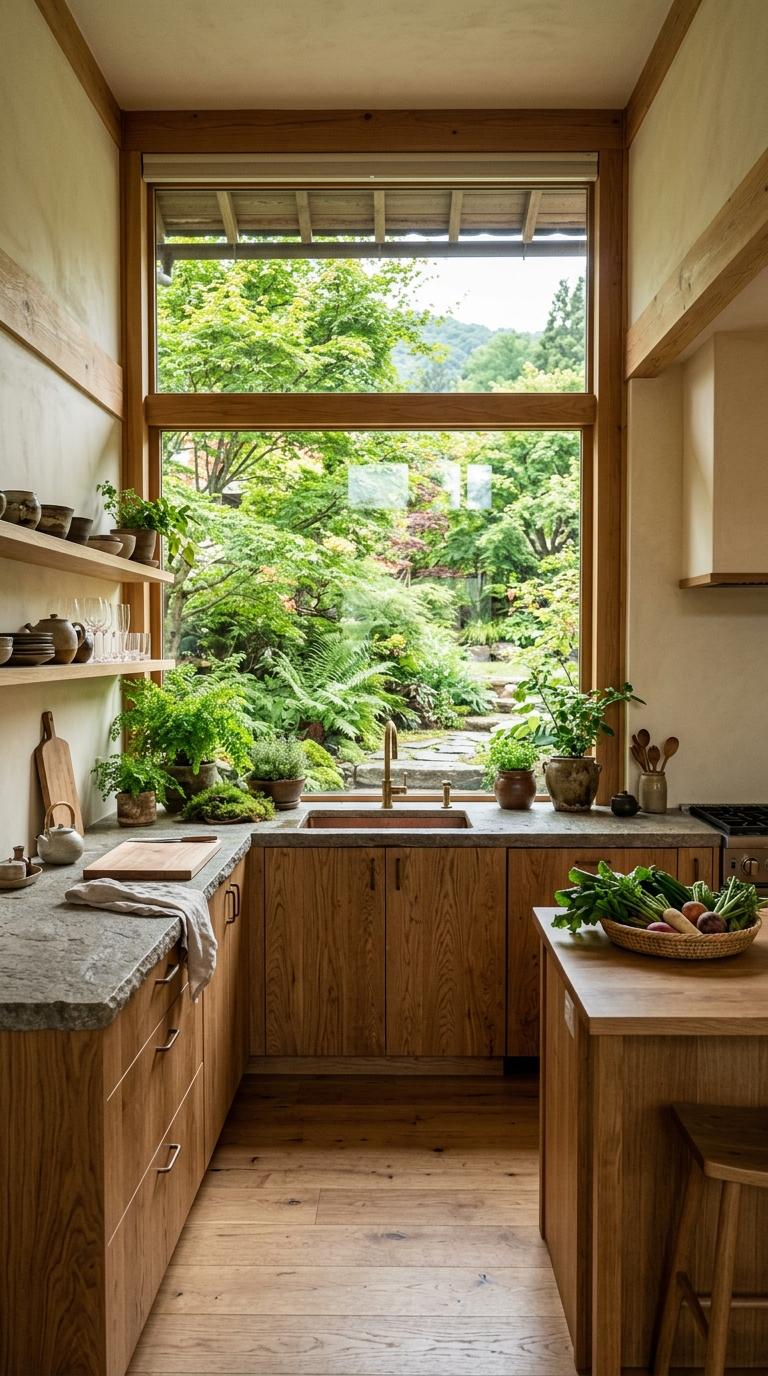
Satoyama refers to the traditional Japanese cultural landscape of the border zone between the mountain forests and the flat agricultural land, a landscape shaped by centuries of human interaction with nature in a way that created environments of extraordinary biodiversity and beauty. The satoyama concept has been applied more broadly in contemporary Japanese design to describe the quality of intimate connection with the natural world that the best Japanese domestic spaces create, a quality that makes the interior feel like an extension of the natural landscape rather than a sealed, artificial environment separate from it.
In a modern kitchen with traditional Japanese references, the satoyama principle is expressed through the consistent use of natural materials that retain the visual and tactile evidence of their natural origin, through the introduction of living plants that bring the outdoor natural world into the interior, and through the management of natural light in a way that allows the changing light of the sky and the seasons to be experienced within the kitchen as a daily reminder of the natural world beyond the apartment walls.
Light wood that shows its grain, stone that shows its mineral inclusions, ceramic tiles that show the marks of their making, and a window that is kept unobstructed to bring natural light and the view of whatever natural elements exist outside the apartment, a tree, the sky, a distant hillside, into the kitchen experience, these are the satoyama elements of a modern Japanese kitchen and they create a quality of natural connection that is one of the most consistently valued qualities of Japanese interior design in any cultural context.
9. Zen Spatial Discipline in Kitchen Organization
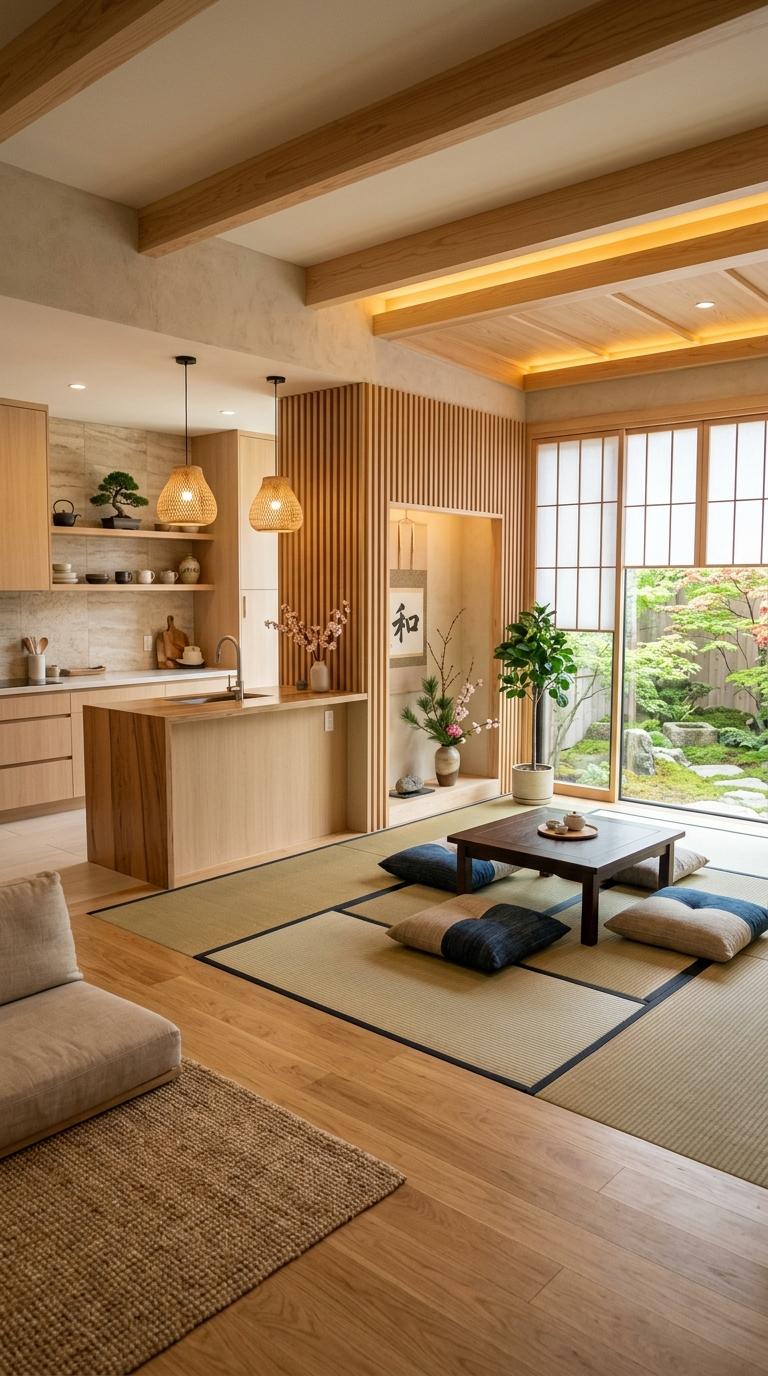
Zen Buddhism has influenced Japanese domestic design more deeply and more pervasively than any other single cultural force, and its influence is most clearly visible in the organizational discipline that the best Japanese kitchens maintain and that makes them function with a quality of ease and efficiency that cluttered, poorly organized kitchens of the same dimensions cannot approach. Zen organizational discipline is not tidiness in the conventional sense of things being put away and surfaces being clear. It is something more fundamental, the reduction of the kitchen’s contents to exactly what is needed and used, the placement of every item in the position from which it is most naturally retrieved and to which it is most naturally returned, and the maintenance of that system not through effort but through the habitual and automatic practice of returning things to their place after every use.
The application of Zen organizational discipline to a modern Indian kitchen with Japanese influences begins with the honest assessment of what the kitchen actually uses in the normal course of daily cooking and the removal of everything that is not genuinely used on at least a weekly basis. This process, which the Japanese home organization philosophy of KonMari has made internationally familiar, creates a kitchen that contains less than most Indian kitchens but that works better than almost all of them because what remains has been selected for genuine utility and is organized with complete clarity about where it lives and why.
The organizational systems that support Zen kitchen discipline in a modern context are the full-extension drawers, the precise internal organizers, the dedicated appliance storage, and the labeled pantry system that Japanese kitchen hardware brands have developed with extraordinary sophistication. These systems make the automatic return of every item to its designated position as natural and as effortless as its retrieval, which is the organizational condition that Zen discipline describes and that the best Japanese compact kitchen design delivers.
10. Contemporary Washitsu Aesthetic in Open Plan Kitchen Design
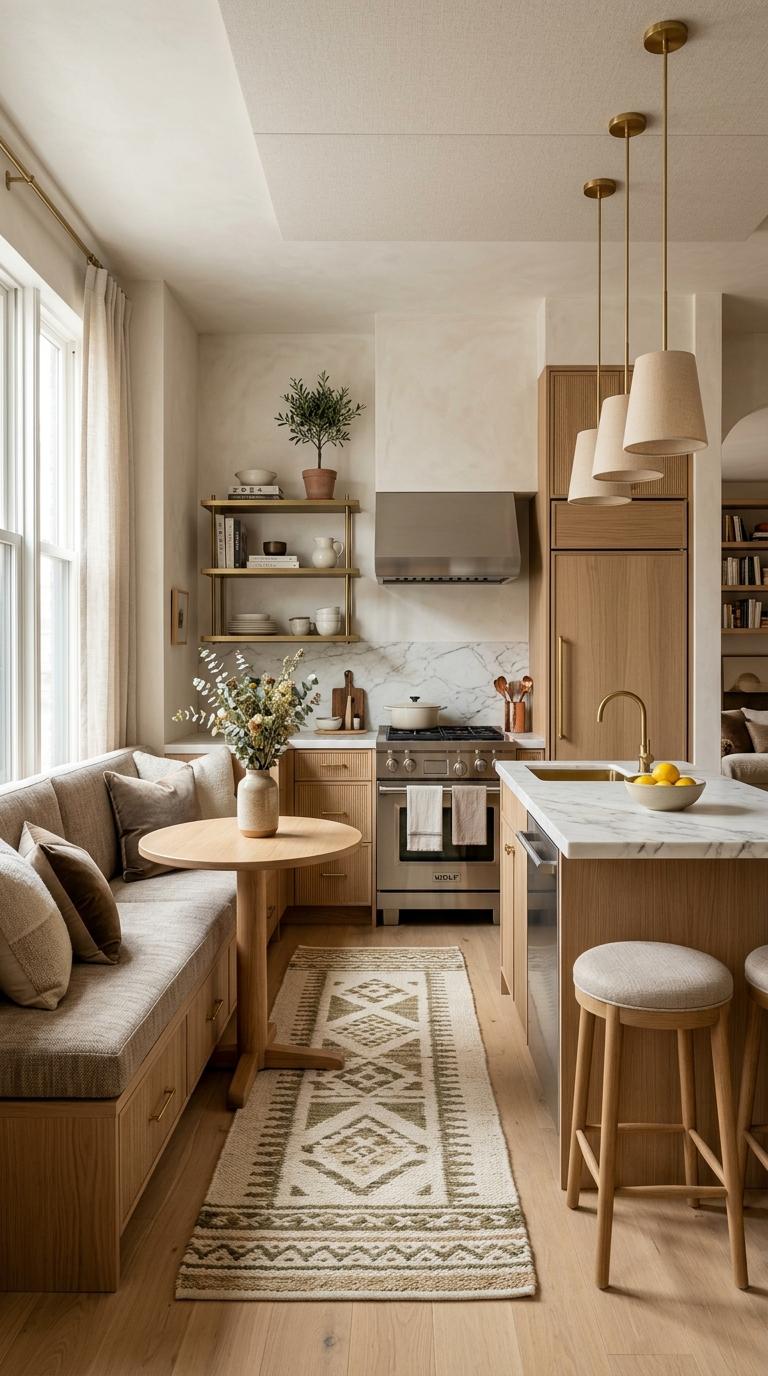
The washitsu, the traditional Japanese room finished in natural materials with tatami flooring, paper screens, and wooden structure, is the spatial expression of traditional Japanese domestic aesthetic values in their most complete and most refined form. It is not a room for any specific purpose but a room that accommodates every domestic purpose with equal grace because its natural materials, its flexible furniture, and its connection to the exterior create an environment of extraordinary adaptability and beauty.
In a contemporary open-plan kitchen and living space, the washitsu aesthetic is expressed not through the literal replication of tatami and sliding screens but through the consistent use of natural materials across every surface and every object in the space, the management of natural light as the primary lighting source supplemented by warm artificial light that honors rather than competes with it, and the organization of the space around the activities of daily life rather than around a fixed furniture arrangement that imposes its own logic on the life lived within it.
A kitchen and living space designed on washitsu principles uses light wood, natural stone, woven fiber, handmade ceramic, and cast metal throughout. Its furniture is lighter and more easily rearranged than the heavy upholstered pieces of conventional Indian living rooms. Its lighting comes primarily from the window during the day and from warm, low, positioned lamps in the evening rather than from a central overhead source. Its decoration changes with the seasons rather than remaining fixed for years. And its organization is determined entirely by the specific cooking and living habits of the specific household that inhabits it rather than by generic kitchen and living room planning conventions imported from a design culture with different spatial assumptions and different domestic habits.
The Living Tradition of Japanese Kitchen Design
A traditional Japanese kitchen style with modern finishes is not a historical reconstruction or a cultural appropriation. It is the contemporary expression of a design tradition that has always understood beauty as the product of material quality, spatial discipline, craft excellence, and the alignment of the designed environment with the rhythms of natural and domestic life. These values are not historical. They are present and they are universal, as relevant to a compact apartment kitchen in Mumbai or Bangalore as they are to a traditional machiya townhouse in Kyoto. The modern finishes, the integrated appliances, the smart lighting systems, and the engineered stone counters that contemporary kitchens require are not obstacles to Japanese aesthetic values. They are the contemporary materials through which those values can be expressed with the same integrity and the same beauty that the traditional materials expressed them in their own time. The tradition is not preserved by replicating its historical forms. It is preserved by continuing to apply its living principles to the materials and conditions of the present moment, which is exactly what the best contemporary Japanese kitchen design does and what any kitchen designed in its spirit can aspire to do.

Aarav Sharma is a passionate home and lifestyle writer. He loves exploring kitchen design, home decoration, and interior styling. With a keen eye for beautiful details and practical design ideas. Aarav Sharma shares inspiration to help readers create comfortable and functional living spaces.