
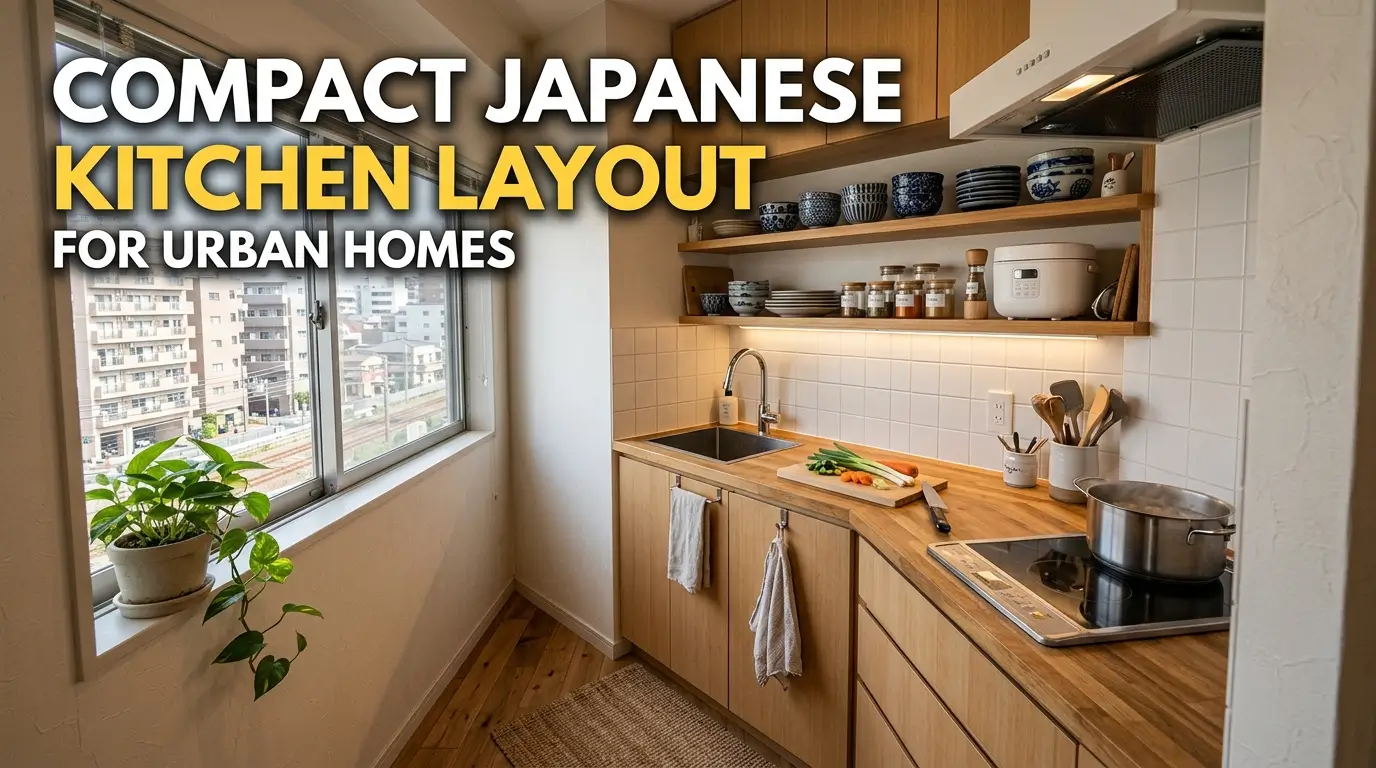
Japan has been solving the problem of the compact urban kitchen longer and more thoughtfully than any other country in the world. The constraints that Indian urban apartment dwellers experience as novel frustrations, limited floor area, insufficient storage, the need to accommodate complex cooking within a minimal spatial footprint, have been the defining conditions of Japanese domestic kitchen design for decades. Tokyo, Osaka, and Kyoto apartments routinely deliver kitchen spaces that make the compact kitchens of Indian metro cities look generous, and the design intelligence that Japanese kitchen designers have developed in response to those extreme constraints is among the most refined and most practically applicable body of spatial thinking available to anyone dealing with a small urban kitchen anywhere in the world.
What makes Japanese compact kitchen design particularly relevant to the Indian urban context is not just the spatial similarity of the challenge but the philosophical compatibility of the response. Japanese kitchen design is not about making a small kitchen look like a large one through visual tricks and spatial illusions. It is about making a small kitchen function with the completeness and the quality of experience of a large one through the precision of its layout, the intelligence of its storage, the quality of its materials, and the discipline of its organization. It is a design approach that begins from a position of complete honesty about spatial constraints and responds to those constraints with the full force of design intelligence rather than with the compensatory gestures of a design that is embarrassed by its limitations.
The principles of Japanese compact kitchen layout are transferable, applicable to any small urban kitchen regardless of its cultural context, and they produce results that are measurably better in terms of workflow efficiency, storage capacity, and daily quality of experience than the conventional approaches to compact kitchen design that most Indian apartment kitchens are currently organized around.
Japanese Compact Kitchen Layout Principles and Ideas
1. The Galley Layout as the Foundation of Japanese Kitchen Efficiency
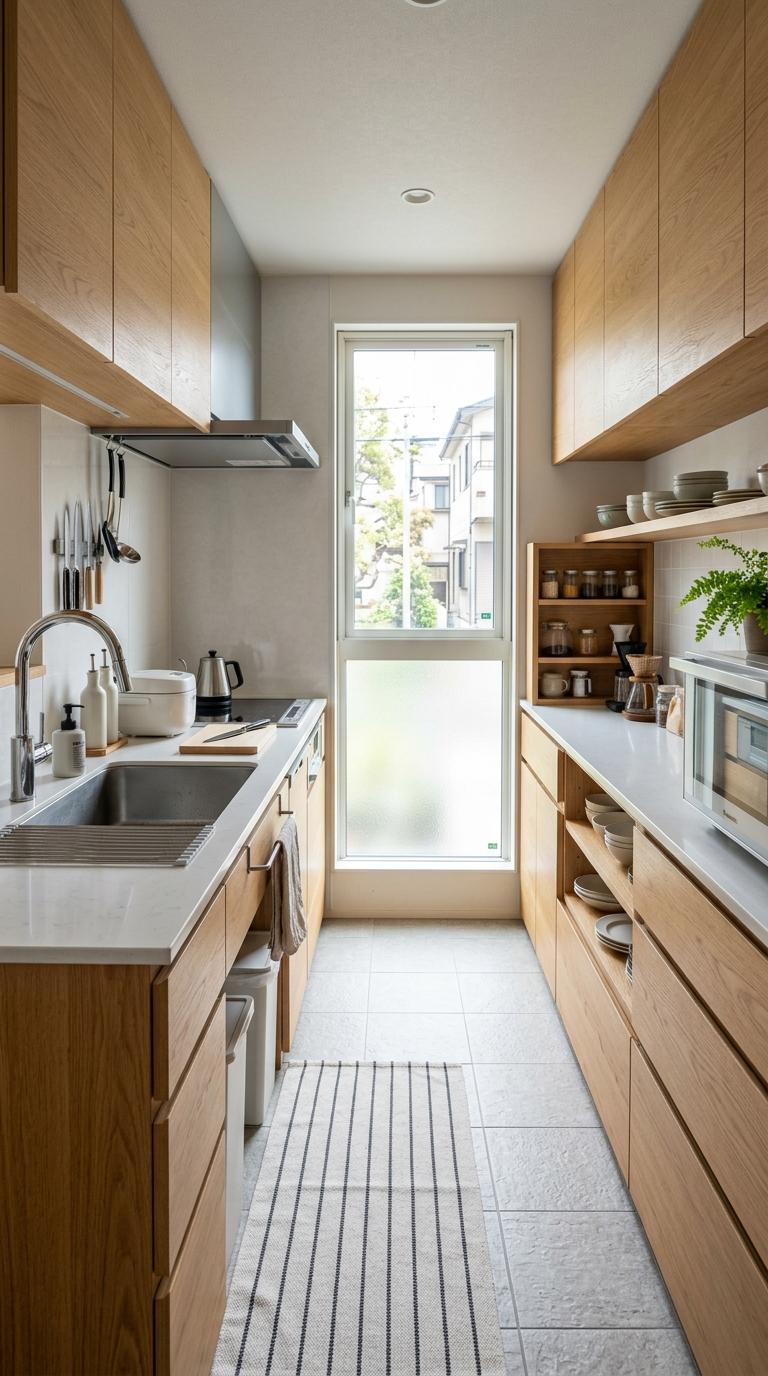
The galley kitchen, two parallel runs of counter and cabinetry facing each other across a central aisle, is the layout most commonly found in Japanese urban apartments and the one that Japanese kitchen design has refined to the highest level of functional excellence. Its efficiency derives from the fundamental logic of its arrangement, every element of the kitchen is within one or two steps of every other element, the primary work triangle of sink, cooking surface, and refrigerator is compressed into a compact, highly efficient configuration, and the linear arrangement of the two counter runs maximizes the counter length available within a minimal floor footprint.
In a Japanese galley kitchen the aisle width is typically between eight five centimeters and one meter, which is narrower than Western kitchen design standards generally recommend but which Japanese kitchen ergonomics research has established as fully functional for a single cook and comfortable for the cooking patterns that characterize Japanese domestic food preparation. In an Indian urban kitchen context where two people may frequently cook simultaneously, an aisle width of ninety five centimeters to one meter ten centimeters creates more comfortable simultaneous use while remaining within the spatial constraints that most compact apartment kitchens impose.
The galley layout’s linear clarity also creates the most natural expression of the Japanese design principle of sequential organization, where the kitchen’s work zones are arranged in the order in which they are used during a typical cooking sequence. The refrigerator at the entry end of the galley where ingredients are retrieved at the beginning of meal preparation. The washing and preparation zone in the middle of the galley where ingredients are cleaned and cut. The cooking zone at the far end of the galley where prepared ingredients are cooked. The plating and service zone immediately adjacent to the cooking zone. This sequential arrangement creates a kitchen workflow of extraordinary efficiency that reduces unnecessary movement and makes the cooking process feel organized and controlled rather than chaotic and reactive.
2. The L-Shaped Layout for Open Plan Urban Apartments
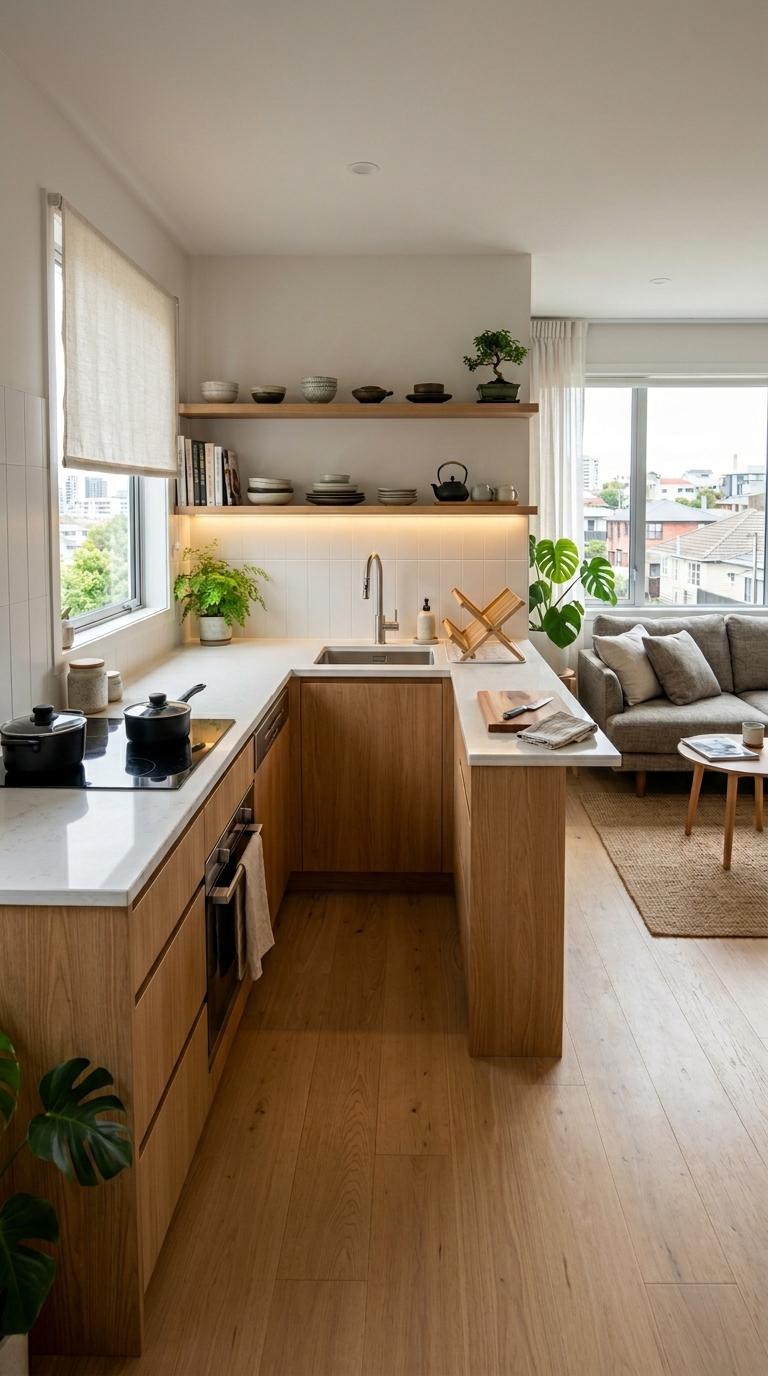
The L-shaped kitchen layout, where the counter and cabinetry runs along two adjacent walls rather than two facing ones, is the Japanese compact kitchen configuration most suited to the open-plan apartment format that is increasingly common in Indian urban housing. The L-shape occupies two walls of the kitchen zone rather than occupying the central floor area with a facing counter run, which leaves the open end of the L completely free, creating a transition zone between the kitchen and the adjacent living or dining area that feels open and unobstructed.
In a Japanese design interpretation, the L-shaped layout is organized so that the two arms of the L serve distinct primary functions that reinforce the sequential workflow logic. The longer arm of the L, typically running along the wall parallel to the apartment’s window, handles the primary cooking functions, the hob, the primary counter space, and the primary storage. The shorter arm of the L handles the service and preparation functions, the sink, the secondary counter, and the transition to the dining area. This functional differentiation of the two arms creates a kitchen where the workflow has a clear beginning, middle, and end that guides the cook through the meal preparation sequence without requiring conscious navigation.
The corner junction of an L-shaped kitchen is the area that Japanese kitchen design handles most thoughtfully and most innovatively. The deep, dark corner cabinet that is the standard Western response to the L-junction problem, where items stored at the back of the corner cabinet are effectively inaccessible, is replaced in Japanese kitchen design with corner carousel systems, pull-out corner drawers, and Lemans corner systems that bring every item in the corner storage to the front of the cabinet with a single pull or rotation. These corner storage solutions are available through premium kitchen hardware brands distributed in India and represent one of the most practically impactful storage investments available in any L-shaped compact kitchen.
3. Height Utilization as the Primary Storage Strategy
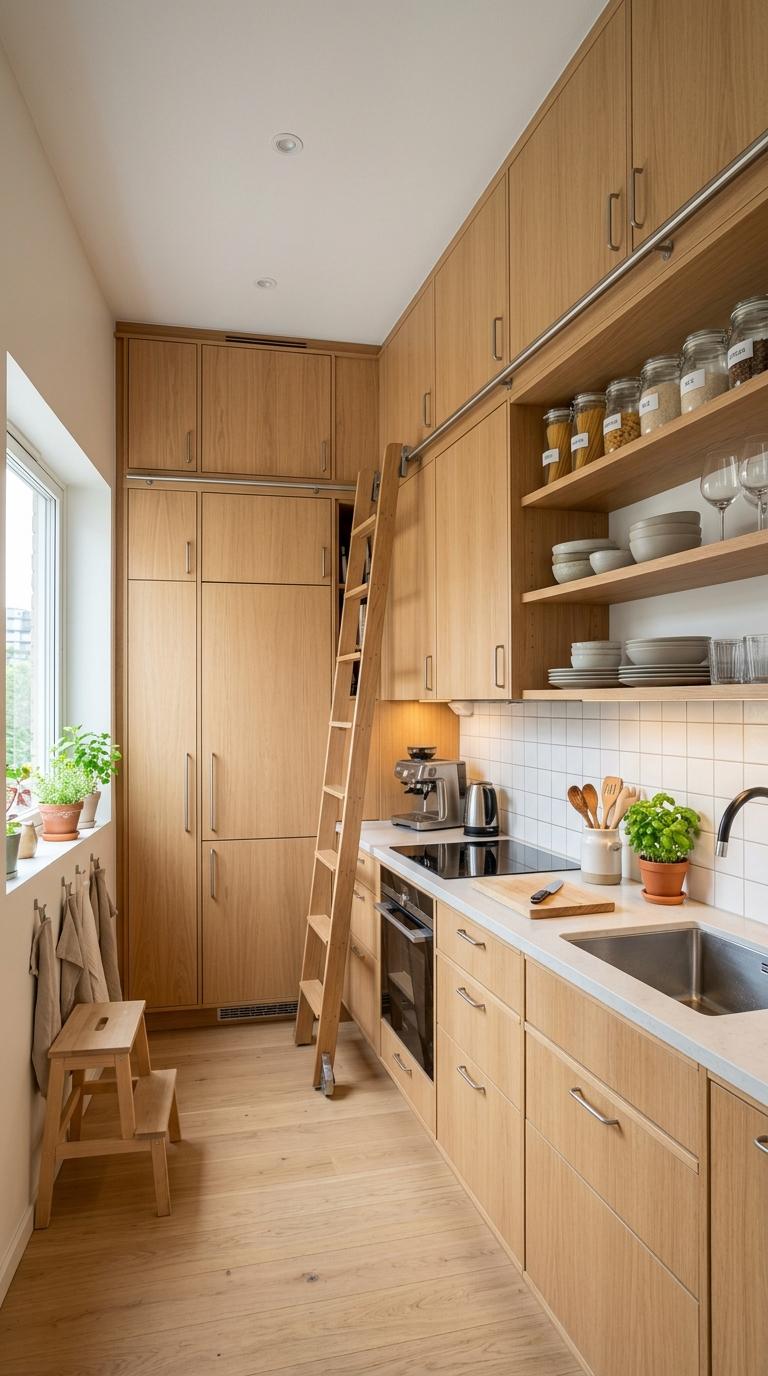
Japanese compact kitchen design treats the vertical dimension of the kitchen with the same seriousness and the same design intelligence that it applies to the floor plan, and the result is a kitchen where the storage capacity is dramatically greater than the floor area would suggest because every available height from the floor to the ceiling is used with precision and purpose.
The standard Indian modular kitchen stops its upper cabinetry at a height of approximately two meters, leaving the space between the cabinet tops and the ceiling, which in a standard Indian apartment is typically between forty and sixty centimeters, completely unused. Japanese kitchen design fills this space with an additional row of closed cabinetry that stores items used seasonally or infrequently, festival equipment, spare vessels, bulk pantry items, and appliances that come out only occasionally. The addition of this ceiling-height cabinet row to a standard Indian modular kitchen adds storage capacity equivalent to an entire additional cabinet run without consuming a single square centimeter of floor space.
Below the counter, Japanese kitchen design uses full-height base cabinet drawers rather than the standard combination of one or two drawers above a large cabinet with shelves. Full-height drawers with full-extension slides provide access to the entire depth and height of the base cabinet storage in a way that shelf-based cabinets never achieve, because every item in a full-height drawer is visible and reachable when the drawer is pulled open rather than requiring the removal of front items to access back items as shelf storage always does. In an Indian compact kitchen where the volume and variety of storage requirements is substantial, this conversion from shelf to drawer storage in the base cabinets is one of the most impactful functional improvements available.
4. The Japanese Work Triangle Compressed for Compact Efficiency
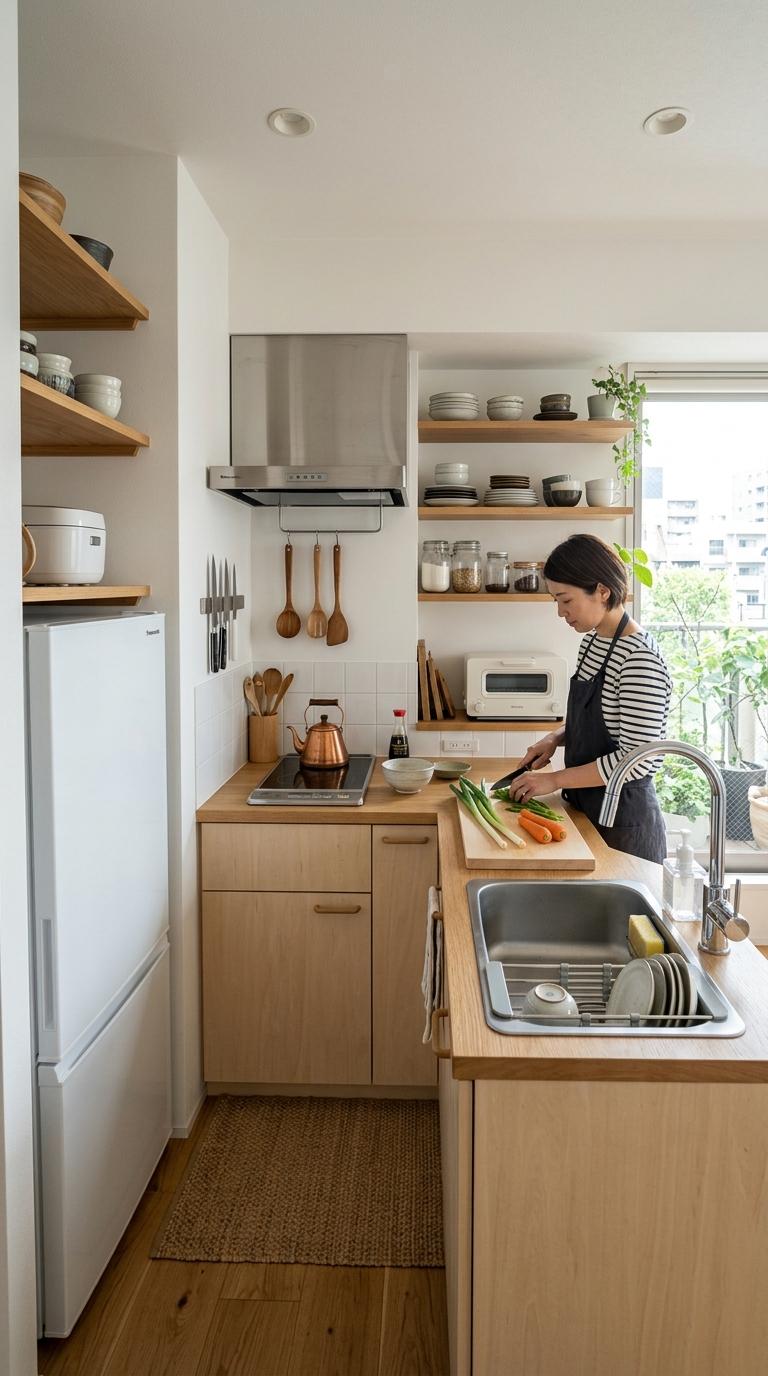
The kitchen work triangle, the relationship between the three primary activity zones of refrigerator, sink, and cooking surface, is the fundamental planning principle of kitchen layout design, and Japanese compact kitchen design has developed a more compressed and more precisely calibrated version of this principle that suits the spatial constraints of urban apartment kitchens more accurately than the generous work triangle dimensions recommended for large Western kitchens.
In a Japanese compact kitchen, the total perimeter of the work triangle is typically between three and four meters rather than the four to seven meters recommended for standard Western kitchens. This compression is achieved by positioning the three primary zones in close proximity to each other along a single counter run or at the junction of two counter runs, minimizing the distance the cook must travel between them. The efficiency gains from this compression are significant, a Japanese kitchen study found that the average cook makes between two hundred and four hundred movements per meal preparation session, and reducing the average distance of each movement by even twenty centimeters creates a cumulative reduction in effort and time that makes the cooking experience noticeably less tiring.
The positioning of the sink relative to the cooking surface is the most critical work triangle decision in a Japanese compact kitchen because the transition between these two zones is the most frequent movement in Japanese cooking, where ingredients are washed immediately before use rather than pre-washed and staged. A maximum distance of sixty to ninety centimeters between the sink and the primary cooking surface is the Japanese kitchen standard, and maintaining this proximity in an Indian compact kitchen layout is the single layout decision that most directly improves the cooking workflow regardless of the cuisine being prepared.
5. The Single-Wall Kitchen with Maximum Storage Intelligence
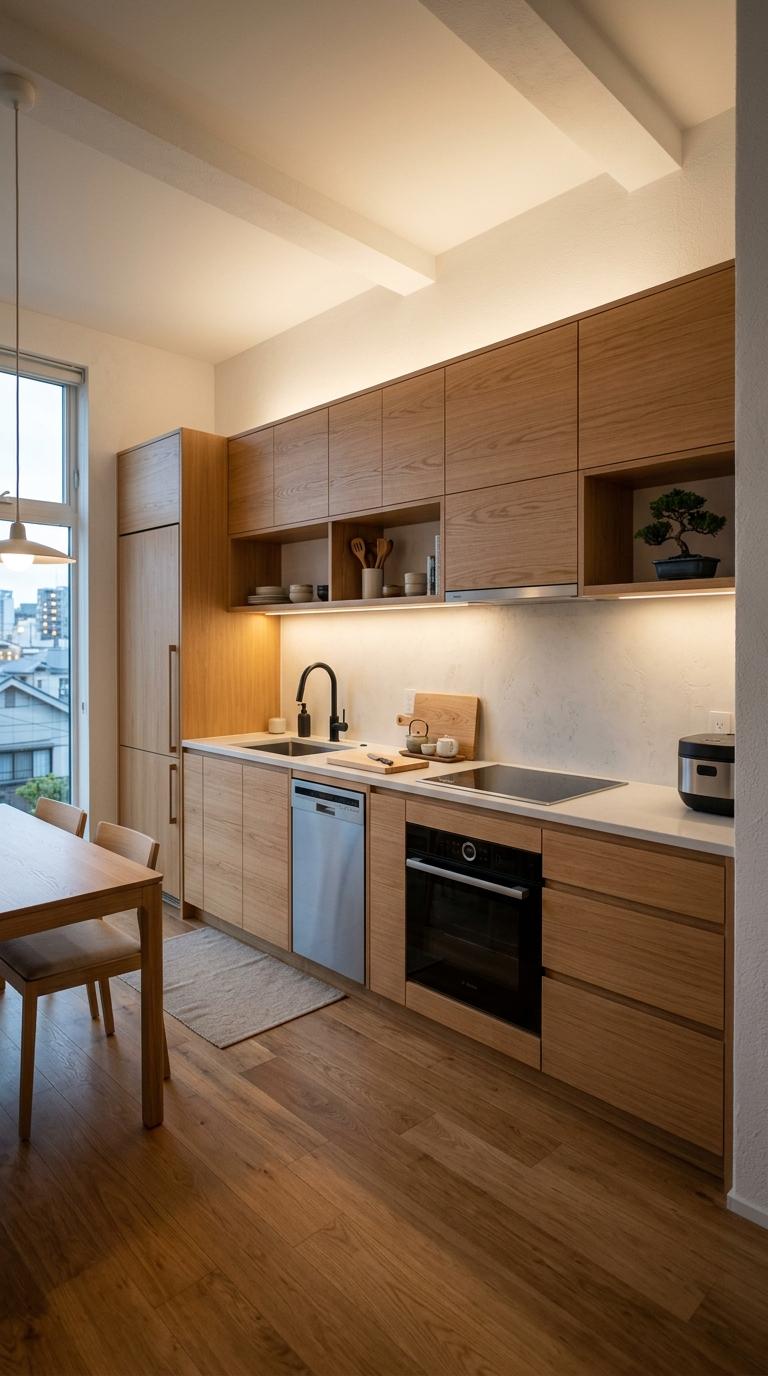
The single-wall kitchen, where all of the kitchen’s functions are arranged along a single wall, is the most compact kitchen layout available and the one that makes the most extreme demands on the storage and design intelligence of the kitchen system. It is also, when properly designed, the layout that most effectively integrates the kitchen into an open-plan living space because its single-wall configuration leaves the maximum floor area available for living and dining functions.
In a Japanese design interpretation, the single-wall kitchen is organized as a precisely composed wall installation where every element is positioned with the accuracy of a piece of furniture rather than the utility of a service installation. The refrigerator at one end, the sink in the center, the cooking surface at the other end, and the storage distributed across the full width and height of the wall in a composition of closed cabinetry, open shelving, and integrated appliances that creates a kitchen wall of genuine visual quality as well as extraordinary functional density.
The visual treatment of the single-wall kitchen as a designed wall element rather than a utilitarian service installation is particularly important in an open-plan Indian apartment where the kitchen wall is visible from the living and dining areas at all times. A single-wall kitchen with light wood cabinet fronts, a consistent stone counter running its full length, and integrated lighting that washes warmly down the cabinet faces creates a kitchen wall that looks like a beautiful piece of interior architecture rather than a functional installation grafted onto the wall as an afterthought.
6. Dedicated Zones for Every Kitchen Function
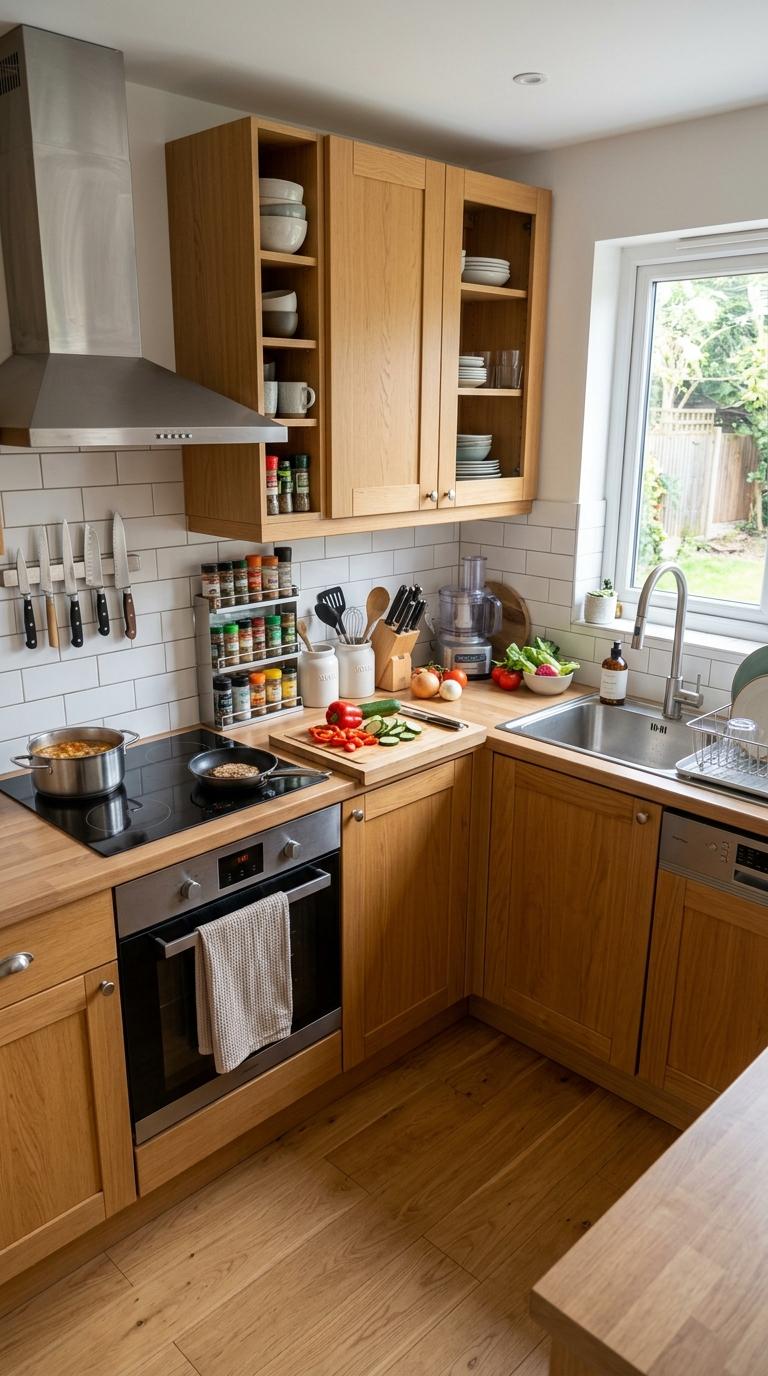
Japanese kitchen design philosophy treats the organization of the kitchen into distinct, dedicated zones for each function with the same seriousness that Japanese architecture treats the organization of larger spaces, and the result in a compact kitchen is a spatial clarity that makes the kitchen feel significantly more generous and more organized than its dimensions alone would suggest.
The zone concept in a Japanese compact kitchen means that every activity has a designated area of the kitchen, and that area is equipped, organized, and scaled specifically for that activity rather than serving as a generic multi-purpose counter surface that accommodates everything with equal indifference. The preparation zone has its dedicated cutting board surface, its nearby knife storage, its immediate access to the most frequently used preparation tools, and its proximity to the sink for rinsing during preparation. The cooking zone has its hob, its adjacent counter for staging prepared ingredients and plating cooked dishes, its immediate access to the most frequently used cooking vessels, and its ventilation system scaled to the actual cooking load. The washing zone has its sink, its drying rack positioned to allow natural drainage back into the sink, its access to cleaning materials, and its proximity to the storage locations for washed vessels.
In an Indian compact kitchen where the complexity of the cuisine creates a broader range of zone requirements than most other domestic cooking traditions, the Japanese zone concept needs to be adapted to include an Indian-specific preparation zone for the grinding, mixing, and spice preparation that characterizes Indian cooking. A dedicated section of counter with immediate below-counter storage for the mixer-grinder and the masala dabba, proximity to the spice storage system, and sufficient surface area for the cutting boards and vessels of a complex Indian meal preparation session creates a zone of Indian cooking-specific functionality within a Japanese spatial framework.
7. The Japanese Approach to Kitchen Appliance Storage
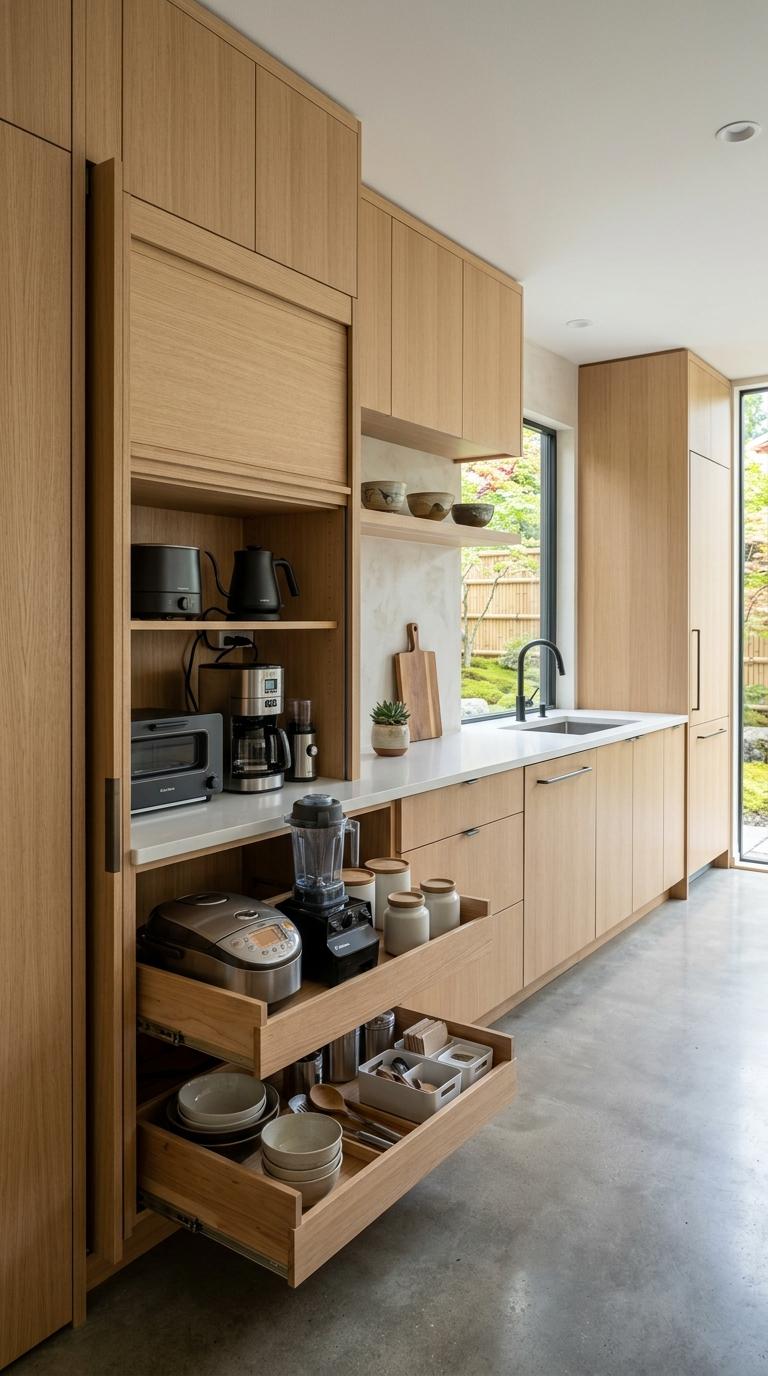
Japanese kitchen design treats the storage of small appliances with a precision and intentionality that most other kitchen design traditions do not, because in a compact Japanese kitchen the management of appliance clutter is one of the most critical factors determining whether the kitchen functions smoothly or chaotically. Every small appliance in a Japanese kitchen has a dedicated storage position that is sized exactly to the appliance, positioned logically relative to where the appliance is used, and accessible without the removal of other items.
The rice cooker, which is as fundamental to a Japanese kitchen as the pressure cooker is to an Indian one, typically has a dedicated pull-out shelf in a lower cabinet positioned immediately adjacent to the counter where rice is served and plated, with a power socket inside the cabinet that allows the cooker to operate in its stored position. The same principle applied to an Indian compact kitchen would place the pressure cooker in a dedicated lower cabinet with an internal power connection, the mixer-grinder in a dedicated appliance garage with its own power supply, and the induction cooktop in a designated storage position on the counter or in a dedicated drawer that brings it to counter height when needed.
The result of this appliance-specific storage philosophy is a compact Indian kitchen where no appliance lives permanently on the counter unless it is used daily. The counter surface is kept clear for the preparation work that requires it, and the appliances appear on the counter when they are being used and return to their dedicated storage positions when they are not. This discipline of appliance storage creates a kitchen that functions better, feels larger, and looks more organized than one where appliances accumulate permanently on every available horizontal surface.
8. Sliding and Pocket Doors for Kitchen Space Efficiency
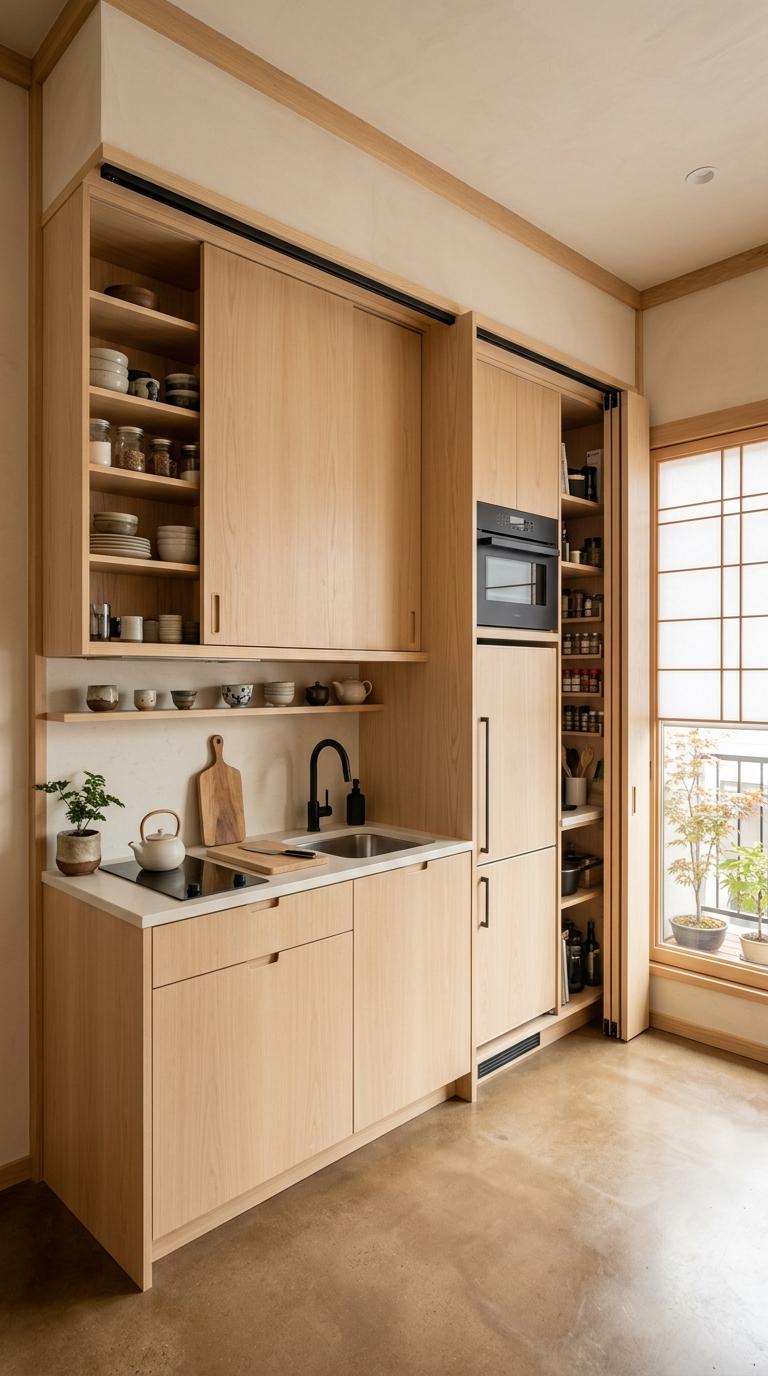
The Japanese use of sliding doors rather than swing doors throughout the domestic interior is one of the most directly applicable space-saving architectural principles available to compact kitchen design in India, and its application to kitchen cabinet doors, pantry doors, and kitchen entry doors creates meaningful gains in usable floor area and movement clearance that the conventional swing door approach consistently wastes.
A swing door requires a clearance arc equal to its own width in order to open fully, and in a compact kitchen where aisle width is at or near the minimum comfortable dimension, this clearance arc consumes precisely the space that the kitchen can least afford to sacrifice. A sliding door requires no clearance arc at all and opens completely within the plane of the wall or cabinet it serves, leaving the kitchen’s aisle space unencumbered regardless of the door’s open or closed position.
Sliding cabinet doors in a compact Japanese kitchen are typically full-height panels that slide along a slim track system, covering two adjacent cabinet sections and sliding to reveal one while covering the other. This configuration uses less hardware, creates a cleaner visual surface than hinged doors with their multiple visible hinge points, and requires no aisle clearance to operate. The visual simplicity of sliding cabinet panels is also more aligned with Japanese aesthetic values than the visual complexity of hinged door systems with their projecting hardware and shadow lines.
9. The Japanese Kitchen’s Relationship to Water
Water management in the Japanese compact kitchen is given a level of design consideration that Indian kitchen design rarely matches, and the practical benefits of this water-conscious approach are significant in the daily experience of using the kitchen. The sink zone in a Japanese kitchen is designed not just as a washing area but as a comprehensive water management station where the flow of water from use through drainage is managed efficiently and hygienically at every stage.
The deep, single-compartment sink that characterizes Japanese kitchen design provides a basin of sufficient volume for the washing of large items, including the large vessels of Indian cooking, without the division of the basin by a central divide that reduces the effective usable depth of each compartment. A sink depth of twenty to twenty-five centimeters, deeper than the standard Indian kitchen sink, accommodates large kadais and pressure cooker inserts that standard sinks struggle to accommodate comfortably.
The drying rack positioned immediately adjacent to the sink, over the counter to the right or left of the sink or directly above it on a wall-mounted rack system, allows washed vessels to drain naturally back into the sink basin without consuming independent counter area. This integrated sink and drying station concept, which treats the washing and drying of vessels as a single spatial function rather than two separate ones, creates a water management zone of exceptional efficiency and cleanliness that is directly and immediately applicable to an Indian compact kitchen.
10. Natural Light and Ventilation as Layout Determinants
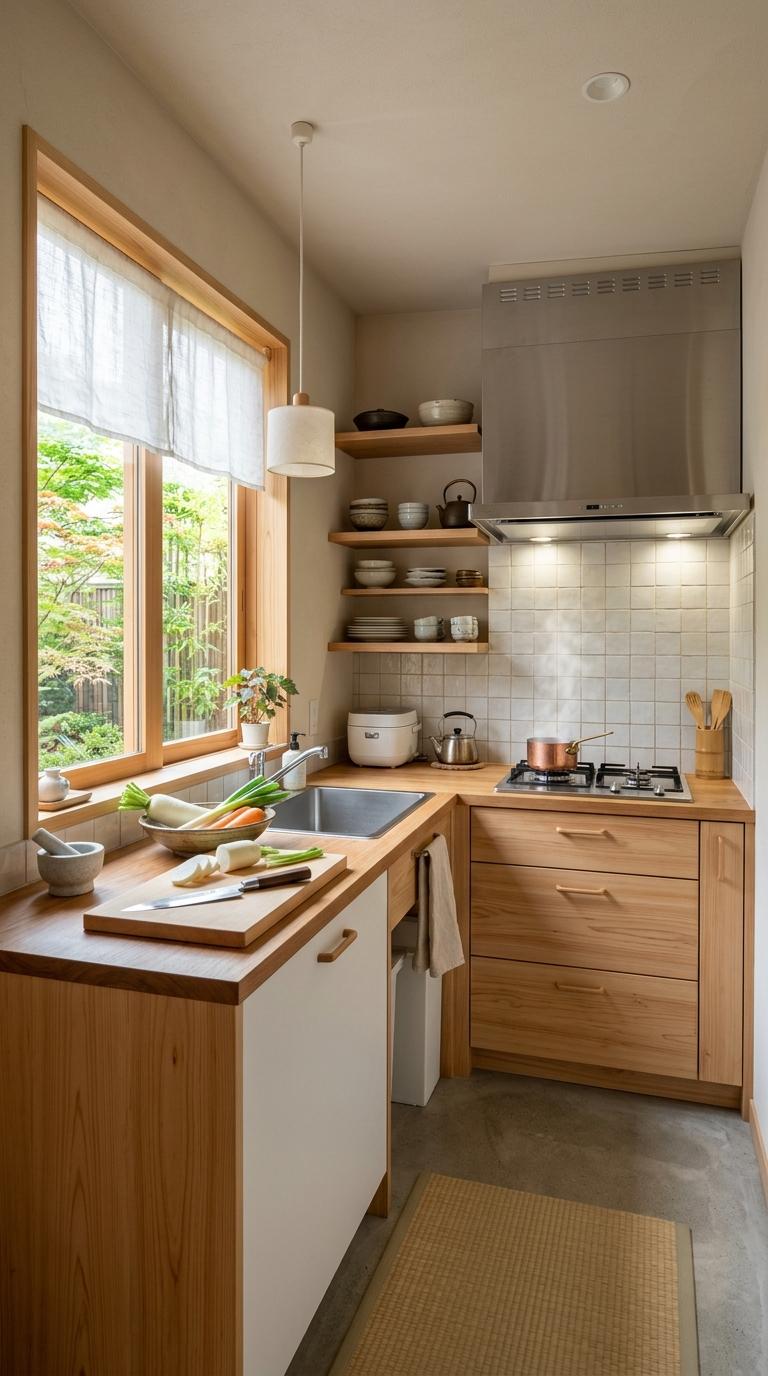
Japanese kitchen design treats natural light and natural ventilation as layout determinants of equal importance to workflow and storage, because a compact kitchen that is well lit by natural light and well ventilated feels significantly more spacious and more pleasant to work in than one of the same dimensions with poor natural light and inadequate ventilation.
The positioning of the primary preparation and cooking zones relative to the kitchen’s window, if a window is present, is the most important natural light decision in the kitchen layout. Placing the sink and primary preparation counter immediately below or adjacent to the window creates the most naturally lit work surface in the kitchen and positions the cook facing the window during the majority of their kitchen time, which creates a psychological quality of openness and connection to the outside world that significantly improves the experience of spending time in a compact kitchen.
Natural ventilation in an Indian compact kitchen requires a range hood system of sufficient extraction capacity for the volume and intensity of Indian cooking, positioned directly above the primary cooking surface and vented either externally through the kitchen wall or ceiling or recirculated through activated carbon filters where external venting is not possible. The Japanese principle of integrating the range hood into the cabinet design rather than treating it as a separate appliance mounted above the hob creates a kitchen composition of greater visual coherence and makes the ventilation system feel like an architectural element of the kitchen rather than a piece of equipment retrofitted to it.
Applying Japanese Layout Principles to Indian Compact Kitchens
The application of Japanese compact kitchen layout principles to Indian urban kitchens requires a translation process that respects both the spatial intelligence of the Japanese approach and the specific functional requirements of Indian domestic cooking. The workflow logic, the zone organization, the height utilization, the drawer-based storage philosophy, and the water management thinking of Japanese kitchen design are all directly transferable and immediately beneficial in the Indian context. The specific dimensions of the zones, the appliances they accommodate, and the spice and ingredient storage systems they incorporate need to be calibrated to the actual cooking patterns of the Indian household rather than adopted wholesale from a Japanese kitchen design template.
The result of this thoughtful translation is a compact kitchen that combines the spatial intelligence and organizational clarity of Japanese design with the functional completeness required for the complexity and richness of Indian cooking. It is a kitchen that works harder than its size suggests, that feels larger and more pleasant than its dimensions allow, and that makes the daily act of cooking in a compact urban apartment a genuinely good experience rather than a logistical compromise. That combination of spatial intelligence and cooking-specific functionality is what the best compact kitchen design makes available, and the Japanese tradition offers the most refined and most directly applicable framework for achieving it.

Aarav Sharma is a passionate home and lifestyle writer. He loves exploring kitchen design, home decoration, and interior styling. With a keen eye for beautiful details and practical design ideas. Aarav Sharma shares inspiration to help readers create comfortable and functional living spaces.