
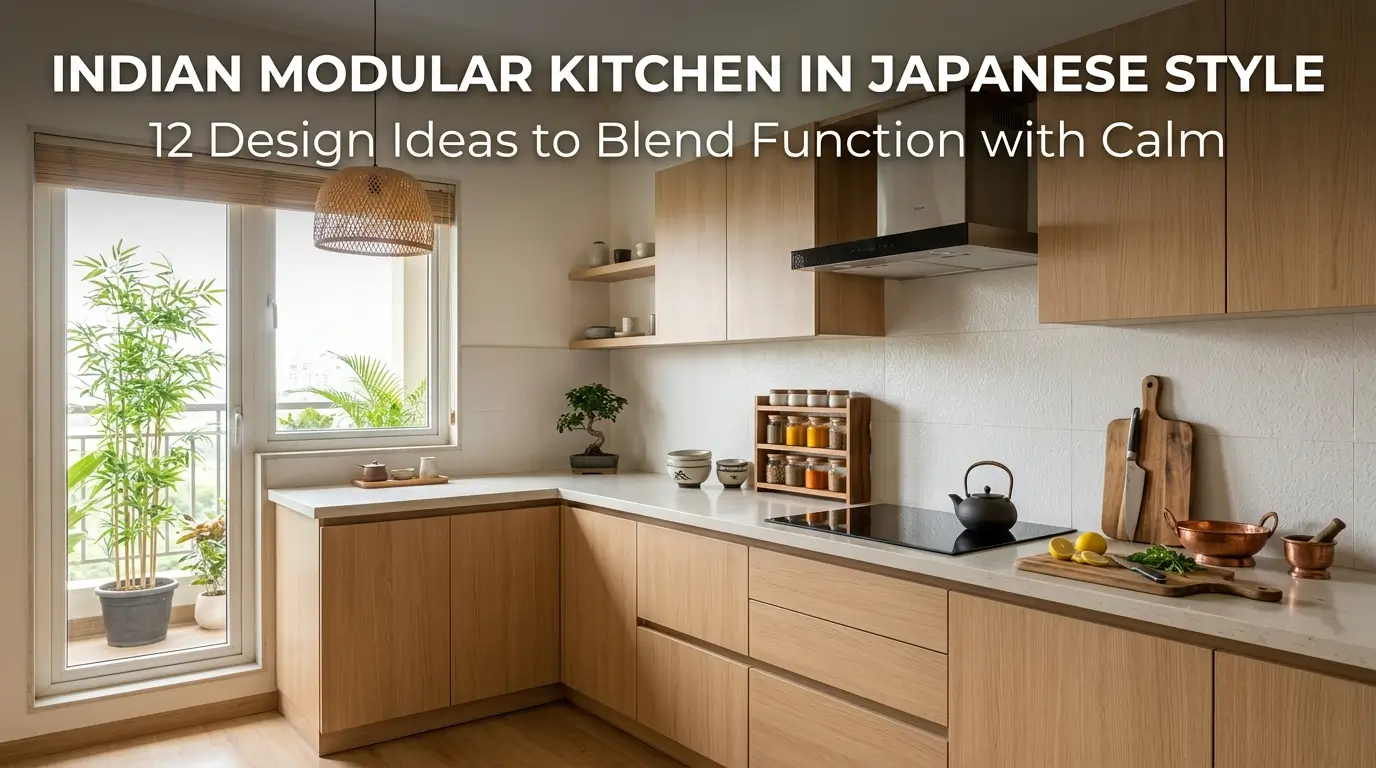
The Indian modular kitchen has come a long way. What started as a practical solution to the chaos of small urban kitchens — standardised cabinets, clean lines, coordinated finishes — has become the default choice for most new flats and home renovations across Indian cities. It is efficient, it is relatively affordable, and it works.
But most Indian modular kitchens end up looking the same. Two-tone cabinets in white and grey, a dark granite countertop, a steel sink, and a chimney that dominates the wall above the cooktop. The layout is sensible but the result rarely feels like a space anyone has thought about beyond the functional.
Japanese kitchen design offers something different. It starts from the same place — a small space that needs to work hard — but the outcome is quieter, more considered, and significantly more beautiful. The principles of wabi-sabi, ma, and omotenashi — imperfect beauty, purposeful emptiness, and thoughtful hospitality — translate directly into kitchen design decisions that are entirely compatible with the Indian modular kitchen format.
Here are 12 ideas to bring Japanese design sensibility into an Indian modular kitchen without compromising on the function that Indian cooking demands.
Indian Modular Kitchen in Japanese Style Design Ideas
1. Single-Tone Cabinet Palette Over Two-Tone
The two-tone modular kitchen — typically white upper cabinets and a darker lower cabinet — is the standard in India. It is safe, broadly appealing, and immediately identifiable as a modular kitchen. Which is precisely the problem.
Japanese kitchen design uses a single, muted tone throughout. Warm white, soft linen, pale ash, or a quiet sage green running consistently across both upper and lower cabinets creates visual continuity that makes the kitchen feel larger and significantly more calm. The absence of contrast is not boring — it is deliberate. It shifts attention from the cabinets themselves to the space as a whole.
2. Flat-Front Handleless Cabinets with J-Pulls
Ornate cabinet fronts with raised panels, curved edges, and decorative hardware are a common choice in Indian modular kitchens. They signal investment and craftsmanship. Japanese kitchens signal the same things differently — through restraint, precision, and the quality of the materials themselves.
Flat-front cabinets with recessed J-pull handles — a slim horizontal groove routed into the top or bottom edge of each door — eliminate visible hardware entirely. The result is a cabinet face that is completely uninterrupted. It is cleaner, easier to wipe down after cooking, and far more in keeping with the Japanese aesthetic that treats simplicity as a form of sophistication.
3. Light Wood Grain Finish on Lower Cabinets
Where Indian modular kitchens often use high-gloss laminates in bold colours on lower cabinets, Japanese kitchens bring in natural wood grain. A light oak, maple, or ash veneer — or a high-quality laminate that accurately mimics natural wood grain — on the lower cabinet run introduces warmth and organic texture that contrasts beautifully with a matte white upper section.
This is one of the most effective ways to Japanify an Indian modular kitchen without changing the structure at all. The wood grain grounds the space, softens the overall look, and references the Japanese deep respect for natural materials in domestic interiors.
4. Matte Stone or Ceramic Countertop
Indian modular kitchens almost universally use polished granite countertops — black galaxy, tan brown, or white fantasy are perennial favourites. Polished granite is durable and practical, but its high sheen and bold patterning work against the quiet, matte aesthetic that Japanese kitchen design aims for.
Switching to a matte-finish quartz, honed stone, or large-format ceramic countertop in a neutral tone — light grey, warm white, or soft concrete — changes the entire register of the kitchen. Matte surfaces absorb light rather than reflecting it, creating a surface that feels calm and grounded. For Indian cooking conditions, matte quartz offers the same heat and scratch resistance as granite with a finish that sits far more naturally within a Japanese aesthetic.
5. Integrated Appliances Behind Cabinet Fronts
One of the hallmarks of a Japanese-influenced kitchen is that appliances disappear. The refrigerator sits behind a panel that matches the cabinetry. The microwave is housed inside a dedicated cabinet with a door that closes over it. The dishwasher — if present — is fronted with the same finish as the cabinets around it.
Indian modular kitchen manufacturers increasingly offer integrated appliance solutions. Specifying these at the design stage — rather than adding appliances independently after the kitchen is installed — creates a seamless cabinet run where the eye travels without interruption. The kitchen reads as a single, unified composition rather than a collection of separate objects.
6. A Dedicated Masala Drawer System
Indian cooking requires spice storage that Japanese kitchen design does not naturally account for. The standard Japanese kitchen organises dry goods in matching containers inside a pantry. The Indian kitchen needs immediate, cooktop-adjacent access to ten or fifteen different spices during active cooking.
The solution within a Japanese-style modular kitchen is a dedicated masala drawer — a deep, pull-out drawer positioned immediately beside the cooktop, fitted with a custom insert that holds matching spice jars in a single layer. Each jar is labelled clearly and sits at the same height. The drawer closes and the counter remains completely clear. It honours the Indian cooking workflow while keeping the Japanese principle of concealed, organised storage fully intact.
7. Open Shelf Section in Place of One Wall Unit
Japanese kitchens rarely rely entirely on closed upper cabinets. A section of open shelving — one unit in the run replaced with open shelves — breaks the visual monotony of a full wall of cabinet doors and creates a space for deliberate display.
In an Indian modular kitchen, this open section can hold a small collection of matching ceramic bowls, a single potted plant, a brass or ceramic oil dispenser, and perhaps two or three cookbooks. The key is strict curation — what sits on the open shelf must be chosen with intention. Random objects placed on open shelving look worse than no shelving at all.
8. Slim Integrated Chimney Flush with Cabinets
The chimney is a non-negotiable in Indian kitchens. The volume of smoke, steam, and oil that Indian cooking produces makes adequate extraction essential. But the standard chimney — a large, angular hood mounted prominently above the cooktop — is one of the most visually disruptive elements in a kitchen.
A slim, built-in chimney that sits flush with the overhead cabinet run — concealed behind a matching panel or integrated into a ceiling cassette — handles the extraction requirement without dominating the space. Several Indian chimney manufacturers now offer flush-fit and ceiling-cassette options designed specifically for modular kitchen integration. The cooktop wall reads as a clean, uninterrupted surface with this approach.
9. Washi-Inspired Glass Inserts on Select Cabinet Doors
Washi — Japanese handmade paper — has a translucent, textured quality that lets light through while obscuring what is behind it. This aesthetic can be referenced in a modular kitchen through frosted or reeded glass inserts on one or two select cabinet doors.
Rather than applying glass across all upper cabinets — which creates visual noise and requires the contents to always be perfectly organised — limiting it to one or two doors introduces a quiet decorative element that references Japanese material culture without being literal or heavy-handed. Behind these doors, keep items that look good through frosted glass — matching white plates, ceramic mugs, simple glassware.
10. Negative Space as a Design Element
Indian modular kitchens tend to maximise every available surface — cabinets run wall to wall, shelves are filled completely, and the counter is used right to the edges. Japanese design treats empty space as a design element in its own right. The gap between two objects is as deliberate as the objects themselves.
In practical terms, this means leaving a section of counter permanently clear, avoiding the temptation to fill every cabinet to capacity, and resisting the addition of accessories that do not serve a clear function. A modular kitchen that is 70 percent full looks more considered and more expensive than one that is packed to the edges. Restraint, in Japanese design, is not a limitation — it is the point.
11. Warm Under-Cabinet and Toe-Kick Lighting
Lighting in Indian modular kitchens is typically limited to a single overhead fitting and possibly a strip light inside the chimney. Japanese interior design uses layered lighting — ambient, task, and accent — to create depth and warmth in a space.
Under-cabinet LED strips in warm white illuminate the countertop for practical task work. Toe-kick lighting — a thin LED strip running along the base of the lower cabinets at floor level — creates a floating effect that makes the cabinets appear lighter and the floor feel larger. Both additions are low-cost at the installation stage and have a significant effect on how the kitchen feels after dark, which is when most Indian working professionals are actually cooking.
12. A Single Natural Element as an Anchor
Every Japanese interior has at least one element drawn directly from nature — a piece of wood in its natural form, a stone surface, a ceramic piece made with visible human hands, a plant that is clearly alive and growing. This natural anchor prevents the minimal aesthetic from feeling cold or corporate.
In an Indian modular kitchen, this anchor might be a solid wood chopping block kept on the counter, a handmade ceramic pot holding cooking utensils, a small bonsai or pothos on the windowsill, or a single slab of natural stone used as a backsplash behind the cooktop. It does not need to be large or expensive. It needs to be genuine — a real material, in its natural state, reminding the kitchen that it belongs to a home and not a showroom.
Build a Kitchen That Feels as Good as It Functions
The Indian modular kitchen and Japanese design philosophy are not opposites. They share the same starting point — a small space that needs to work hard for the people using it. Where they differ is in what they value beyond function.
Japanese design values quiet, calm, and the considered placement of every element. Bringing these values into an Indian modular kitchen does not require a complete redesign. It requires a series of deliberate decisions — about colour, material, hardware, lighting, and what to leave out — that accumulate into a kitchen that feels genuinely different from the standard modular template.
Start with the decisions that cost nothing. Edit the counter. Coordinate the accessories. Then work through the bigger choices as the budget allows. The result will be a kitchen that functions exactly as an Indian kitchen needs to, and feels exactly as a Japanese kitchen should.

Aarav Sharma is a passionate home and lifestyle writer. He loves exploring kitchen design, home decoration, and interior styling. With a keen eye for beautiful details and practical design ideas. Aarav Sharma shares inspiration to help readers create comfortable and functional living spaces.