
Kitchen design has a reputation for being complicated. Showrooms full of samples, catalogues with hundreds of options, designers who speak in abbreviations and module numbers, and an overwhelming sense that getting it wrong is expensive and permanent. For someone planning a small kitchen for the first time, this complexity is the first obstacle, and it is often a bigger obstacle than the actual design challenge of the kitchen itself.
The truth is that a small kitchen, planned with clear priorities and a few well-understood principles, is not a complicated design problem. It is a small room that needs to store things, hold a sink, accommodate a cooktop, and give a person enough surface to prepare food. The complexity that surrounds kitchen design in showrooms and magazines is largely the complexity of options, not the complexity of the problem itself.
A beginner planning a small kitchen for the first time does not need to understand every module number in the catalogue or every finish option in the laminate range. They need to understand a small number of principles that apply to every small kitchen regardless of budget, style, or location. Get those principles right, and the kitchen will work. Get them wrong, and no amount of expensive finishing will fix the fundamental problems that result.
Indian cooking places specific demands on any kitchen, small or otherwise. The volume of storage required for dry goods and vessels, the need for adequate ventilation during high-heat cooking, the importance of having spices accessible during active cooking, and the physical demands of a cuisine that uses multiple burners and generates significant steam and smoke. A beginner planning a small Indian kitchen needs to understand these demands and design for them honestly rather than following generic kitchen advice that was not written with Indian cooking in mind.
Here are 12 simple, clear ideas for planning a small kitchen as a beginner, starting from the basics and building toward a kitchen that works for the way Indian cooking actually happens.
Simple Small Kitchen Design Ideas for Beginners
1. Start With How You Actually Cook, Not How the Kitchen Looks
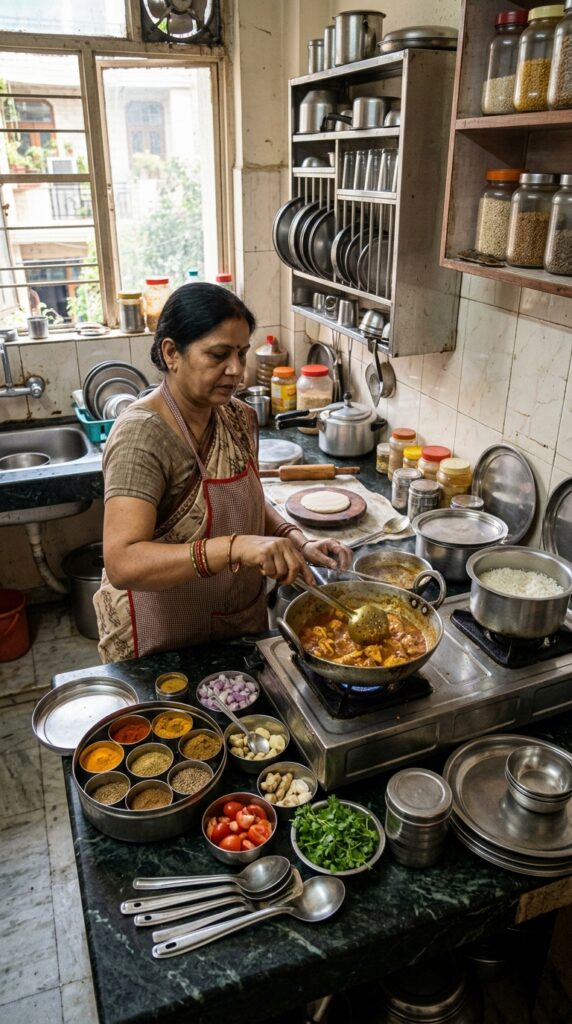
The most common beginner mistake in kitchen design is starting with aesthetics. A colour palette chosen from a magazine, a cabinet style seen in a showroom, a countertop finish that looks attractive in a photograph. The aesthetic decisions come first, and the functional decisions are fitted around them. The result is a kitchen that looks the way it was intended to look and works less well than it should because the functional planning was secondary.
Start instead with a clear, honest account of how the kitchen will actually be used. How many people cook simultaneously. Which meals are prepared most frequently and what equipment those meals require. How much dry goods storage is needed for the household’s shopping and cooking habits. Whether the kitchen needs to accommodate any secondary functions like dining, homework, or laundry. These questions have specific answers that directly determine the layout, the storage configuration, and the appliance specification of the kitchen. The aesthetic decisions that follow should serve those functional answers rather than preceding them.
2. Understand the Three Layout Options and Choose the Right One for the Room
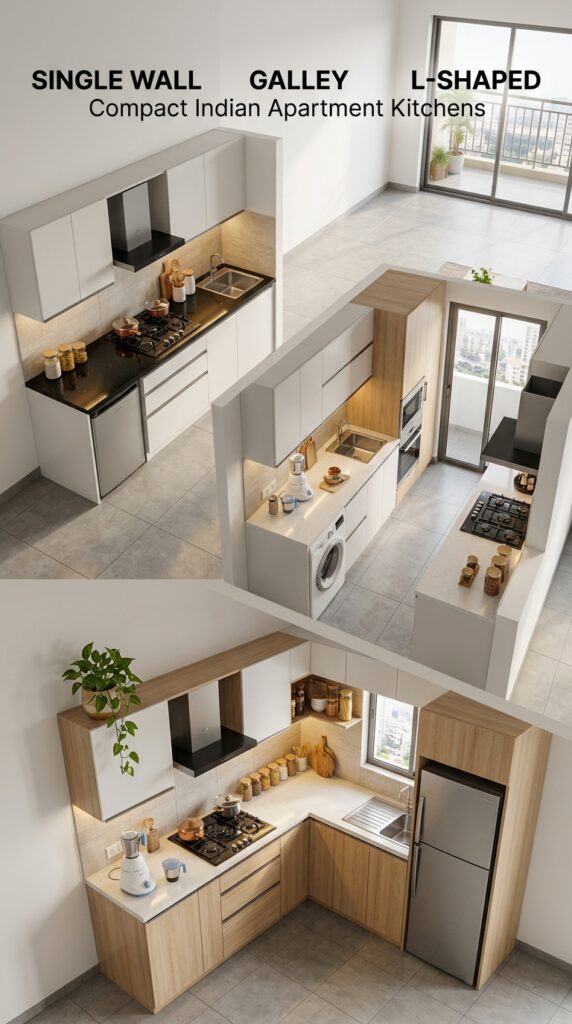
A small kitchen has three realistic layout options. The single wall layout.ut, everything on one wall. The galley or parallel layout, counters on two facing walls. The L-shaped layout, counters on two adjacent walls meeting at a corner. Each layout suits a different room shape and a different set of functional priorities. Choosing the wrong layout for the room shape is the most fundamental planning error available to a beginner and the one that is most difficult to correct after installation.
A room that is long and narrow with counters on both sides suits a galley layout. A room that is squarish with one good wall and a door on an adjacent wall suits a single wall layout. A room with two adjacent walls available and a corner that can be used suits an L-shaped layout. Measure the room, draw it to scale, and match the room shape to the layout that fits it naturally rather than imposing a layout preference onto a room that does not support it. The correct layout for the room shape makes every subsequent design decision easier. The wrong layout creates constraints that no amount of clever detailing can fully resolve.
3. Get the Work Triangle Right From the Start
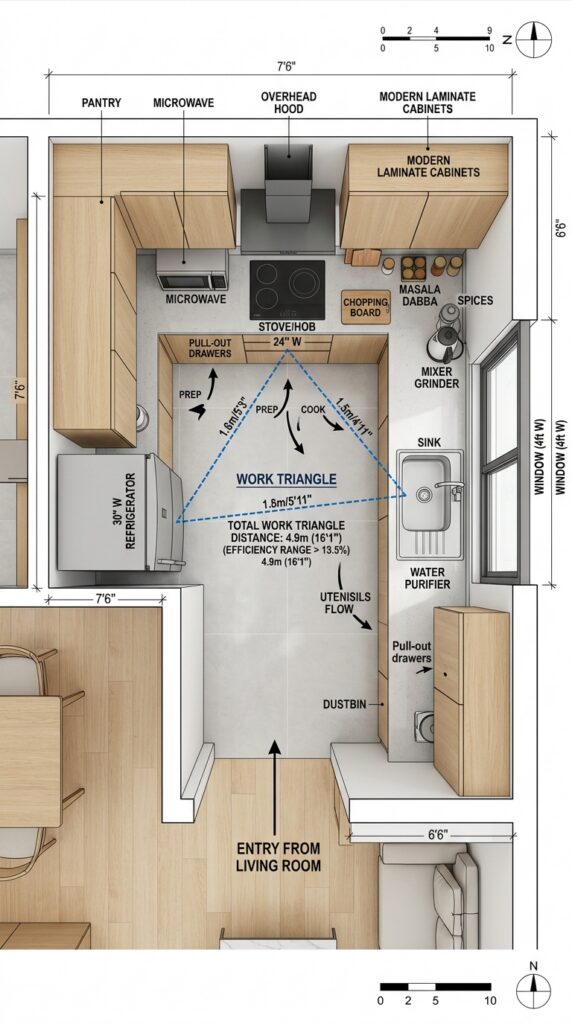
The work triangle is the relationship between the three most used points in any kitchen. The sink. The cooktop. The primary storage, typically the refrigerator or the dry goods cabinet. These three points, and the distances between them, determine how much movement is required during cooking and how efficiently the kitchen functions during active use.
In a small kitchen, the work triangle should be compact. Each leg of the triangle, the distance between any two of the three points, should be between 1 and 2 metres. Shorter than 1 metre and the three points are too close together, creating a crowded working position where the cook cannot move between tasks without the elements of the kitchen interfering with each other. Longer than 2 metres and the distances require full steps between each task, which in a kitchen used for extended cooking sessions creates unnecessary physical effort and slows down the cooking workflow. Draw the three points on a scaled plan, measure the distances between them, and adjust the layout until the triangle is compact without being crowded.
4. Decide on the Cabinet Layout Before Visiting a Showroom

Modular kitchen showrooms are designed to sell options rather than to help a beginner make a clear decision. The range of cabinet sizes, finishes, hardware options, and accessories is extensive, the showroom lighting makes every combination look attractive, and the salesperson’s incentive is to sell more rather than to help select less. A beginner entering a showroom without a clear cabinet layout already decided will leave with more options and more confusion than they arrived with.
Decide the cabinet layout before visiting any showroom. Know how many base cabinets the counter run requires. Know how many wall units the available wall space can accommodate. Know the height of the ceiling and whether full-height wall units are possible. Know the position of the door, the window, and the plumbing stub-out and how each of these constrains the cabinet layout. A beginner who arrives at a showroom with a scaled plan and a clear layout spends the showroom visit selecting finishes and hardware for a decided layout rather than trying to decide the layout in the middle of a showroom full of distractions.
5. Choose One Countertop Material and Understand It Fully
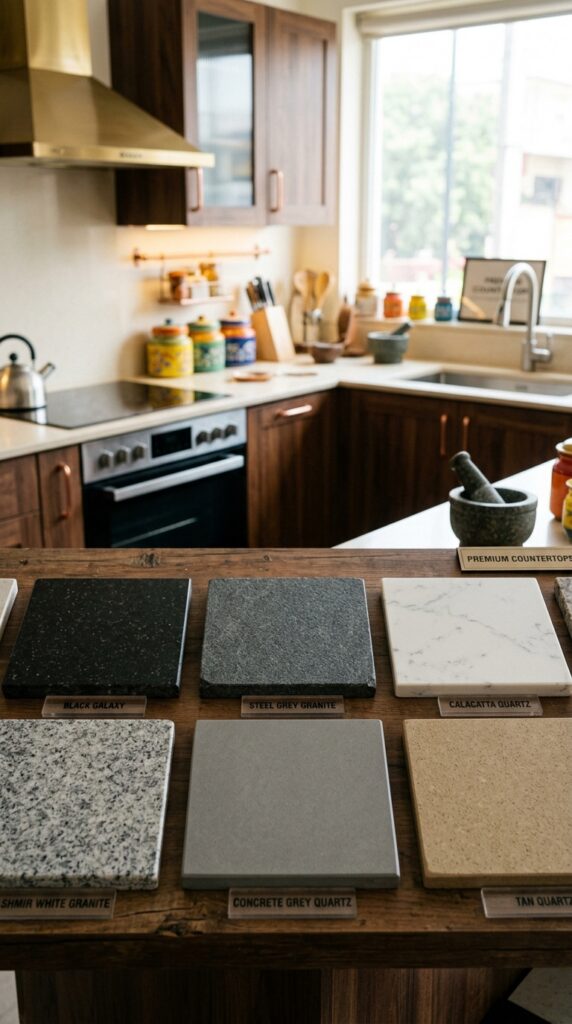
The countertop is the hardest-working surface in the kitchen. It carries . the weight of daily food preparation, the heat of vessels moved from the cooktop, the impact of chopping and rolling, the moisture of wet ingredients and washing, and the chemical exposure of cleaning products used regularly over years. Choosing the countertop material on the basis of how it looks in a showroom sample without understanding how it performs in daily Indian kitchen use is a mistake that becomes apparent very quickly after the kitchen is installed.
For a beginner, the correct approach is to choose one countertop material, understand its performance characteristics fully, and accept its limitations rather than selecting it for appearance alone. Polished granite is durable, heat-resistant, widely available, and affordable in India. Its limitations are that the high polish shows water marks and the strong patterning adds visual noise to a small kitchen. Engineered quartz is more consistent in appearance, available in matte finishes, and performs as well as granite in most respects. Its limitation is cost, which is higher than granite across most of the available range. A honed or matte finish in either material is a better choice for a small Indian kitchen than a high-gloss polished surface. Understand the material before specifying it and choose on the basis of honest performance rather than showroom appearance.
6. Invest in the Chimney Before Any Decorative Element
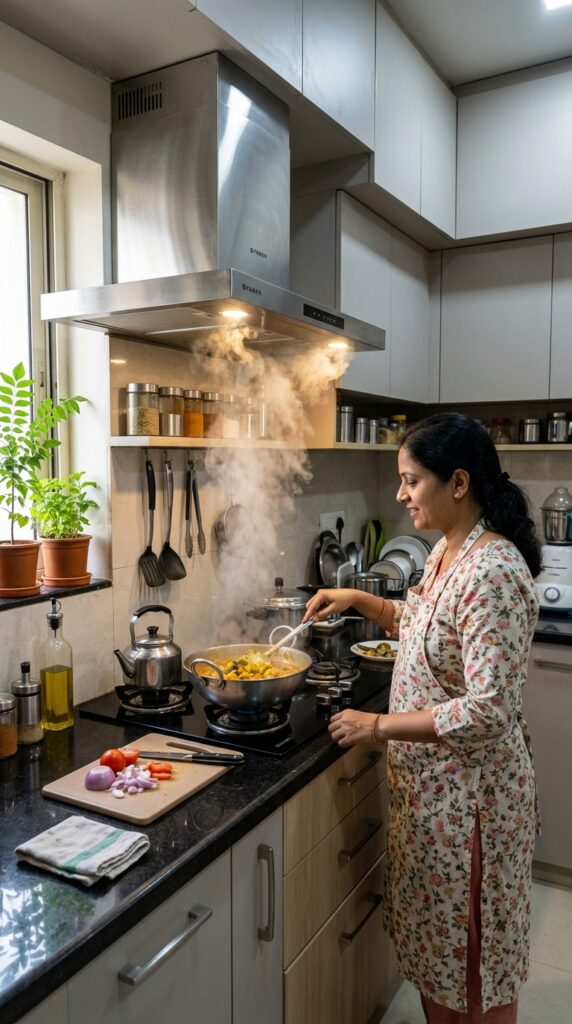
For a beginner planning a small Indian kitchen on a limited budget, every budget allocation is a trade-off between functional and decorative spending. The chimney is the functional element that most directly affects the daily cooking experience and the long-term condition of every surface in the kitchen. It is also the element most frequently under-specified in a budget-constrained beginner kitchen.
An inadequate chimney, one that is too small for the cooking volume it serves or positioned incorrectly relative to the cooktop, fills the kitchen with smoke, coats every surface with a fine layer of grease over time, and makes extended Indian cooking genuinely unpleasant. A correctly specified chimney with adequate extraction capacity for the household’s cooking intensity, positioned at the correct height above the cooktop and ducted to an external exhaust point, transforms the cooking experience in a small Indian kitchen more than any other single appliance investment. Budget for it properly. Do not compromise the chimney to fund a more expensive countertop finish.
7. Standard Cabinet Sizes Are Your Friend, Not Your Limitation
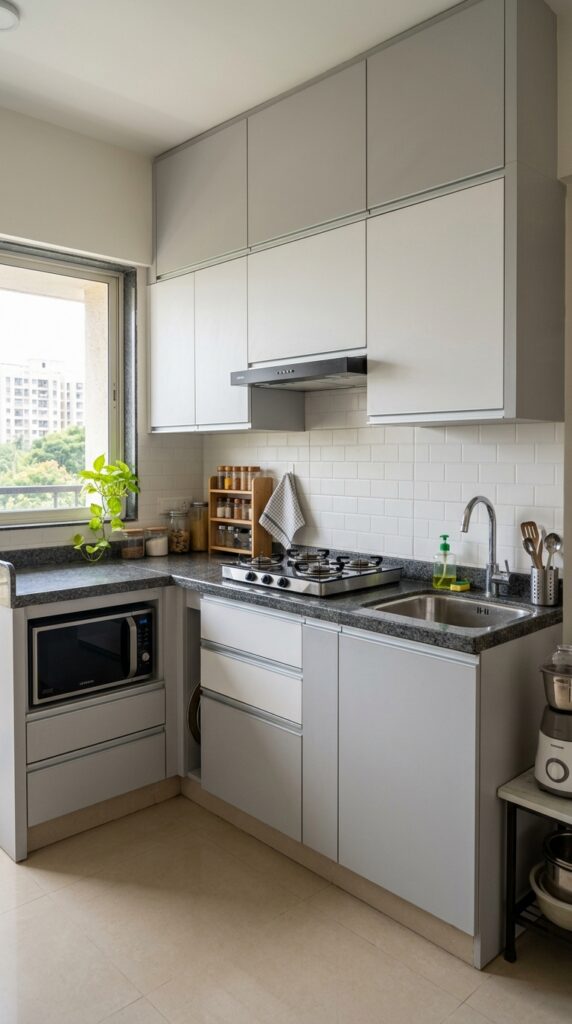
Beginners often approach the modular kitchen catalogue looking for custom dimensions to fit specific spaces or achieve specific proportions. Custom dimensions cost significantly more than standard sizes, take longer to manufacture, and create maintenance problems later because replacement components are harder to source. Standard cabinet sizes, the same dimensions that every modular kitchen manufacturer produces in volume, are priced for accessibility, readily available, and replaceable when individual components need repair or updating.
In most small kitchens, a layout can be designed using entirely standard cabinet sizes with filler panels to accommodate the gaps that arise when standard sizes do not exactly fill the available wall length. A 100 millimetre filler panel between a cabinet and a wall, matching the cabinet finish, is a standard and unobtrusive solution that costs far less than a custom cabinet sized to eliminate the gap. Designing the kitchen layout from standard cabinet sizes outward, rather than from the room dimensions inward, is the approach that produces a kitchen that is faster to install, more affordable to build, and easier to maintain over time.
8. Two Burners Are Enough for Most Indian Households
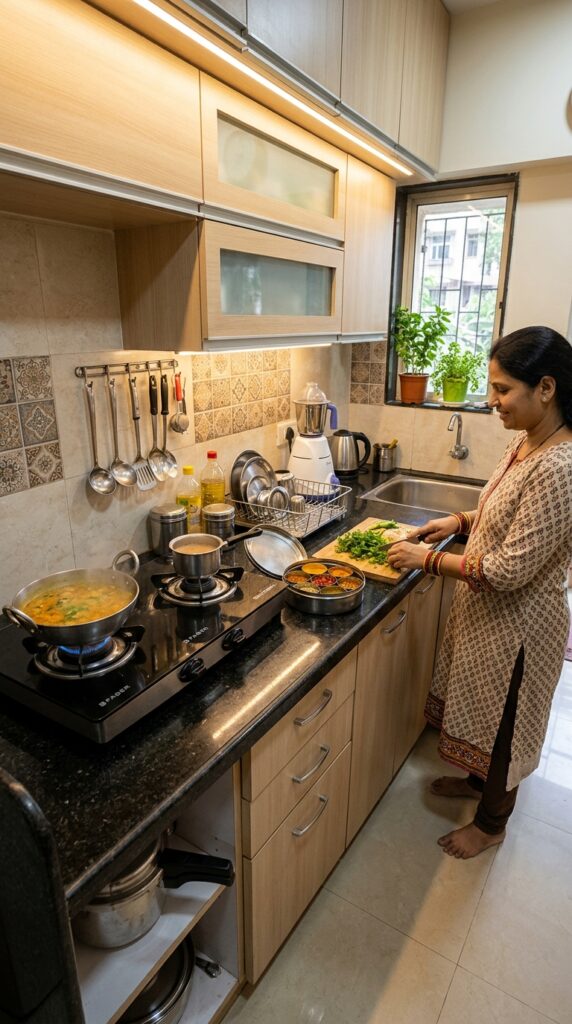
The four-burner cooktop is the default specification for Indian kitchens, and most beginners accept it without considering whether four burners reflect their actual cooking habits. In a small kitchen where the cooktop occupies a fixed section of the counter length, a four-burner cooktop consuming 600 to 750 millimetres of counter is a more significant trade-off than the same cooktop in a larger kitchen where counter length is less constrained.
For a beginner setting up a first kitchen, or for a household of one to three people cooking regular Indian meals, a two-burner cooktop covers the overwhelming majority of daily cooking requirements. Most Indian meals involve a dal or a rice on one burner and a sabzi or a tadka on the other. A third or fourth burner is used occasionally and can be managed with sequencing when it is. A two-burner cooktop in a small kitchen saves 150 to 200 millimetres of counter length compared to a four-burner. In a small kitchen, that length of counter returned to prep surface is a more valuable trade-off than the occasional convenience of two additional burners.
9. Do Not Design the Kitchen Around Appliances You Do Not Yet Own
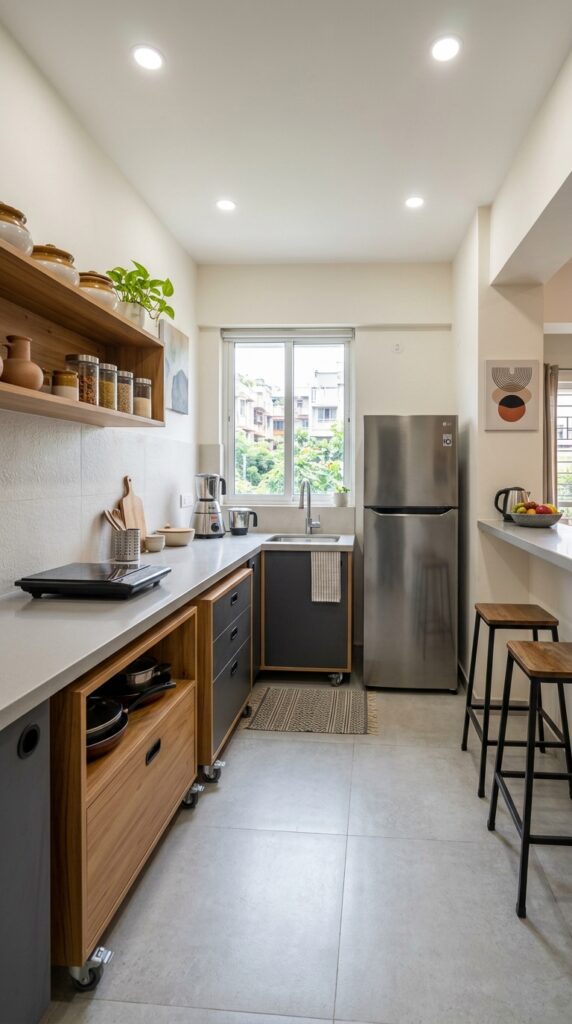
A common beginner mistake is designing dedicated spaces into the kitchen for appliances that have not yet been purchased. A specific cabinet housing sized for a microwave not yet bought. A slot allocated for a dishwasher that may never be installed. A space reserved for an oven that is still aspirational. Each of these allocations consumes cabinet positions, counter length, and electrical infrastructure for appliances that may arrive years after the kitchen is installed, if at all.
Design the kitchen around the appliances that are definitely being installed on day one. A slot for the cooktop. A position for the refrigerator. Housing for the chimney. Space for the mixer-grinder in daily use. Everything else is standard cabinet storage until a specific appliance is purchased and its exact dimensions are known. A cabinet designed for a specific appliance that turns out to be a different size than the housing is a cabinet that never works correctly. A standard cabinet in the same position is a fully functional storage unit that can be adapted to house a specific appliance when the time comes.
10. Leave More Counter Clear Than Feels Necessary
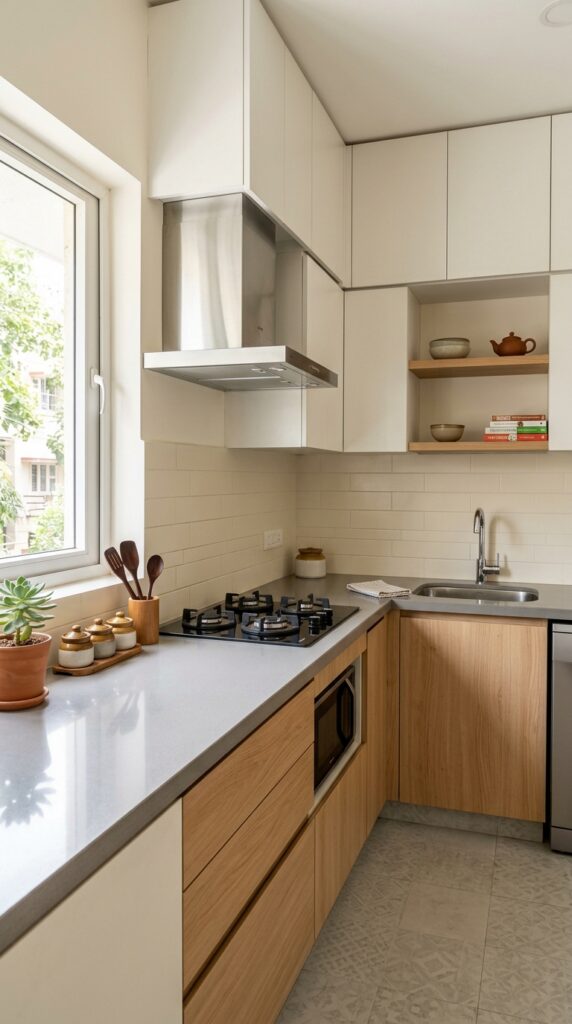
The instinct in a first kitchen is to use every centimetre of counter surface for something. The mixer-grinder earns its counter position because it is used frequently. The kettle stays because it is used every morning. The knife block stays because the knives need to be accessible. The fruit bowl stays because the fruit needs to be somewhere. Each item has a reason to be on the counter, and collectively they reduce the available prep surface to a width that makes cooking genuinely more difficult than it should be.
Leave more counter clear than feels necessary, particularly in the initial weeks of using a new kitchen. The items that genuinely need to be on the counter will make themselves known through daily use. The items that can be stored in a cabinet and retrieved when needed, which is the majority of what most people keep on the counter, will also become apparent. A beginner who resists the urge to populate every counter surface in the first weeks of a new kitchen arrives at a more honest and more functional counter configuration than one who fills every surface immediately and then tries to work around the accumulation.
11. Lighting Is Not a Finishing Detail, It Is a Functional Requirement
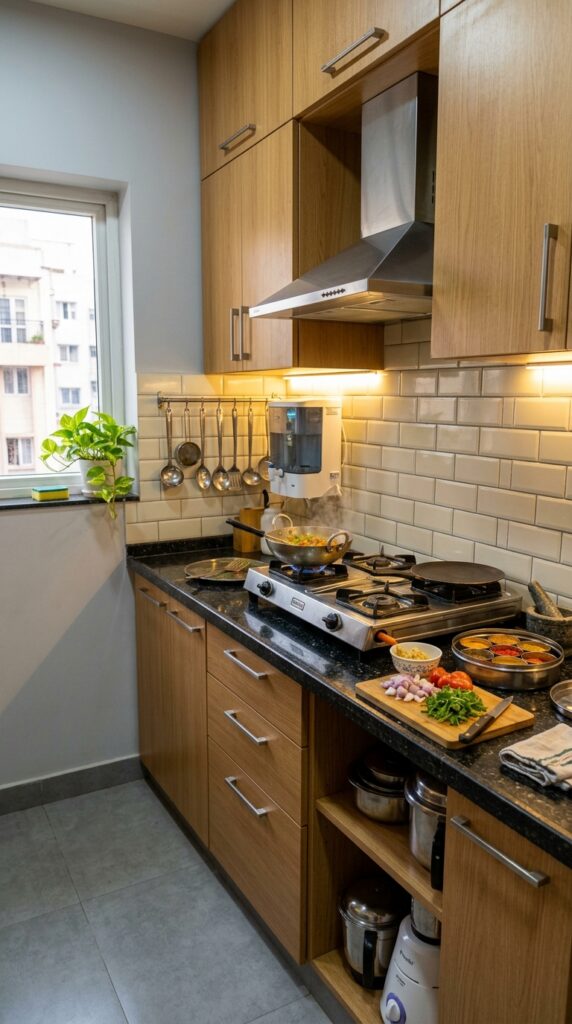
Beginners consistently treat kitchen lighting as a finishing detail, something addressed after the cabinets, the countertop, and the appliances are installed. The result is a kitchen that is lit by whatever overhead fitting happened to be in the ceiling when the renovation began, supplemented by the strip light inside the chimney hood. Both are inadequate for the task lighting that Indian cooking requires, and neither can be properly corrected without significant additional work after the kitchen is complete.
Plan the kitchen lighting as a functional requirement from the start. Decide where the task lighting will be positioned before the wall cabinets are installed so that under-cabinet strip lights can be wired in during the installation rather than added as a surface-mounted afterthought. Decide whether the overhead ambient light needs upgrading before the ceiling is plastered so that a new fitting can be positioned correctly rather than inheriting the position of the old one. Lighting planned from the start and installed as part of the kitchen project costs less and performs better than lighting retrofitted to a kitchen that was designed without it.
12. Build the Kitchen for the Way You Live Now, Not for the Way You Might Live Later
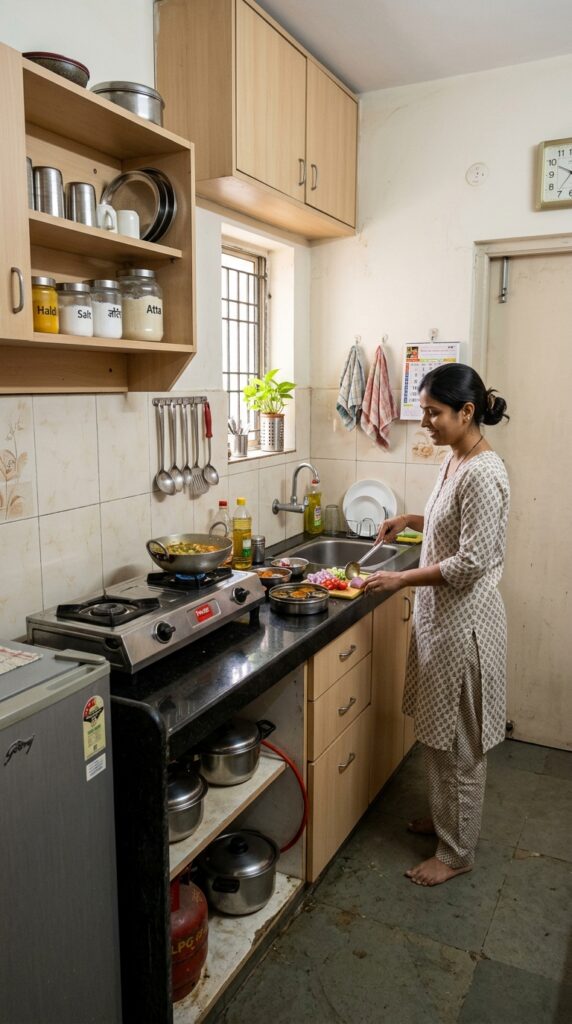
The most consistently useful advice for a beginner designing a first small kitchen is also the simplest. Design for the life that is actually being lived in the flat right now rather than for a hypothetical future life that may or may not arrive. A kitchen designed for a household of one that includes a large dining counter for dinner parties, an integrated dishwasher for the large volume of washing up that rarely happens, and storage for equipment that will be useful when entertaining is more frequent, is a kitchen that serves a version of the household that does not currently exist.
A kitchen designed for a household of one that prioritises efficient single-person Indian cooking, adequate storage for one person’s dry goods and equipment, a simple and clean aesthetic that makes the daily cooking experience pleasant, and a layout that handles the actual cooking that happens every day, is a kitchen that works from the first day it is used. Future changes in household size, cooking habits, and lifestyle can be accommodated through future renovations. The beginner’s first kitchen should be designed for the present, built well, and used until the present changes enough to justify changing it.
Get the Basics Right, and Everything Else Follows
A small kitchen designed well by a beginner is not a lesser kitchen than one designed by a professional with a larger budget and more experience. It is a kitchen that understands what it needs to do, makes the decisions that serve those needs, and resists the temptation to add complexity that the space and the budget cannot support.
Start with the layout that fits the room. Get the work triangle compact. Choose the chimney before the countertop finish. Use standard cabinet sizes. Leave the counter clear. Plan the lighting before the cabinets go in. Design for now.
A small kitchen that does all of those things well is a kitchen that works every day for every meal that is cooked in it. That is the correct ambition for a first kitchen. Not the most impressive kitchen in the showroom. The most functional kitchen in the flat.

Aarav Sharma is a passionate home and lifestyle writer. He loves exploring kitchen design, home decoration, and interior styling. With a keen eye for beautiful details and practical design ideas. Aarav Sharma shares inspiration to help readers create comfortable and functional living spaces.