
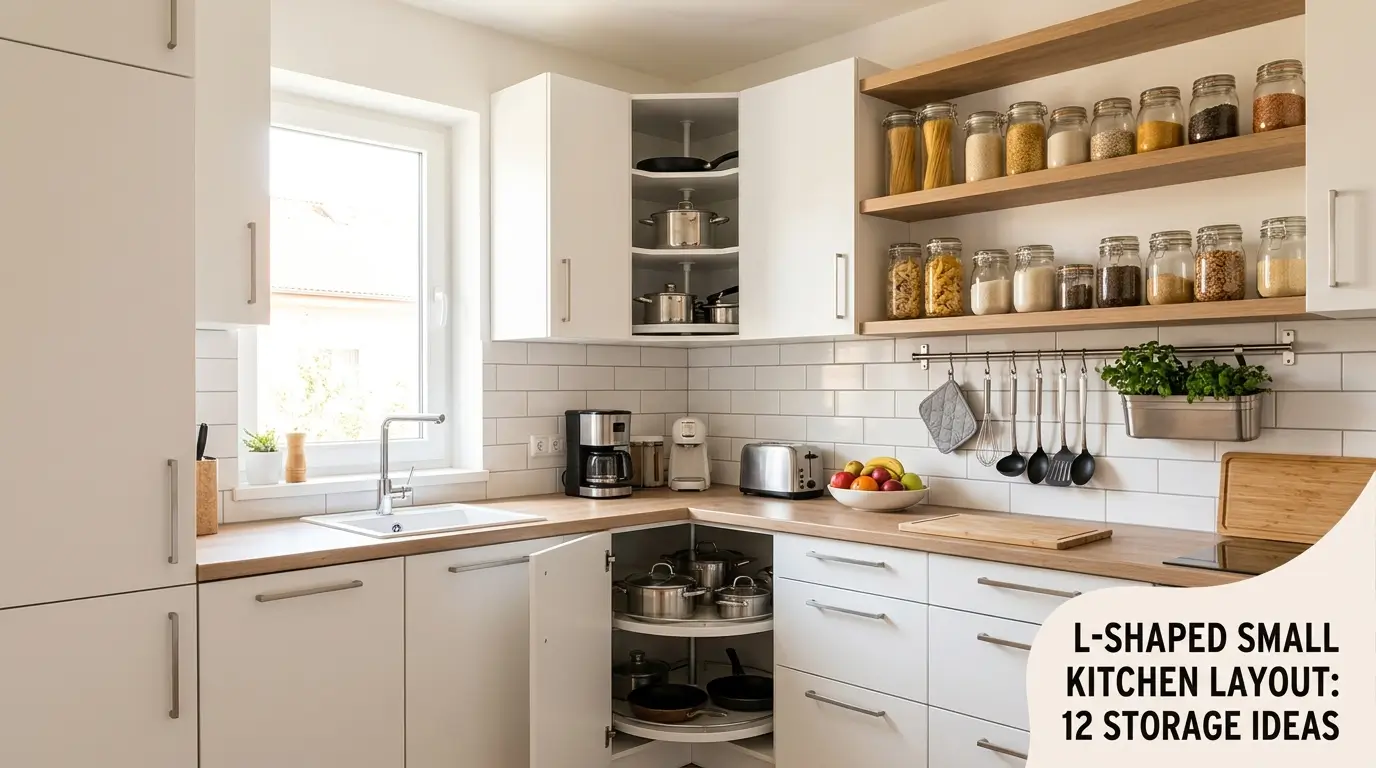
The L-shaped kitchen is the most well-balanced layout available for a small kitchen. Two walls, meeting at a corner, give the kitchen a natural work triangle without the cramped facing-counter dynamic of a galley and without the storage limitation of a single wall. The corner itself, which in a poorly planned L-shaped kitchen is a problem, becomes in a well-planned one a significant storage and workflow asset that no other layout can replicate.
For Indian homes, the L-shaped kitchen is particularly well-suited to the way Indian cooking actually happens. One arm of the L handles the wet work: the sink, the washing, the prep. The other arm handles the cooking, the cooktop, the spices, the vessels. The corner sits between the two zones and organises the transition from prep to cooking in a way that keeps everything within a compact, efficient area. The cook stands at the corner and has access to both arms without stepping away from the work position.
The storage potential of an L-shaped kitchen is also its most underused feature. Two walls of base cabinets, two walls of wall units, a full-height corner position, and the corner itself all contribute to a storage capacity that, when planned correctly, is more than adequate for the full range of Indian kitchen requirements. When planned poorly, the corner becomes a dead zone, the two arms compete for storage rather than complementing each other, and the L-shaped kitchen ends up feeling as cramped and inadequate as the single wall it replaced.
Getting the storage right in an L-shaped small kitchen is the difference between a kitchen that uses both arms well and one that uses both arms partially. Here are 12 ideas to make every corner and cabinet in a compact L-shaped kitchen work at its full capacity.
L-Shaped Small Kitchen Layout With Storage Ideas
1. Resolve the Corner Before Planning Anything Else
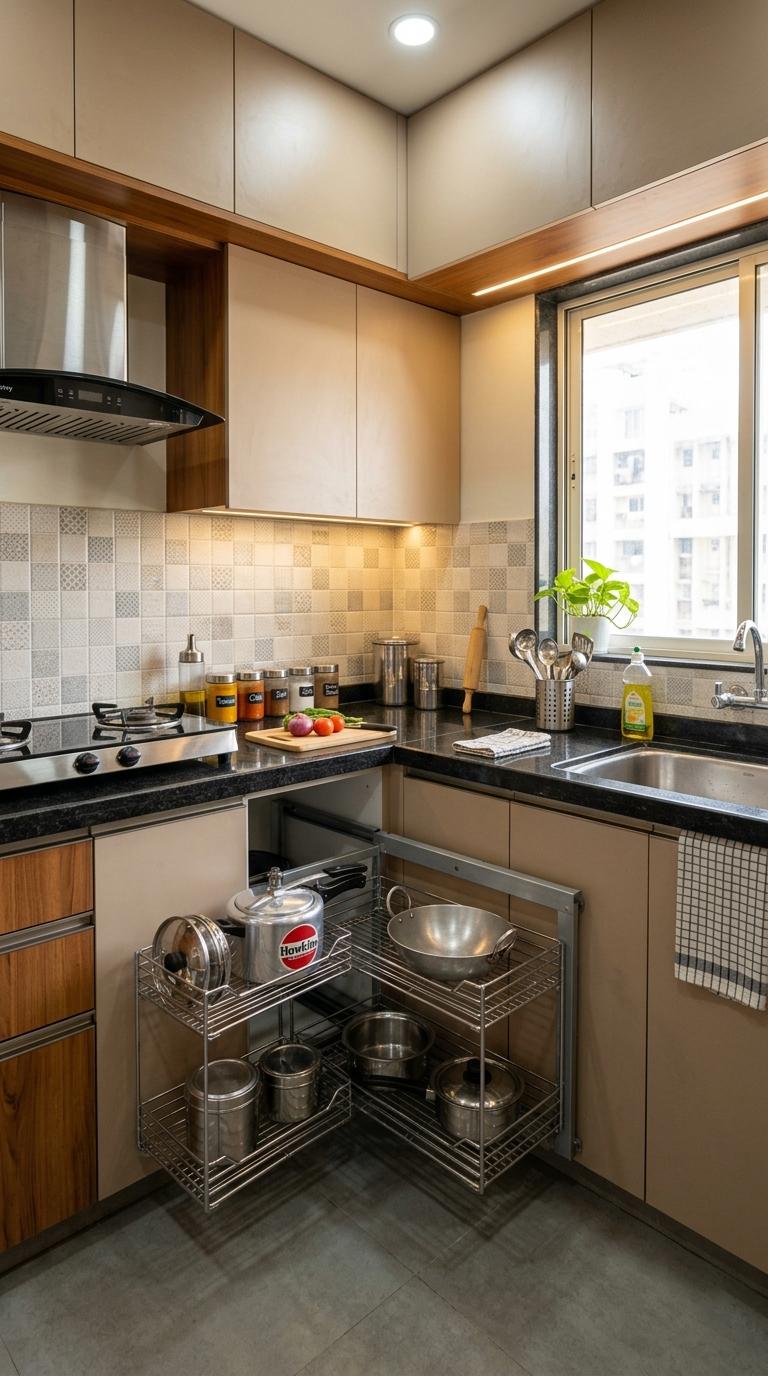
The corner of an L-shaped kitchen is the most structurally complex and most frequently mishandled element in the layout. Where the two arms meet, the base cabinets on one arm obstruct access to the base cabinets on the other arm, creating a deep, dark zone at the back of the corner that standard cabinet design does not naturally reach. If this corner problem is not resolved at the planning stage, it creates a significant dead zone in the most central part of the kitchen that undermines the storage capacity of both arms.
There are three standard solutions to the L-shaped kitchen corner. A carousel unit, a rotating shelf system that spins to bring the contents of the deep corner to the front when the cabinet door opens. A pull-out corner unit, sometimes called a magic corner or a Le Mans unit, where the shelves slide out of the corner on an articulated arm and present themselves at the cabinet opening. And a diagonal corner cabinet, where the corner is cut at 45 degrees and fitted with a single wide door that gives direct access to a more accessible corner space. Each solution has a different cost, a different depth of corner it reaches, and a different degree of accessibility. Choose one and specify it before finalising the rest of the layout. The corner solution determines the cabinet dimensions on both arms adjacent to it.
2. Assign One Arm to Wet Work and One to Cooking
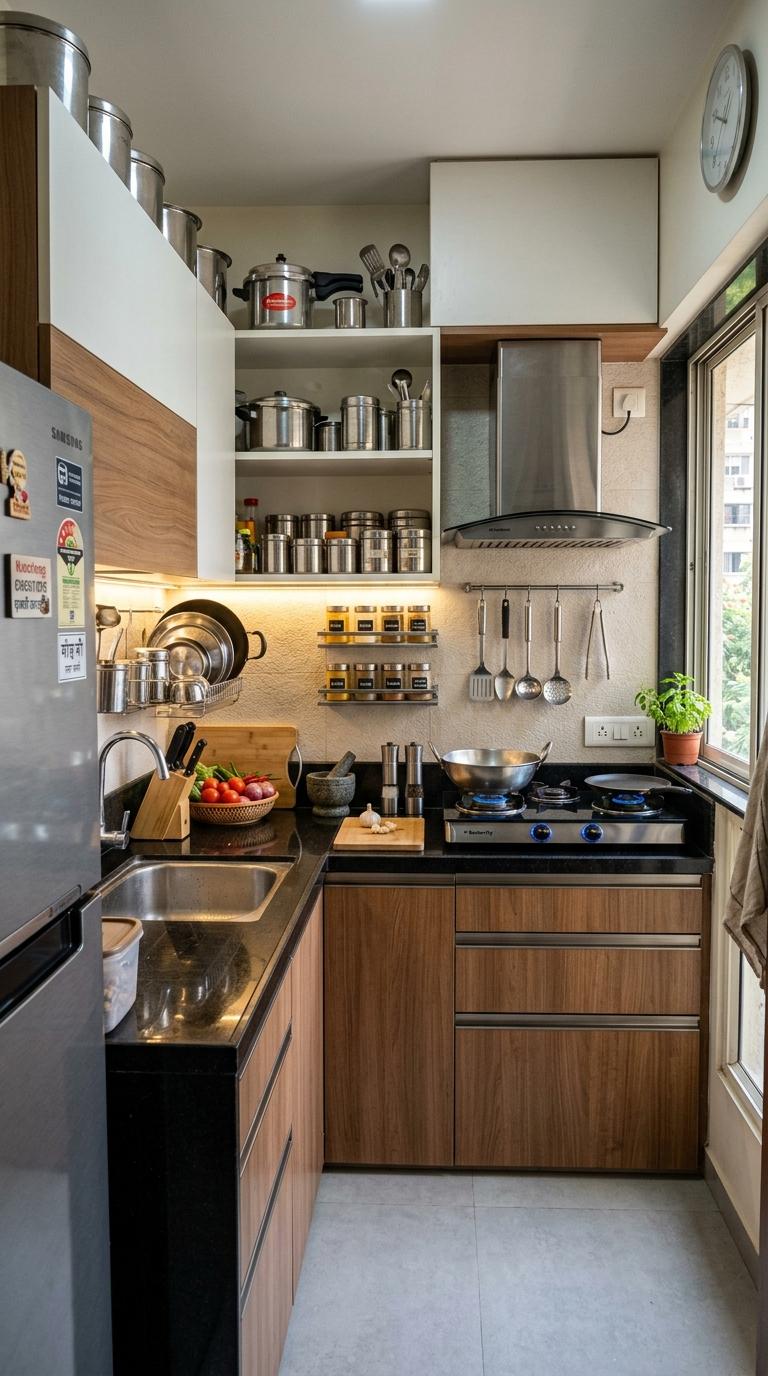
The most important planning decision in an L-shaped kitchen, after resolving the corner, is the assignment of functions to the two arms. A layout where the sink and the cooktop are on the same arm, with the other arm used only for storage, creates an L that is functionally a one-wall kitchen with an adjacent storage wall rather than a genuine two-zone kitchen. A layout where one arm carries all the wet work, and the other carries all the cooking creates a genuine two-zone kitchen where the two arms complement each other, and the corner between them becomes the natural transition point.
The longer arm of the L should carry the cooktop and cooking storage. Indian cooking happens at the cooktop and requires immediate access to spices, vessels, and equipment that should all be on the same arm as the cooking position. The shorter arm carries the sink, the prep counter, and the refrigerator. Washing and prep happen at the sink end, and the prepared ingredients travel from the prep zone to the cooking zone across the corner in the natural sequence of Indian cooking. This functional assignment makes both arms productive and the corner purposeful.
3. Full-Height Storage at the End of the Longer Arm
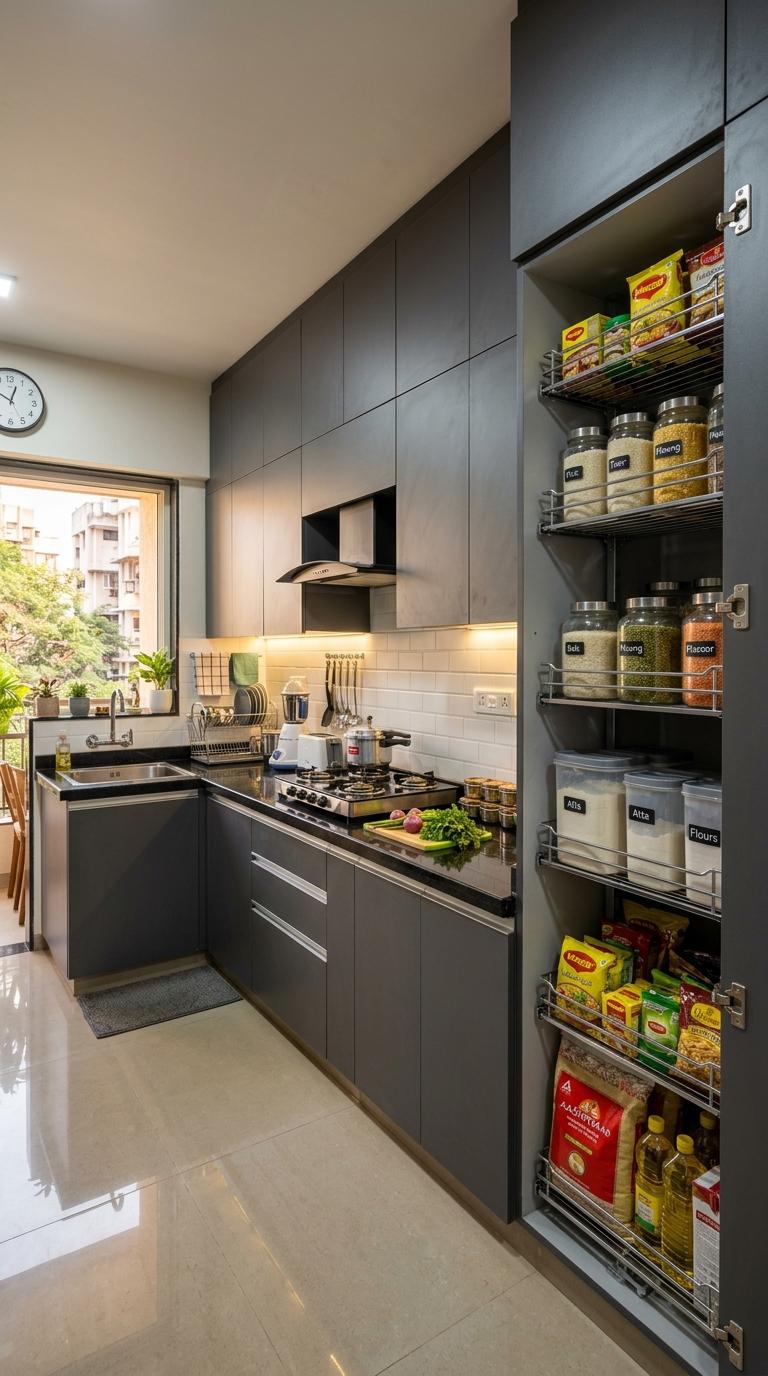
The end of the longer arm of the L, the point where the counter run terminates at the wall or the room opening, is the natural position for the tallest storage unit in the kitchen. A full-height larder column or pantry tower at this end position uses the full floor-to-ceiling height of the kitchen at a point where it does not reduce the usable counter length on either arm and does not create a visual obstruction in the corner area where the two arms meet.
In an L-shaped Indian kitchen, the full-height unit at the end of the longer arm typically serves as the primary dry goods storage. Pull-out shelves at different heights hold rice, dal, atta, and bulk dry goods at their correct storage levels without the contents competing with vessels and equipment for shelf space in the standard wall and base cabinets along the two arms. A full-height unit at the end of the longer arm also visually anchors the L-shaped kitchen, giving the longer wall a strong vertical element at its terminus that makes the kitchen feel considered and complete.
4. Deep Pull-Out Drawers in Every Base Cabinet
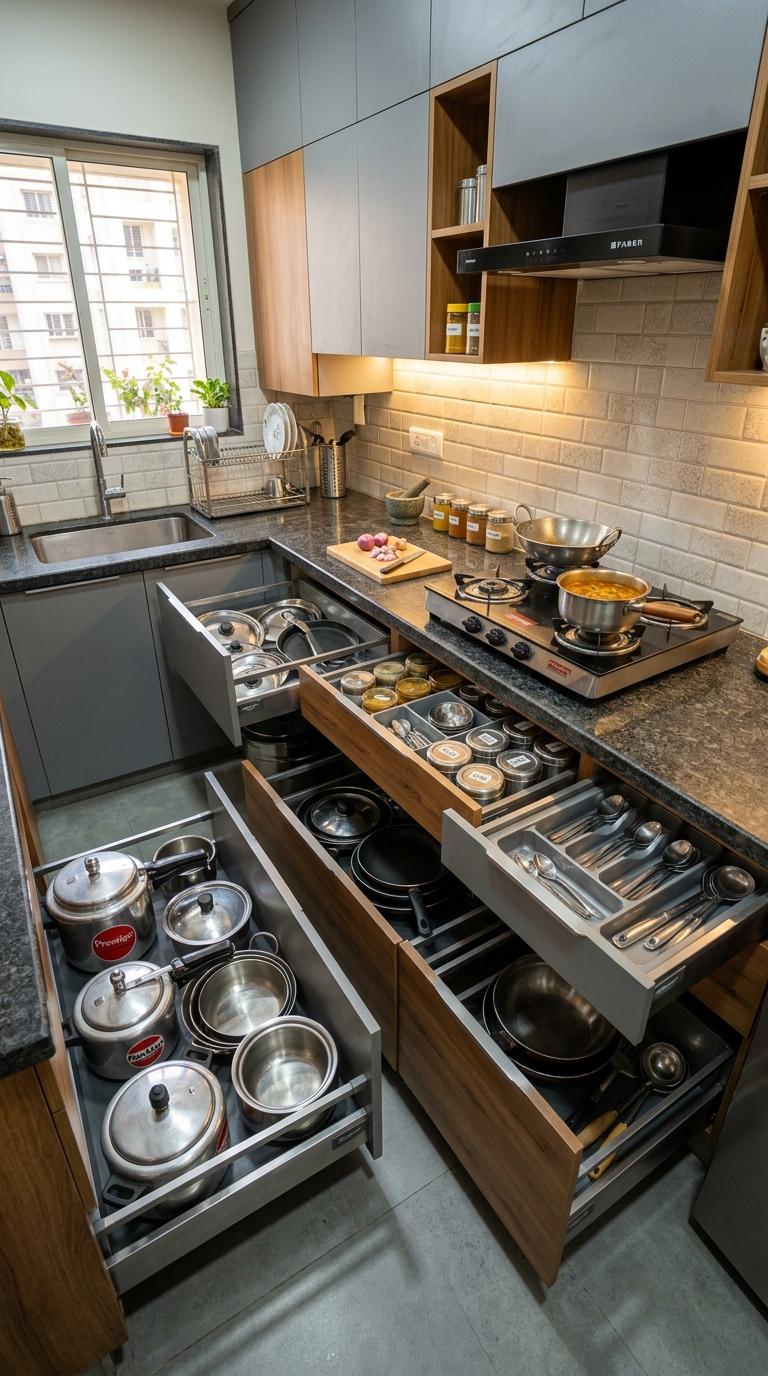
The base cabinets of an L-shaped kitchen carry the heaviest items and represent the most consistently underused storage zone in most Indian kitchen installations. Fixed shelves behind hinged doors, the standard base cabinet format, make the back half of every lower cabinet effectively inaccessible. In an L-shaped kitchen with two full arms of base cabinets, the total wasted storage from inaccessible back-of-cabinet space is significant.
Deep pull-out drawers in every base cabinet position across both arms of the L transform the functional capacity of the lower storage zone. The deepest drawers, fitted to the tallest base cabinets adjacent to the cooktop, hold large vessels, pressure cookers, and heavy kadais in a format where the item needed is visible, accessible, and retrievable without removing anything else first. Shallower pull-out drawers in the base cabinets along the prep arm hold containers, smaller vessels, and everyday cooking equipment with the same full-access advantage. Specifying pull-out drawers across every base cabinet position on both arms is the single most impactful storage upgrade available in an L-shaped kitchen.
5. The Sink in the Corner or Adjacent to It
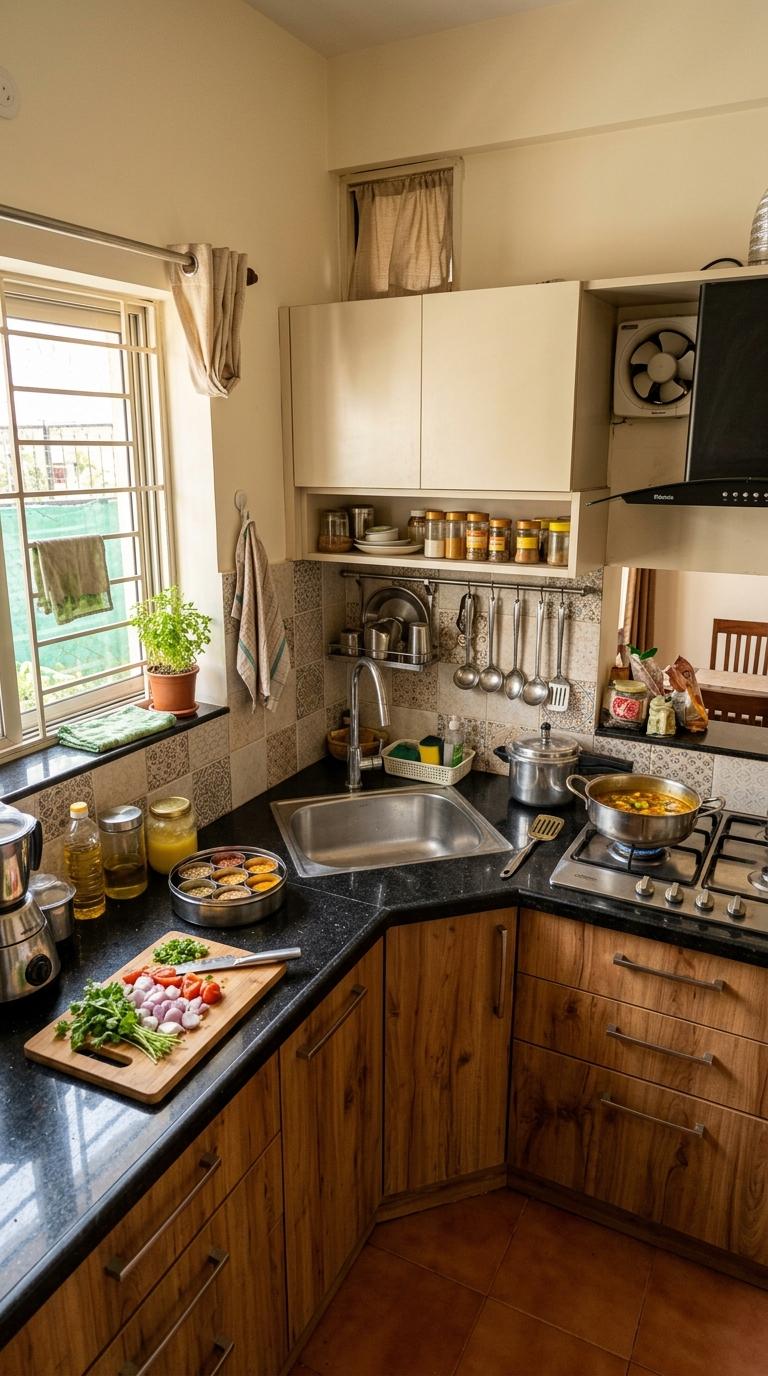
The corner of an L-shaped kitchen is a structural transition between the two arms. In most L-shaped kitchen layouts, the corner is occupied by a storage cabinet, either the carousel or the pull-out corner unit. But in a small L-shaped kitchen where the corner position is also the natural transition between the wet and cooking zones, positioning the sink in the corner or immediately adjacent to it on the prep arm creates a workflow that puts the prep and washing function at the junction between the two zones.
A corner sink, a single bowl sink set diagonally in the corner cabinet position, uses the corner space directly and places the sink at the natural meeting point of the two arms. The counter on both sides of the corner sink, on the prep arm to one side and the cooking arm to the other, is available for prep and staging simultaneously. The cook can wash and prep on one side, rotate to the corner, and reach the cooktop on the other arm without moving more than a step. The corner sink is not available from all modular kitchen manufacturers but is worth seeking out for an L-shaped layout where the corner transition is the most active point in the cooking workflow.
6. Wall Cabinets That Continue Around the Corner
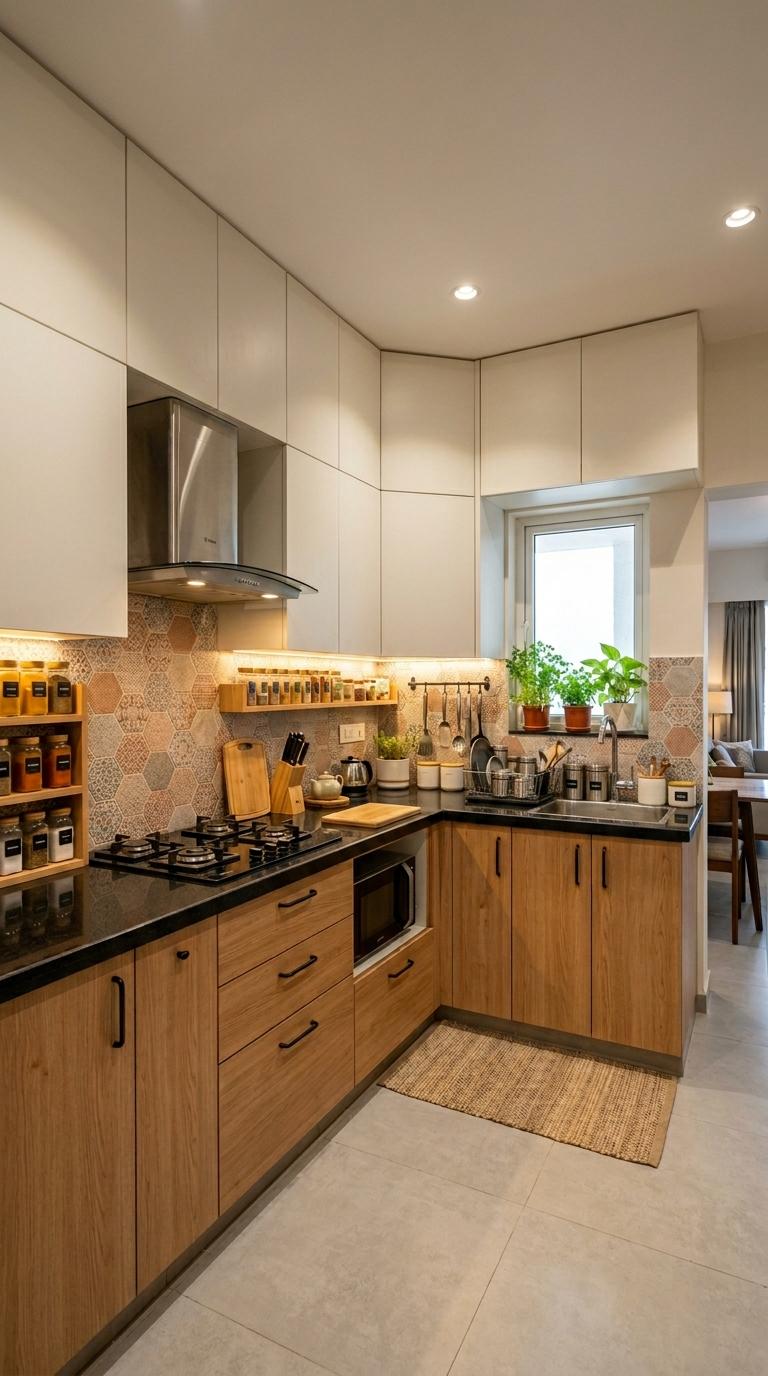
The wall cabinets in most L-shaped kitchen installations stop at the corner. One arm has wall cabinets running to the corner and the other arm has wall cabinets starting from the corner, but the corner itself is either left as an open wall surface or fitted with a single angled cabinet that does not use the corner space efficiently at the wall level.
Continuing the wall cabinets around the corner, through the use of a corner wall cabinet unit that sits at the junction of the two arms and provides shelving accessible from both sides, uses the wall storage area at the corner that most L-shaped kitchens leave empty. The corner wall cabinet position is accessible from both arms of the L, making it a natural location for items used across both zones. Spices accessed from the cooking arm. Small containers accessed from the prep arm. The corner wall cabinet, specified and installed correctly, turns the corner wall from a blank transition into a useful storage position.
7. A Breakfast Counter Extension on the Outer Edge of the Shorter Arm
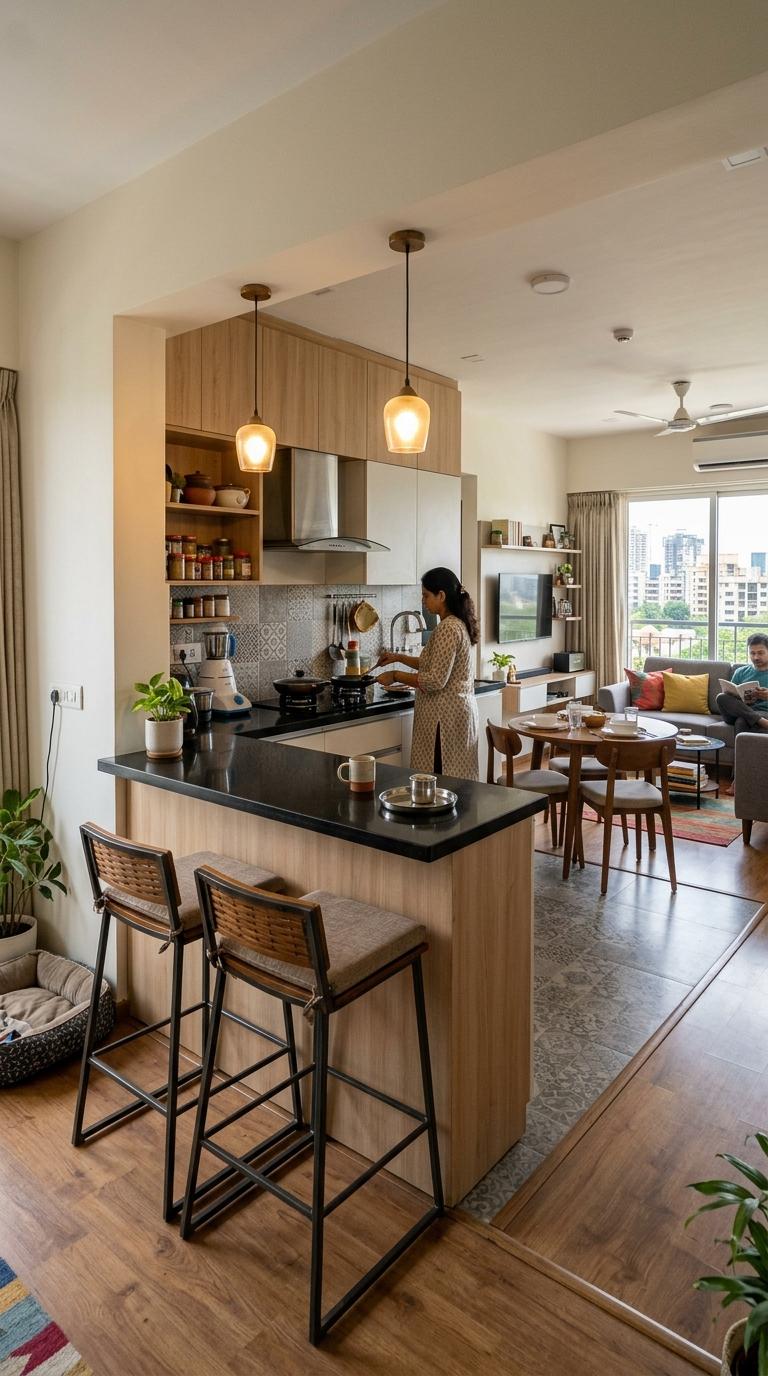
The outer edge of the shorter arm of the L, the face of the base cabinets that looks into the room rather than at the wall, is typically a plain cabinet face with no surface function. In a small flat where the L-shaped kitchen opens into the living or dining area, this outer edge is an opportunity for a breakfast counter or a dining bar that extends the kitchen function into the living space without adding floor area to the kitchen zone.
A counter overhang of 300 to 350 millimetres on the outer face of the shorter arm base cabinets, at standard counter height or raised to bar height with a corresponding cabinet structure adjustment, creates a casual dining surface for two to three people that sits at the kitchen boundary without a separate table. Bar stools or counter stools on the room-facing side complete the dining position. The breakfast counter on the outer edge of the shorter arm is the most natural and most space-efficient way to add a dining function to an L-shaped kitchen in a small flat.
8. Spice Storage Immediately Adjacent to the Cooktop
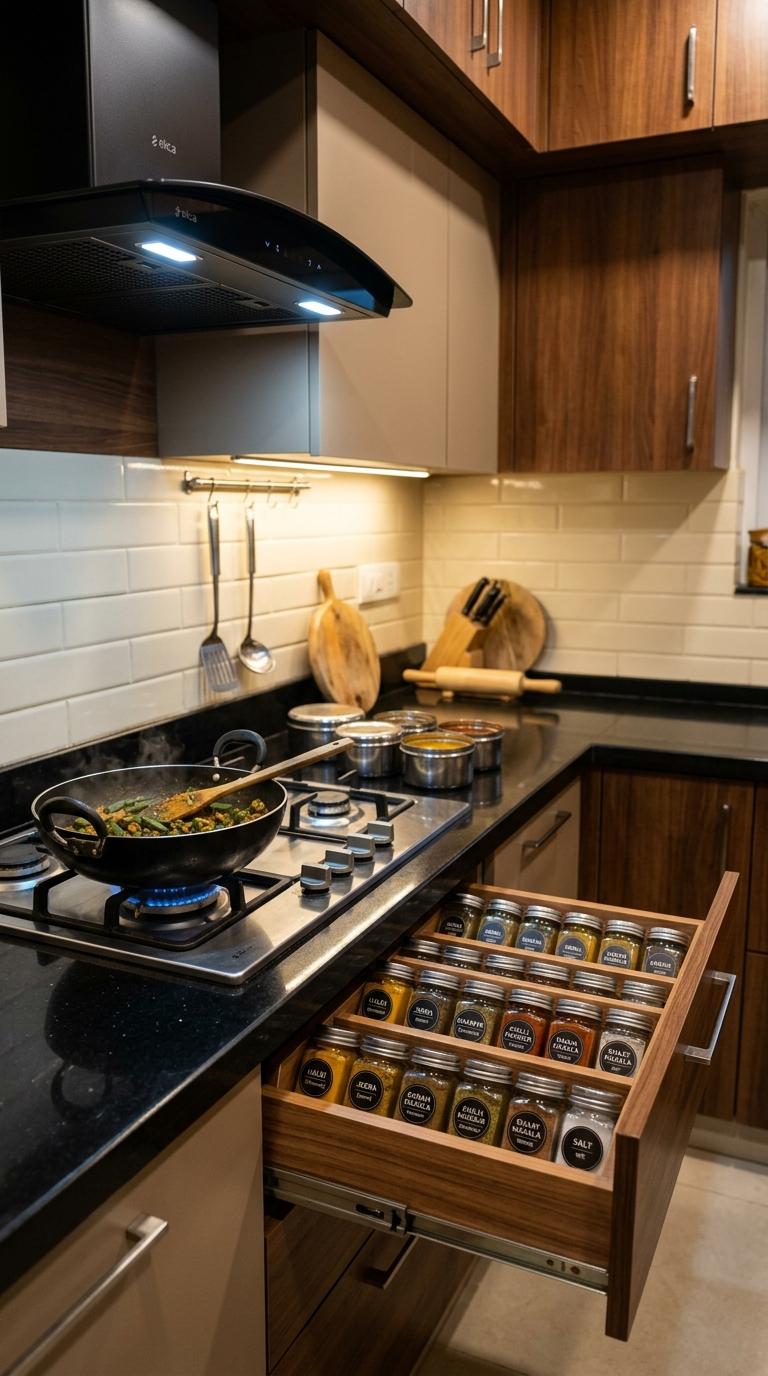
In an L-shaped Indian kitchen, the spice storage position is a detail that has a disproportionate effect on the cooking experience. Indian cooking requires immediate access to a range of spices during active cooking. Spices stored in a wall cabinet that requires opening a door, scanning the contents, and retrieving the correct jar during cooking add friction to a process that should be fluid. Spices stored in a pull-out drawer immediately beside the cooktop, with every jar visible from above when the drawer is open, remove that friction entirely.
A dedicated spice pull-out drawer, 150 to 200 millimetres wide and fitted with a tiered insert that holds individual spice jars in a single accessible layer, positioned immediately to one side of the cooktop on the cooking arm, puts the full spice collection within reach of the cooking position without a door to open or a cabinet to search. This single storage decision, made at the layout planning stage and specified as part of the base cabinet configuration, improves the daily cooking experience in an L-shaped Indian kitchen more than any other individual storage element.
9. Toe-Kick Drawers on the Cooking Arm
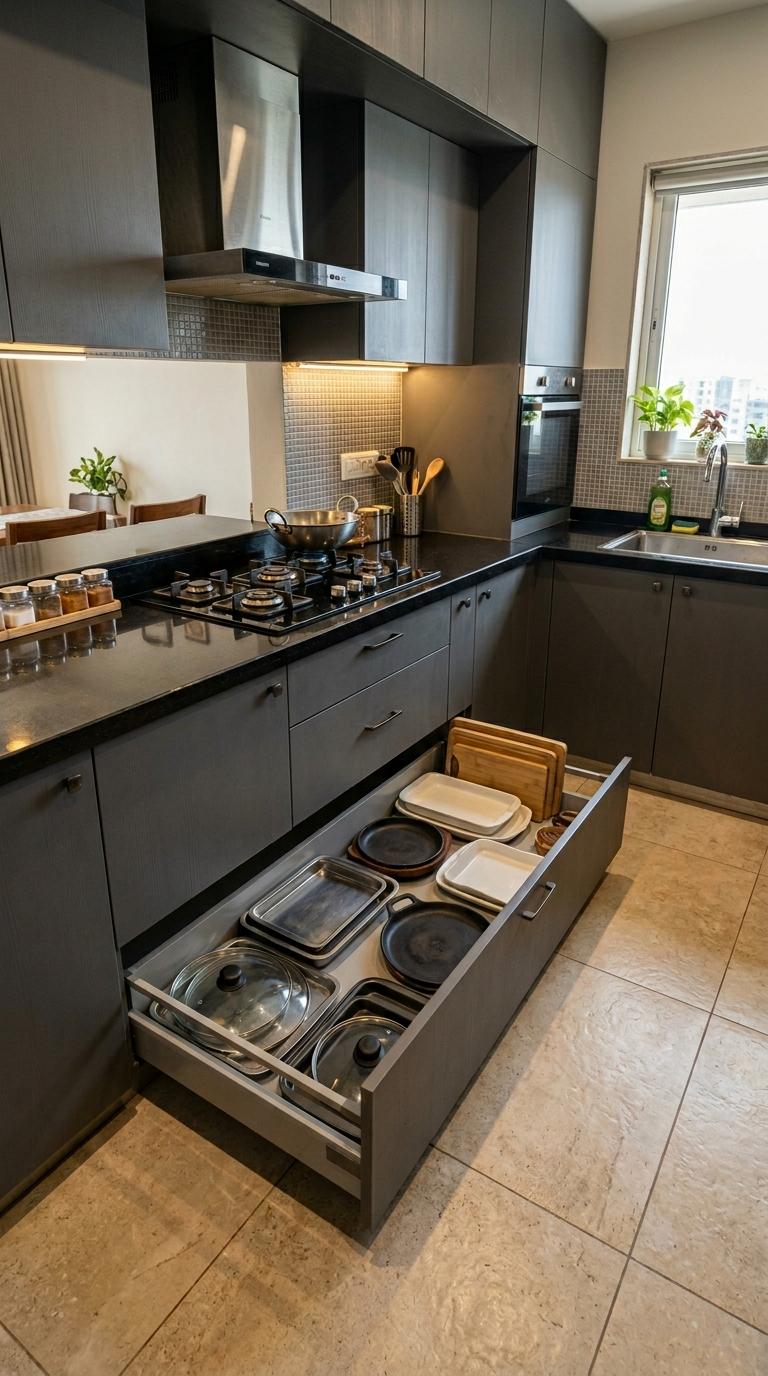
The toe-kick space below the base cabinets on both arms of the L carries a void that the standard modular kitchen treats as ventilation space and nothing more. The void is real and the storage potential it represents, running the full length of both arms at a height of 100 to 150 millimetres, is significant when converted to shallow pull-out drawers.
On the cooking arm, where floor space below the base cabinets is most consistently left as unused void, toe-kick drawers provide storage for flat items that have no natural home elsewhere in the kitchen. Large flat lids, baking sheets, a spare tawa, large serving platters, and flat boards all fit within the toe-kick drawer depth and are stored at the floor level where they are used rather than in an upper cabinet where the weight and size of these items makes retrieval awkward. Toe-kick drawers on the cooking arm of an L-shaped kitchen add a storage layer that works in parallel with the main cabinet system without competing with it for the same items.
10. Under-Cabinet Lighting on Both Arms
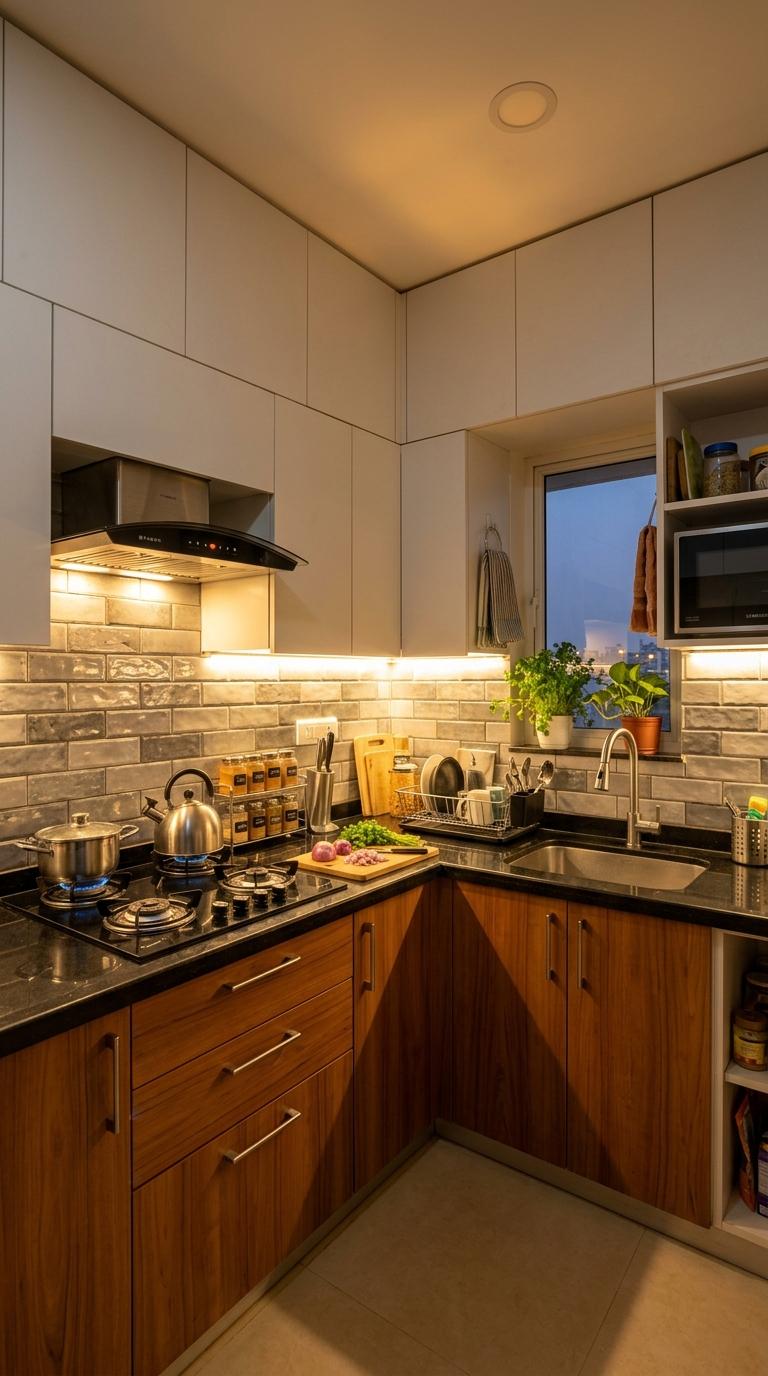
Task lighting in an L-shaped kitchen needs to cover both arms of the counter run rather than just the section directly below the overhead fitting. A single overhead light fitting in an L-shaped kitchen creates adequate ambient light but casts shadows on the counter in both arms, particularly in the corner area where the overhead light is furthest from both counter surfaces.
Under-cabinet LED strips fitted to the underside of the wall cabinets on both arms of the L provide direct, consistent task lighting across every section of the counter on both arms. The lighting runs along the full length of the wall cabinet underside on the cooking arm and continues around the corner and along the full length of the prep arm, creating a uniform band of task light at counter level across the entire working surface of the L. In the corner area where the overhead light reaches least effectively, the under-cabinet light from both arms overlaps to create adequate illumination at the most critical workflow transition point in the kitchen.
11. A Dedicated Vessel Zone in the Cooking Arm Base Cabinets
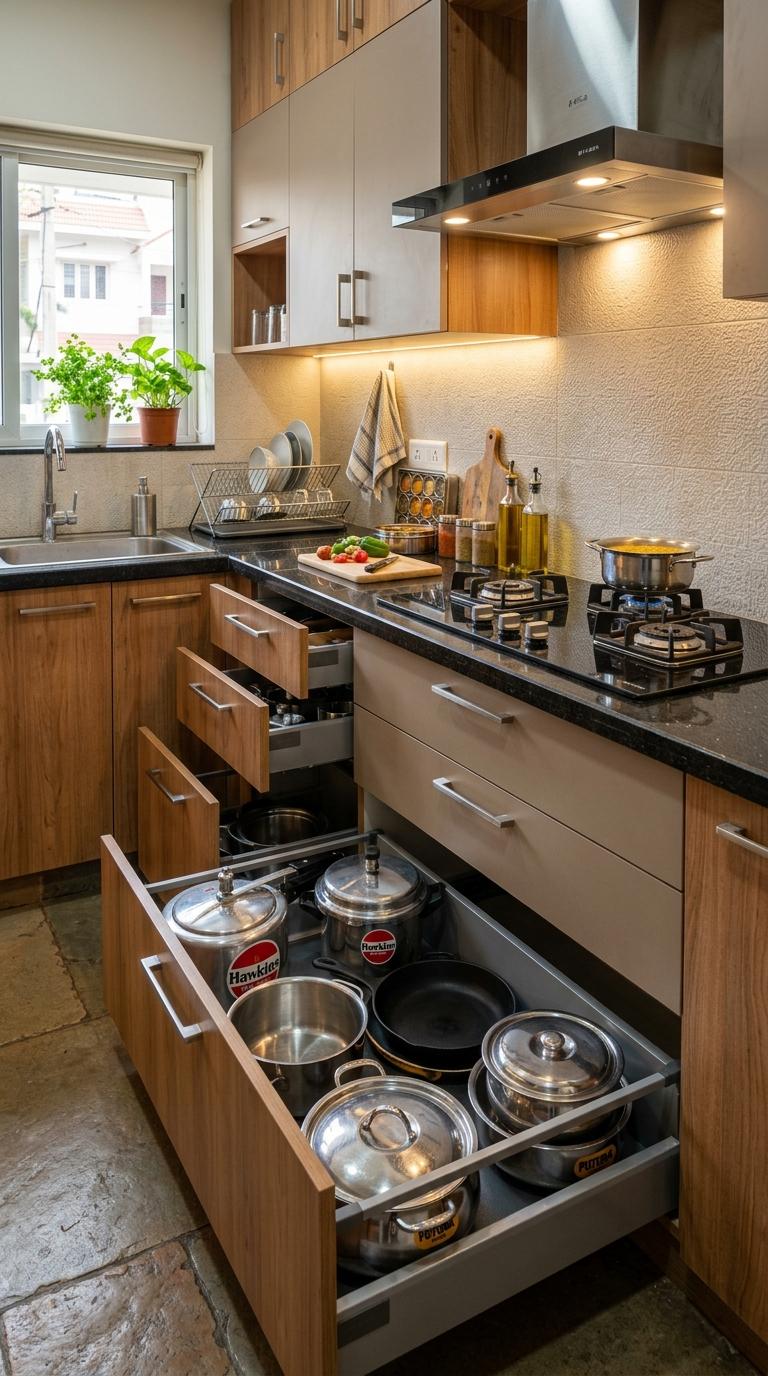
The base cabinets on the cooking arm of an L-shaped kitchen carry the largest and heaviest items in the kitchen. Pressure cookers, large kadais, stockpots, and the full range of Indian cooking vessels that are used regularly and need to be accessible without effort. In a kitchen where these items are distributed randomly across multiple base cabinets on both arms, finding and retrieving a specific vessel during cooking requires a search that, in a kitchen occupied by an active cook, creates unnecessary movement and unnecessary time pressure.
Assigning the base cabinets on the cooking arm specifically to vessel storage, with pull-out drawers sized and configured for the largest items in the collection, creates a dedicated vessel zone where every cooking vessel has a fixed location within reach of the cooktop. The base cabinets on the prep arm handle smaller items, containers, and everyday equipment. The cooking arm base cabinets hold the vessels. The organisation is simple, the discipline to maintain it is minimal, and the cooking workflow benefits from having every vessel immediately accessible from the position where it will be used.
12. A Slim Open Shelf Above the Window on the Prep Arm
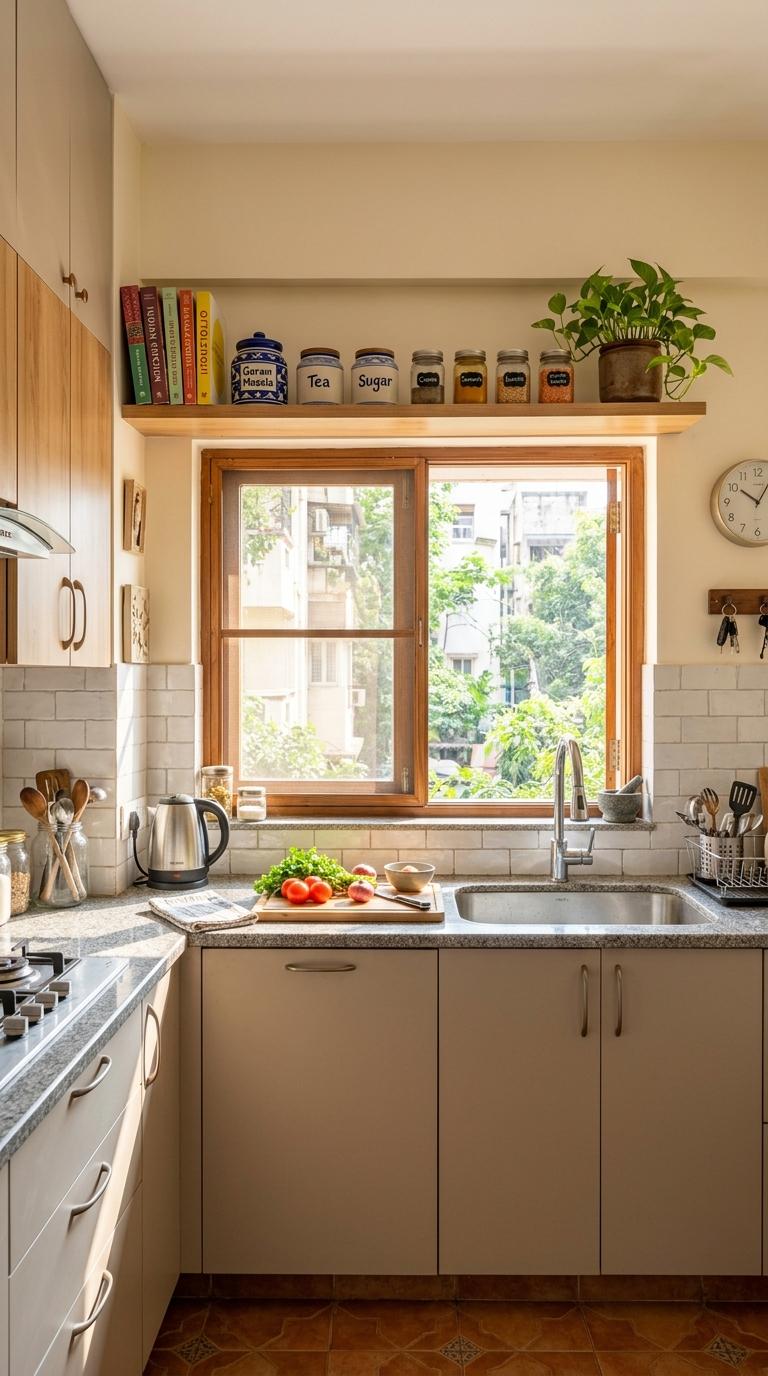
In an L-shaped kitchen where the prep arm has a window, the wall space above the window is typically left blank. The window itself admits light and provides ventilation for the prep zone, but the wall above it, between the window head and the ceiling, is unused surface that in a kitchen where wall storage space is already at a premium represents a missed opportunity.
A slim open shelf fitted above the window on the prep arm, at a height between the window head and the underside of the wall cabinet run, provides a narrow storage surface for small items that benefit from being at or above eye level. Cookbooks, small ceramic containers, a plant that benefits from the natural light coming through the window below, or a collection of matching glass jars holding everyday dry goods all sit naturally on a slim shelf above the window. The shelf is shallow enough not to obstruct the window light and high enough not to interfere with the workflow at the prep counter below. It uses wall space that no other storage can reach and adds a layer of organised storage and visual warmth to the prep arm of the L.
Plan Both Arms Together, Not One at a Time
An L-shaped small kitchen with storage planned well is a kitchen where the two arms work as a system rather than as two separate one wall kitchens that happen to meet at a corner. The corner is resolved first. The functions are assigned to the correct arms. The storage on each arm is configured for the items used at that arm. The corner wall cabinet and the corner base unit connect the two arms at the junction rather than leaving the corner as dead space between them.
The result is a kitchen where the cook moves within a tight, efficient area, where every storage location is accessible from the position where its contents are used, and where the L-shaped layout delivers on the promise it makes when it is planned correctly.
Two walls, one corner, and every centimetre working.

Aarav Sharma is a passionate home and lifestyle writer. He loves exploring kitchen design, home decoration, and interior styling. With a keen eye for beautiful details and practical design ideas. Aarav Sharma shares inspiration to help readers create comfortable and functional living spaces.