
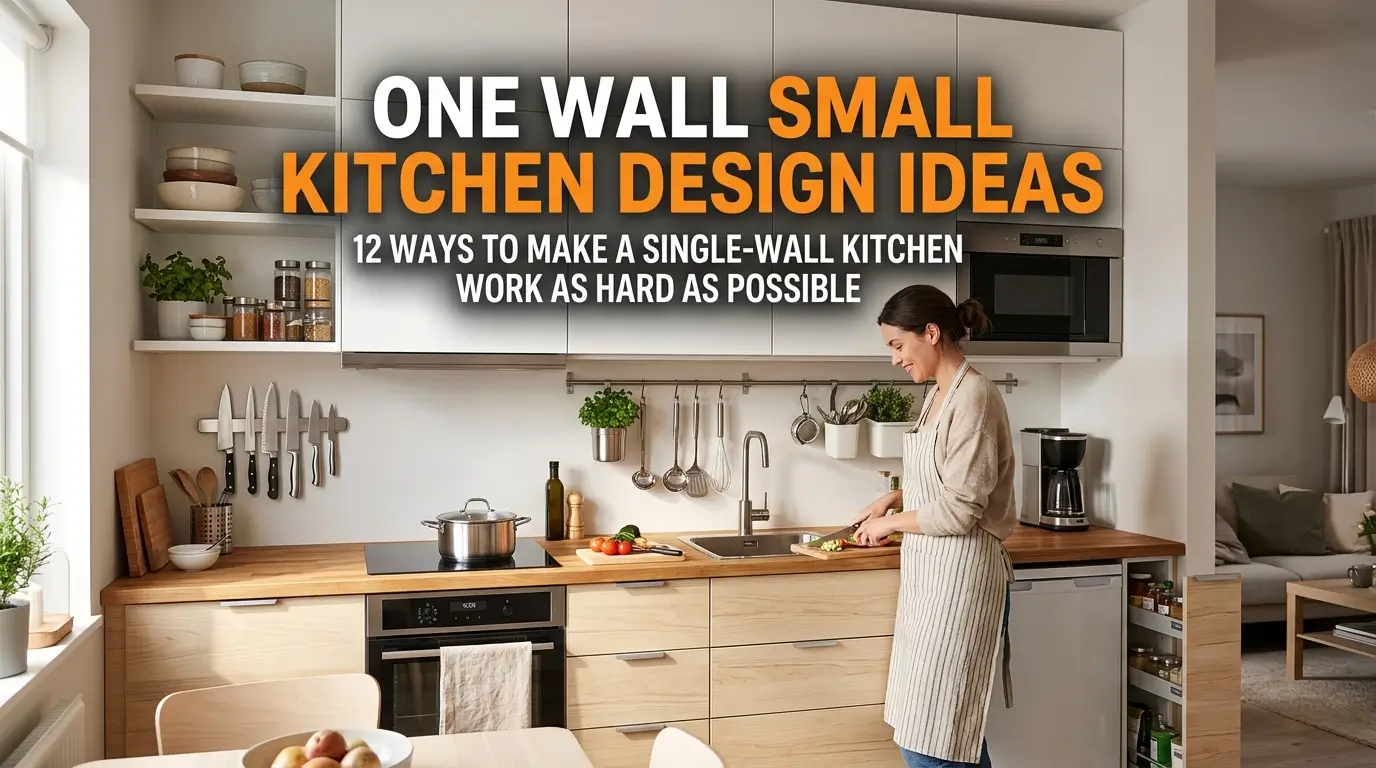
The one-wall kitchen is the most reduced form a kitchen can take. Everything on a single line. One counter, one cabinet run, one wall carrying the entire function of the kitchen from the refrigerator at one end to whatever is at the other. No corner to negotiate, no second wall to plan, no work triangle to draw. Just one wall and the decisions made along it.
This simplicity is both the strength and the challenge of the one-wall kitchen. The strength is clarity. The layout cannot be complicated because there is only one axis to work on. Every element is visible, every storage location is accessible from a single standing position, and the workflow from one end of the counter to the other is a straight line that never doubles back on itself. In a small flat or studio apartment where the kitchen shares space with the living area, the single-wall kitchen contains itself neatly against one surface and leaves the rest of the room available for living.
The challenge is linearity. Everything the kitchen needs to do has to happen along one wall. The counter length is fixed by the wall width. The storage is limited to what the single run of cabinets can hold. There is no second wall to borrow, no corner to use, no perpendicular run to add storage that the main wall cannot carry. When the single wall runs out, the kitchen runs out. Every centimetre of that wall therefore has to be planned with more care than the equivalent centimetre in a larger kitchen with more walls to work across.
In an Indian flat, the one-wall kitchen has the additional challenge of Indian cooking volume and variety. A cuisine that regularly uses multiple burners, generates significant smoke and steam, requires bulk dry goods storage, and involves a range of vessels and equipment that a single cabinet run struggles to accommodate without very careful planning.
Here are 12 ideas for making a one-wall small kitchen work as hard as any kitchen three times its size.
One Wall Small Kitchen Design Ideas
1. Sequence the Counter Run in the Correct Order
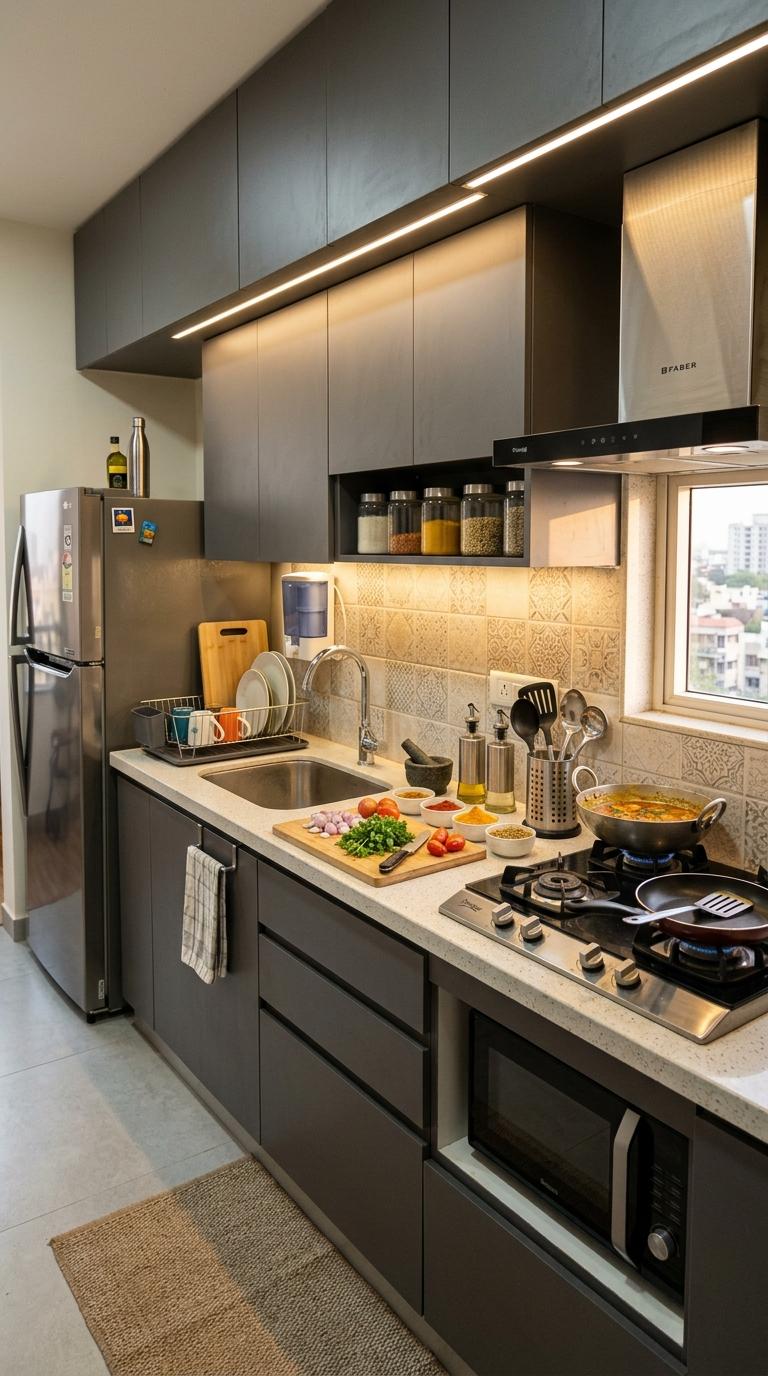
The sequence in which the elements of a one-wall kitchen are arranged along the counter determines how efficiently the kitchen functions during cooking. A single-wall kitchen means the cook is constantly reaching across elements, stepping sideways between tasks, and working against the natural flow of food preparation rather than with it.
The correct sequence for a one-wall Indian kitchen runs from cold storage at one end to cooking at the other, with prep in the middle. Refrigerator at the far end. Counter space for unpacking and staging ingredients immediately beside the refrigerator. Sink next, for washing and prep. A second counter section for active food preparation between the sink and the cooktop. Cooktop at the other end, under the chimney. This left-to-right or right-to-left sequence mirrors the natural flow of Indian cooking and means every step of the process happens in order along the wall rather than jumping between non-adjacent points.
2. Use the Full Wall Height for Cabinet Storage
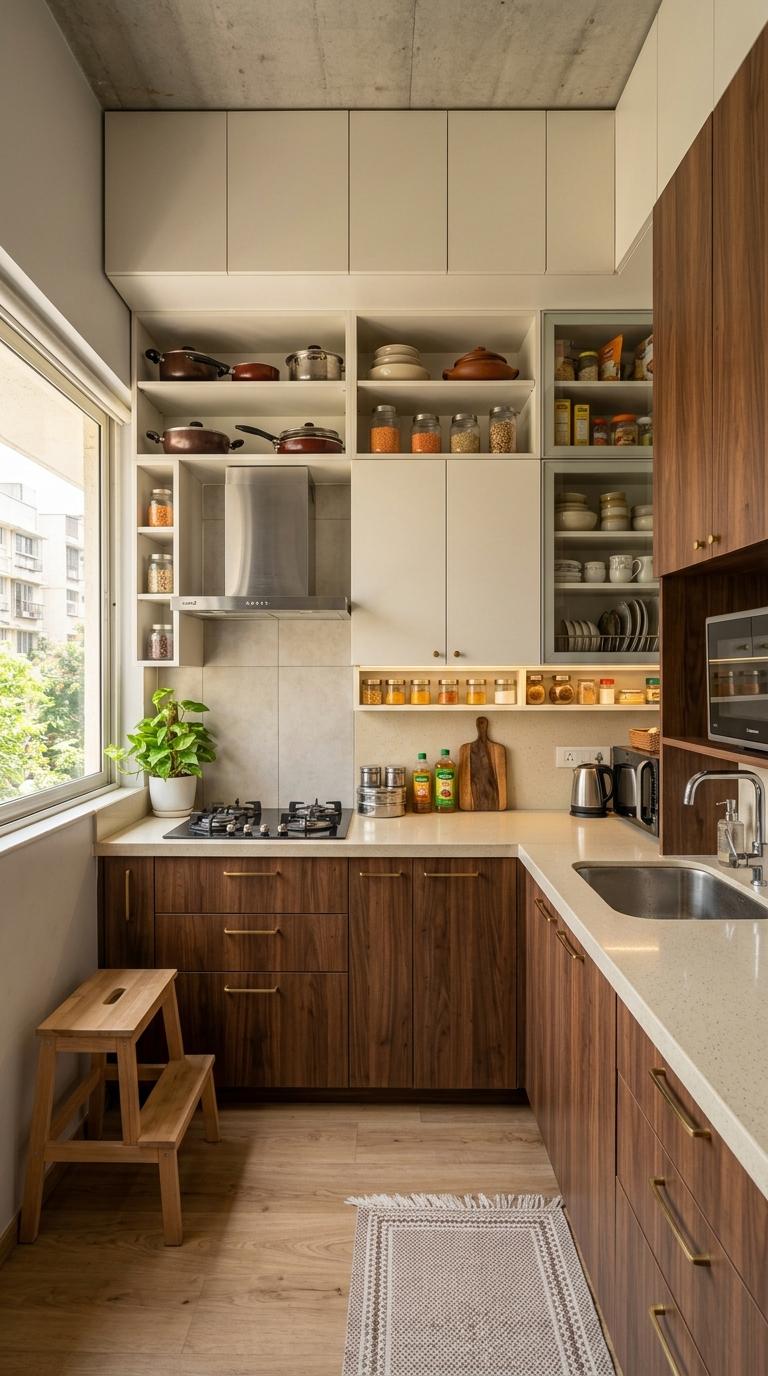
A one-wall kitchen has exactly one wall to put cabinets on. Using that wall to its full height from floor to ceiling is the most direct way to compensate for the storage limitation of a single-wall configuration. Every additional cabinet tier added above the standard wall unit height adds storage without adding floor area or counter length.
Full-height wall units from floor to ceiling, or the combination of standard base cabinets, standard wall units at standard height, and a third tier of talusebinets above them running to the ceiling, uses the vertical dimension of the single wall as completely as the horizontal dimension. The upper tier stores items used infrequently. The standard wall unit tier stores everyday items at comfortable reach height. The base cabinets below handle vessels, appliances, and heavy items. The full height of the wall is working at every level rather than stopping at the standard wall unit top and wasting everything above it.
3. A Continuous Countertop With No Breaks
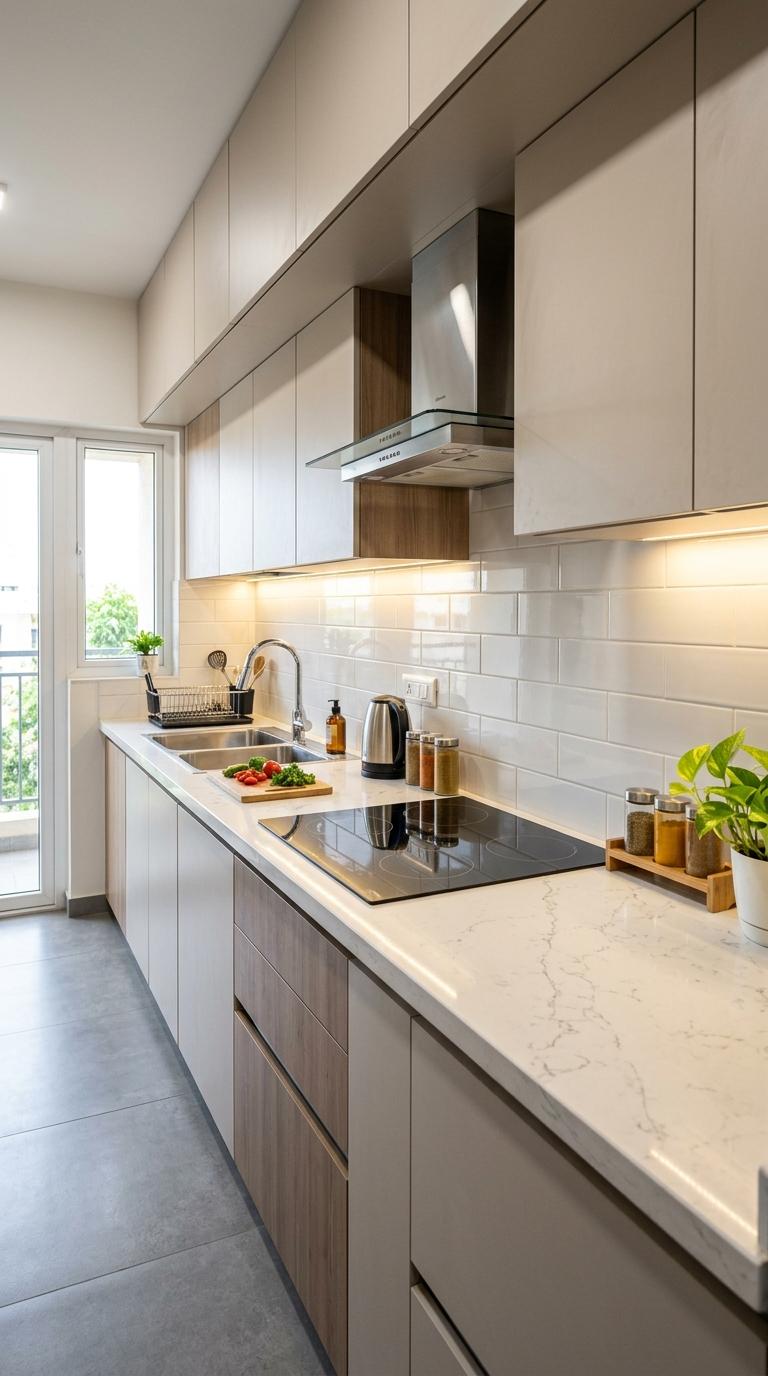
The countertop of a one-wall kitchen is its most valuable functional surface. In a kitchen where there is only one counter run, every interruption in that run reduces the available prep and working surface. Breaks between countertop sections- the standard gaps left between appliances and cabinets in a poorly planned single-wall layout- fragment the usable surface and create edges and joints that accumulate food debris and are difficult to clean.
Specify a continuous countertop that runs the full length of the single wall without any breaks, from the refrigerator end to the wall at the other end. Where the cooktop sits, the countertop runs through the recess and the cooktop is set flush with the counter surface. Where the sink sits, the countertop continues on both sides without any gap or break in the surface. A continuous countertop makes the single wall kitchen feel like a single, unified piece rather than a collection of separate elements placed end to end, and maximises every centimetre of working surface along the wall.
4. A Fold-Down One-Wall Extension at One End
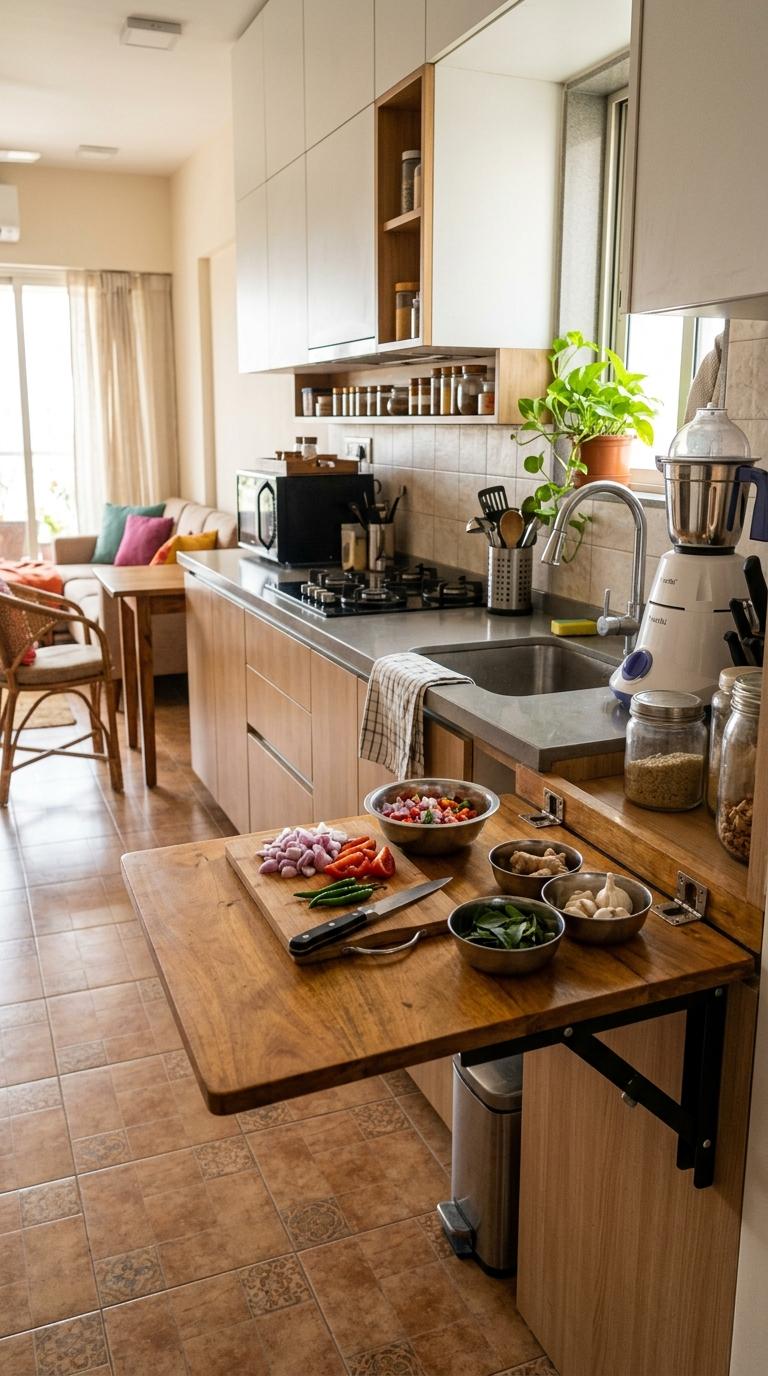
When the fixed counter length of the one wall kitchen is not sufficient for the cooking that happens in it, which for Indian cooking it frequently is not, a fold-down counter extension at one end of the wall adds prep and staging surface that can be deployed during cooking and stored away when the kitchen is not in active use.
A fold-down shelf fixed to the wall at counter height at the prep end of the single wall run, supported by folding brackets that lock into position when the shelf is deployed, extends the effective counter length of the one wall kitchen during the cooking period without consuming any permanent floor area. In a studio flat or small apartment where the kitchen shares space with the living area, a fold-down counter that disappears when not in use respects the shared nature of the space rather than permanently claiming floor area for a kitchen function that is only needed during meal preparation.
5. Pull-Out Base Cabinets for Every Lower Storage Position
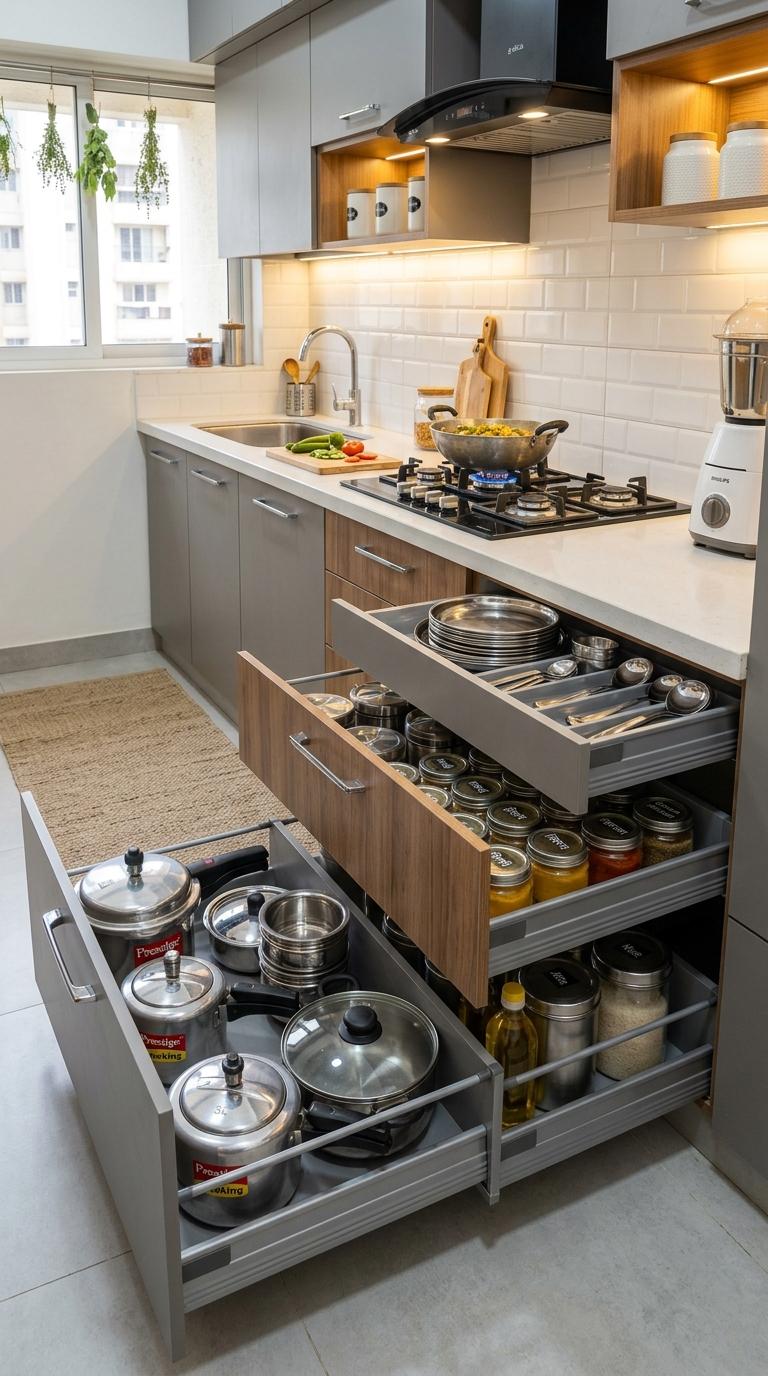
The base cabinets of a one-wall kitchen carry the heaviest and largest items in the kitchen. Pressure cookers, large kadais, heavy vessels, and bulk storage all live in the lower cabinets because the weight and size of these items make wall cabinet storage impractical. In a one-wall kitchen where the number of base cabinet positions is limited by the wall width, every base cabinet position needs to work at maximum capacity.
Pull-out drawer systems in every base cabinet position maximise the usable storage in each cabinet by making the full depth accessible and the full contents visible. A deep base cabinet fitted with two or three pull-out drawers holds significantly more usable storage than the same cabinet with a fixed shelf and a hinged door, because nothing is hidden at the back and nothing requires removing the front layer to access items behind it. In a one-wall kitchen where the total number of base cabinets is limited by the available wall length, each cabinet working at maximum capacity is the only way to make the storage adequate for Indian cooking requirements.
6. A Tall Larder Column at One End of the Wall Run
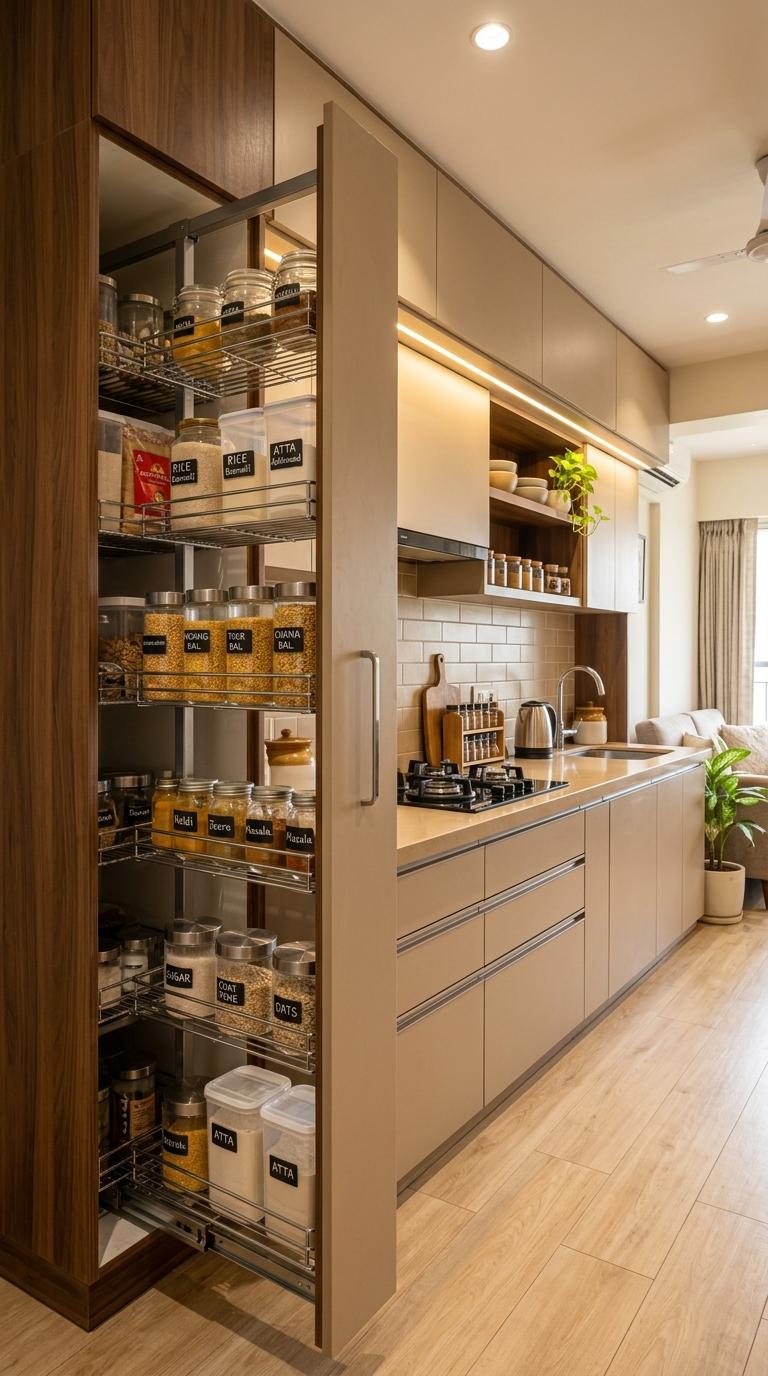
The storage limitation of the one-wall kitchen is most acute for dry goods. The bulk quantities of rice, dal, atta, and other staples that Indian cooking requires fill the available shelf space in a single wall cabinet run quickly and leave little room for the vessels, utensils, and equipment that also need to be stored. The solution is to consolidate all dry goods storage into a single, tall larder column at one end of the wall run rather than distributing it across the standard wall and base cabinets.
A tall larder column, a full-height cabinet from floor to ceiling with pull-out shelves and wire baskets at different levels, positioned at the end of the single wall run nearest the prep zone, holds the entire dry goods requirement of the household in a single dedicated unit. This consolidation frees the remaining wall and base cabinets from dry goods storage entirely, leaving them available for vessels, utensils, and equipment without the competition for shelf space that occurs when dry goods and cooking equipment share the same cabinets.
7. An Island or Rolling Cart in Front of the Counter
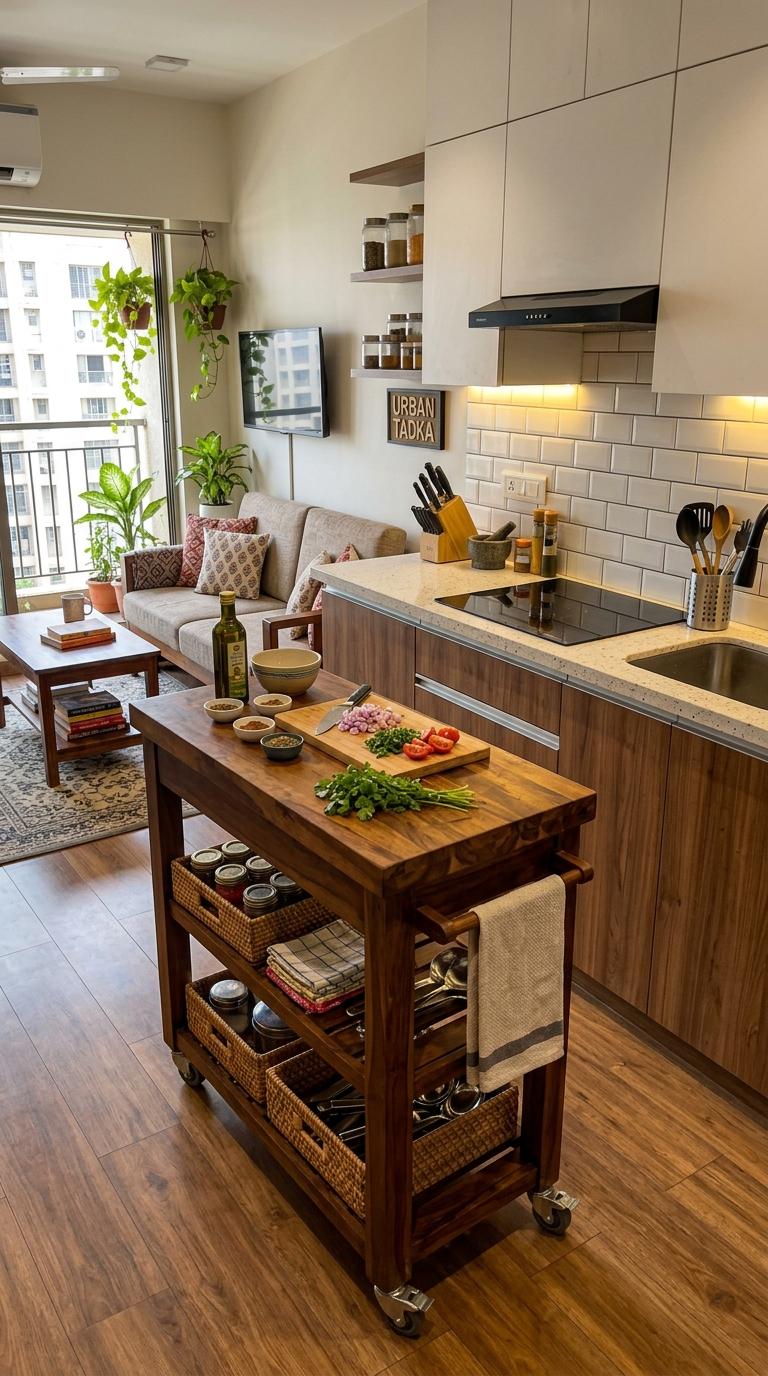
A one-wall kitchen in a space large enough to accommodate a freestanding element in front of the counter, with adequate clearance between the counter and the island of at least 900 millimetres for comfortable movement, benefits significantly from a compact island or rolling cart positioned opposite the single wall. The island or cart adds counter surface, adds storage on its lower shelves, and creates a second working position in the kitchen that the single wall cannot provide.
In a small flat where the kitchen is open to the living area, a compact kitchen island or a slim rolling cart in front of the one-wall kitchen also defines the kitchen zone within the larger open-plan space. It creates a visual boundary between the kitchen and the living area without a physical wall, gives the single wall kitchen a second surface to work from, and when the cart is on wheels, moves out of the way when the kitchen space needs to function as part of the living room rather than as a kitchen.
8. Open Shelving for the Most Frequently Used Items
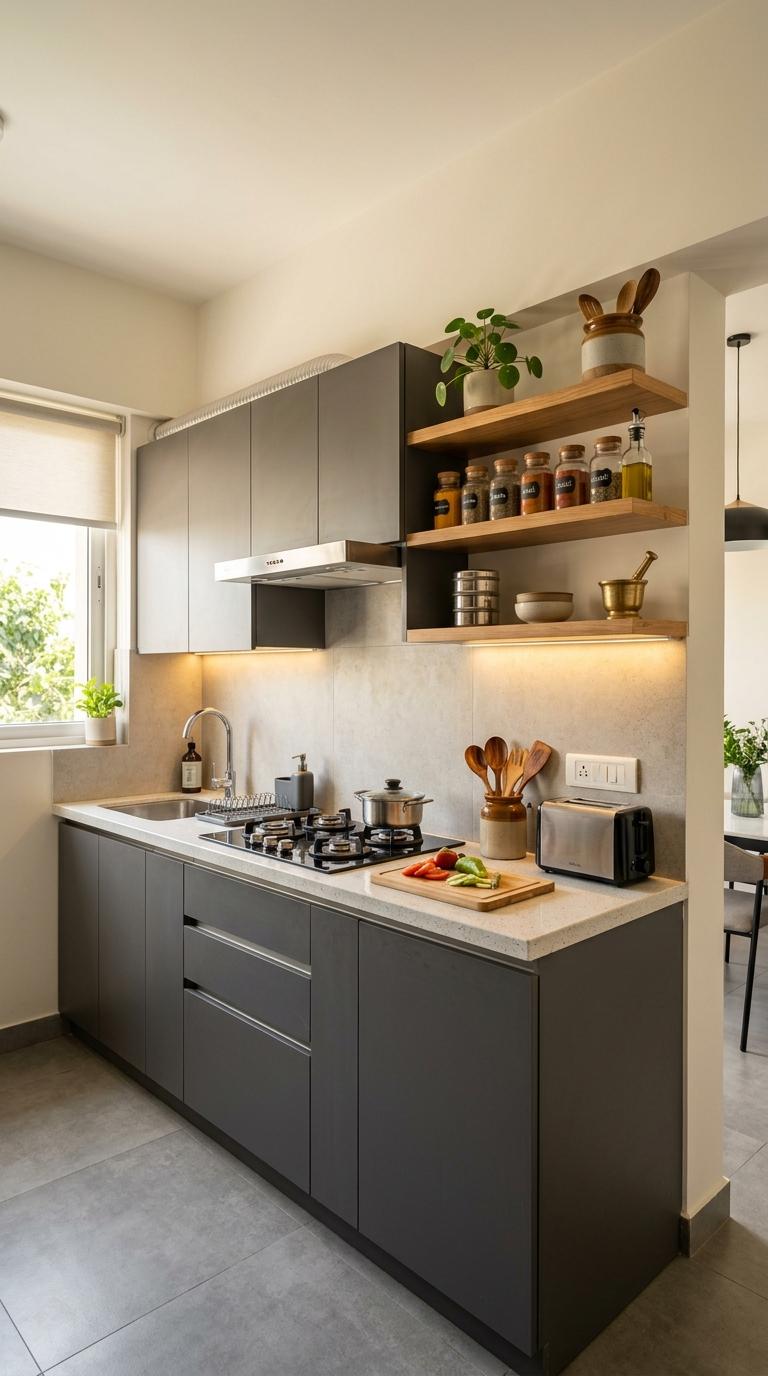
In a one-wall kitchen where the cabinet doors along the single wall create an unbroken visual mass of closed storage, replacing one section of wall cabinets with open shelving introduces visual relief and creates a more accessible storage zone for the items reached for most frequently during cooking. Spices, everyday vessels, oil and condiment bottles, and frequently used utensils on open shelves are faster to access than the same items behind cabinet doors, which in the tight workflow of a single-wall kitchen during active cooking is a genuine functional advantage.
The open shelf section should replace one wall cabinet unit in the run, positioned at the prep and cooking zone where fast access to everyday items is most valuable. Keep the open shelves curated and consistent. Three or four coordinated spice jars, a small ceramic vessel for utensils, a bottle of oil, and one small plant is an organised open shelf. A random accumulation of jars, packets, and bottles is visual clutter that makes the single wall kitchen feel chaotic rather than efficient.
9. Under-Cabinet Lighting Across the Full Counter Length
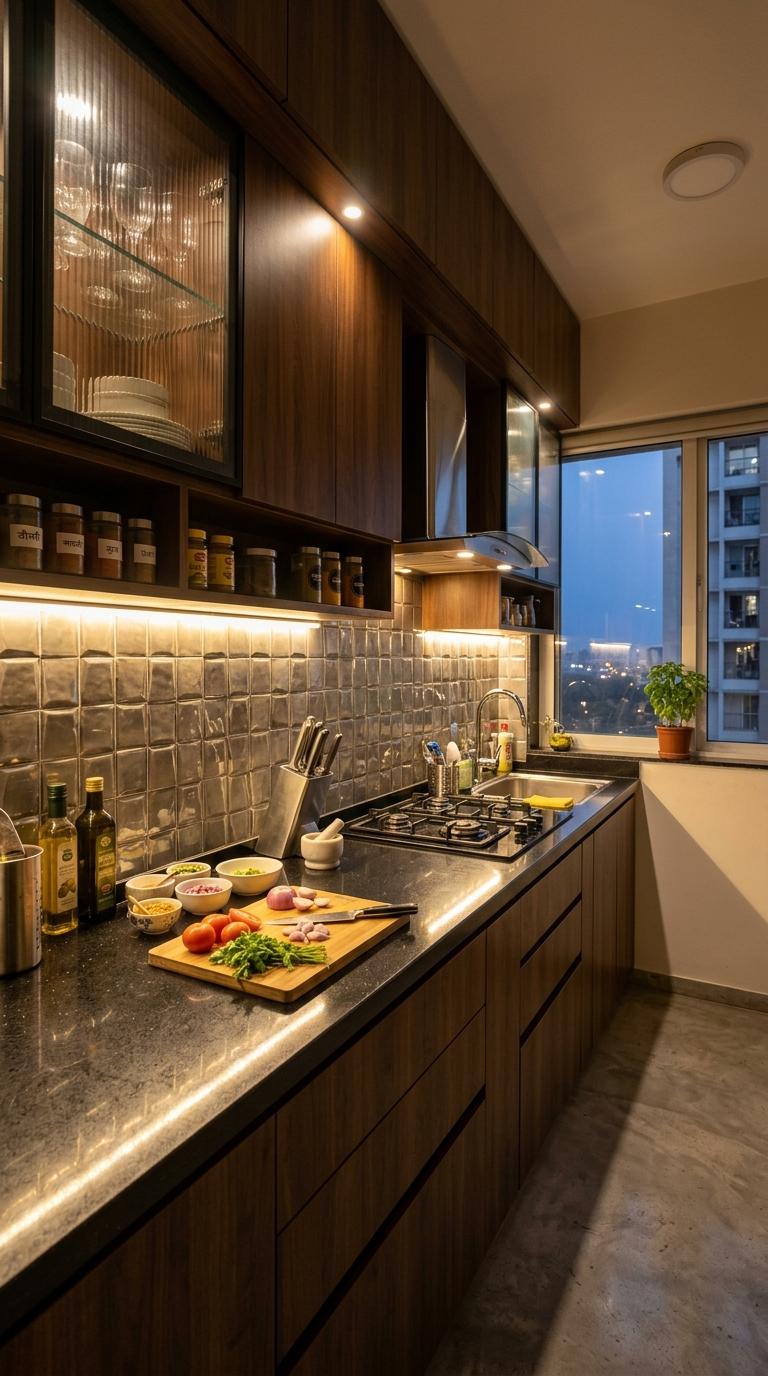
The single counter of a one wall kitchen is the primary work surface for every stage of food preparation. Lighting it adequately is a functional requirement rather than an aesthetic one. A single overhead fitting in a kitchen where the cook stands directly below it and blocks the light with their own body during counter work is insufficient task lighting for chopping, rolling, and the detailed prep that Indian cooking requires.
Under-cabinet LED strip lighting fitted to the underside of the wall cabinets, running the full length of the counter below them, provides direct, consistent task lighting across the entire working surface without shadows. In a one wall kitchen, this means a single continuous strip of under-cabinet light along the full single wall, creating a uniform illumination of the counter from one end to the other. The practical improvement in counter visibility is immediate. The visual effect, a warm band of light across the full counter surface, also makes the one wall kitchen feel more considered and more deliberately designed than the same kitchen lit only from above.
10. A Compact Chimney Specified for the Counter Width
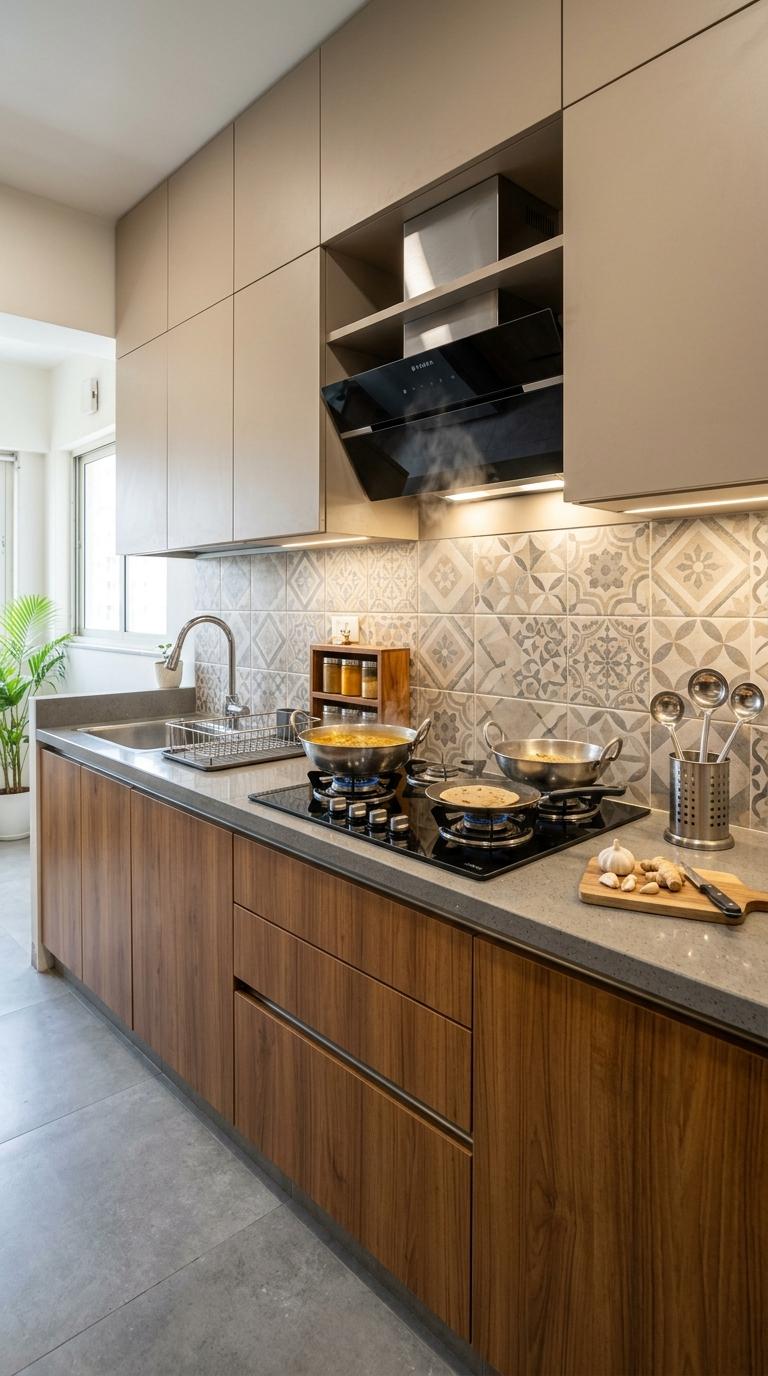
The chimney in a one wall kitchen needs to be sized and positioned to extract efficiently from a cooktop that sits within a counter run that also carries the sink, the prep surface, and the refrigerator on the same wall. A chimney hood that is oversized for the cooktop below it dominates the limited wall space above the counter. One that is undersized leaves the cooking position inadequately ventilated during the heavy smoke and steam of Indian cooking.
Specify the chimney width to match the cooktop width, typically 60 centimetres for a standard two or three burner cooktop, and position it at the manufacturer’s recommended extraction height above the cooking surface. In a one-wall kitchen where the wall above the counter carries both wall cabinets and the chimney on the same surface, the chimney needs to be integrated into the wall cabinet run as a flush-fit unit rather than projecting forward from the wall as a separate element that interrupts the cabinet line. A chimney that sits flush with the surrounding wall cabinets maintains the clean, linear quality of the single wall kitchen without creating an awkward projection that breaks the counter and cabinet composition.
11. A Pegboard or Rail System Above the Counter
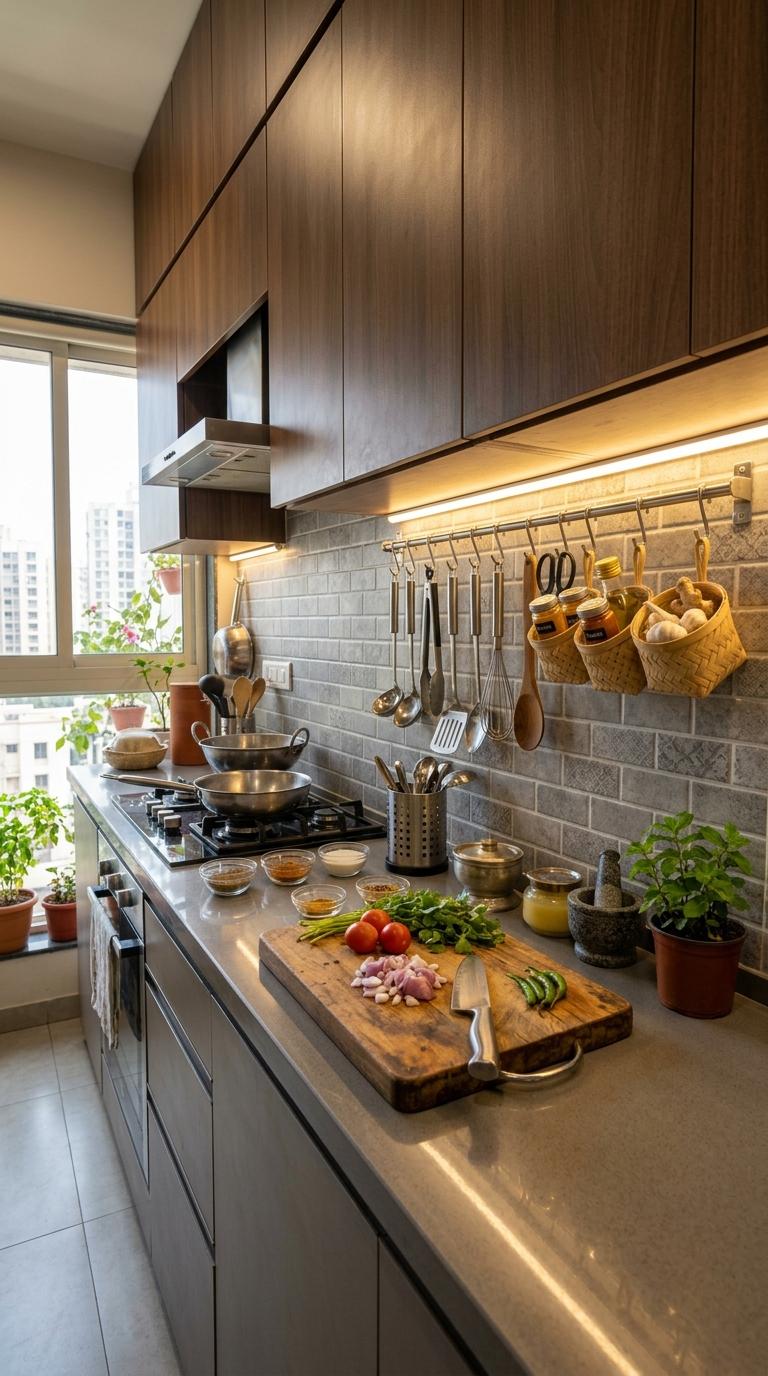
The wall surface above the counter in a one-wall kitchen, between the counter and the underside of the wall cabinets, is typically a backsplash tile with nothing on it. In a kitchen where the counter length is fixed, and the cabinet storage is already fully committed, this vertical surface above the counter represents an additional storage zone that the standard one-wall kitchen does not use.
A stainless steel wall rail fitted to the backsplash wall in this zone, with hooks for utensils, small baskets for spice jars, and a bar for hanging tools, keeps the most frequently used items in the kitchen within immediate reach of the cooking and prep position without using any counter space or any cabinet shelf space. The rail system occupies wall space that was previously decorative rather than functional and converts it into active storage at the most critical point in the single-wall kitchen, directly above and adjacent to the prep and cooking zone.
12. A Bar Counter on the Room-Facing Side
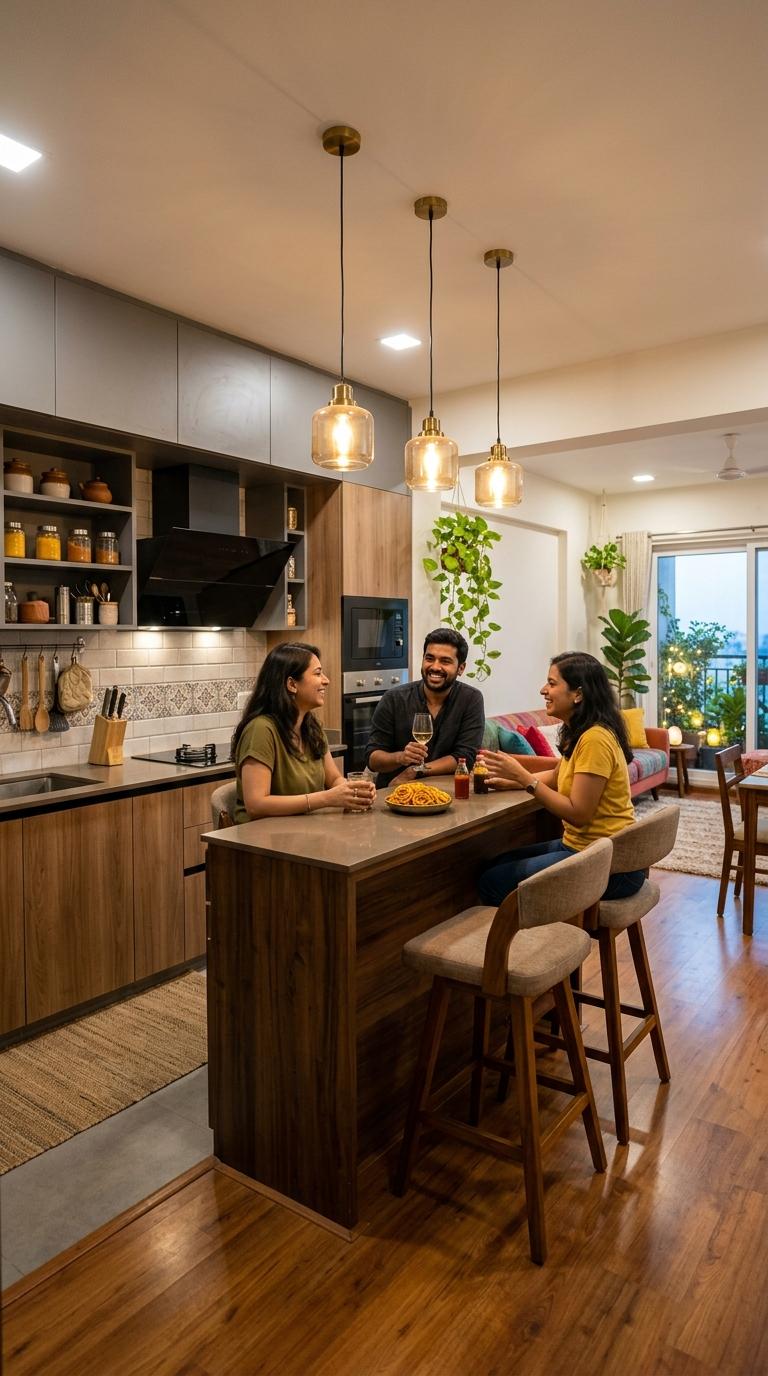
A one-wall kitchen in an open-plan flat has a room-facing side that is typically left as an open edge. Guests look into the kitchen from the living area and the kitchen looks back at the living area without any physical or visual mediation between the two zones. Adding a bar counter along the room-facing edge of the single wall kitchen, a narrow counter at bar height projecting 300 to 350 millimetres from the base cabinet run, creates a boundary between the kitchen and the living area, adds a serving and dining surface on the room-facing side, and creates a social position where guests can sit while the cook works at the counter behind.
The bar counter on the room-facing side of a one-wall kitchen is the most direct way to add a second function to the kitchen- dining and socialising- without adding floor area to the kitchen zone or changing the single wall layout in any way. It uses the depth of the base cabinet run as its structural base, requires only a counter overhang and two or three bar stools to complete, and transforms the one wall kitchen from a purely functional cooking surface into an integrated cooking and dining space that works naturally in an open-plan flat.
One Wall, Done Well
A one-wall kitchen designed with care is not a lesser kitchen. It is a kitchen that has resolved the challenge of doing everything along a single line and done it well enough that the limitation is no longer visible in the result.
Sequence the counter correctly. Use the full wall height. Specify pull-out storage in every base cabinet. Add the fold-down extension and the larder column. Light the counter from below. Put the rail above it.
The one-wall kitchen that does all of those things well gives back more than its dimensions suggest is possible. Which is exactly what good design is supposed to do.

Aarav Sharma is a passionate home and lifestyle writer. He loves exploring kitchen design, home decoration, and interior styling. With a keen eye for beautiful details and practical design ideas. Aarav Sharma shares inspiration to help readers create comfortable and functional living spaces.