
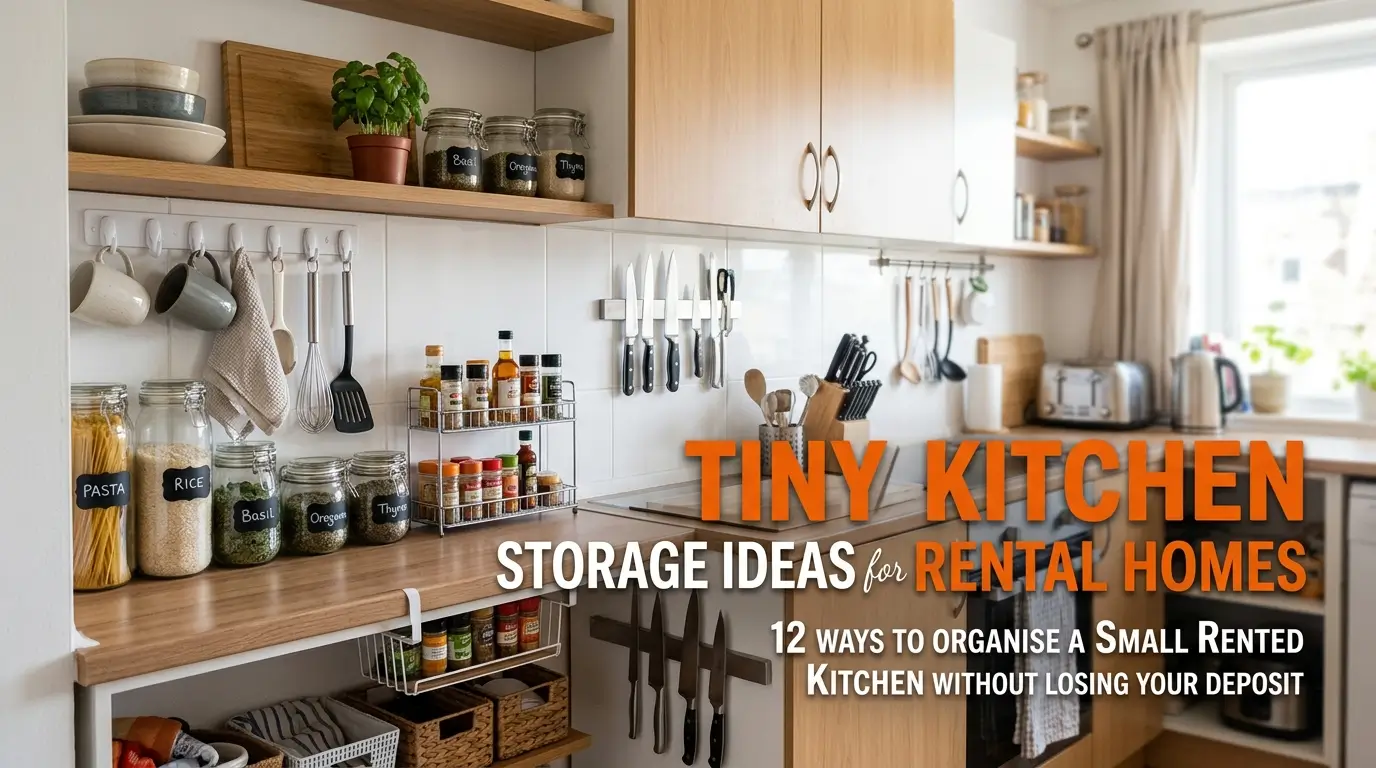
A tiny rented kitchen presents a storage problem with a fixed set of constraints that do not apply to any other kind of kitchen project. You cannot drill into the walls. You cannot replace the cabinets. You cannot reconfigure the plumbing or move the appliances that the landlord installed. The kitchen is what it is, and the storage solutions available to you are limited to what can be added, placed, hung, or attached without leaving permanent marks on surfaces that belong to someone else.
This is a more solvable problem than it first appears. The constraints are real, but they are not as limiting as the instinct to drill and fix might suggest. A significant proportion of the most effective kitchen storage solutions require no wall fixings at all. They work with the existing structure of the kitchen, using surfaces, edges, doors, and vertical space that standard kitchen design consistently overlooks.
The additional challenge in a tiny rented Indian kitchen is the volume and variety of what needs to be stored. Indian cooking uses a wider range of dry goods, spices, vessels, and equipment than most other domestic cooking traditions. A kitchen that might work adequately for light cooking becomes genuinely inadequate the moment it has to accommodate a full set of masalas, a pressure cooker, a tawa, multiple kadais, a mixer-grinder, and the dry goods that Indian cooking requires in regular supply. Storage in a tiny rented Indian kitchen is not an aesthetic consideration. It is a functional necessity.
Here are 12 storage ideas for a tiny rented kitchen that work within the constraints of a rental property and the demands of Indian cooking.
Tiny Kitchen Storage Ideas for Rental Homes
1. Over-the-Door Organisers on Every Cabinet Door
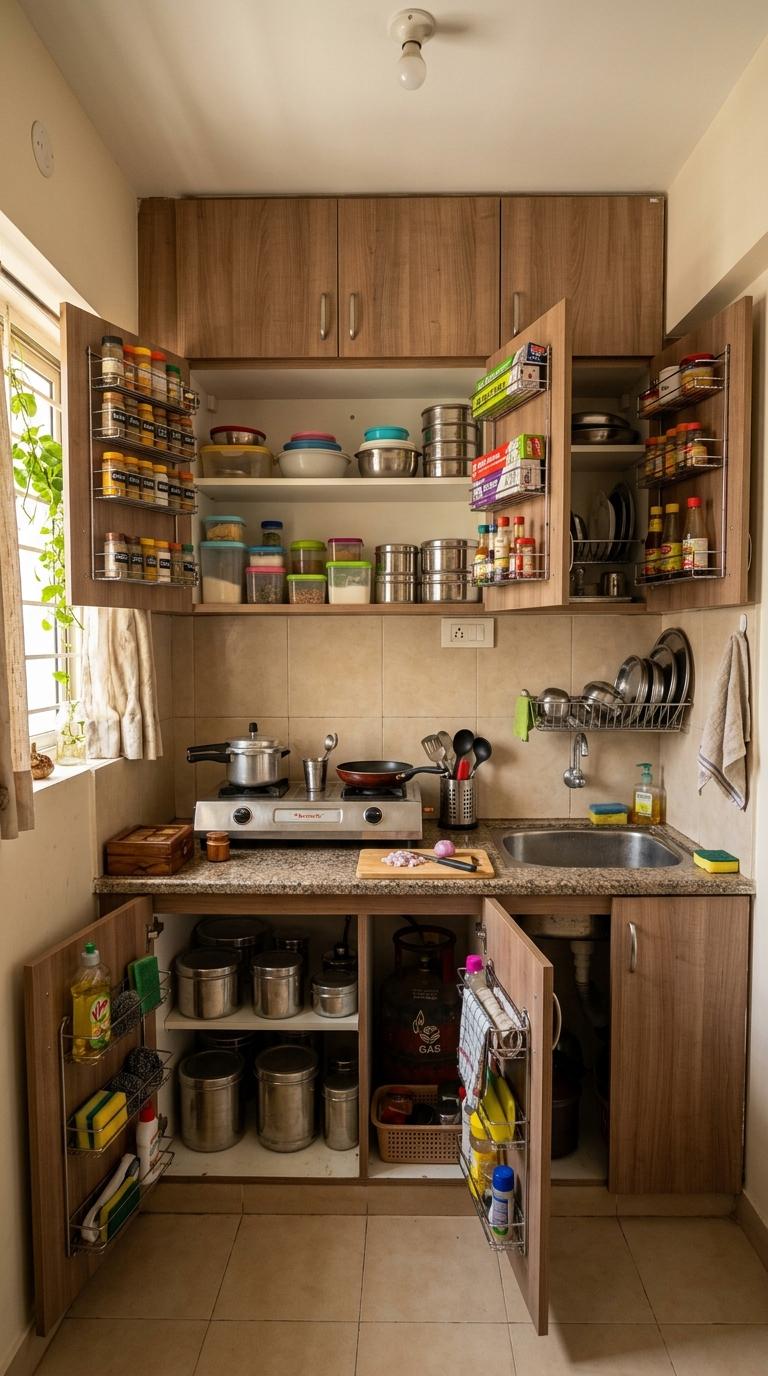
The inside face of every cabinet door in a tiny kitchen is usable storage space that standard kitchen design ignores entirely. An over-the-door organiser, a wire or plastic rack that hooks over the top edge of the cabinet door without any fixing, converts this unused surface into shelving for spice jars, cleaning supplies, foil rolls, small bottles, and the miscellaneous items that accumulate in every kitchen without a natural home.
Over-the-door organisers are available in multiple sizes for both wall cabinet doors and base cabinet doors. A wire rack on the inside of the wall cabinet door nearest the cooktop holds the most frequently used spices within immediate reach without taking up any shelf space inside the cabinet. A rack on the inside of the base cabinet door below the sink holds cleaning supplies, dish soap, and scrubbers in a location that makes them accessible without consuming the under-sink floor space that the plumbing already reduces. Applied consistently across every cabinet door in the kitchen, over-the-door organisers add a meaningful volume of additional storage at minimal cost with no wall fixings required.
2. Tension Rods to Create Vertical Dividers in Cabinets
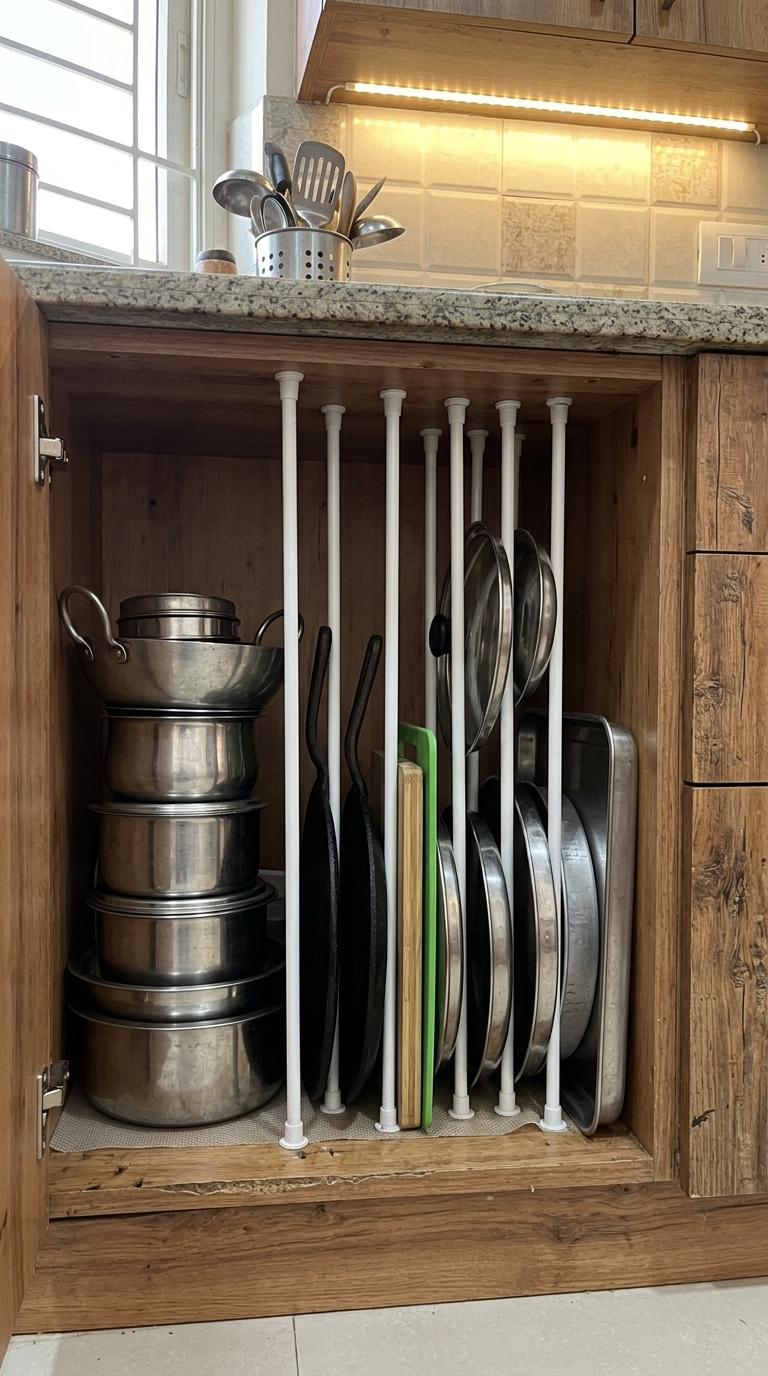
The deep base cabinet is the storage problem that most consistently defeats small kitchen organisation. Items pushed to the back become invisible and inaccessible. Flat items like baking trays, tawas, and cutting boards stack horizontally and require removing the entire stack to access the item at the bottom. The cabinet is full but functionally useless beyond the front layer of whatever has been placed nearest the door.
Tension rods placed vertically inside a deep base cabinet, spanning from the cabinet floor to the underside of the shelf above, create dividers that allow flat items to stand upright rather than lying horizontal. A tawa, a flat griddle, and two cutting boards stored vertically between tension rod dividers take up a fraction of the floor space they would require lying flat, are individually accessible without moving anything else, and leave the remaining cabinet floor space free for vessels and containers. Tension rods require no drilling, no adhesive, and no permanent modification. They compress between two surfaces and hold by friction alone.
3. A Freestanding Pantry Unit as the Storage Backbone
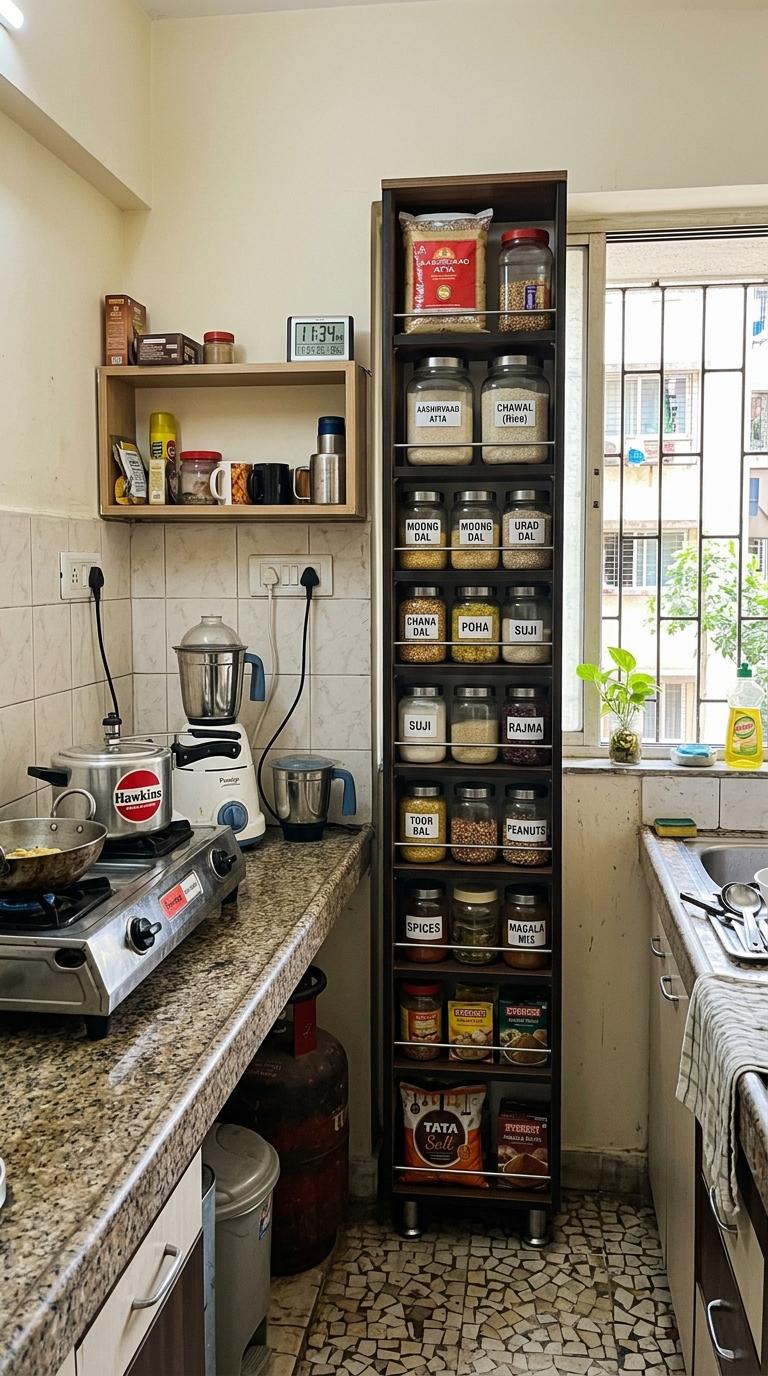
When cabinet storage runs out, and in a tiny rented kitchen it almost always runs out before the storage requirements are met, a freestanding pantry unit is the most volume-efficient addition available without touching the walls. A slim pantry unit, 30 to 40 centimetres in depth and as tall as the ceiling allows, placed in whatever gap exists in the kitchen layout, adds multiple shelves of storage in a footprint that is often smaller than a single base cabinet width.
In a tiny rented Indian kitchen, the freestanding pantry unit typically becomes the home for dry goods that overflow the cabinets. Rice, dal, atta, poha, and the range of stored grains and pulses that Indian cooking requires in quantity fit naturally on pantry shelves in uniform containers that keep the unit organised and the contents visible. The pantry unit requires no wall fixing, no modification to the kitchen, and moves to the next home when the tenancy ends.
4. Magnetic Knife Strip on the Fridge Side Panel
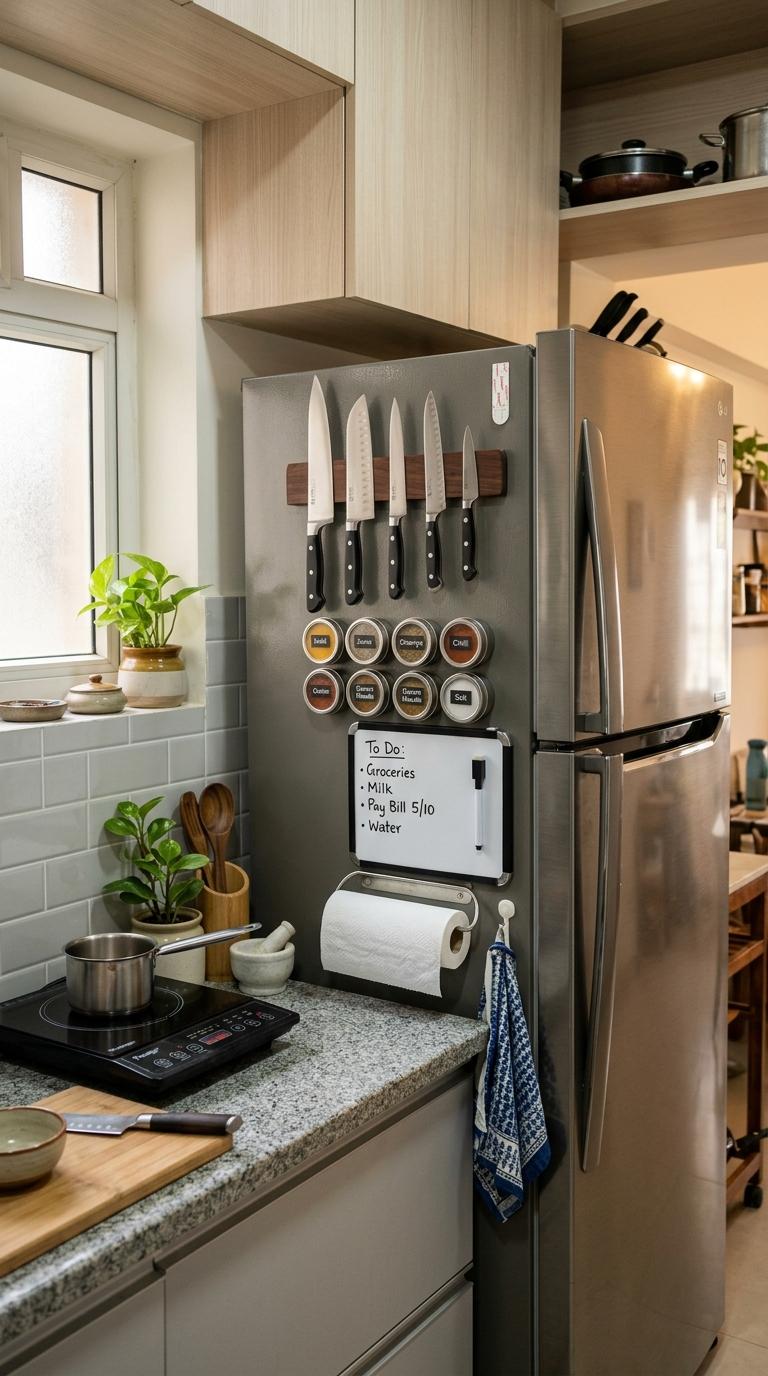
Counter space in a tiny rented kitchen is too valuable to accommodate a knife block. A standard knife block holding five or six knives occupies 200 to 250 square centimetres of counter surface and contributes nothing to the kitchen beyond holding knives. A magnetic knife strip, adhered to the side panel of the refrigerator with heavy-duty removable adhesive strips, holds the same number of knives vertically on a surface that was previously unused without occupying any counter space at all.
The side of the refrigerator is a consistently underused vertical surface in most kitchens. Beyond the magnetic knife strip, it can also carry a small magnetic whiteboard for notes and lists, magnetic spice tins for the most frequently used spices, and a magnetic paper towel holder that removes the paper towel roll from the counter. Each addition uses the refrigerator surface for storage without requiring any wall fixing or permanent modification to the rental property.
5. Stackable Containers for All Dry Goods
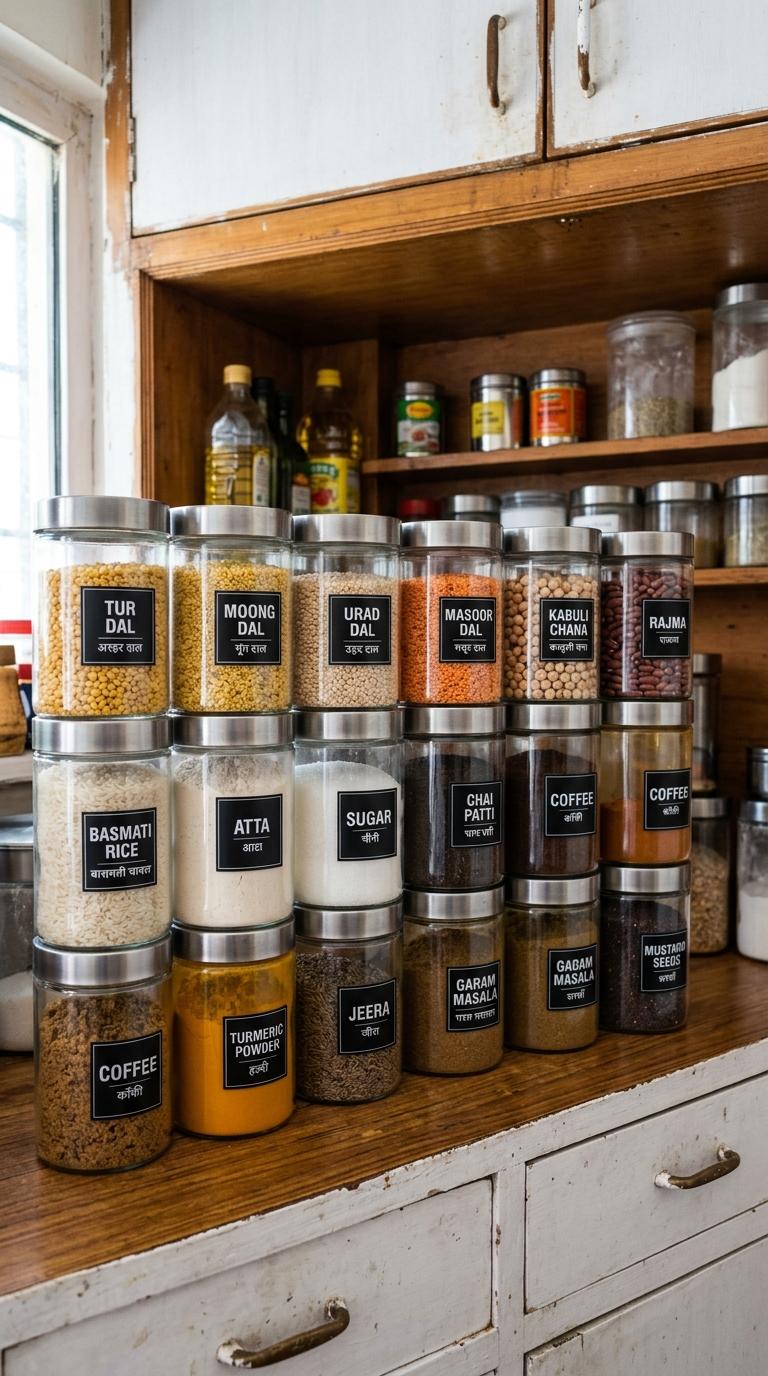
The single most impactful organisation change available in any kitchen, regardless of size or tenure, is decanting dry goods from their original packaging into uniform stackable containers. Original packaging- bags of dal in various sizes, partially used atta packets folded and clipped, jars of different heights and widths all stored together on a shelf- creates visual noise and wastes space through the irregular shapes and sizes of the containers.
Uniform stackable containers in clear plastic, glass, or stainless steel, filled with decanted dry goods and labelled clearly, stack efficiently, use shelf height to maximum advantage, make quantities immediately visible, and create a visual order in the cabinet that makes the storage feel organised rather than crammed. In a tiny rented kitchen where the shelf space inside cabinets is fixed and cannot be increased, making every centimetre of that shelf space as efficient as possible through uniform stackable containers is the most direct way to expand the effective storage capacity without adding a single new storage unit.
6. A Rolling Cart as a Mobile Storage and Prep Surface
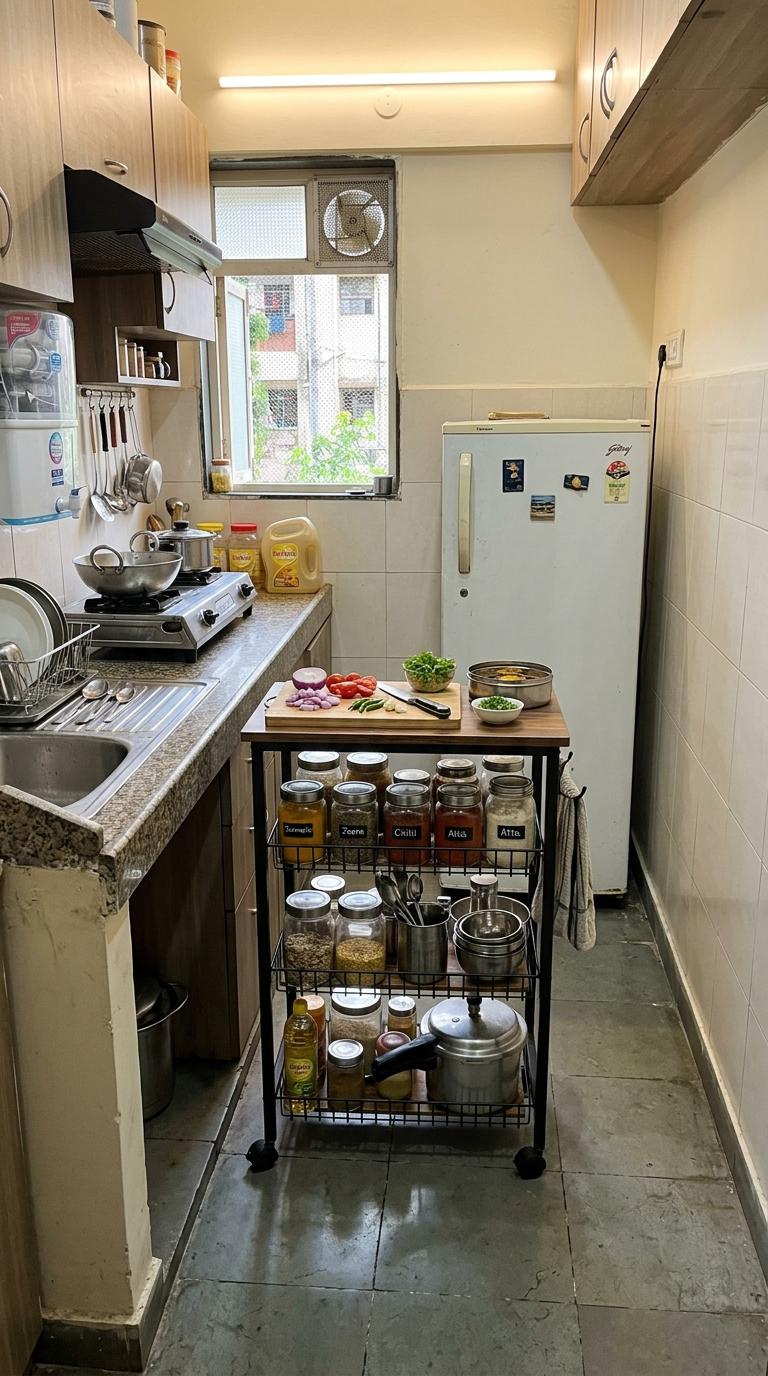
A compact rolling cart, a slim unit on wheels with one or two shelves below a work surface, solves two problems simultaneously in a tiny rented kitchen. It adds counter space when the fixed counter is not sufficient for the meal being prepared. And it adds storage on its lower shelves for the items that do not fit in the existing cabinets.
The rolling cart earns its place in a tiny kitchen through its mobility. During cooking, it positions next to the counter as an extension of the prep surface. During meals, it moves to a different part of the kitchen or outside the kitchen entirely. When the kitchen is not in use, it parks in whatever gap exists in the layout. A slim cart, 40 to 45 centimetres wide, fits in gaps beside the refrigerator or at the end of the counter run that would otherwise be wasted space. It requires no installation, no wall fixing, and moves to the next home when the tenancy ends.
7. Shelf Risers Inside Every Cabinet
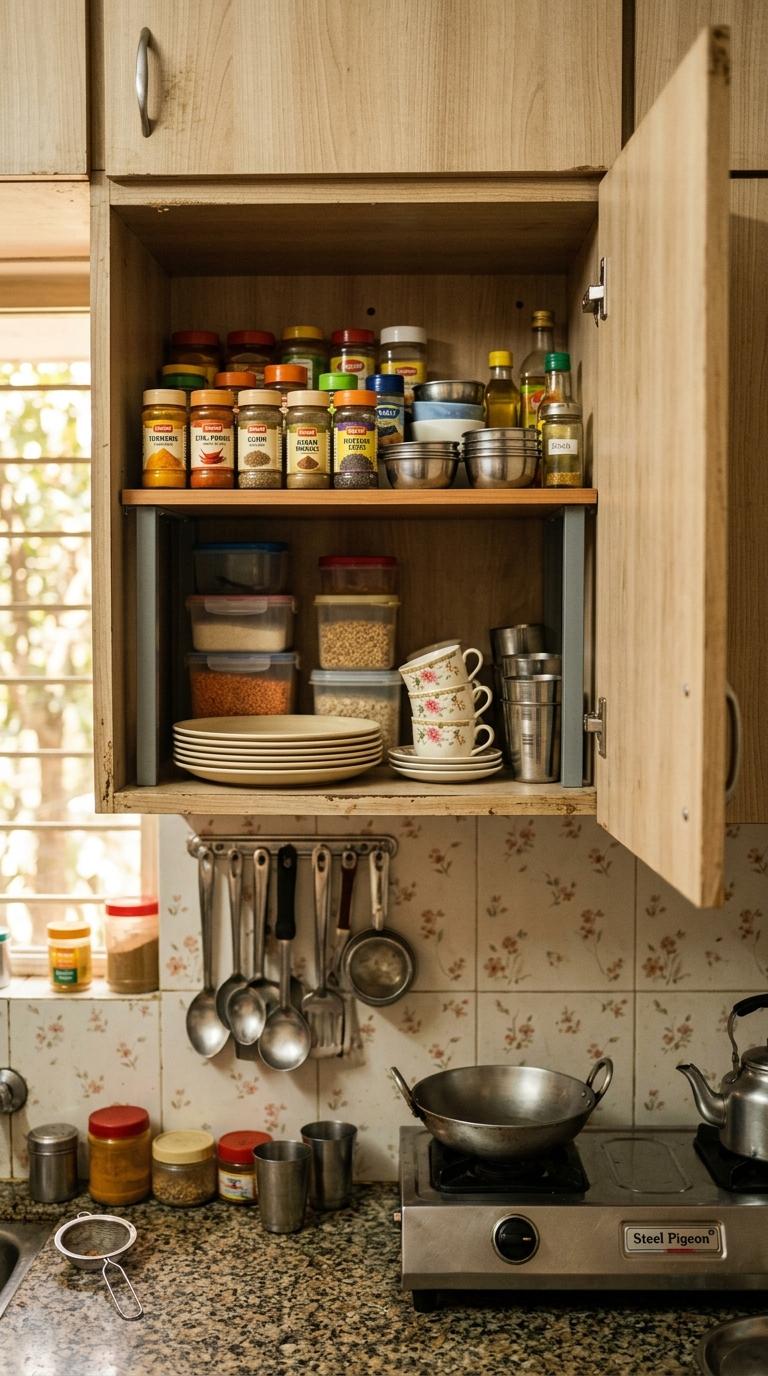
The vertical space inside a cabinet between one shelf and the shelf above it is rarely used to its full height. A shelf loaded with items that are 15 centimetres tall leaves 10 to 15 centimetres of unused air above those items, all the way to the next shelf. In a tiny kitchen where every storage location is at a premium, that unused height represents a significant volume of space being discarded on every shelf in the kitchen.
Shelf risers, small freestanding platforms that sit on the existing shelf and create a second level of storage within the same shelf space, use this unused height by stacking a second layer of items above the first. A shelf riser in the wall cabinet holds a second row of spice jars above the front row. A shelf riser in the base cabinet stacks a second layer of smaller containers above the base layer of larger ones. Applied across every shelf in the kitchen, shelf risers can increase the effective storage capacity of existing cabinets by 30 to 50 percent without adding a single new unit.
8. The Counter Appliance Audit
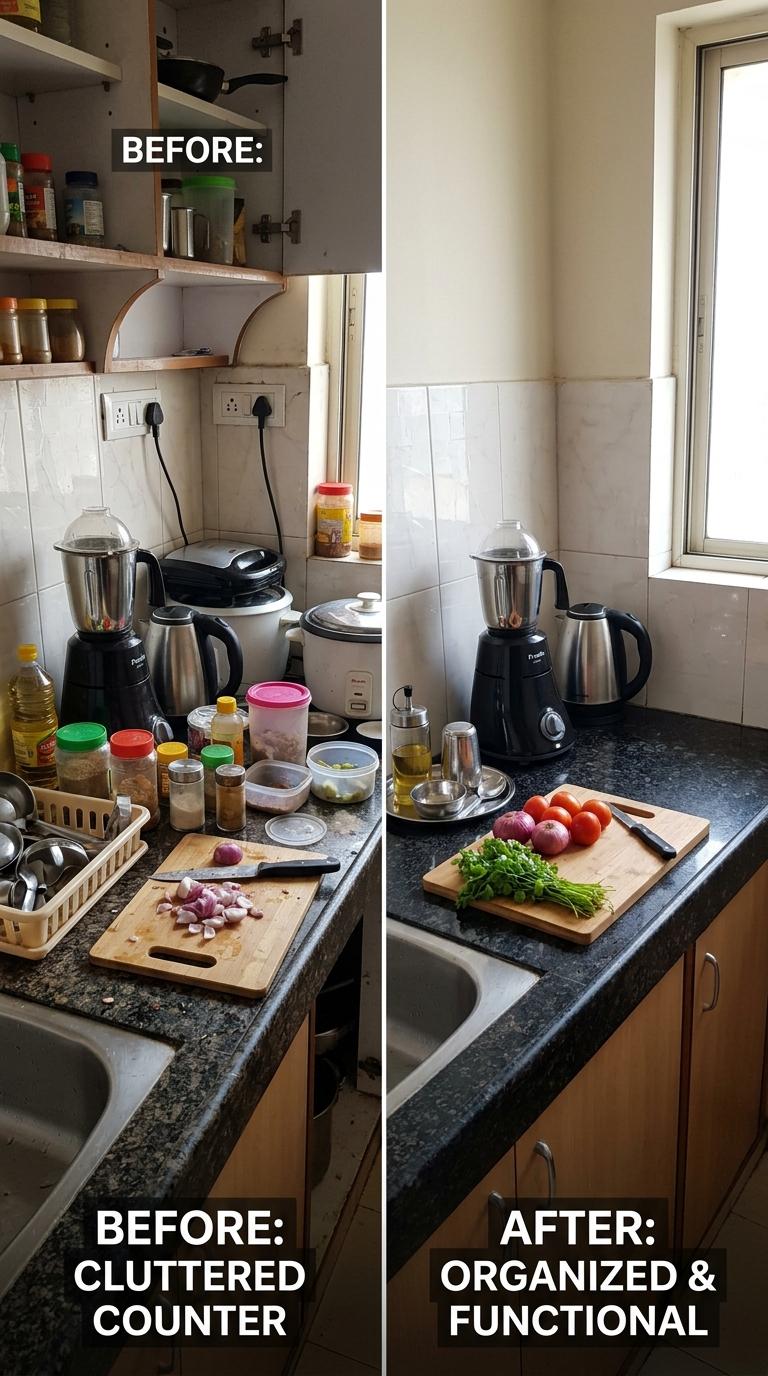
In a tiny rented kitchen, the counter is the most valuable surface in the room and the one most consistently misused. Appliances that live on the counter permanently because they are used regularly- the mixer-grinder, the electric kettle, the toaster- accumulate alongside appliances that are used occasionally but have migrated to the counter because there is nowhere obvious to store them. The result is a counter that is functionally unavailable for the prep and cooking that it should be supporting.
Conduct a counter appliance audit. Every appliance on the counter goes into one of two categories. Used daily, in which case it earns its counter position. Used less than daily, in which case it goes into a cabinet, onto a shelf, or into storage. The mixer-grinder and the electric kettle are legitimate daily-use counter appliances in most Indian households. The sandwich maker, the air fryer, and the electric rice cooker used twice a week are not. Storing occasional-use appliances off the counter and accepting the minor inconvenience of retrieving them when needed returns a significant section of counter to active use and makes the tiny kitchen feel immediately more workable.
9. An Over-the-Sink Expandable Rack
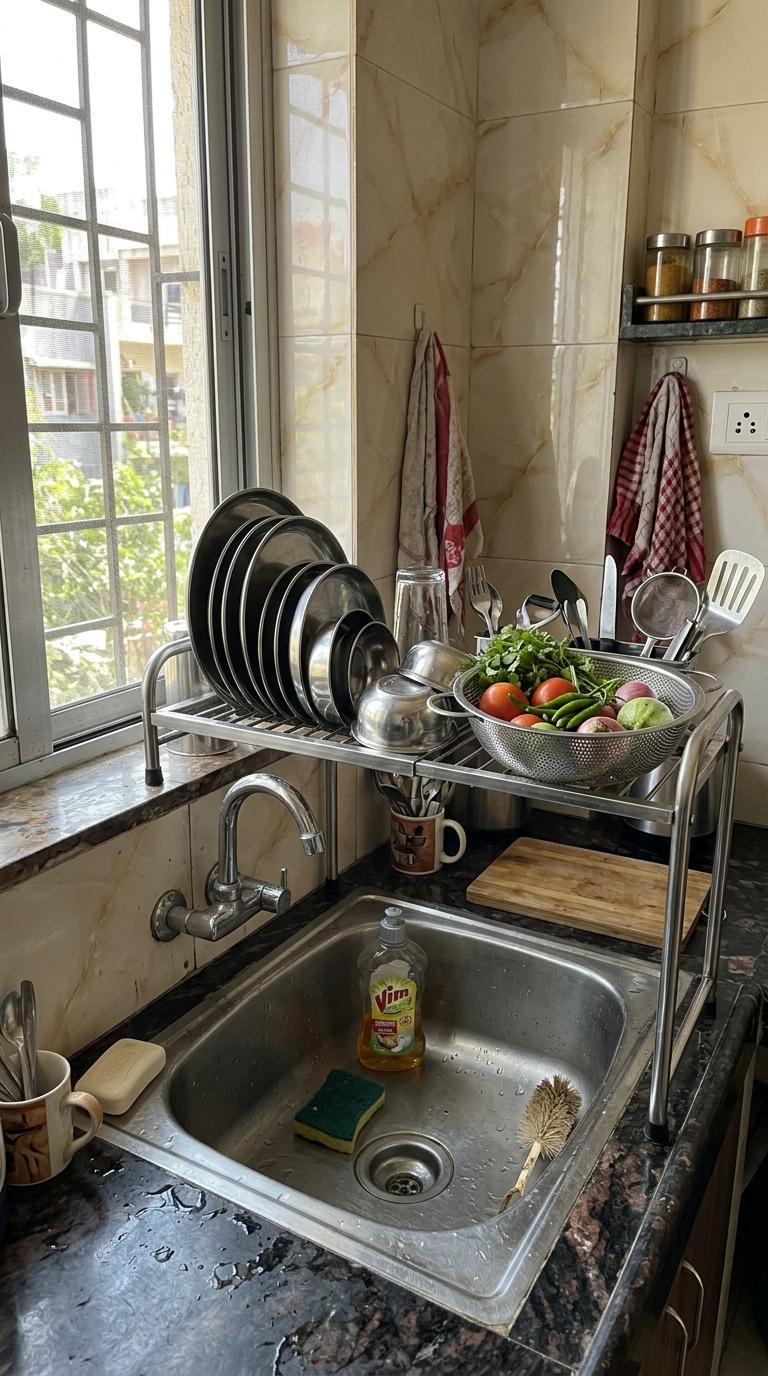
The space directly above the sink, bridging the gap between the two sides of the counter, is unused in most kitchens. An expandable over-the-sink rack, a frame that rests on the counter edges on either side of the sink, creates a surface directly above the sink bowl for drying dishes, staging items mid-prep, or holding a small colander of washed vegetables draining above the sink.
In a tiny rented kitchen where the counter on both sides of the sink is limited, the over-the-sink rack creates an additional work surface at a critical point in the workflow without requiring any installation. It sits on the counter edges by its own weight, can be moved or removed in seconds, and adds a meaningful additional staging area at the point in the kitchen where staging is most frequently needed. For a kitchen where the counter beside the sink is the primary prep area, an over-the-sink rack can effectively extend that prep area by the width of the sink bowl.
10. Pegboard Panel Propped Against the Splashback
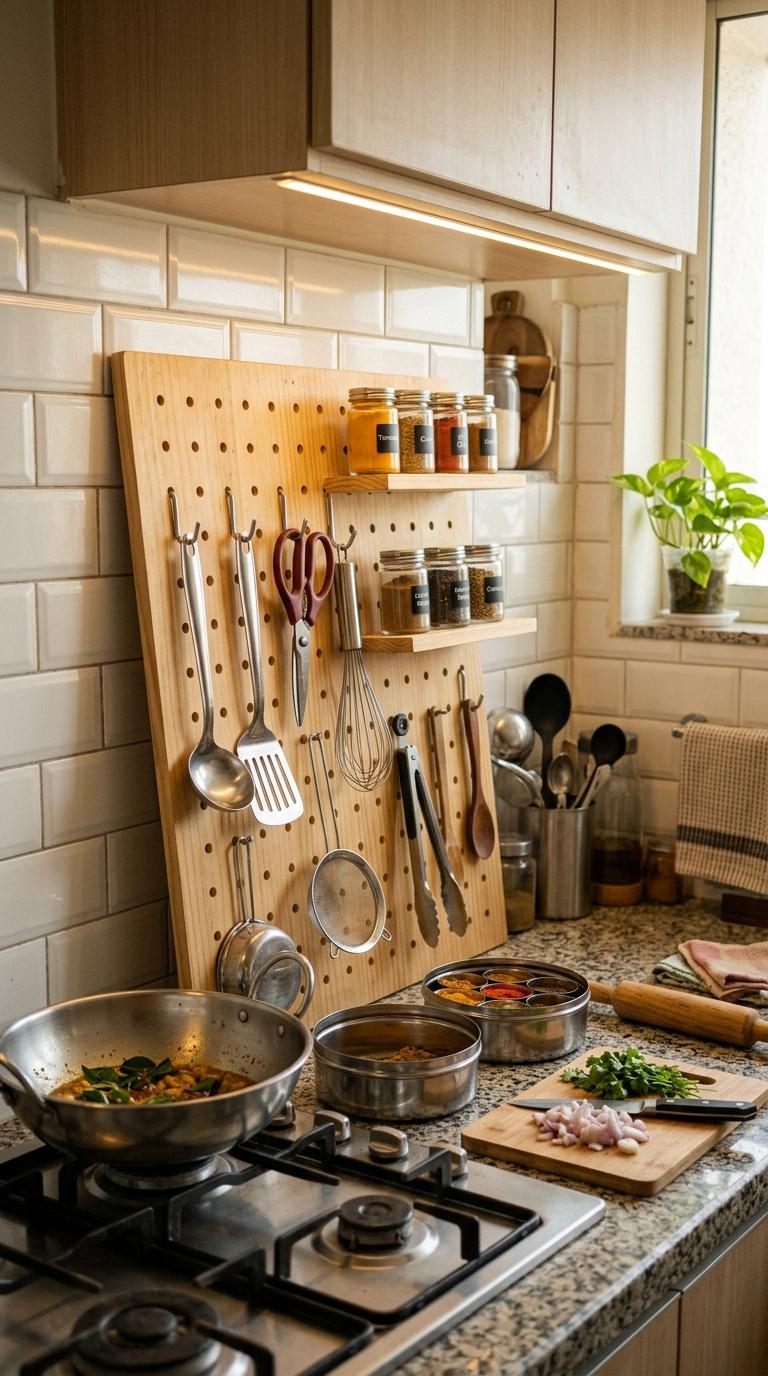
A pegboard panel fitted with hooks and small shelves is one of the most flexible storage systems available for a kitchen wall. In a rental property where drilling the wall to fix a pegboard is not permitted, the solution is to lean the pegboard panel against the splashback wall rather than fixing it to the wall surface.
A pegboard panel leaned against the splashback, held in place by a narrow ledge or by the counter surface it sits behind, holds utensils, small pots, spice jars on small shelf attachments, and kitchen tools on hooks without a single wall fixing. The panel sits on the counter surface at the back, leans against the splashback wall for support, and stores everything that would otherwise be taking up counter space or overcrowding a drawer. When the tenancy ends, the panel lifts away from the wall cleanly, leaving no marks on the splashback surface it was resting against.
11. Hanging Rail on the Inside of a Tall Cabinet Door
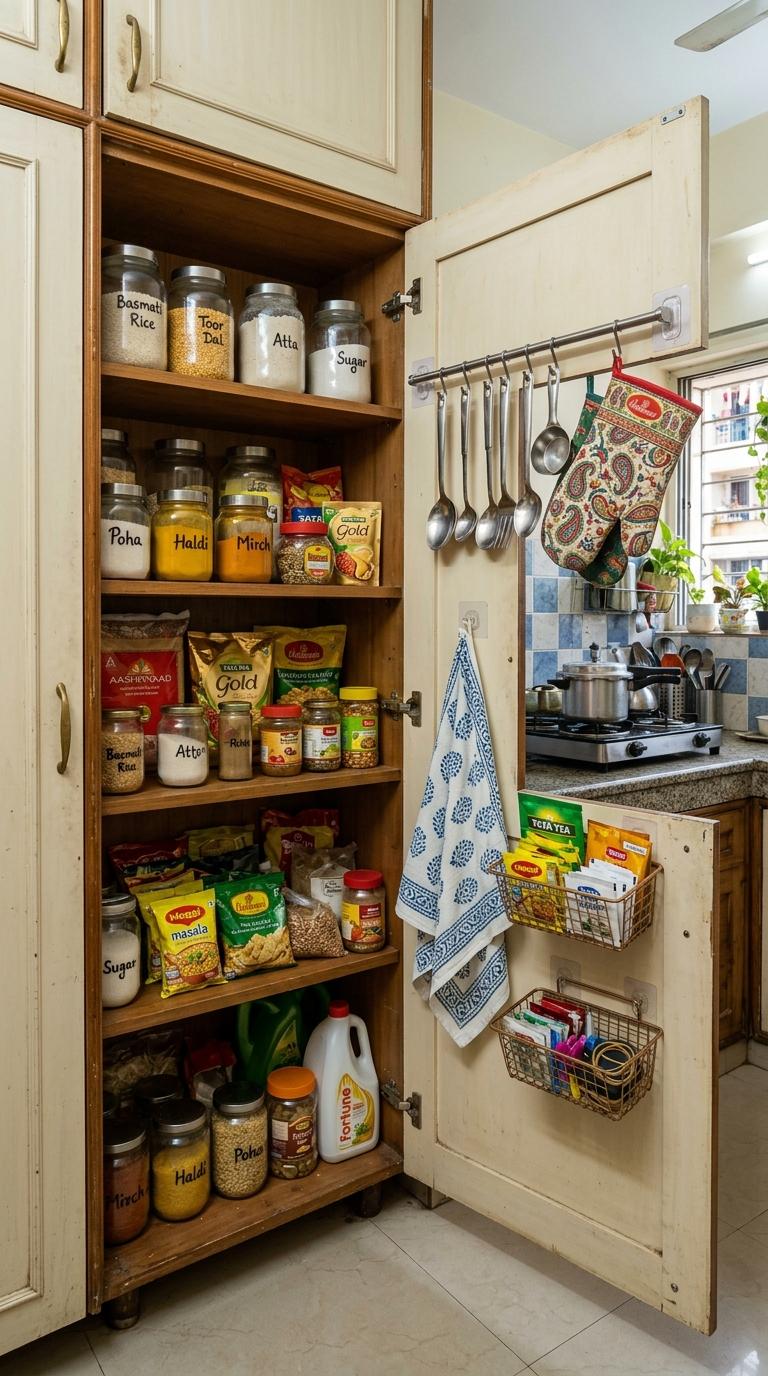
A tall cabinet or a pantry unit door, if one exists in the tiny rented kitchen, offers the largest single door surface available for over-door storage. A hanging rail fixed to the inside face of the tall cabinet door with adhesive mounting hardware holds a row of hooks for utensils, small hanging baskets for packets and sachets, and a holder for oven mitts and kitchen towels in a location that is accessible the moment the cabinet door is opened.
The inside face of a tall cabinet door is significantly larger than the inside face of a standard wall or base cabinet door and can accommodate a correspondingly larger rail and accessory system. In a tiny kitchen where the drawer and shelf storage is already fully committed, the tall cabinet door interior represents one of the few remaining large, unused surfaces available for additional storage without any wall fixing or permanent modification.
12. Label Everything and Assign Fixed Locations
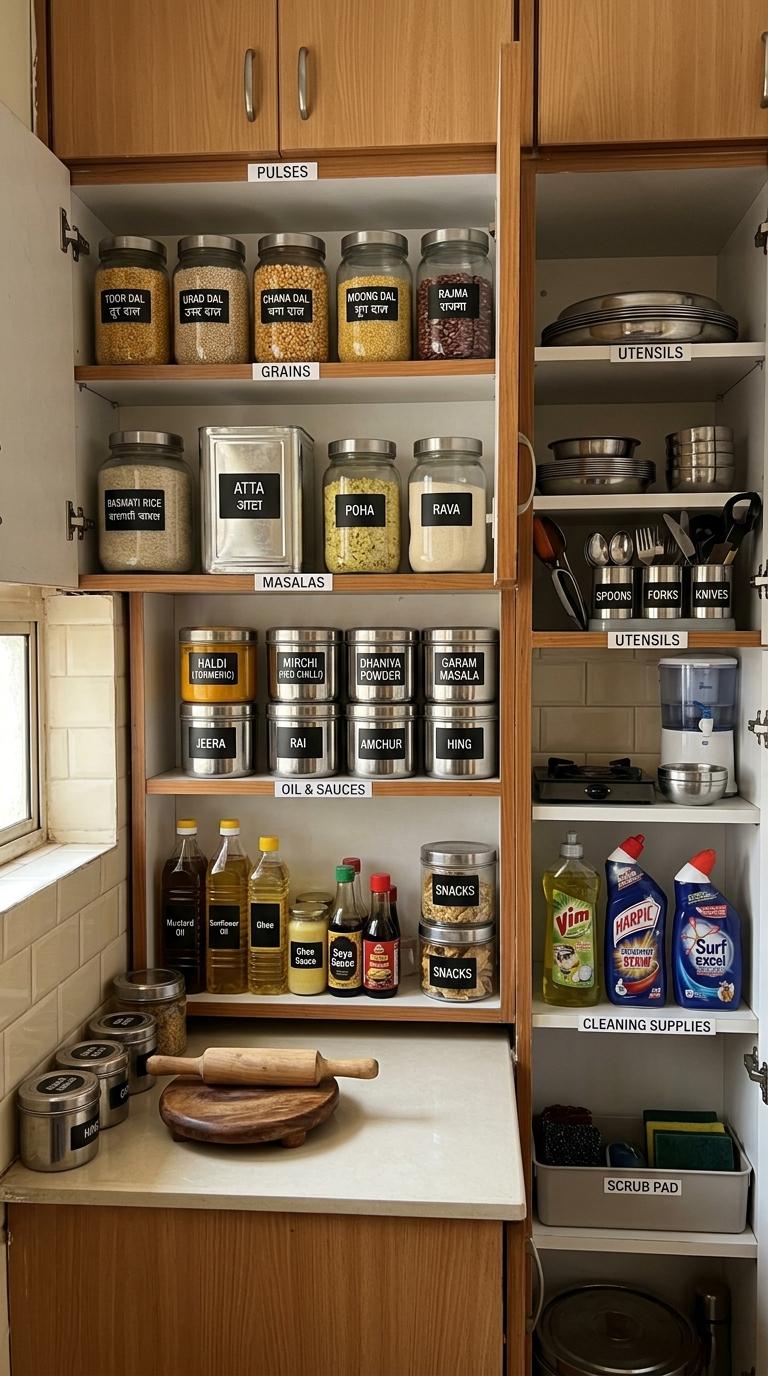
Organisation in a tiny rented kitchen is not maintained by the storage systems alone. It is maintained by the habit of returning every item to its assigned location after every use and labelling every container clearly enough that the correct location is never ambiguous. A tiny kitchen with good storage systems but no labelling and no fixed location discipline deteriorates into disorder within days of being organised. A tiny kitchen with modest storage systems but consistent labelling and location discipline stays organised indefinitely.
Label every container in the pantry and on the shelves. Label the shelves themselves if the categories stored on them are not immediately obvious. Assign a fixed location for every category of item in the kitchen and do not allow categories to migrate between locations as the kitchen fills up. When new items arrive in the kitchen, the question is not where there is space for them but where they belong in the existing location system. In a tiny rented kitchen where the storage is already at capacity, disciplined labelling and fixed location assignment is not a nicety. It is what makes the difference between a kitchen that stays organised and one that requires reorganising every few weeks.
Work With What You Have
A tiny rented kitchen is a fixed constraint, not a design problem that requires renovation to solve. The storage solutions that work best within it are the ones that engage with what is already there, using the inside faces of existing doors, the unused height inside existing cabinets, the surfaces of existing appliances, and the gaps in the existing layout, rather than adding new structures that compete with the limited space available.
Start with what costs nothing. The counter appliance audit. The fixed location assignment. The labelling. Then add the over-door organisers, the shelf risers, and the tension rod dividers that make the existing cabinets work at full capacity. Then bring in the rolling cart and the freestanding pantry for the storage that the existing cabinets genuinely cannot accommodate.
A tiny rented kitchen organised this carefully does not feel tiny. It feels considered. That distinction is available to every renter regardless of budget, regardless of the landlord’s restrictions, and regardless of how small the kitchen actually is.

Aarav Sharma is a passionate home and lifestyle writer. He loves exploring kitchen design, home decoration, and interior styling. With a keen eye for beautiful details and practical design ideas. Aarav Sharma shares inspiration to help readers create comfortable and functional living spaces.