
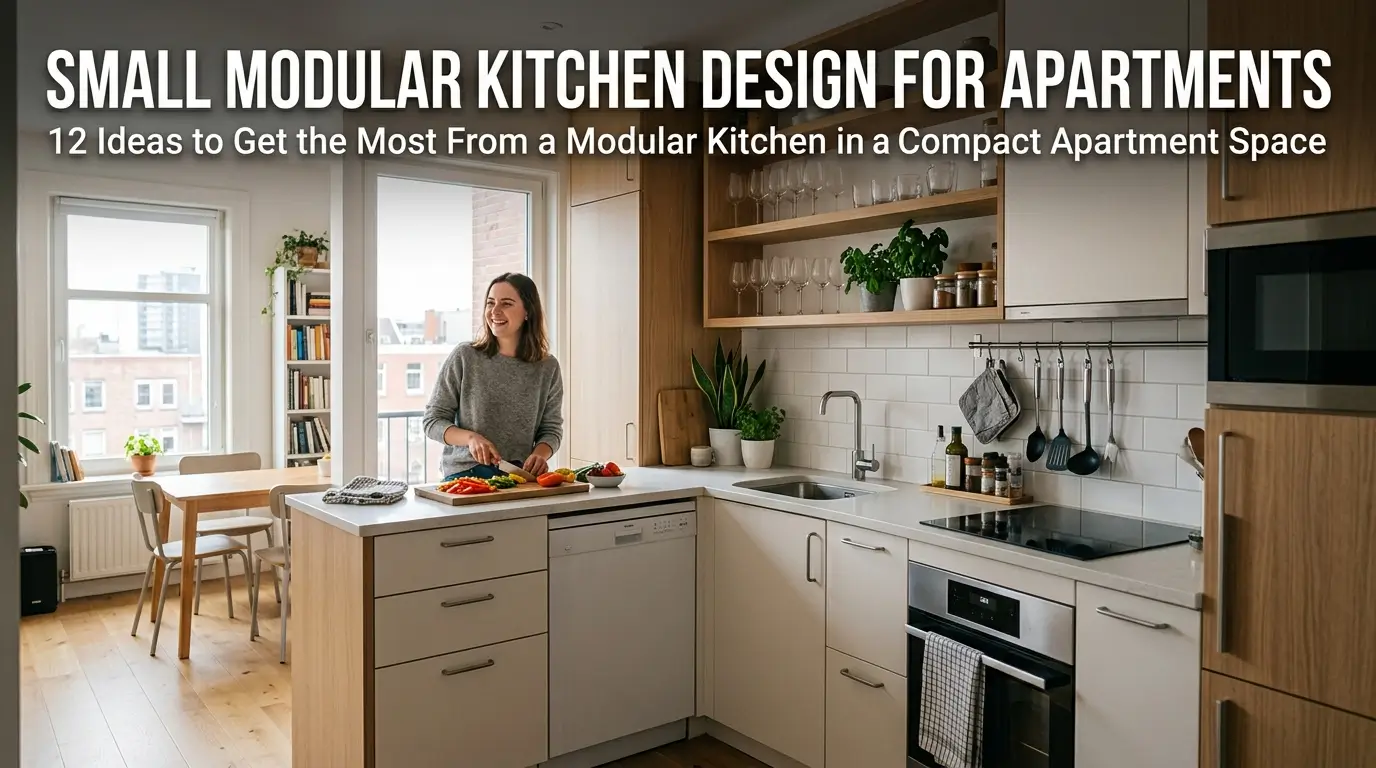
The modular kitchen has become the standard kitchen format for Indian apartments. Walk into any new residential project in any Indian city and the kitchen will almost certainly be modular. Standard cabinet sizes, coordinated finishes, factory-made components installed by a team in two or three days. It is efficient, it is relatively affordable, and it solves the basic organisational problems of a small kitchen in a format that most developers and most homeowners are comfortable with.
The problem is not the modular kitchen itself. The problem is the way most modular kitchens in Indian apartments are specified. The same two-tone colour combination. The same granite countertop in the same three options. The same cabinet layout regardless of the specific proportions of the room. The same hardware, the same chimney, the same under-cabinet tile. The result is a kitchen that is functional in a generic way and distinctive in no way at all.
A modular kitchen in a small apartment, specified with genuine attention to the room it is going into and the cooking that will happen in it, can be significantly better than the standard apartment kitchen in every measurable respect. More storage, better workflow, more considered appearance, and a stronger sense that it was designed for this specific kitchen rather than delivered from a catalogue that applies equally to every kitchen in every apartment in the building.
Here are 12 ideas for getting more from a modular kitchen in a small apartment.
Small Modular Kitchen Design Ideas for Apartments
1. Measure the Room Before Opening the Catalogue
The modular kitchen catalogue is designed for salespeople, not for rooms. It presents options, combinations, and configurations in showroom conditions that bear little resemblance to the specific dimensions, proportions, and constraints of an actual apartment kitchen. The most common and most costly mistake in a modular kitchen project is selecting a configuration from the catalogue and then trying to make the room fit it rather than the other way around.
Measure the kitchen room in full detail before any catalogue conversation begins. Floor-to-ceiling height. Width of every wall. Position of every door and window opening. Location of existing plumbing connections. Position of the electrical board and existing power points. Depth of any structural beams or columns that project into the room. These measurements define the actual modular kitchen that the room can accommodate. Any configuration that does not begin from these measurements is a configuration that will require compromises during installation that were entirely preventable at the planning stage.
2. Specify Full-Height Wall Units on Every Available Wall
Standard modular kitchen wall units in India are specified at 600 to 700 millimetres in height, installed at a standard height above the counter, leaving a gap of 300 to 400 millimetres between the top of the wall unit and the ceiling. In a small apartment kitchen where storage is genuinely limited, this gap represents a significant volume of space that is simply being discarded.
Full-height wall units, or the combination of standard wall units with a dedicated storage unit above them running to the ceiling, eliminates this gap and converts it into usable storage. The upper section, accessible with a small step, holds items used infrequently. The section at standard reach height holds everyday items. Full-height wall units make the kitchen appear taller as well as providing more storage, both of which are valuable outcomes in a small apartment kitchen.
3. Choose a Loft Unit Over the Refrigerator
The refrigerator in most Indian apartment kitchens sits in a dedicated alcove or at the end of the counter run with empty wall space above it. The space above the refrigerator, typically 400 to 600 millimetres between the top of the refrigerator and the ceiling, is almost always unused.
A loft unit, a wall-mounted cabinet specified to fit the exact width of the refrigerator alcove and the exact height between the refrigerator top and the ceiling, fills this space with storage without affecting the refrigerator position or access in any way. It is one of the most consistently overlooked storage additions in a modular kitchen and one of the simplest to specify. The loft unit holds items used infrequently, the same way the upper section of a full-height wall unit does, but specifically targets the dead space above what is typically the largest appliance in the kitchen.
4. Tandem Drawers in Lower Cabinets Over Fixed Shelves
The standard lower cabinet in an Indian modular kitchen is a box with a fixed shelf inside, accessed through a door that opens outward. It is a format inherited from earlier generations of kitchen furniture that has persisted long past its usefulness. Fixed shelves in lower cabinets are inefficient, difficult to organise, and impossible to use fully because the back half of the shelf is always inaccessible.
Tandem drawer systems, where the lower cabinet is fitted with two or three full-extension drawers rather than a door and fixed shelf, transform the usable capacity of every lower cabinet they replace. Everything in the drawer is visible from above when the drawer is open. The full depth of the cabinet is accessible without reaching, bending, or removing items from the front to access items at the back. In a small apartment kitchen where the lower cabinets represent a significant proportion of the total storage, converting fixed-shelf lower cabinets to tandem drawers is the single most impactful storage upgrade available.
5. A Dedicated Masala Pull-Out Adjacent to the Cooktop
Spice storage is the detail that separates a modular kitchen designed for Indian cooking from one designed for a generic user. Indian cooking requires immediate access to a range of spices during active cooking. The standard solution, a shelf inside a wall cabinet or a masala dabba on the counter, works but does not use the modular kitchen format to its full potential.
A dedicated masala pull-out, a narrow pull-out unit between 150 and 200 millimetres wide fitted with multiple horizontal tiers of spice jar holders, installed immediately beside the cooktop cabinet, keeps the full spice collection within arm’s reach during cooking without any of the jars sitting on the counter surface. The pull-out extends fully during cooking and closes flush with the cabinet face when not in use. It is a modular kitchen component designed specifically for Indian cooking requirements and available from most quality modular kitchen manufacturers in India.
6. An Integrated Appliance Tower for the Microwave and Oven
The microwave in most Indian apartment kitchens sits on the counter, consuming a significant section of prep surface. In a small modular kitchen where counter space is already limited, a counter-mounted microwave is a genuine functional problem rather than a minor inconvenience.
An integrated appliance tower, a tall modular unit with dedicated housing for the microwave at eye level and space for an oven below it, removes both appliances from the counter surface entirely and gives them a fixed, purpose-built location within the cabinet structure. The appliance tower can also incorporate storage above and below the appliance housings, making it one of the most storage-efficient vertical units in the modular kitchen range. Specifying an appliance tower as part of the initial modular kitchen layout rather than retrofitting it later ensures that the unit dimensions, the electrical connections, and the counter layout are all coordinated from the start.
7. Waterfall Island or Breakfast Counter Where Space Allows
A kitchen island in a small apartment kitchen is typically not feasible. The floor area required to accommodate an island with adequate circulation space on all sides, typically 900 millimetres minimum between the island and the surrounding cabinets, is simply not available in most compact Indian apartment kitchens.
A narrow breakfast counter, a modular unit 300 to 350 millimetres in depth projecting from the end of the main counter run, or a wall-mounted fold-down counter along the kitchen boundary wall, provides a casual dining surface and an additional prep surface without the floor area commitment of a full island. In a modular kitchen, the breakfast counter unit uses the same cabinet components and the same countertop material as the main run, reading as a natural extension of the kitchen rather than a separate piece of furniture added to the room.
8. Consistent Hardware Across Every Cabinet and Drawer
Hardware is the detail that most distinguishes a carefully specified modular kitchen from a generic one, and it is the detail most frequently compromised in budget-constrained apartment kitchen projects. Mismatched handles, standard chrome knobs on cabinets that have been specified in every other modular kitchen in the building, and hardware that is inconsistent in finish across different cabinet types all undermine the visual quality of an otherwise well-planned kitchen.
Choose one hardware profile and one finish and apply it consistently across every cabinet door, every drawer front, and every pull-out unit in the kitchen. Matte black bar pulls, brushed brass recessed handles, or satin nickel slim bar handles all make appropriate choices for a small apartment kitchen and each creates a distinctly different character. The consistency of hardware application across the full kitchen is more important than the specific hardware chosen. A kitchen where every element uses the same handle reads as considered. One where the handles vary by cabinet type reads as assembled from whatever was available.
9. A Honed or Matte Countertop Finish Over High Gloss
The polished granite countertop is the default in Indian apartment modular kitchens. It is the finish that most developers specify, most showrooms display, and most homeowners accept without question because it is what they have seen in every other kitchen. Polished granite is durable and practical but its high reflectivity and the visual complexity of its natural patterning add visual noise to a small kitchen that works against the sense of calm and space that the kitchen needs.
A honed or matte finish countertop, in engineered quartz, honed granite, or a large-format matte ceramic, reduces the reflectivity of the counter surface and creates a calmer visual in the kitchen. Matte and honed surfaces in neutral tones, light grey, warm white, or a soft concrete colour, recede visually in a way that polished surfaces with strong patterning never do. In a small apartment kitchen where the counter is one of the most visible surfaces in the room, the choice between a polished and a matte finish has a more significant effect on the overall character of the space than almost any other single decision.
10. Internal Cabinet Organisation as Part of the Initial Specification
The interior of a modular kitchen cabinet is typically an afterthought. The external configuration is planned carefully, the finishes are selected, the appliances are specified, and then the internal organisation of the cabinets, the cutlery trays, the plate holders, the pot lid organisers, and the drawer dividers, is addressed after installation with whatever accessories are available at the time.
Specifying the internal cabinet organisation as part of the initial modular kitchen project, with the same attention given to it as to the external configuration, produces a kitchen that is organised from day one rather than gradually accumulating organisation accessories over the following months. Most modular kitchen manufacturers offer a range of internal accessories in coordinated finishes that fit their cabinet dimensions precisely. Specifying these at the outset ensures that they are sized correctly, fitted cleanly, and accounted for in the overall budget rather than purchased separately as an afterthought.
11. A Pocket Door or Sliding Panel for the Kitchen Opening
In apartment kitchens that open into the living or dining area, the door between the two spaces creates a specific set of problems. An outward-opening door requires clear floor space in front of it on both sides. An inward-opening door occupies floor space inside the kitchen when open. Either configuration reduces the effective floor area of a small apartment kitchen and creates a swing path that conflicts with the workflow near the kitchen entrance.
A pocket door that slides into the wall cavity, or a sliding panel that moves along a wall-mounted track, eliminates the swing path entirely and returns the floor area consumed by the door arc to usable kitchen space. In a small apartment kitchen where the entrance is adjacent to the counter or the cooking position, the difference between a hinged door and a sliding panel can meaningfully improve the workflow and the sense of space at the most critical transition point in the kitchen.
12. Lighting Specified Across Three Levels
Lighting in a modular apartment kitchen is typically resolved with a single overhead fitting, sometimes supplemented by a strip light inside the chimney hood. This single-level approach to kitchen lighting produces an evenly lit but atmospherically flat space that performs adequately for cooking and poorly for everything else.
A modular kitchen in a small apartment benefits from lighting specified across three distinct levels. Overhead ambient lighting for general illumination of the room. Under-cabinet task lighting directed onto the counter surface for prep and cooking. Interior cabinet lighting, LED strips inside glass-fronted cabinets or inside deep lower drawers, that makes the contents of the storage visible and adds a layer of accent light to the overall kitchen. Three lighting levels, each controlled independently, allow the kitchen to be lit appropriately for cooking, for casual use, and for the moments when the kitchen is part of the background of the living space rather than the focus of activity in it. The additional cost of specifying all three levels during the initial installation is modest. The functional and atmospheric return justifies it entirely.
Specify the Modular Kitchen the Apartment Deserves
A modular kitchen in a small apartment is not a standard product delivered into a standard space. It is a set of decisions, each one specific to the room it is going into and the cooking that will happen in it, that together determine whether the kitchen is genuinely good or merely functional.
The decisions that matter most cost nothing extra. The layout chosen from the actual room dimensions rather than the catalogue. The colour palette that creates continuity rather than contrast. The hardware applied consistently rather than varied by cabinet type. The counter finish that adds calm rather than visual noise.
The decisions that cost a modest amount more and deliver a disproportionate return. The full-height wall units that use the ceiling height properly. The tandem drawers that make the lower cabinets actually work. The masala pull-out that handles the Indian cooking requirement honestly. The three-level lighting that makes the kitchen feel designed rather than illuminated.
Make those decisions carefully and the modular kitchen in the small apartment will be significantly better than the standard version. Not because the budget was larger, but because the thinking was.

Aarav Sharma is a passionate home and lifestyle writer. He loves exploring kitchen design, home decoration, and interior styling. With a keen eye for beautiful details and practical design ideas. Aarav Sharma shares inspiration to help readers create comfortable and functional living spaces.