
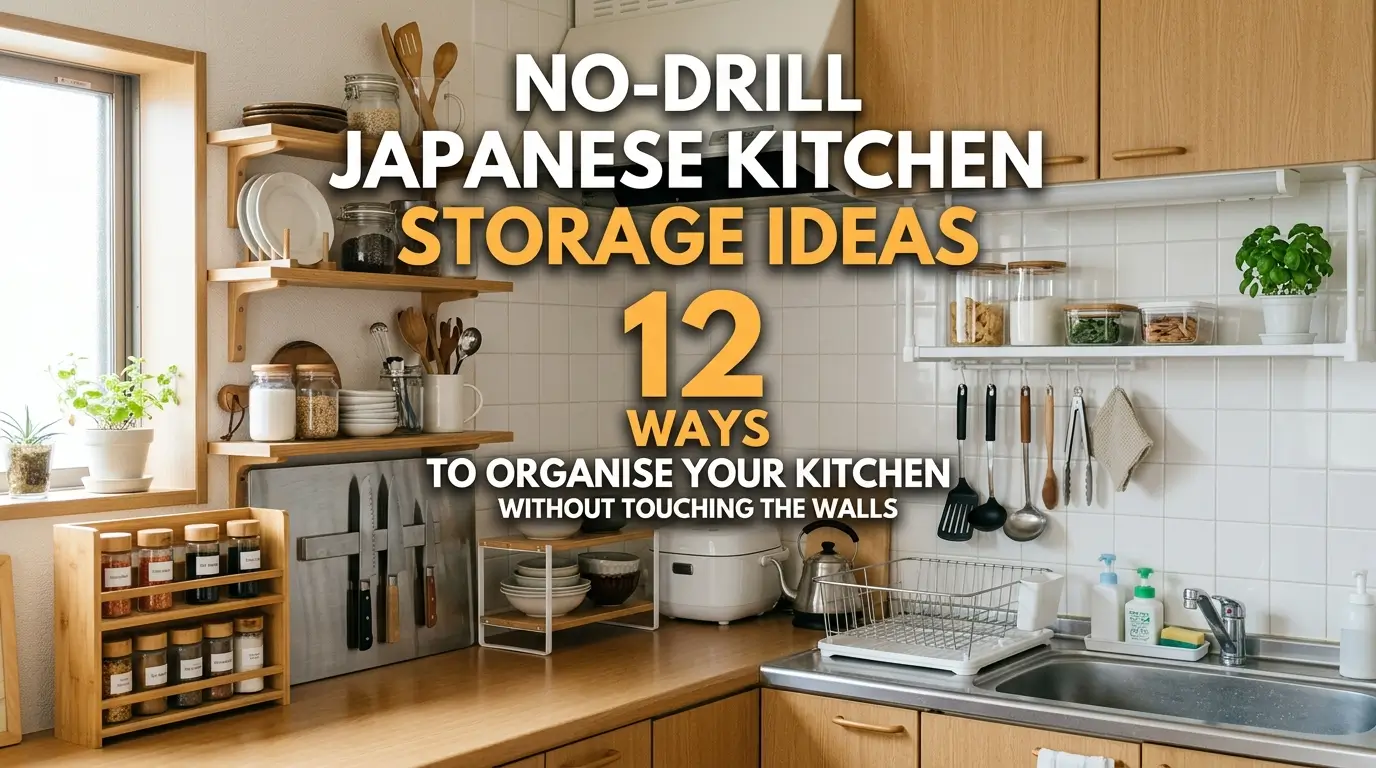
Storage is one of the most persistent problems in small kitchens. There is never quite enough of it, and the things that need storing — spices, utensils, cutting boards, cleaning supplies, dry goods — have a way of spreading across every available surface if left without a system.
The instinct is usually to drill. Wall-mounted racks, hooks, and shelves feel like the obvious solution when counter and cabinet space runs out. But drilling is not always an option — in rental flats, older buildings with tiled walls, or kitchens where the walls simply cannot take the weight, you need storage solutions that work without making a single hole.
Japanese kitchen organisation offers a different approach entirely. Rather than mounting everything on walls, it works with the existing structure of the kitchen — cabinet interiors, countertop edges, vertical space, and the insides of doors — to create a system where everything has a place and nothing is left out unnecessarily.
Here are 12 no-drill Japanese kitchen storage ideas that bring order, calm, and function to any kitchen.
No-Drill Japanese Kitchen Storage Ideas
1. Tension Rod Dividers Inside Cabinets
Tension rods — the kind used for curtains — are one of the most versatile no-drill storage tools available. Placed vertically inside a deep cabinet, they create dividers that keep cutting boards, baking trays, and flat lids upright and separated rather than stacked in an unstable pile.
This is a core Japanese organisation principle — vertical storage over horizontal stacking. Items stored vertically are easier to see, easier to access, and take up significantly less usable cabinet space. Tension rods are inexpensive, adjustable, and leave no marks when removed.
2. Over-the-Cabinet-Door Organisers
The inside face of a cabinet door is almost always wasted space. Over-the-door organisers — slim wire or bamboo racks that hook over the top edge of the door — can hold spice jars, cleaning supplies, foil and cling wrap rolls, or small bottles without requiring any drilling or adhesive.
In Japanese kitchen design, the principle at work here is kakushikata — the art of concealed, organised storage. Everything is accessible but nothing is visible from the outside. The kitchen looks calm and uncluttered while remaining fully functional behind closed doors.
3. Freestanding Bamboo Shelf Risers
Cabinet interiors are often too tall for their contents, leaving a large gap of unused vertical space above shorter items. Shelf risers — small freestanding platforms that sit inside a cabinet and create a second level — solve this immediately.
Bamboo risers are the most Japanese-appropriate option. They bring a natural material warmth to the inside of the cabinet while doubling the usable storage on each shelf. Use them to stack plates and bowls on two levels, or to separate mugs from glasses without the items touching and risking chips.
4. Magnetic Spice Jars on the Fridge
The side of a refrigerator is a large, vertical magnetic surface that most people ignore entirely. Magnetic spice tins — small, flat-backed containers that attach directly to the fridge surface — keep frequently used spices visible, accessible, and completely off the counter.
Decant your most-used spices into matching magnetic tins with simple printed or handwritten labels. The uniform containers and clean labels are very much in keeping with the Japanese approach to storage — everything matching, everything legible, nothing excess. This works particularly well in kitchens where the fridge sits at the end of the counter and the side panel faces the cooking area.
5. Countertop Utensil Crocks and Vertical Holders
Rather than a drawer full of tangled utensils, Japanese kitchens typically keep a small, curated selection of everyday tools in a single upright holder on the counter. A ceramic crock, a simple bamboo pot, or a stone utensil holder keeps spatulas, ladles, and tongs vertical and immediately accessible during cooking.
The key is curation — not every utensil belongs in the crock. Keep only what you reach for daily. Everything else goes into a drawer. A countertop utensil holder that contains six well-chosen tools looks intentional and calm. One overflowing with fifteen items looks like clutter.
6. Adhesive Hooks Inside Cabinet Doors
For items that do not sit flat — oven mitts, small colanders, measuring cups, lids — adhesive hooks on the inside of cabinet doors provide a clean, no-drill hanging solution. Modern adhesive hooks are rated for reasonable weight loads and remove without damaging painted surfaces when the correct removal technique is followed.
Place hooks on the inside of the cabinet closest to where the item is used. Oven mitts go inside the cabinet nearest the cooktop. Measuring cups go inside the cabinet above the prep area. This location logic is central to Japanese kitchen organisation — storage proximity to use point reduces friction and keeps the workflow efficient.
7. Pull-Out Cabinet Organisers
Deep lower cabinets are a storage problem in almost every kitchen. Items get pushed to the back and forgotten, and accessing anything requires removing everything in front of it first. Pull-out organisers — wire or bamboo trays that slide in and out on their own base — solve this without any installation.
These sit freely inside the cabinet and slide forward when you open the door, bringing the contents of the back half of the cabinet into full view. In Japanese organisation philosophy, this connects to the idea that storage should make things easier to find, not harder. Hidden storage that obscures its contents defeats its own purpose.
8. Stackable Modular Containers for Dry Goods
Decanting dry goods into uniform, stackable containers is one of the foundational habits of Japanese kitchen organisation. Matching containers in clear glass or white ceramic, stacked neatly inside a cabinet or on a designated shelf, create a system where contents are visible, quantities are easy to monitor, and the storage itself looks considered.
Choose containers with airtight lids — particularly important in Indian kitchens where humidity, insects, and strong odours can affect dry goods quickly. A consistent container system also eliminates the visual noise of mismatched packets, bags, and half-open boxes that make cabinets feel chaotic even when they are not overfull.
9. Over-the-Sink Expandable Rack
The space directly above the sink — bridging the two sides of the counter — is rarely used but structurally very convenient. An expandable over-the-sink rack rests on the counter edges on either side, creating an additional surface for drying dishes, holding a small plant, or staging items mid-cooking without drilling anything into the wall above.
This is particularly useful in small Indian kitchens where counter space around the sink is limited. The rack sits on friction and weight alone, requires no hardware, and can be moved or removed in seconds.
10. Narrow Freestanding Pantry Tower
When cabinet space runs out and counter space is already compromised, a narrow freestanding pantry tower is one of the most effective storage investments available. A slim unit — as narrow as 20 to 25 centimetres in depth — can sit in a gap between the refrigerator and the wall, or at the end of a cabinet run, and provide several shelves of additional storage.
Japanese interiors handle vertical storage naturally — shelving that runs floor to ceiling is common in small Japanese homes precisely because it trades floor area for height. A freestanding pantry tower brings this principle into a rental or small kitchen without requiring any wall fixings.
11. Lazy Susan Turntables Inside Cabinets
Corner cabinets and deep shelves share the same problem — things at the back are invisible and inaccessible. A lazy Susan turntable placed inside the cabinet rotates to bring everything to the front, eliminating the need to reach, rummage, or remove items to find what is behind them.
Use one turntable for spices, one for condiments, and one for oils and vinegars — keeping each category contained and rotatable. Lazy Susans require no installation and sit on the shelf surface by their own weight. They are one of the quietest and most effective organisation tools available for small kitchens.
12. Hanging Rail System on a Freestanding Unit
If you want the functionality of a wall-mounted rail — hooks for utensils, small baskets for produce, a bar for hanging towels — without drilling into the wall, attach the rail to a freestanding unit instead. A bamboo or metal hanging rail fixed to the back panel of a kitchen cart or island brings all the storage benefits of a wall rail with none of the wall damage.
This approach reflects the Japanese preference for systems over individual solutions — a single, well-designed unit that handles multiple storage needs at once rather than a collection of unrelated fixes spread across the kitchen.
Build a Kitchen That Works Without Compromise
No-drill storage is not about working around limitations — it is about working with the space you have, which is precisely what Japanese kitchen organisation has always been about. Every surface, every door interior, every vertical gap is an opportunity. Nothing needs to be drilled, glued permanently, or left behind when you move.
Start with the areas causing the most friction — the overcrowded spice situation, the chaotic utensil drawer, the deep cabinet where things disappear. Solve one area at a time, use natural materials wherever possible, and resist the urge to add more storage than you actually need. A kitchen with less in it, better organised, will always outperform one with more storage used carelessly.

Aarav Sharma is a passionate home and lifestyle writer. He loves exploring kitchen design, home decoration, and interior styling. With a keen eye for beautiful details and practical design ideas. Aarav Sharma shares inspiration to help readers create comfortable and functional living spaces.