
When I tried to make a proper bowl of miso soup. I had the ingredients: the dashi, the tofu, the seaweed. But I didn’t have the right tools. I was using a Western stockpot and a metal ladle. The result? It tasted fine, but it didn’t feel right. It lacked that detailed, peaceful theme that defines Japanese cooking.
Japanese cuisine is unique. It isn’t just about soy sauce and rice; it is a philosophy of precision, simplicity, and respect for the ingredient. To cook this way, you don’t need a kitchen full of expensive gadgets. You actually need very little. But the little you do need, you need to be right.
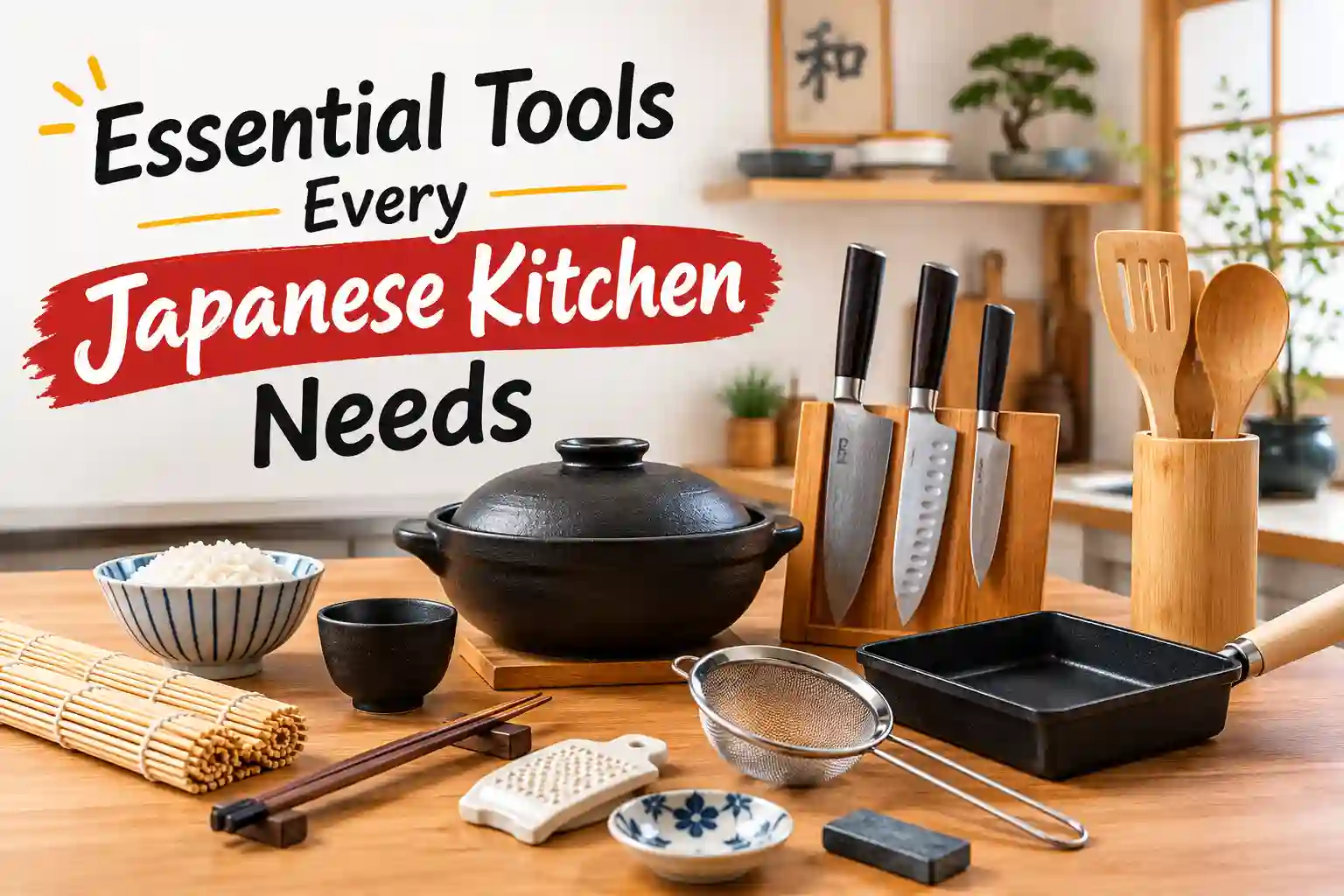
If you want to move beyond just “cooking Asian food” and actually understand the rhythm of a Japanese kitchen, here are the essential tools you need to get started.
1. The Rice Cooker (Suihanki)
Let’s start with the obvious one. In Japan, rice is not a side dish; it is the heart of the meal. If you are serious about Japanese cooking, a cheap pot on the stove won’t cut it. You need a rice cooker, known as a suihanki.
Why? Consistency. Japanese short-grain rice is sticky and temperamental. It requires a specific ratio of water to grain and a specific cooking curve—soaking, heating, steaming, and resting—that is hard to master on a stovetop.
What to look for:
You don’t need the $600 model with a built-in AI that plays music. A basic, mid-range model from brands like Zojirushi, Tiger, or Panasonic is perfect. Look for “Fuzzy Logic” technology. This means the machine has a microchip that adjusts the temperature and cooking time based on the amount of rice and water inside.
The Specifications:
The key feature to look for is the “keep warm” function. Japanese rice is meant to be eaten at room temperature or warm, never cold. A good rice cooker will keep the rice perfect for 24 hours. The inner pot should be non-stick and thick—thicker pots distribute heat more evenly, making the rice fluffier.
Pro Tip:
Always use the measuring cup that comes with the cooker. It is not a standard cup. It is a gō (180ml), which is the traditional Japanese measurement. Using a standard American cup will result in mushy rice.
2. The Donabe (Earthenware Pot)
If the rice cooker is the heart, the donabe is the soul. A donabe is a heavy, glazed earthenware pot used for everything from stews (nabe) to cooking rice over an open flame.
The magic of the donabe is in the clay. It heats up slowly and retains heat incredibly well. This allows for gentle, slow simmering that draws out the umami in ingredients without breaking them down.
Why you need it:
You can use a Dutch oven, but it conducts heat differently. A Dutch oven is heavy cast iron; it sears and braises. A donabe is porous and delicate. It is designed for the table. You cook in it, and you serve from it. It is communal.
Specific Details:
Look for a donation made in Iga, Japan. Iga clay is porous and has a high thermal resistance, meaning it won’t crack easily when you subject it to high heat. The lid often has a small hole in it, which acts as a pressure valve to prevent boil-overs.
How to use it:
You can use it on a gas stove (with a diffuser plate) or a portable butane stove. You cannot use it on an induction cooktop unless you buy a specific induction-ready model. Season it before use by cooking a porridge of rice and water in it—this seals the microscopic pores in the clay.
3. The Santoku Knife
The santoku is the Japanese version of the chef’s knife. The word translates to “three virtues,” referring to its ability to slice, dice, and mince.
Why it beats a Western knife:
Western chef knives are designed for a rocking motion—you push down and rock the blade. Japanese knives are designed for a push-pull slicing motion. They are thinner and harder. They don’t smash the food; they glide through it. This is crucial for vegetables, where you want to preserve the cell structure to keep them crisp.
Specific Details:
A traditional Japanese knife (like a Gyuto or Santoku) is usually made of high-carbon steel or a blend of stainless steel with a carbon core. The angle of the edge is the big difference. A German knife (like Wusthof) is sharpened to about 20 degrees. A Japanese knife is sharpened to about 15 degrees or even less.
The Maintenance:
This is high-maintenance cookware. You cannot put it in the dishwasher. You must wash it by hand and dry it immediately. If it is high-carbon steel (not stainless), it will rust if you look at it wrong. But the trade-off is a blade so sharp you can cut tomatoes without squishing them.
Which one to buy:
Start with a Santoku. It is shorter than a Western chef’s knife, usually around 7 inches, which makes it more maneuverable in a small Japanese kitchen. Look for a “Wa-handle” (a traditional wooden handle) or a Western handle, depending on your grip preference.
4. The Suribachi and Surikogi (Mortar and pestle)
You might think a blender is better. It is faster. But a blender chops. A suribachi grinds.
The suribachi is a ceramic bowl with ridges (called kushi-no-me) on the inside. The surikogi is a wooden pestle. When you grind sesame seeds or miso in a suribachi, you are crushing the cells to release oils. A blender just cuts them into tiny pieces. The flavor difference is massive.
Why you need it:
You need this for two main things: grinding toasted sesame seeds and making marinades. Toasted sesame seeds are a staple in Japanese cooking. If you grind them in a suribachi, you get a paste that is nutty, fragrant, and oily. If you use a food processor, you get a dry powder.
Specific Details:
The ridges are key. They are designed to grab the ingredients and pull them down as you grind in a circular motion. The wooden pestle is softer than the ceramic, so it wears down over time, but it won’t chip the bowl.
Usage:
You don’t pound up and down like you would with a Mexican molcajete. You grind in a circular motion. It takes a little elbow grease, but it connects you to the food. It is a meditative process.
5. The Hangiri (Sushi Rice Mixing Tub)
If you are going to make sushi, you need a hangiri. This is a wide, shallow wooden tub, usually made of cypress.
Why not a metal bowl?
This is about physics and chemistry. When you cook sushi rice, you need to cool it down quickly while adding vinegar. If you use a metal bowl, the metal conducts heat and traps moisture. The rice will get soggy and gluey. The wood of the hangiri absorbs excess moisture and insulates the rice, allowing it to cool at the perfect rate.
Specific Details:
The hangiri is traditionally bound with copper hoops. It is shallow so you can spread the rice out in a thin layer. You use a shamoji (a flat wooden paddle) to cut and fold the rice, not stir it. You are using the paddle to fan the rice while mixing.
The Technique:
You don’t just dump vinegar on. You sprinkle it over the shamoji so it rains down evenly on the rice. Then you use the paddle to slice through the rice, turning it over, like you are folding batter. This cools the rice and evaporates the excess vinegar, leaving just the flavor.
6. The Fine-Mesh Strainer (Zaru)
A zaru is a fine-mesh strainer, usually made of stainless steel with a wooden or wire handle. It looks like a spider skimmer but with a much finer mesh.
Why you need it:
Japanese cooking involves a lot of straining. You strain dashi, you strain custards for chawanmushi, and you strain sauces. A regular colander has holes that are too big. You need a mesh so fine that it catches the scum (aku) that rises to the top of a broth.
Specific Details:
Look for one that is round and fits easily into your pots. The mesh should be fine enough to strain sesame seeds but sturdy enough to hold up to washing vegetables.
Other uses:
You can use it to dust powdered sugar or matcha over desserts. You can use it to drain fried foods (though a wire rack is better for that). But mostly, it is for making clear, clean broths.
7. The Tamagoyaki Pan
Tamagoyaki is a rolled omelet. It is a staple in bento boxes and sushi (as tamago). To make it correctly, you need a rectangular pan.
Why rectangular?
A round pan makes a round omelet. To make a roll, you need straight edges. The rectangular shape allows you to fold the egg over and over itself, creating those distinct layers.
Specific Details:
These pans are usually made of copper or aluminum with a non-stick coating. Copper is the best because it heats evenly and responds to temperature changes quickly. You need to control the heat precisely. If the pan is too hot, the egg browns (which you don’t want; you want a bright yellow color). If it is too cold, the egg sticks.
The Technique:
You pour a thin layer of egg, let it set, and then roll it to one side. Then you oil the pan again, pour more egg, lift the existing roll, and let the new egg run under it. Then you roll it all up again. It takes practice, but a rectangular pan is non-negotiable if you want the look right.
8. The Miso Muddler (Surikogi) and Miso Strainer
We talked about the suribachi, but specifically for miso soup, a small fine-mesh strainer and a wooden muddler are essential.
Why you need it:
Miso paste is thick. If you just dump a spoonful into boiling water, it will clump. You need to dissolve it.
The Specifications:
You place the miso in the strainer and dip it into the broth. You use the muddler to press the miso through the mesh. This does two things: it dissolves the miso perfectly, and it removes any large chunks of soybeans that didn’t break down during fermentation.
Pro Tip:
Never boil miso soup after you add the miso. Boiling kills the living cultures (probiotics) in the miso and changes the flavor. You add the miso at the very end, off the heat.
9. The Bamboo Rolling Mat (Makisu)
This is a simple tool: a mat made of thin bamboo slats tied together with cotton string.
Why you need it:
Sushi rolls. Yes, you can roll sushi with a towel or plastic wrap, but the makisu is designed for it. The bamboo slats allow you to apply even pressure without crushing the rice. It also helps you shape the roll into a perfect cylinder.
Specific Details:
They are cheap, usually a few dollars. But you have to keep them clean. Rice starch gets stuck in the slats. You need to wash them and dry them completely, or they will get moldy.
Other uses:
You can use them to squeeze water out of vegetables (like spinach) or to shape other foods.
10. The Chopsticks (Hashi)
This might sound silly. You already have chopsticks from takeout. But Japanese cooking chopsticks (saibashi) are different.
Why you need them:
Saibashi are longer than eating chopsticks (usually about 12 to 15 inches). This keeps your hands away from hot oil and boiling water. They are usually made of bamboo or wood, often lacquered.
Why not tongs?
Tongs are clumsy. They crush delicate food. Saibashi allows you to pick up a single strand of noodle or a delicate piece of fish with precision. Once you get used to cooking with them, you will find them faster and more delicate than tongs.
Specific Details:
You use them to stir-fry, to flip tempura, to arrange food on a plate. They are an extension of your fingers.
The Philosophy of the Japanese Kitchen
You might look at this list and think, “That’s a lot of specific gear.” And you would be right. But the Japanese philosophy of kodawari—a relentless pursuit of perfection in a specific craft—explains why.
Every tool exists for a reason. The hangiri exists because metal makes rice soggy. The donabe exists because clay tastes better than iron for certain dishes. The suribachi exists because grinding releases flavor that chopping cannot.
You don’t need to buy all of these at once. Start with the knife and the rice cooker. Then get a donation. Then a suribachi.
The goal isn’t to have a kitchen that looks like a museum. The goal is to have a kitchen that works. A Japanese kitchen is efficient. It is small. It is organized. Every tool has a place, and every tool has a purpose.
When you use these tools, you aren’t just cooking. You are participating in a tradition that values the ingredient, the process, and the person you are cooking for. You are taking the time to do it right.
And that, more than any specific ingredient, is the secret to Japanese cooking.
A Note on Maintenance
A quick word on keeping these tools alive. Japanese tools are often made of natural materials: wood, bamboo, clay, carbon steel. They require care.
- Wood: Don’t soak it. Wash it, wipe it, let it air-dry.
- Carbon Steel: Dry it immediately. Oil it lightly.
- Clay: Let it cool slowly. Don’t thermal shock it (don’t put a hot pot in cold water).
If you take care of them, they will last a lifetime. In fact, many Japanese kitchens have tools that have been passed down for generations. A good knife or a good pot gets better with age, just like the food you cook in it.
So, clear out some cabinet space. Make room for the essentials. Your cooking is about to change.

Aarav Sharma is a passionate home and lifestyle writer. He loves exploring kitchen design, home decoration, and interior styling. With a keen eye for beautiful details and practical design ideas. Aarav Sharma shares inspiration to help readers create comfortable and functional living spaces.