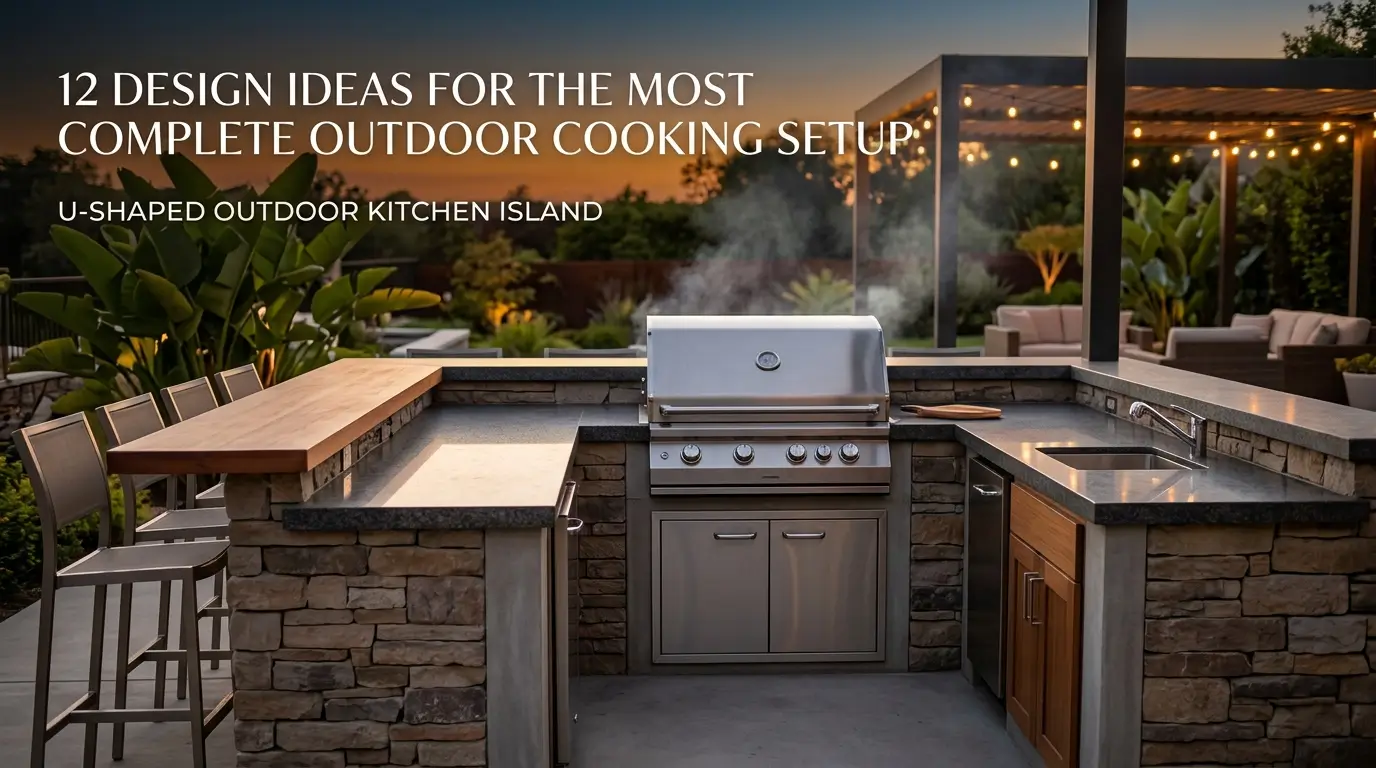
The U-shaped outdoor kitchen is the most ambitious configuration available for outdoor cooking. Three connected counter runs — two parallel arms and a connecting base — create an enclosed cooking environment that handles every stage of the outdoor cooking process without the cook ever needing to leave the workspace. Prep, cook, plate, serve, and store — all of it happens within the U, within arm’s reach, in a sequence that makes outdoor cooking feel as organised and efficient as any indoor kitchen.
It is also the layout that commits most fully to the idea that the outdoor kitchen is not a seasonal accessory — a grill dragged out for a Sunday barbecue and put away again on Monday — but a permanent, year-round cooking space that is genuinely central to the way a home functions.
The built-in grill is what anchors the U-shaped outdoor kitchen as a serious cooking setup. A grill that is integrated into the counter structure — not a freestanding unit placed beside it — changes the register of the entire space. It signals permanence, intention, and a level of cooking ambition that a portable grill simply cannot communicate. Combined with the U-shaped layout that wraps the cook in workspace on three sides, the built-in grill makes the outdoor kitchen a destination rather than a convenience.
Here are 12 design ideas for planning, building, and finishing a U-shaped outdoor kitchen island with a built-in grill that works as hard as it looks.
U-Shaped Outdoor Kitchen Island with Built-In Grill Design Ideas
1. Establish the U Orientation Before Anything Else
The single most important planning decision in a U-shaped outdoor kitchen is which direction the U opens. The open end of the U determines where guests stand or sit, how the cook interacts with the rest of the outdoor space, and how traffic moves around the kitchen during use.
In most garden settings, the U should open toward the main seating area — so the cook faces guests while working and the entire outdoor kitchen functions as a social space rather than a private work station. If the outdoor kitchen sits against a boundary wall, the U typically opens toward the garden with the closed base of the U against the wall. If the kitchen is a freestanding island away from the walls, the U can open in any direction — choose the orientation that puts the cook in the best relationship to the rest of the space. Fix this decision before any construction begins. Everything else follows from it.
2. Position the Built-In Grill on the Base Counter
The base counter — the connecting arm at the back of the U, typically against the wall or fence — is the correct location for the built-in grill. Positioning the grill here puts it at the back of the cooking workspace, away from the open end of the U where guests stand or sit, and gives the cook a full counter on each parallel arm for prep and plating on either side.
A built-in grill set into the base counter also puts the cooking heat and smoke against the boundary rather than projecting it toward the seating area. The chimney or exhaust hood above the grill fixes cleanly to the wall behind it. The parallel arms of the U extend forward from either side of the grill, creating a natural framing of the cooking position that feels contained and professional.
3. Dedicate Each Arm of the U to a Specific Function
The U-shaped layout works best when each of its three sections has a clearly defined purpose. The base counter holds the built-in grill and the primary cooking equipment. One parallel arm handles prep — the sink, the cutting surface, and the immediate ingredient storage. The other parallel arm handles serving and plating — a clean counter surface with under-counter storage for tableware, condiments, and serving equipment.
This functional zoning is a direct application of the professional kitchen principle of station cooking — each zone in the kitchen has a job, and that job does not bleed into adjacent zones. In a U-shaped outdoor kitchen, this discipline makes the difference between a layout that is genuinely efficient and one that is spacious but chaotic.
4. Built-In Grill Specification for Outdoor Indian Cooking
A built-in grill for an Indian outdoor kitchen needs to handle a wider range of cooking tasks than a standard Western barbecue grill. Beyond grilling meat and vegetables, the outdoor kitchen is likely to be used for tandoori preparations, grilled fish, corn, and a variety of preparations that benefit from direct high heat. A built-in grill with at least two independently controlled burner zones — one high-heat zone for direct grilling and one lower zone for indirect cooking and finishing — handles this range comfortably.
Specify a built-in grill with a stainless steel body rated for outdoor installation, a cast iron or stainless steel grate, and a grease management system that directs drippings away from the burner. A built-in grill without a proper grease management system creates a fire risk and a cleaning problem that makes outdoor cooking more trouble than it should be. This is not a specification detail to compromise on.
5. Counter Height Consistency Across All Three Arms
All three counters of the U should sit at the same height — 85 to 90 centimetres for a cooking-focused layout, or 90 to 95 centimetres if the cook is tall. The temptation to raise the two parallel arms to bar height to accommodate seating on the outer faces should be resisted in a U-shaped configuration where the primary function is cooking.
A U-shaped outdoor kitchen with bar-height parallel arms forces the cook to work at an uncomfortable height on the base grill counter while guests sit at the parallel arms — which creates an awkward spatial dynamic and an ergonomically poor cooking position. If seating is required within the U-shaped layout, a separate bar counter on the outside face of one parallel arm — at a different height and clearly separate from the cooking workspace — is a better solution than raising the cooking counters.
6. Integrated Side Burner Adjacent to the Grill
A built-in grill handles direct heat cooking. An integrated side burner — a single or double LPG burner set into the base counter beside the grill — handles everything that needs a pan, a pot, or a wok. For Indian outdoor cooking, the side burner is not optional — it is where the dal simmers, the tadka is made, the rice is cooked, and the sauce is reduced while the grill handles the proteins and vegetables.
Position the side burner on the base counter immediately beside the built-in grill — within arm’s reach of the grilling position — so both cooking surfaces can be managed simultaneously by a single cook without stepping away from the base counter. A built-in grill and a side burner on the same base counter creates a complete outdoor cooking station that handles the full range of Indian outdoor cooking without compromise.
7. Waterfall Edge Counter Detail on the Parallel Arms
The outer faces of the parallel arms — the sides of the U that face the garden or seating area — are the most visible surfaces of the outdoor kitchen from outside the U. A waterfall edge detail — where the countertop material continues vertically down the outer face of the parallel arm to the ground — creates a clean, architectural finish that makes the outdoor kitchen look genuinely designed rather than built.
A waterfall edge in natural stone, concrete, or large-format porcelain tile on both parallel arms gives the U-shaped outdoor kitchen a strong, sculptural presence in the garden. It also protects the cabinet structure beneath the counter from weather and impact on the most exposed faces. The detail costs more than a standard square edge but the visual return — particularly when the outdoor kitchen is seen from the main seating area — is significant.
8. Overhead Extraction Above the Built-In Grill
A built-in grill produces heat, smoke, and grease that needs to be managed efficiently to make the cooking position comfortable and the outdoor kitchen clean. An overhead extraction hood — fixed to the boundary wall directly above the grill position — draws smoke and grease upward and away from the cook rather than letting it disperse across the outdoor space.
For an outdoor kitchen, the extraction hood does not need the same extraction rate as an indoor chimney — natural air movement handles much of the dispersal. A simple canopy hood in stainless steel or powder-coated steel, fixed at 60 to 70 centimetres above the grill surface, is sufficient for most outdoor conditions. In covered or pergola-protected outdoor kitchens where natural ventilation is reduced, specify a hood with a powered extraction fan and route the exhaust through or above the pergola structure.
9. Under-Counter Refrigeration in the Prep Arm
The prep arm of the U — with the sink and cutting surface — is the natural location for an under-counter outdoor refrigerator. Positioned immediately below the prep counter, it keeps fresh ingredients, marinades, and condiments within reach of the prep zone without requiring movement across the kitchen to retrieve items from a remote location.
An outdoor-rated under-counter refrigerator in the prep arm also keeps the workflow of the U coherent — ingredients move from the fridge directly to the prep counter directly to the grill, in a single direction that mirrors the logical sequence of outdoor cooking. Specify a refrigerator rated for outdoor ambient temperatures — units designed for indoor use will fail in the temperature range of an Indian outdoor environment without climate control.
10. Knee Wall at the Open End of the U
The open end of the U — the gap between the two forward ends of the parallel arms — is typically where guests stand, look into the kitchen, and interact with the cook. In most U-shaped outdoor kitchen designs, this end is left completely open, which works well for interaction but leaves the interior of the U without a counter surface on the fourth side.
A low knee wall — 40 to 50 centimetres high — across the open end of the U, topped with the same countertop material as the rest of the kitchen, creates a surface that guests can lean against, place drinks on, and use as a natural boundary between the cooking workspace and the social space. It defines the U as a kitchen without closing it off as a room. It also gives the open end of the U a finished, architectural edge rather than two counters stopping abruptly and leaving a gap.
11. Consistent Stone or Tile Cladding Across All Exterior Faces
The exterior faces of the U-shaped outdoor kitchen — the outer faces of both parallel arms and the base counter — are the surfaces seen by anyone in the garden who is not inside the U. Cladding all exterior faces in a single consistent material — natural stone, large-format outdoor tile, or board-formed concrete — gives the outdoor kitchen a unified, monolithic presence that reads as a single architectural object rather than three separate counters.
In an Indian garden context, natural Kota stone, black granite cladding, or a textured exterior tile in a stone or concrete tone all work well and handle the range of Indian weather conditions with minimal maintenance. The cladding material should be specified before the counter structure is built — not applied as an afterthought — so that the thickness of the cladding is accounted for in the overall dimensions of the U.
12. Landscape Integration Around the Base of the U
A U-shaped outdoor kitchen island is a substantial structure in a garden. Without deliberate landscape integration — planting, paving, and softening around its base — it can feel like a piece of kitchen furniture placed in a garden rather than a feature that belongs there.
Plant low, structural planting — ornamental grasses, dwarf bamboo, ground cover succulents, or a row of lemongrass — along the outer base of the parallel arms. Lay a defined paving zone — the same stone or tile as the countertop, or a complementary material — under and immediately around the full footprint of the U. Add a large planted pot at each outer corner of the parallel arms to visually anchor the ends of the structure. These landscape details cost a fraction of the kitchen construction itself but have a significant effect on how the outdoor kitchen relates to the garden as a whole — and on whether the final result feels like a garden kitchen or a kitchen in a garden.
Build the Outdoor Kitchen You Will Actually Use Every Week
A U-shaped outdoor kitchen with a built-in grill is the most complete outdoor cooking setup available. It is also the one that requires the most planning, the most investment, and the most commitment to outdoor cooking as a genuine part of domestic life rather than an occasional activity.
Done well — with the U orientation decided deliberately, the grill specified correctly, the three arms zoned by function, and the structure integrated into the garden with materials and planting — it becomes the most used and most valued space in the home. Not the most expensive, not the most impressive to photograph, but the most used.
That is the correct measure of any kitchen, indoors or out.