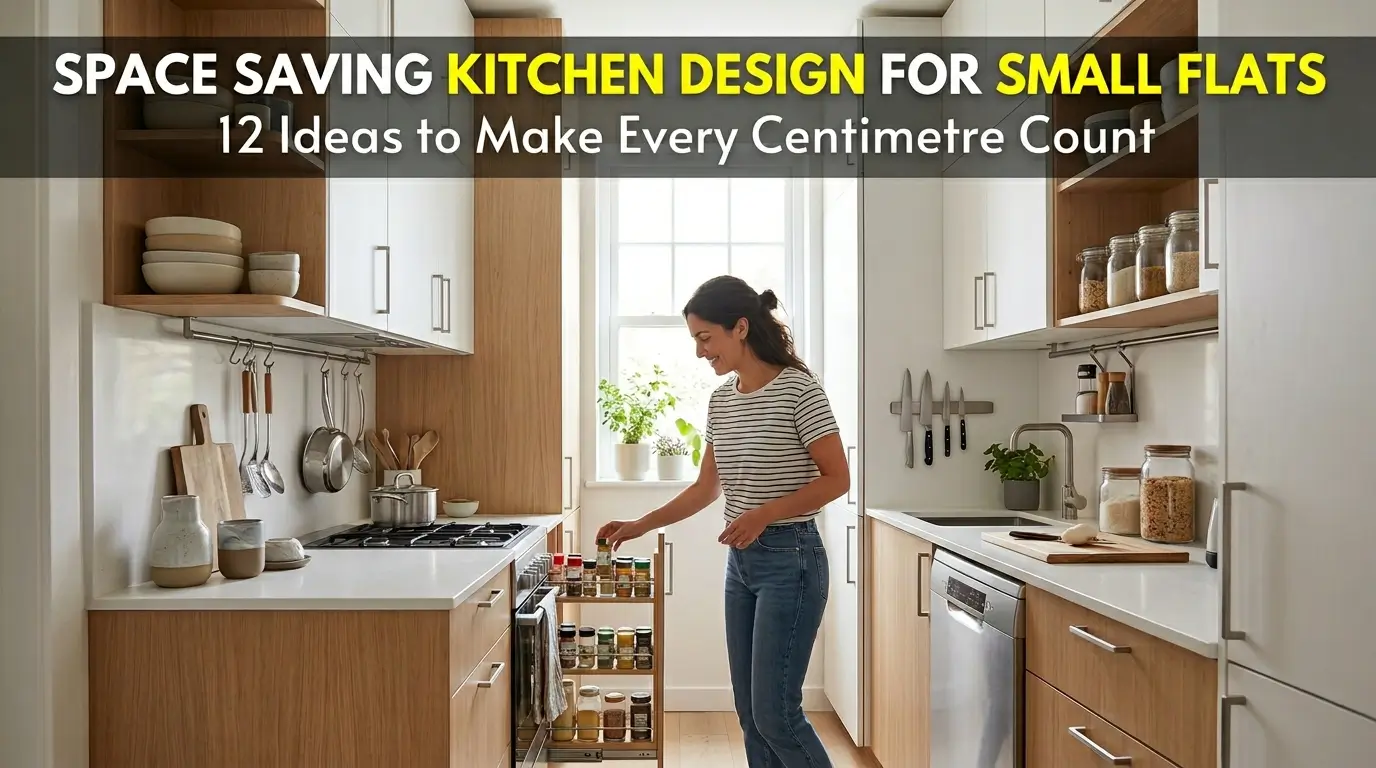
The small flat kitchen is one of the most consistently underdesigned spaces in Indian urban housing. Developers allocate the minimum viable floor area to the kitchen, install the most basic modular units available within the project budget, and hand over a space that technically contains a kitchen without genuinely functioning as one. The homeowner moves in, fills the limited storage immediately, runs out of counter space within the first week of cooking, and spends the following years managing the inadequacy rather than resolving it.
The resolution does not require a larger kitchen. It requires a better-designed one. Space saving kitchen design is not about making the kitchen look bigger in photographs. It is about making it work better in practice. Every square foot of a small flat kitchen can be made to perform at a higher level than the default installation delivers. Every storage decision, every layout choice, every appliance specification, every surface selection either adds to the functional capacity of the kitchen or reduces it. Getting those decisions right is the difference between a small kitchen that works and one that merely occupies the space allocated to it.
Indian cooking places specific demands on a small kitchen that generic space saving advice does not address. The volume of dry goods that needs to be stored. The range of vessels, from the small tadka pan to the large pressure cooker, that need to be accessible. The multiple burners running simultaneously. The smoke and steam that needs to be extracted. The spices that need to be within reach during active cooking. Space saving kitchen design for an Indian flat has to solve for all of these requirements within the same compact footprint.
Here are 12 space saving ideas that address the specific realities of cooking and living in a small Indian flat.
Space Saving Kitchen Design Ideas for Small Flats
1. Treat the Ceiling as the Upper Limit of Storage, Not the Top of the Wall Unit
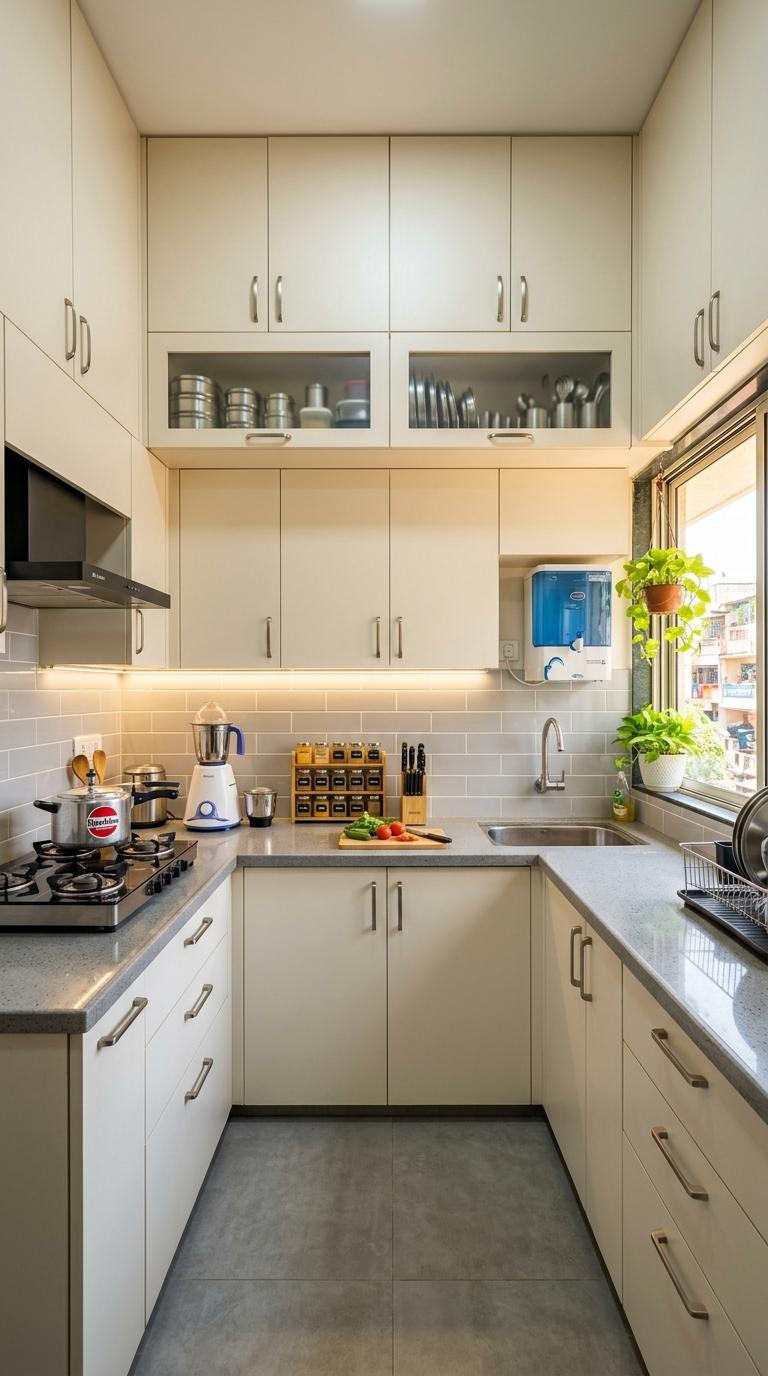
The gap between the top of the wall cabinet and the ceiling is the most consistently wasted space in a small flat kitchen. Standard wall units installed at standard height leave 300 to 450 millimetres of empty space above them that collects dust, creates visual clutter, and represents a storage volume that is simply being abandoned.
Taking wall cabinets to the full ceiling height is the single most space-efficient storage upgrade available in a small kitchen without changing the floor plan. The additional cabinet volume above standard reach height stores items used infrequently. The visual effect of a full-height cabinet run is a kitchen that feels taller, more considered, and more deliberately designed than one with the standard gap above the units. Where the budget does not allow full-height custom cabinets, a second tier of standard wall units installed above the first achieves the same result using off-the-shelf components at a lower cost.
2. Replace Every Hinged Lower Cabinet Door With Pull-Out Drawers
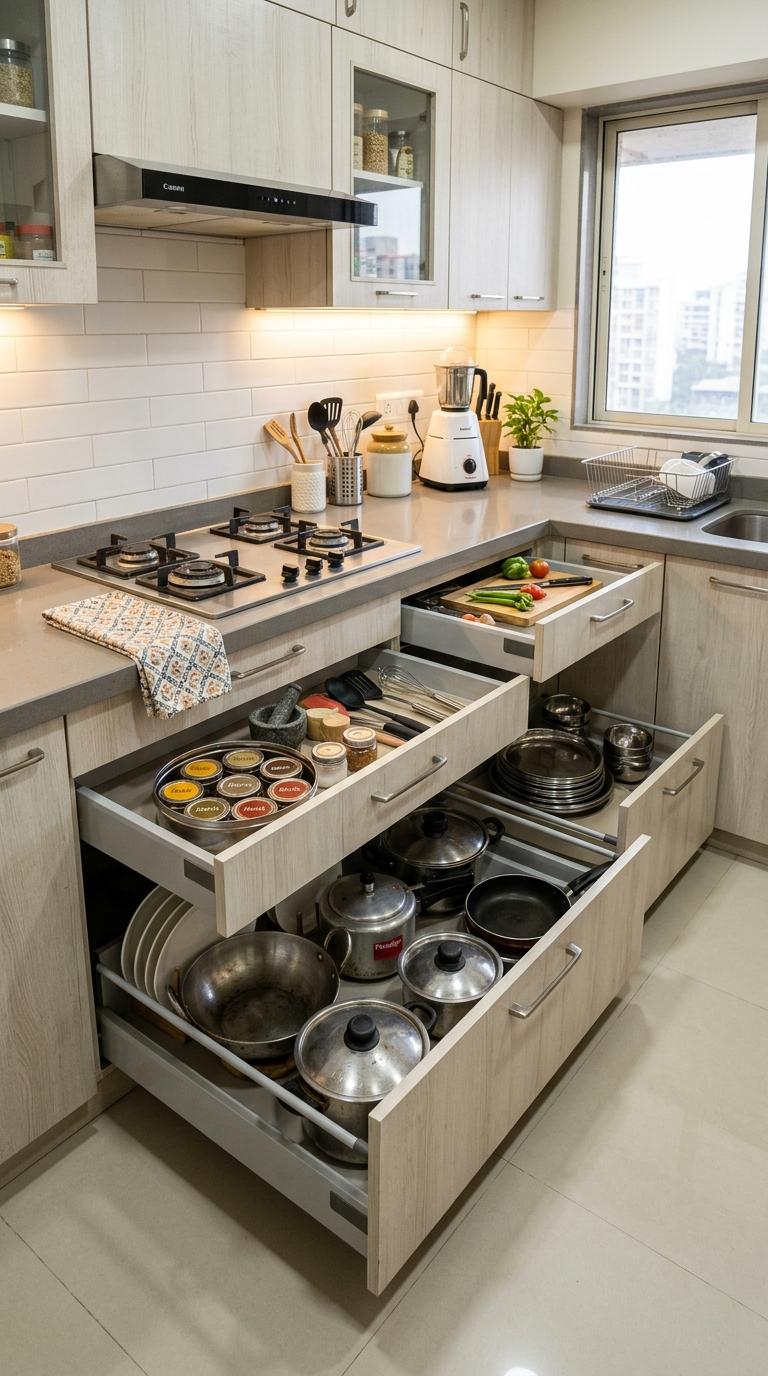
The hinged lower cabinet door is one of the least efficient storage formats in kitchen design. It provides access to a box that requires removing the front items to reach the back items, that stores things horizontally in stacks that are difficult to assess and sort, and that uses the floor area of the cabinet at the expense of the vertical space above the base shelf. In a small flat kitchen where every storage location needs to work at maximum capacity, the standard hinged lower cabinet is a structural inefficiency built into the most accessible storage zone in the kitchen.
Pull-out drawer systems in the lower cabinets, either specified as part of a new modular kitchen installation or retrofitted into existing lower cabinets, transform the functional capacity of the same physical space. Everything in a pull-out drawer is visible from above when the drawer is open. The full depth of the cabinet is accessible without effort. Items at the back are as accessible as items at the front. The vertical space within the drawer is used through stacking and layering rather than wasted. For the lower cabinet zone of a small Indian kitchen, pull-out drawers are not a luxury specification. They are the correct way to use the space.
3. A Dedicated Appliance Garage for Counter Appliances
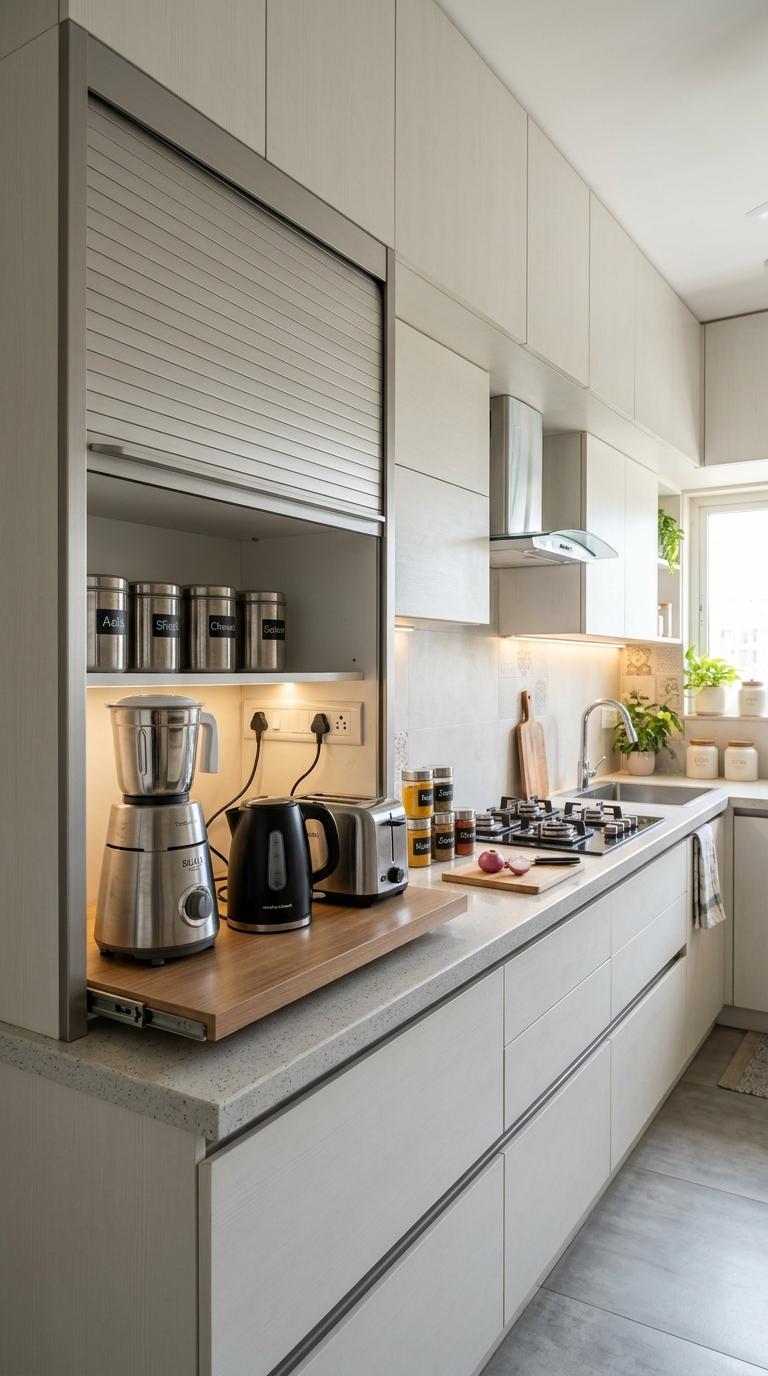
Counter appliances are the primary cause of counter space loss in small Indian kitchens. The mixer-grinder, the electric kettle, the toaster, and whichever additional appliance has migrated to the counter most recently together consume a section of prep surface that the kitchen cannot afford to lose. The standard solution is to accept the loss and work around the appliances. The space saving solution is to remove them from the counter without removing them from the kitchen.
An appliance garage, a dedicated cabinet section with a roller shutter or a lift-up door, houses counter appliances behind a closed door when they are not in active use. The appliances sit on a pull-out shelf inside the garage, connected to a power point inside the cabinet, so they can be slid forward, used, and returned without unplugging or relocating. When the garage door is closed, the counter in front of it is fully available for prep. In a small flat kitchen where the counter is the most critical functional surface, an appliance garage returns a significant section of it to active use.
4. The Work Triangle Reduced to Its Minimum Viable Dimensions
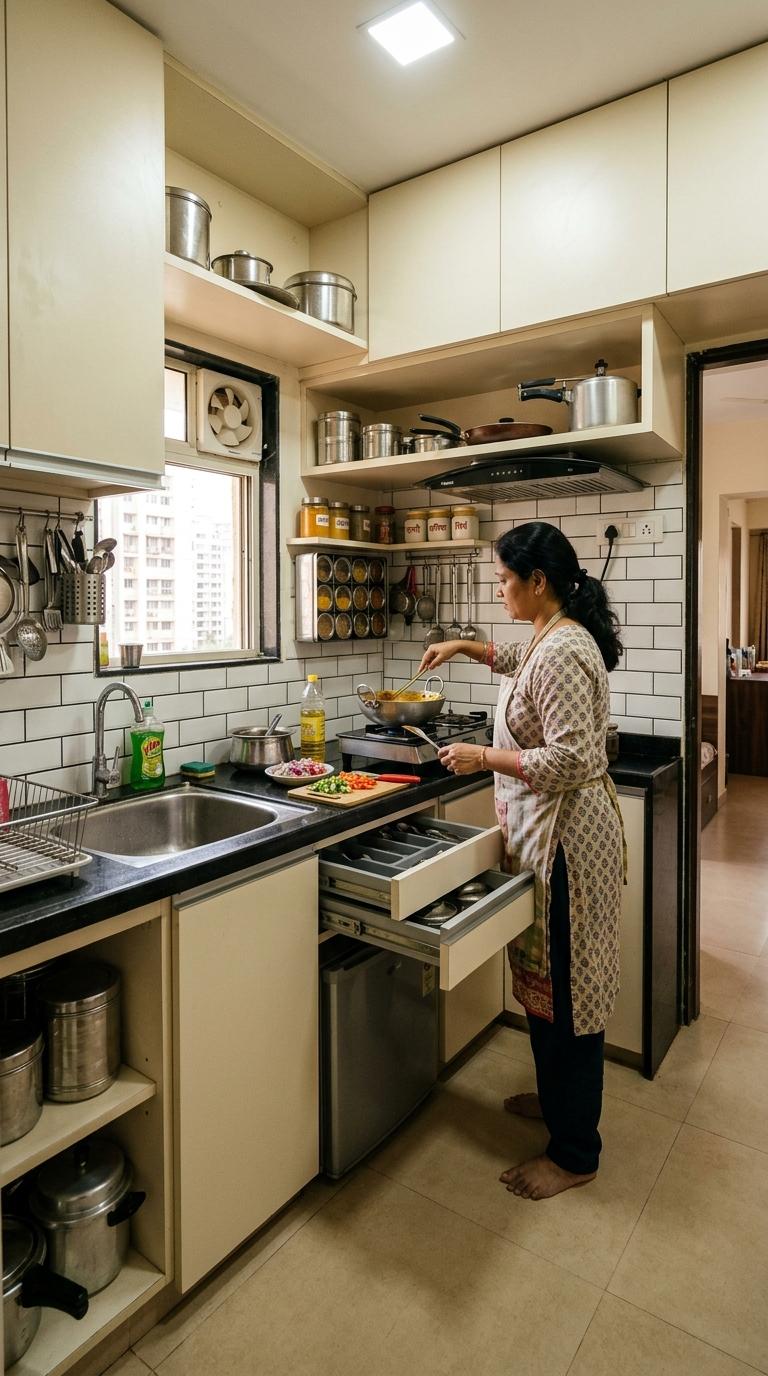
The work triangle, the relationship between the sink, the cooktop, and the primary storage, determines how much movement is required during cooking and how efficiently the kitchen functions during active use. In a large kitchen, the work triangle can be generous without creating problems. In a small flat kitchen, a work triangle that is too spread out means the cook is constantly crossing the kitchen between tasks, which in a tight space creates congestion and makes cooking more physically demanding than it needs to be.
In a small flat kitchen, the goal is to reduce the work triangle to its minimum viable dimensions without crowding the three points so close together that they overlap. The sink, the cooktop, and the primary storage should each be within two or three steps of one another, forming a compact triangle that keeps the cooking workflow tight, efficient, and contained within a small area of the kitchen floor. This constraint should drive the layout decision from the outset rather than being assessed after the layout is fixed.
5. A Compact Two-Burner Cooktop Over a Four-Burner
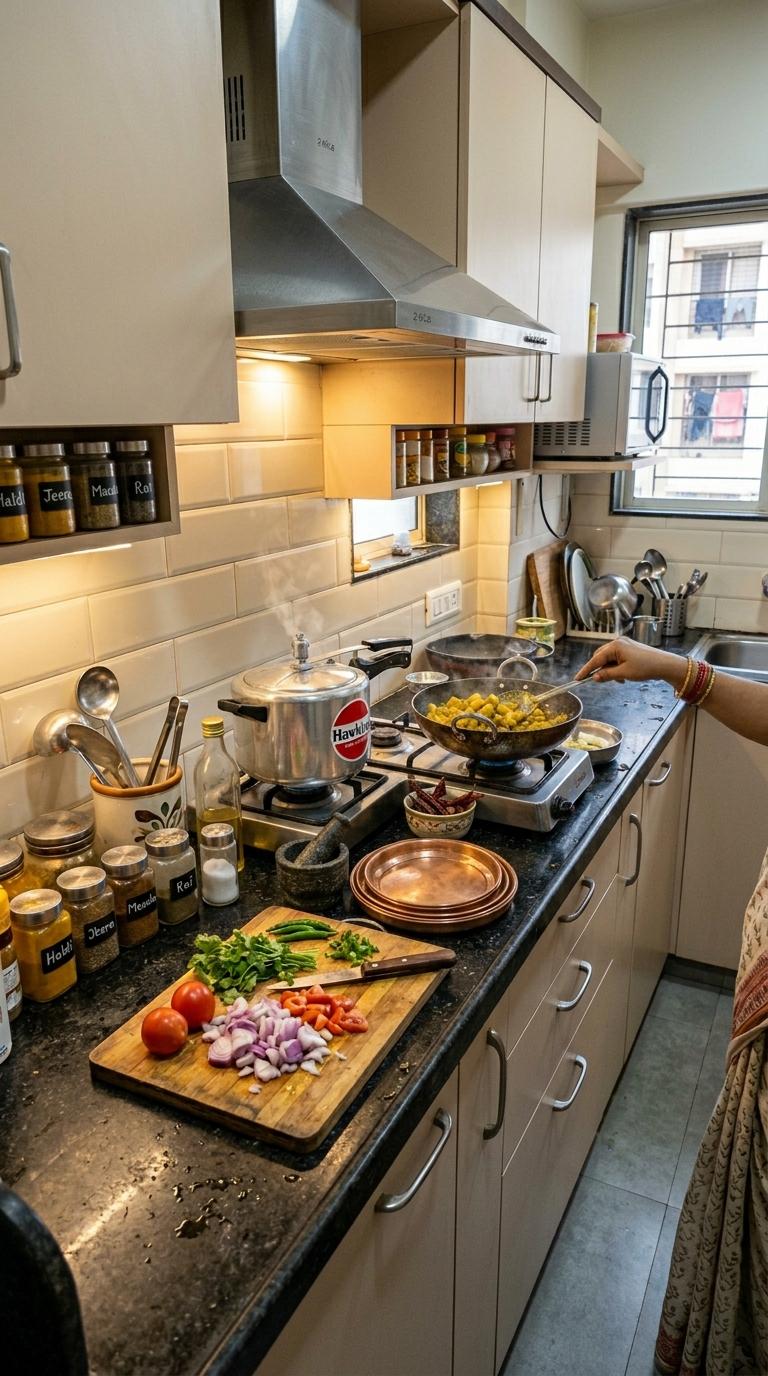
The four-burner cooktop is the default specification in most Indian modular kitchens. It is what the developer installs, what the showroom displays, and what most homeowners request without considering whether four burners actually reflects their daily cooking reality. In a small flat kitchen, a four-burner cooktop consumes 600 to 750 millimetres of counter length that a two-burner cooktop covers in 400 to 500 millimetres.
For a household cooking daily Indian meals, two burners handle the overwhelming majority of cooking tasks. A pressure cooker on one burner and a pan for the sabzi on the other covers most weekday meals. The third and fourth burners on a four-burner cooktop are used during larger cooking sessions that most households manage with two burners and a little sequencing. A compact two-burner cooktop in a small flat kitchen returns 150 to 200 millimetres of counter length to prep space, which in a kitchen where every centimetre is accounted for is a meaningful recovery.
6. A Fold-Down or Pull-Out Prep Extension
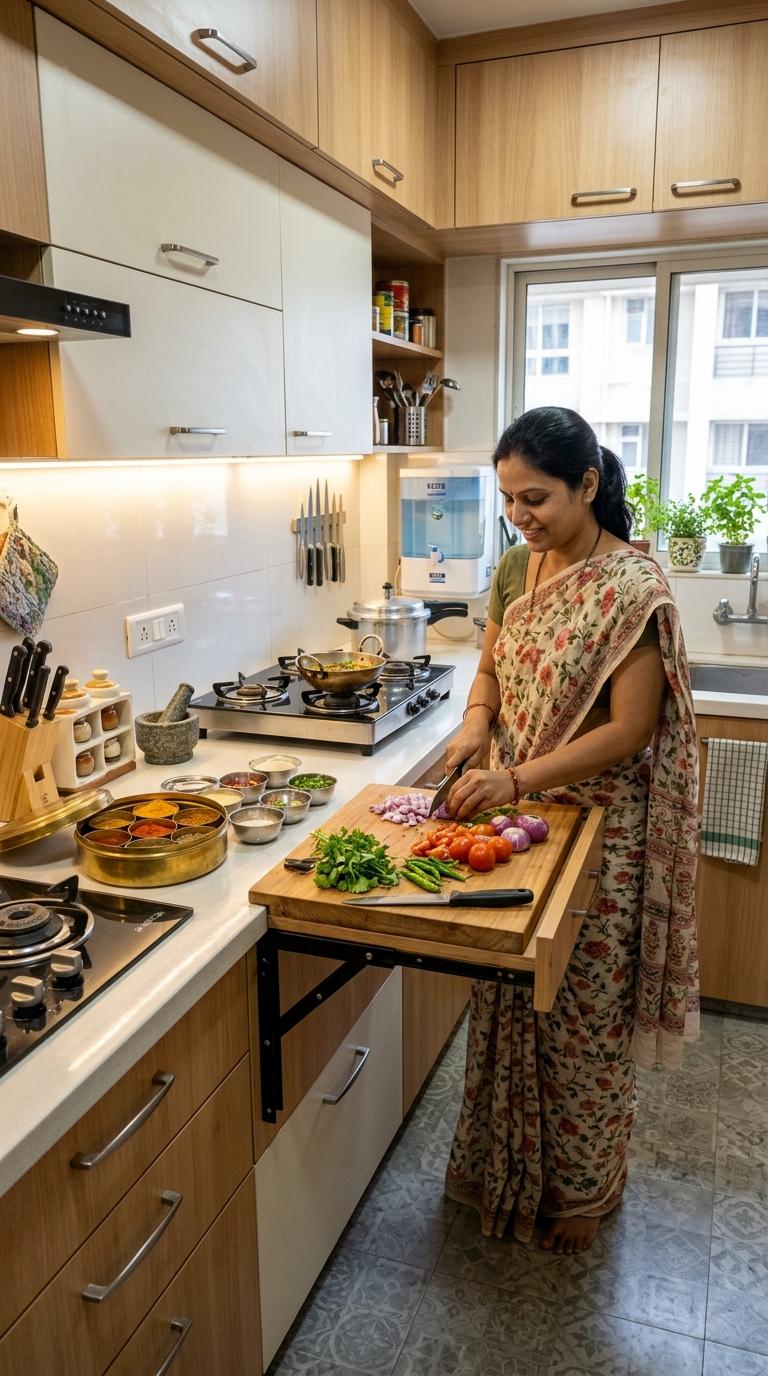
In a small flat kitchen where the fixed counter length is insufficient for comfortable food preparation, a fold-down or pull-out counter extension provides additional prep surface exactly when it is needed and disappears completely when it is not. A fold-down shelf fixed to the wall at counter height, supported by folding legs or a wall-mounted bracket, adds a full-width extension to the counter run during food preparation and folds flat against the wall when cooking is complete.
A pull-out prep board, a cutting board mounted on full-extension slides beneath the counter surface, provides an alternative that stays within the counter footprint entirely. The board pulls out to a working position at counter height, is used for chopping and prep, and returns to its housed position when no longer needed. Both solutions address the counter shortage of a small flat kitchen without adding permanent floor area to the kitchen layout or requiring any structural modification to the room.
7. Integrated Storage Inside the Kickboard
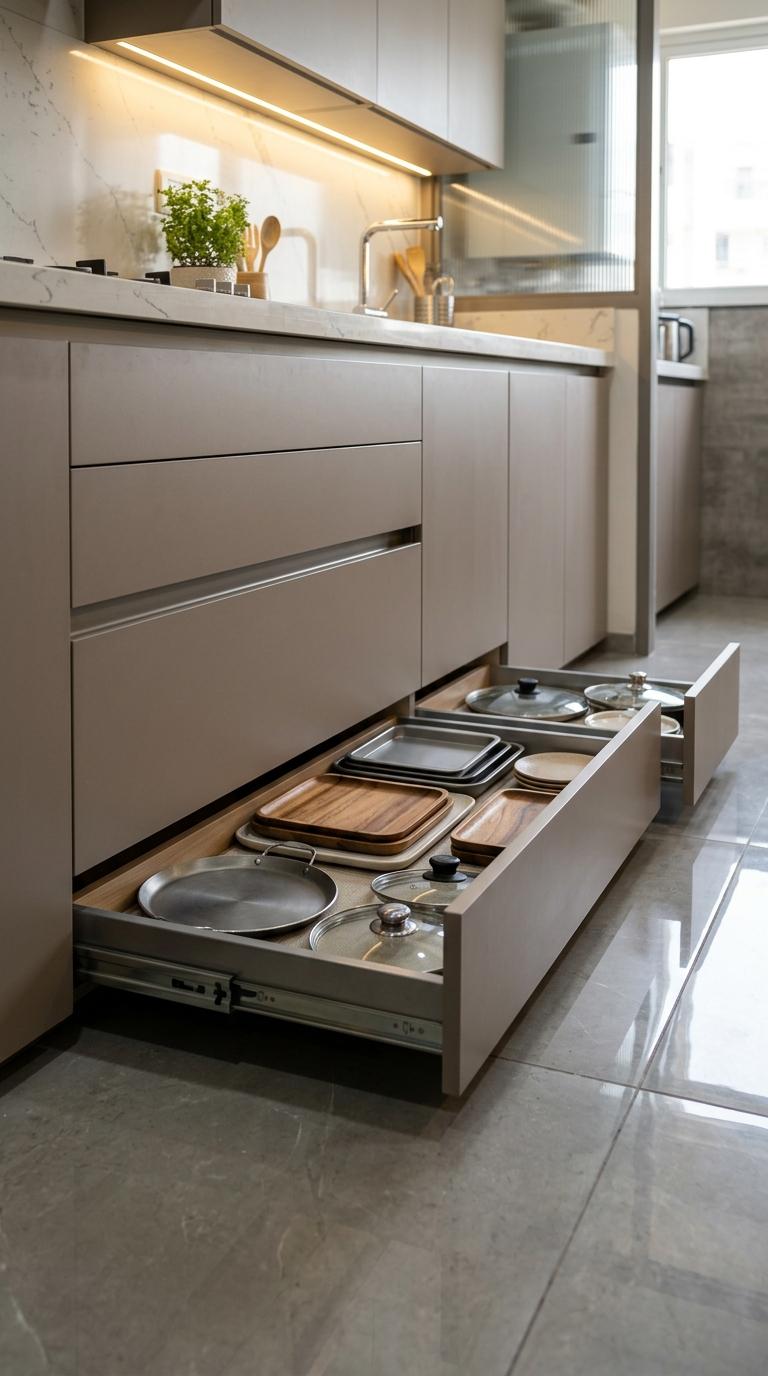
The kickboard, the panel at the base of the lower cabinets between the floor and the cabinet box, encloses a void that runs the full length of the lower cabinet run at a height of approximately 100 to 150 millimetres. In a standard modular kitchen, this void is inaccessible and unused. In a space saving small flat kitchen, it is a storage opportunity that runs the entire length of the counter.
Kickboard drawers, shallow pull-out drawers that replace the standard kickboard panel with a hinged or sliding drawer front, convert the kickboard void into storage for flat items. Baking sheets, large flat lids, a spare tawa, placemats, and large serving platters all fit within the kickboard drawer depth and have no other natural home in a small kitchen. Kickboard drawers are available as a standard accessory from most modular kitchen manufacturers in India and can be retrofitted into existing kickboard spaces by a carpenter with standard drawer slide hardware.
8. A Slim Larder Unit for Bulk Dry Goods Storage
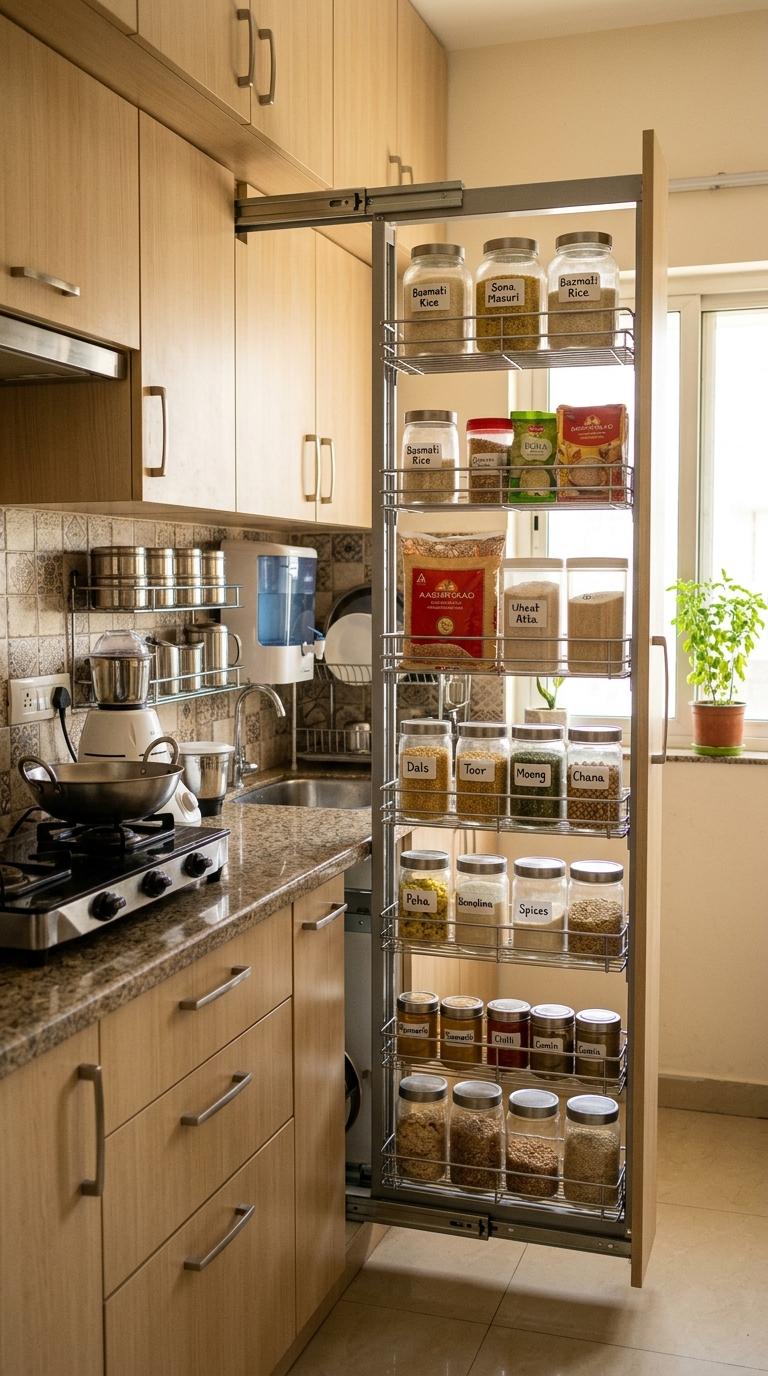
Indian households store dry goods in quantities that a standard modular kitchen cabinet system is not designed to accommodate. Rice in 5 or 10 kilogram quantities, multiple varieties of dal, atta, poha, semolina, and the range of dry pulses and grains that form the staple of Indian cooking require a storage volume that fills standard wall and base cabinets quickly and leaves little room for anything else.
A slim larder unit, a tall floor-to-ceiling cabinet 300 to 400 millimetres wide with pull-out shelves and wire baskets at different heights, consolidates all bulk dry goods storage into a single vertical column that uses the height of the kitchen efficiently without consuming significant floor area. The larder unit is the most space-efficient format for bulk dry goods storage in a small flat kitchen. It keeps the dry goods in one organised, accessible location rather than distributed across multiple cabinets where they compete with vessels, utensils, and equipment for the same shelf space.
9. Reflective Surfaces and Consistent Light Tones
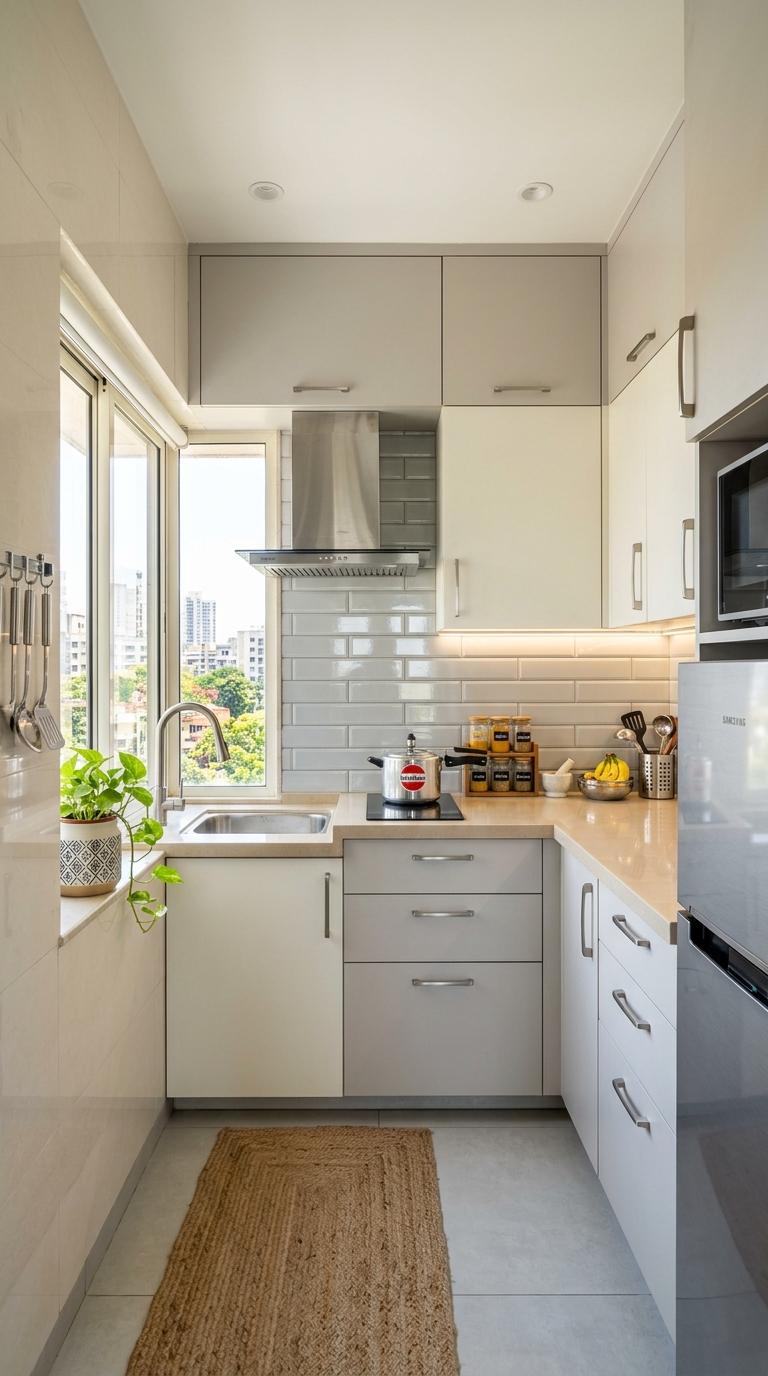
A small flat kitchen that feels cramped is a less pleasant place to cook in than one that feels open, regardless of whether the actual dimensions have changed. Reflective surfaces and consistent light tones do not add square footage but they add the perception of space, which in a kitchen that is used for extended periods every day has a genuine effect on the cooking experience.
Light, consistent cabinet colours in off-white, pale grey, or warm linen, a countertop in a light neutral tone with a matte or semi-matte finish, and a backsplash in a large-format tile that reflects light without introducing visual pattern complexity all work together to make a small flat kitchen feel more open than its dimensions suggest. A glossy backsplash tile in a very light tone reflects under-cabinet light and overhead light across the kitchen, effectively brightening the space without adding any light fittings. In a kitchen without a window, this reflective quality of the backsplash surface is a meaningful contribution to the overall light quality of the room.
10. A Wall-Mounted Fold-Down Dining Surface
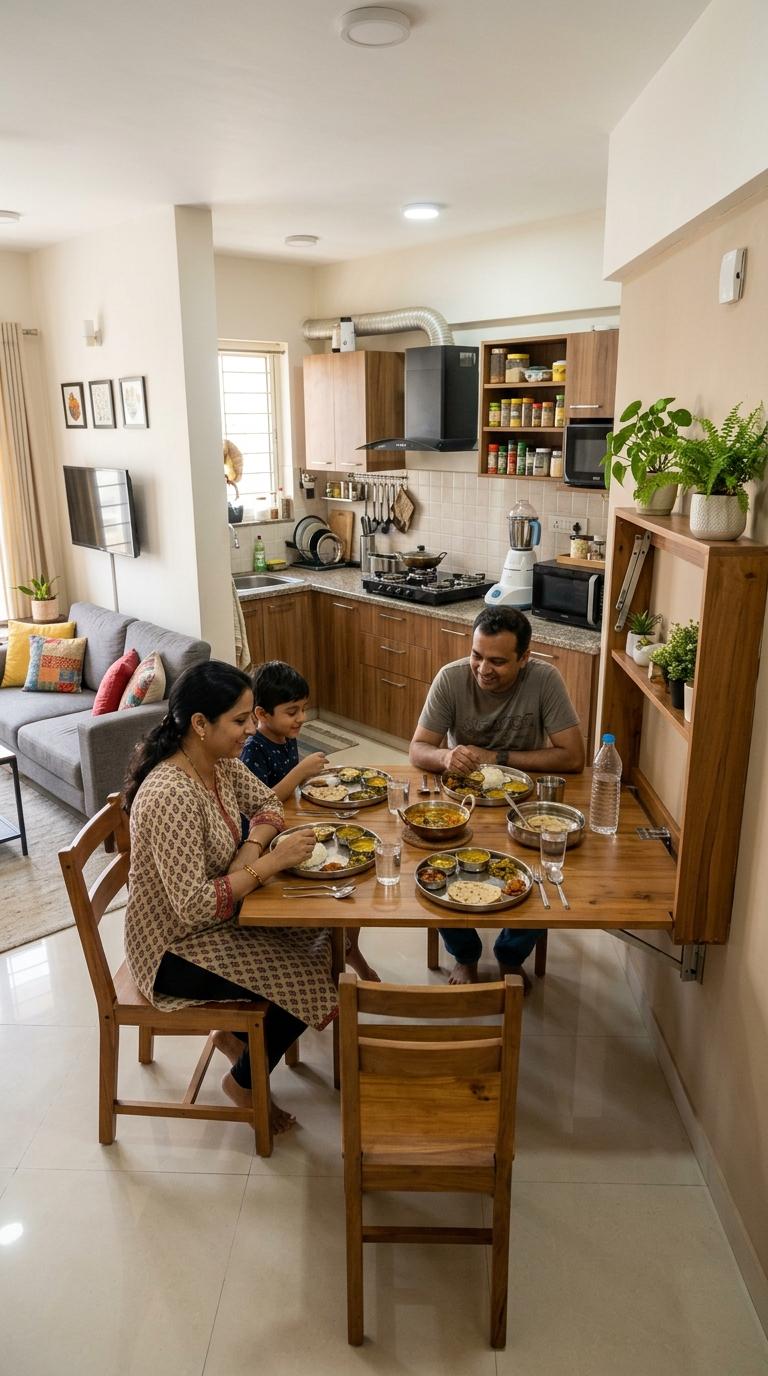
The dining requirement in a small flat that does not have a separate dining room typically lands in or immediately outside the kitchen, consuming floor area that the kitchen workflow needs for circulation and that the flat needs for living. A conventional dining table for two to four people, with adequate chair clearance on all sides, requires a floor area that in a small flat represents a significant proportion of the available living space.
A wall-mounted fold-down dining surface, fixed to the wall at the kitchen boundary or on the nearest available wall in the living area, provides a dining surface for two to four people that folds completely flat against the wall when the meal is finished. The floor area it occupies during a meal is returned to the living space immediately after. In a small flat where the boundary between kitchen and living space is already compressed, a fold-down dining surface is a more honest response to the spatial reality than a permanent table that occupies floor area regardless of whether it is being used.
11. Dedicated Zones for Every Storage Category
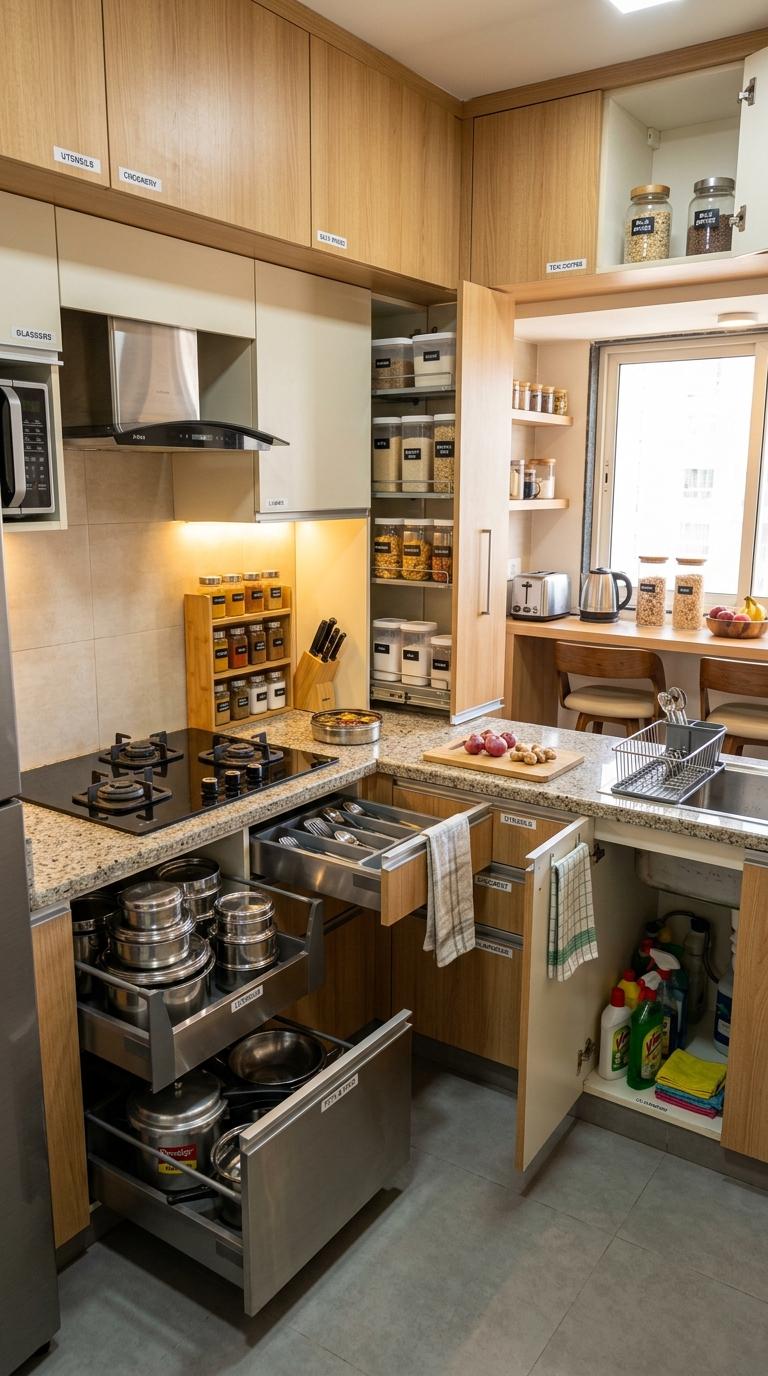
A small flat kitchen that is physically well-equipped with adequate storage, pull-out drawers, full-height cabinets, a larder unit, and over-door organisers, but that has no discipline in how those storage locations are used, will feel as disorganised and as cramped as a kitchen with half the storage. The physical storage capacity and the organisational discipline that makes that capacity useful are two separate things and both are required.
Assign a dedicated zone to every storage category in the kitchen. Spices adjacent to the cooktop. Vessels in the lower cabinets nearest the cooktop. Dry goods in the larder unit. Cleaning supplies under the sink. Breakfast items in the cabinet nearest the dining surface. Baking equipment in the least accessible lower cabinet. The assignment itself is less important than the consistency of returning every item to its assigned zone after use. A small flat kitchen with dedicated zones and consistent return discipline stays organised naturally. One without it requires reorganising regularly and feels constantly on the verge of chaos regardless of how much storage it contains.
12. Natural Light and Ventilation as Design Priorities
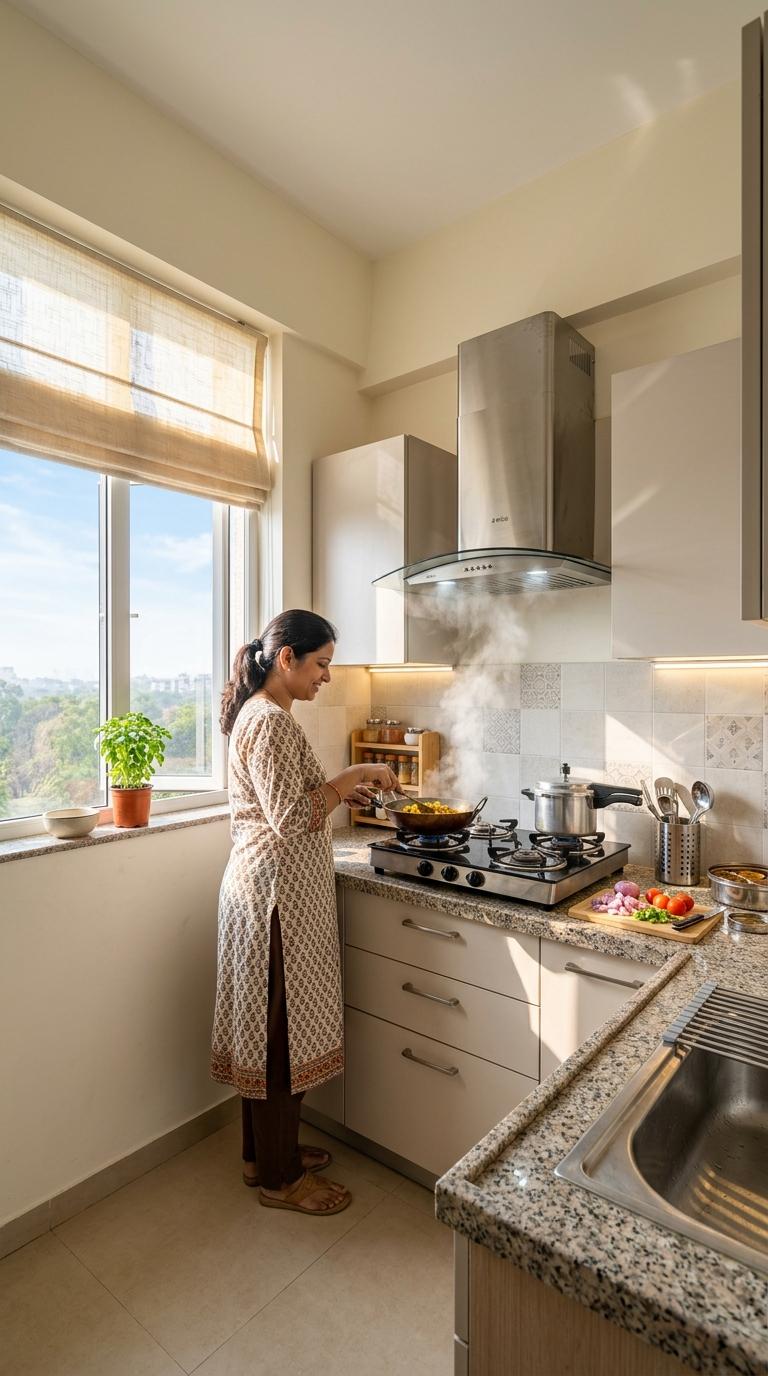
A small flat kitchen that is dark and poorly ventilated feels smaller, less pleasant, and more difficult to work in than the same kitchen with good light and air circulation. Natural light and ventilation are not decorative considerations in a small kitchen. They are functional ones that affect how the kitchen performs as a working space and how the cook experiences the time spent in it.
Where a window exists, maximise the light it admits. Avoid wall cabinets that block the window. Keep the window clear of permanent objects on the sill. Use a light, translucent blind rather than a heavy curtain if privacy is needed. Where the kitchen is enclosed without a window, install the best artificial lighting the budget allows across multiple levels, overhead ambient, under-cabinet task, and internal cabinet accent, and invest in a chimney with adequate extraction capacity to manage the heat and steam that Indian cooking generates in an enclosed space. A well-lit, well-ventilated small flat kitchen is a genuinely different space from a dark, stuffy one of identical dimensions.
Design for the Cooking, Not the Catalogue
A space saving kitchen design for a small flat is not a collection of clever tricks applied to a generic layout. It is a set of decisions made specifically for the way one household cooks, stores, and uses the kitchen every day.
The layout that reduces the work triangle. The pull-out drawers that make the lower cabinets work properly. The appliance garage that returns the counter to the cook. The larder unit that handles the dry goods honestly. The fold-down dining surface that responds to how the flat is actually lived in.
None of these decisions require an exceptional budget. They require attention to the specific kitchen, the specific cooking, and the specific household that will use the space every day.
A small flat kitchen designed with that attention is not a compromise. It is a kitchen that knows what it is and does it well.