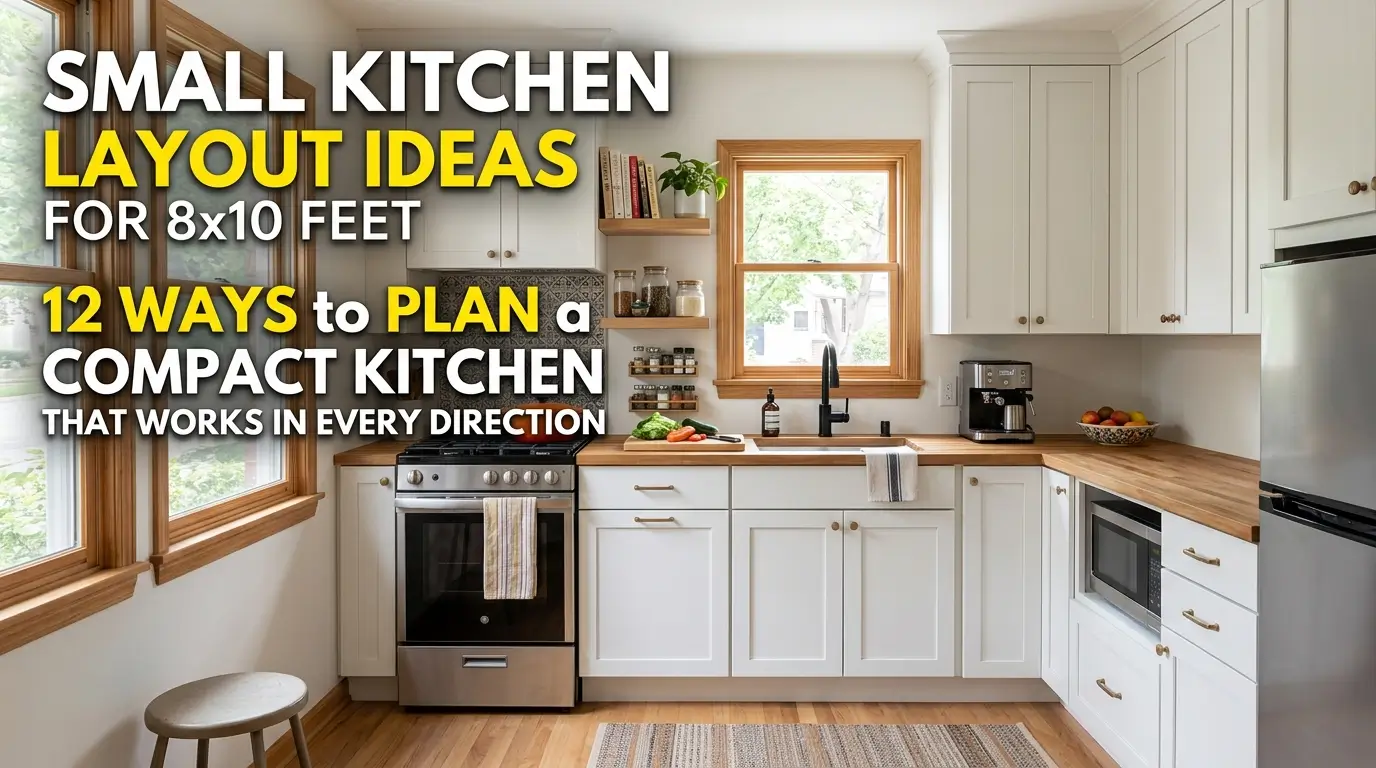
An 8×10 feet kitchen is a specific challenge with a specific set of solutions. It is not so small that cooking becomes genuinely impractical, and not large enough that layout decisions can be made casually. Every centimetre of an 8×10 kitchen is accounted for. Every decision about where the sink goes, which wall carries the cabinets, where the cooktop sits, and how the door opens either makes the space work better or makes it harder to use.
The number that matters most in an 8×10 kitchen is not the total square footage. It is the clearance. The distance between facing counters, between the open refrigerator door and the opposite wall, between the person cooking at the cooktop and the person trying to pass behind them. In an 8×10 kitchen, clearance is the constraint that every layout decision has to respect. Get it right and the kitchen feels manageable. Get it wrong and the kitchen feels impossible regardless of how well everything else has been planned.
Indian cooking adds another layer to this challenge. A cuisine that uses multiple burners simultaneously, requires immediate access to a range of spices during cooking, produces significant smoke and steam that needs to be extracted efficiently, and generates a volume of vessels and equipment that needs to be stored accessibly, demands more from a small kitchen than most other cooking traditions. An 8×10 kitchen designed for Indian cooking needs to do considerably more work than an 8×10 kitchen designed for occasional light cooking.
Here are 12 layout ideas for making an 8×10 feet kitchen work as hard as Indian cooking requires.
Small Kitchen Layout Ideas for 8×10 Feet
1. Map the Fixed Points Before Planning the Layout
Every kitchen layout begins from its fixed points. The door opening. The window position. The existing plumbing connection for the sink. The electrical board location. These elements cannot be moved without significant additional expense and in a rental apartment they typically cannot be moved at all. The layout has to work around them rather than through them.
In an 8×10 kitchen, draw the room to scale on paper before opening a catalogue or visiting a showroom. Mark every fixed point precisely. The door swing arc. The window sill height. The plumbing stub-out location. The position of the overhead beam if one exists. The layout that works for this specific room will emerge from these fixed constraints rather than from a generic template. A layout chosen from a catalogue and then adjusted to avoid the fixed points is always a compromise. A layout planned from the fixed points outward is always more coherent.
2. The Single-Wall Layout for the Narrowest Configuration
An 8×10 kitchen where the width is the limiting dimension, a room that is 8 feet wide with counters on both sides leaving only 4 feet of clearance between them, may be better served by a single-wall layout than a galley. A single-wall layout concentrating all counters, the sink, the cooktop, and the storage along one 10-foot wall leaves the opposite wall completely free, giving a full 8 feet of clear floor width that makes the kitchen feel open and easy to move in.
The trade-off is counter length. A 10-foot single-wall run provides roughly 3 metres of counter after the sink and cooktop are accounted for, which is workable but not generous for Indian cooking. A pull-out prep board, a fold-down counter extension at one end, or a slim rolling cart parked against the opposite wall when needed supplements the fixed counter without committing to the narrower clearance of a full galley layout.
3. The Galley Layout for Maximum Counter Length
Where the 8×10 kitchen is used primarily for cooking rather than as a pass-through space, and where the clearance between facing counters can be maintained at a workable minimum of 900 millimetres, a galley layout makes the most productive use of the available wall length. Counters along both the 10-foot walls create a total counter run of up to 6 metres, which is generous for any household and more than adequate for the most demanding Indian cooking requirements.
The galley layout works best when the kitchen has a door at one end only, so traffic through the kitchen does not conflict with the cooking workflow along the counter. A galley kitchen with doors at both ends becomes a corridor, and a corridor is very difficult to cook in regardless of how well the individual elements are specified. If the room has only one door, the galley layout is the highest-performing option available for an 8×10 kitchen.
4. The L-Shaped Layout for the Balanced Room
An 8×10 kitchen where neither dimension is so limiting that it forces a single-wall or galley decision, and where a corner is available without a door or window interrupting it, is well suited to an L-shaped layout. One arm of the L runs along the 10-foot wall. The shorter arm runs along the 8-foot wall from the corner. The remaining floor area, the open quadrant of the L, provides clear circulation space and can accommodate a small dining counter or a compact rolling cart without crowding the cooking zone.
The L-shaped layout for an 8×10 kitchen works best when the corner of the L is occupied by the sink or a corner carousel unit that makes the deep corner storage accessible. An unused corner in an L-shaped small kitchen is a significant proportion of the total counter length and storage volume. A corner carousel, a pull-out corner unit, or a diagonal corner sink that makes the corner workable is worth specifying at the outset rather than discovering the corner problem after installation.
5. Position the Cooktop Away From the Door
In an 8×10 kitchen, the cooktop position has more implications than any other single element in the layout. The cooktop needs to be away from the door opening for safety reasons. It needs to be under or adjacent to the chimney for ventilation. It needs to have counter space on at least one side for vessels and ingredients during cooking. And it needs to be positioned so the cook is not standing with their back to the door, which is both practically inconvenient and creates a safety risk when hot vessels are being moved.
In most 8×10 kitchens, the cooktop belongs on the wall furthest from the door, under the chimney, with at least 300 millimetres of counter on each side. This position keeps the cooking activity away from the kitchen entrance, maximises the counter space adjacent to the cooktop, and keeps the chimney extraction at the point where smoke and steam are generated rather than allowing them to travel across the kitchen before being extracted.
6. Sink Placement at the Natural Light Source
The sink is used more frequently than any other point in the kitchen. Washing vegetables, filling vessels, rinsing utensils, washing hands between tasks. In an 8×10 kitchen where the sink placement also determines the plumbing run, the default is to position the sink at the existing plumbing stub-out regardless of where that happens to fall in the room.
Where the existing plumbing allows any flexibility at all, position the sink at or near the natural light source, typically below the window if one exists, or on the wall closest to the window if the sink cannot go directly below it. Washing and prep work done in natural light is more pleasant and more accurate than the same work done under artificial light. In an 8×10 kitchen where the cooking experience matters as much as the cooking output, sink placement at the natural light source is a quality-of-life decision that pays back every single day.
7. Refrigerator at the End of the Counter Run, Never in the Middle
The refrigerator is the largest single object in the kitchen and its position has a disproportionate effect on how the rest of the layout flows. In an 8×10 kitchen, a refrigerator positioned in the middle of a counter run breaks the counter into two shorter sections and creates a physical interruption in the workflow that makes the kitchen harder to use. It also creates awkward transitions between the refrigerator door swing and the adjacent counter that reduce the effective usable counter width on both sides.
Position the refrigerator at the end of the counter run, against the side wall, where it does not interrupt the counter continuity. At the end of the run, the refrigerator door opens away from the counter rather than across it. The counter runs uninterrupted from the sink to the cooktop without the refrigerator breaking it in the middle. In an 8×10 kitchen, this single positioning decision can make the difference between a counter run that feels workable and one that feels constantly interrupted.
8. A Fold-Down Dining Counter Instead of a Separate Table
An 8×10 kitchen that also needs to accommodate dining, a common requirement in small Indian apartments where a separate dining room does not exist, cannot support a conventional dining table without sacrificing the clearance that the cooking workflow requires. A standard four-seater dining table requires a floor area of roughly 8×5 feet including chair clearance, which in an 8×10 kitchen leaves almost nothing for the kitchen itself.
A fold-down dining counter fixed to the wall at bar height or standard table height, with folding legs that support it when deployed and fold flat against the wall when not in use, provides a dining surface for two to four people without consuming any permanent floor area. When the kitchen is in active cooking use, the fold-down counter is closed and the floor area is available for cooking movement. When the cooking is done, the counter unfolds and the kitchen becomes the dining room. It is a direct and practical response to the real spatial constraint of an 8×10 kitchen that needs to serve two purposes.
9. A Compact Corner Chimney for Better Cooktop Placement Flexibility
The standard chimney in an Indian modular kitchen is a wall-mounted unit fixed directly above the cooktop on the same wall. In an 8×10 kitchen where the cooktop position is constrained by the door location, the window, and the counter layout, the requirement to position the cooktop directly below a wall-mounted chimney can create a conflict that forces a compromise on either the cooktop position or the chimney placement.
A corner chimney, designed to extract from a cooktop positioned in or near the corner of the kitchen, provides extraction coverage from a position that a standard wall-mounted chimney cannot reach without an unusually long flue run. For an 8×10 kitchen where the optimal cooktop position is near the corner of the room, a corner chimney resolves the ventilation requirement without forcing the cooktop away from its ideal location. Not all modular kitchen showrooms stock corner chimney units prominently but they are available from most quality chimney manufacturers in India.
10. Toe-Kick Drawers Below Every Base Cabinet
The toe-kick space, the recessed area at the base of every lower cabinet between the floor and the bottom of the cabinet box, is universally unused in standard Indian modular kitchens. It is simply a void, typically 100 to 150 millimetres high and as deep as the cabinet, left open because standard cabinet construction does not incorporate it as storage.
Toe-kick drawers, shallow pull-out drawers that occupy the full width of the toe-kick space below each base cabinet, convert this otherwise wasted volume into storage for flat items that have no natural home in a small kitchen. Baking trays, flat griddle pans, large cutting boards, and placemats all fit naturally in toe-kick drawer depth. In an 8×10 kitchen where every storage location matters, toe-kick drawers across the full lower cabinet run add a meaningful volume of additional storage without changing the kitchen footprint or the cabinet configuration in any visible way.
11. Open Shelving on One Wall Section to Avoid Visual Crowding
A fully cabineted 8×10 kitchen, with wall units covering every available centimetre of wall surface on all sides, can feel oppressive regardless of the quality of the individual cabinet specification. The unbroken run of cabinet doors on every wall creates a visual enclosure that makes the kitchen feel smaller than it is and significantly more institutional than it needs to be.
Replacing one section of wall cabinets with open shelving, a 600 to 900 millimetre wide open shelf unit at the same height as the surrounding wall cabinets, breaks the visual mass of the full-cabinet kitchen and creates a breathing space that makes the overall kitchen feel less enclosed. The open section carries the items that look good on display, coordinated ceramic containers, a small plant, two or three frequently used vessels. Everything else remains behind closed cabinet doors. One section of open shelving in an otherwise fully cabineted 8×10 kitchen adds visual relief without sacrificing meaningful storage capacity.
12. Ventilation Beyond the Chimney
In an enclosed 8×10 kitchen, the chimney handles extraction above the cooktop but does not address the general air quality and humidity of the kitchen during heavy Indian cooking. A kitchen where multiple burners are running, pressure cookers are venting, and a full meal is being prepared generates heat, steam, and cooking odours that a cooktop chimney alone cannot fully manage.
A small exhaust fan fitted in the wall or the window of an 8×10 kitchen, running continuously during heavy cooking, supplements the chimney extraction by maintaining a general air change rate in the kitchen that keeps the temperature, humidity, and odour level manageable. In a kitchen without a window, a wall exhaust fan connected to an external duct is a ventilation requirement rather than an optional extra. In a kitchen with a window, a window exhaust fan provides the same function at a lower installation cost. Either way, the combination of a cooktop chimney and a supplementary exhaust fan produces a significantly more comfortable cooking environment in an enclosed 8×10 kitchen than a chimney alone.
Plan the Kitchen for the Room, Not the Room for the Kitchen
An 8×10 kitchen is a defined constraint, not a design problem without a solution. Every layout decision, from the position of the cooktop to the specification of the toe-kick drawers, either works with the constraint or fights against it. The layouts and ideas that work best in an 8×10 kitchen are always the ones that begin from what the room actually is rather than from what a larger room might allow.
Map the fixed points. Choose the layout that fits the room proportions. Position the cooktop and sink for workflow and light. Take the storage to the ceiling. Fold down the dining surface when it is needed and fold it away when it is not. Keep one section of wall open so the kitchen can breathe.
An 8×10 kitchen planned this carefully is not a compromise version of a larger kitchen. It is a kitchen designed for what it is, and designed well.