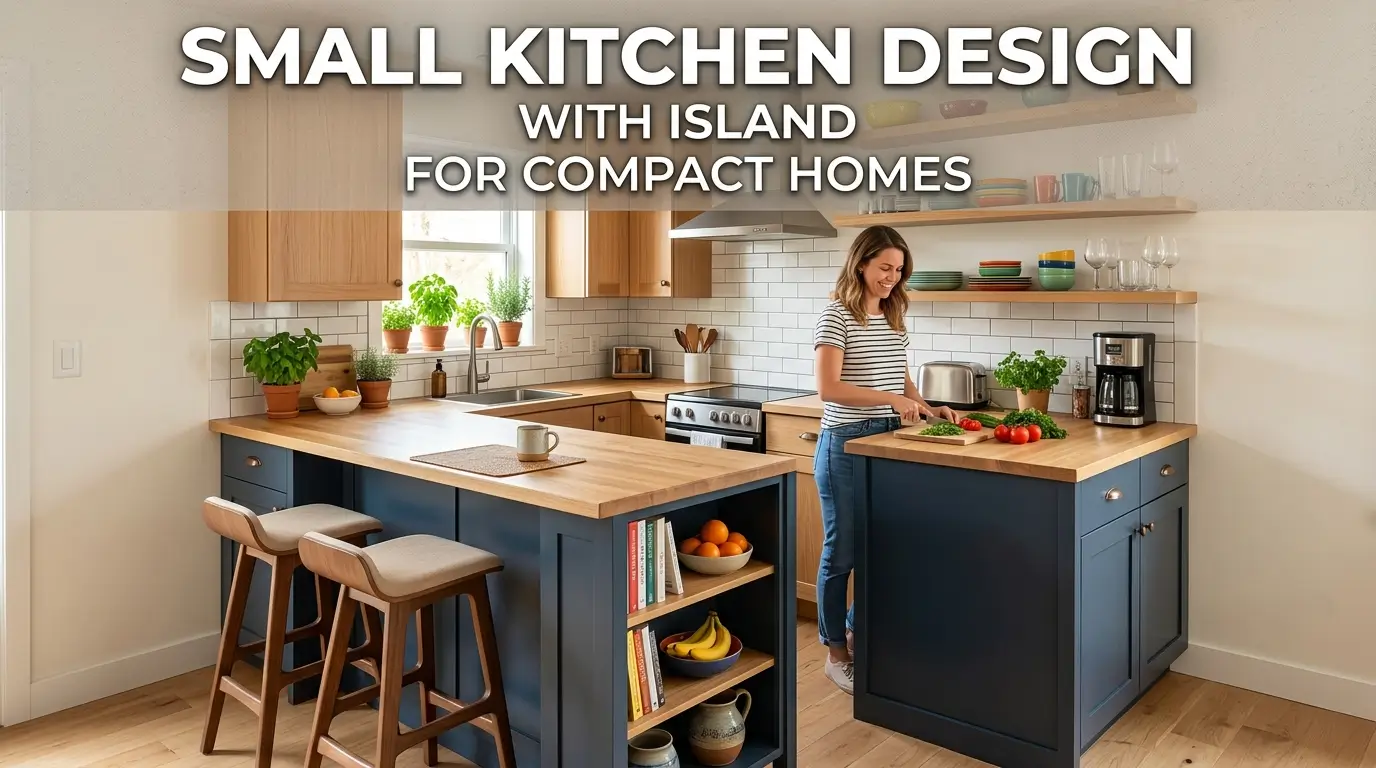
The kitchen island has long occupied a position in the aspirational imagination of Indian homeowners that its practical reality in small kitchens has rarely been able to match. It appears in every showroom, every design magazine, and every renovation inspiration board as the defining feature of a well-equipped, generously proportioned kitchen, and it carries with it a set of associations, generous counter space, sociable cooking, casual dining, professional-grade workspace, that make it one of the most consistently desired kitchen features regardless of the size of the kitchen it is being considered for.
The reality of putting an island into a small kitchen has traditionally been a story of disappointment. Standard kitchen islands are designed for kitchens with the kind of floor area that most Indian apartments simply do not have, and the attempt to fit a conventional island into a compact kitchen typically results in a space that is cramped, difficult to move through, and functionally worse than the kitchen without the island because the floor area the island consumes was the kitchen’s most valuable asset, open space for movement and food preparation, rather than an underused area that the island could productively fill.
But the conventional fixed island is not the only form the concept can take, and the design thinking around compact kitchen islands has evolved significantly over the last several years in response to the reality of urban Indian living. Movable islands, peninsula configurations, slim console islands, fold-down island extensions, and multi-function island units that combine storage, seating, and preparation surface in a genuinely compact footprint have made the kitchen island a realistic possibility in kitchens that would have been simply too small for the conventional interpretation of the concept. The question for a compact Indian kitchen is not whether an island is possible but which configuration of the island concept works within the specific constraints of the space available.
Small Kitchen Design with Island for Compact Homes
1. Understanding the Minimum Space Requirements
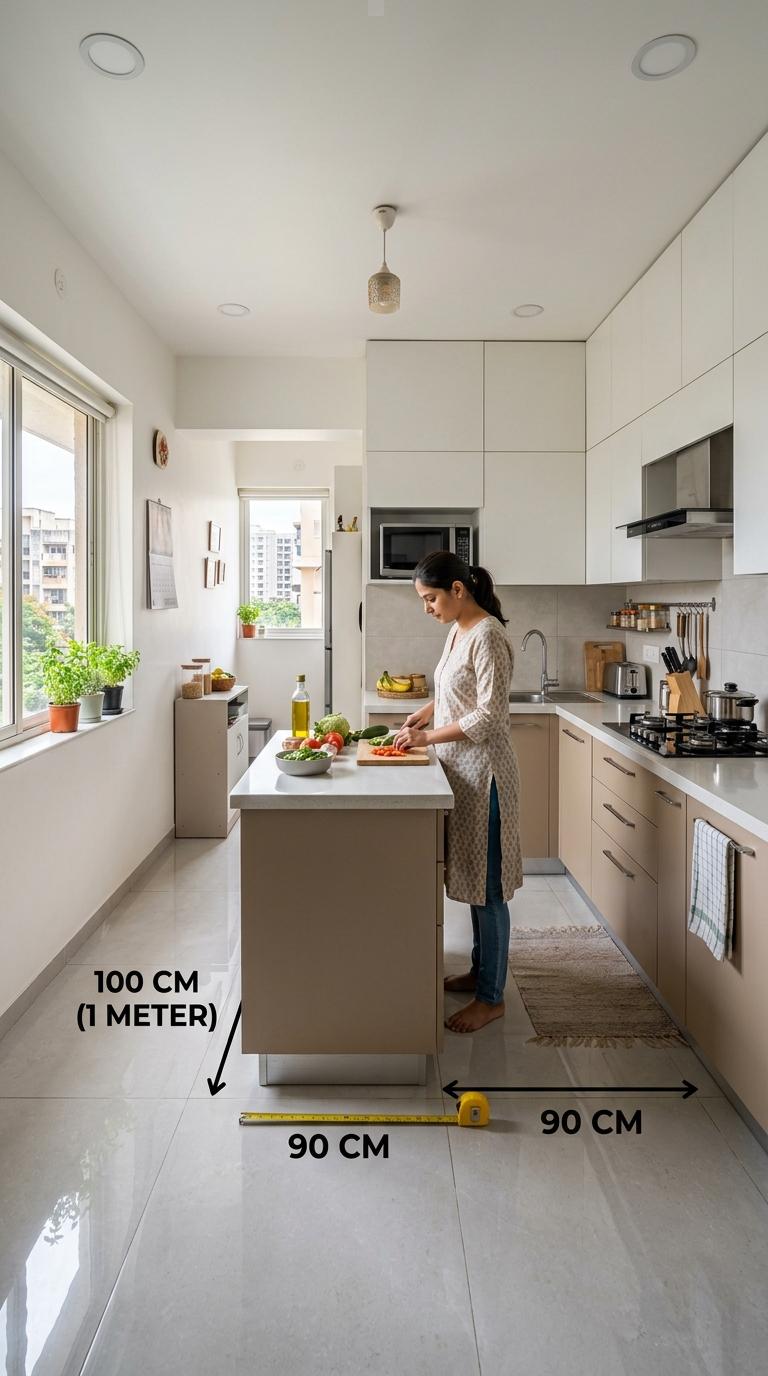
Before any island configuration is chosen, the fundamental spatial requirement of any kitchen island needs to be clearly understood, because it is the constraint that determines which island solutions are available and which are not in a specific kitchen. The minimum clear aisle width on any side of a kitchen island where a person needs to work or pass through is ninety centimeters, and one meter is significantly more comfortable for a kitchen where two people may be working simultaneously.
This means that the maximum width of an island in any kitchen is determined by subtracting the required aisle clearances on both sides from the total width of the kitchen floor. In a kitchen that is two and a half meters wide, with ninety centimeter aisles on both sides of the island, the maximum island width available is seventy centimeters. In a kitchen that is three meters wide, the maximum island width with ninety centimeter clearances on both sides is one meter twenty centimeters. In a kitchen narrower than two and a half meters from counter edge to counter edge, a permanent island of any width leaves insufficient aisle space and is not a viable option regardless of how desirable the island function might be.
For kitchens below the minimum threshold for a permanent fixed island, the movable island and the fold-out island extension offer genuine alternatives that provide island functionality without permanently consuming the aisle space that a small kitchen cannot afford to lose.
2. The Movable Rolling Island
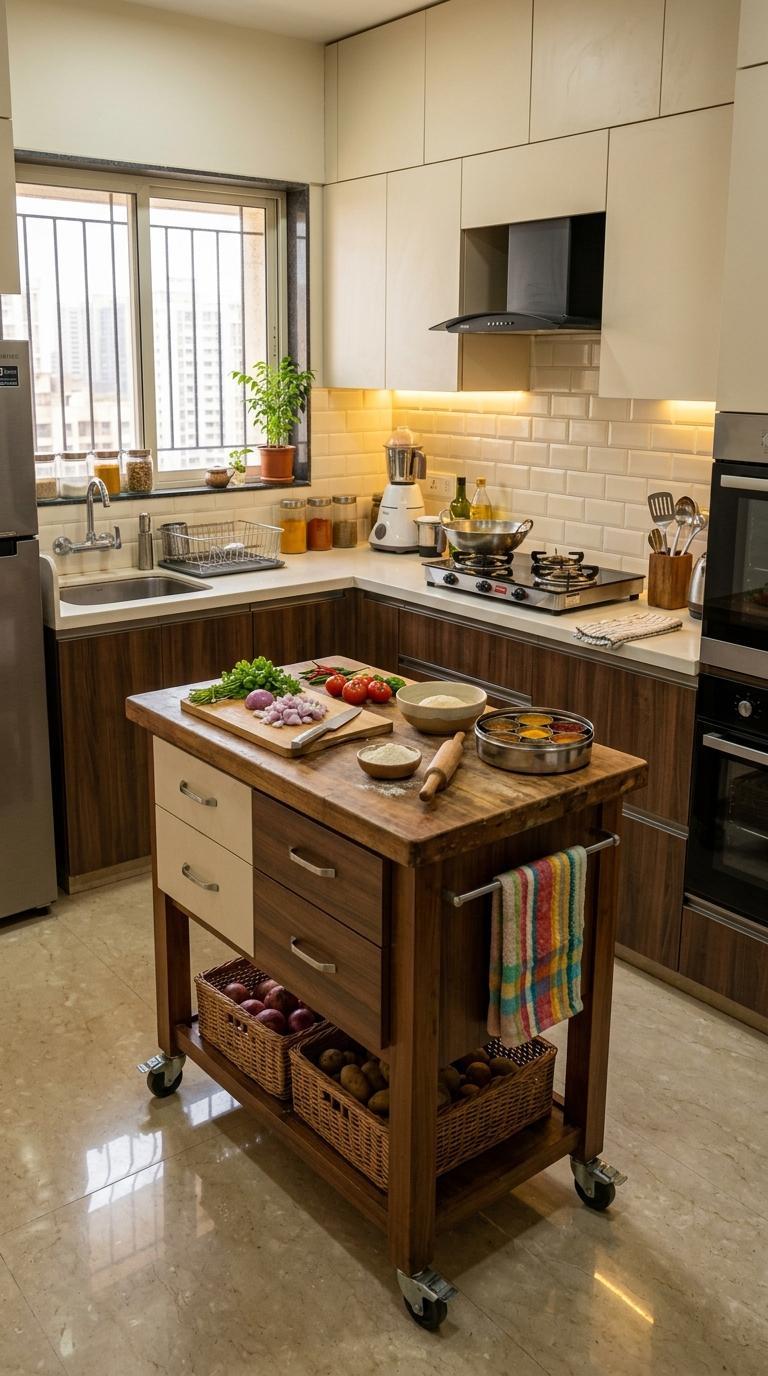
A rolling kitchen island on lockable castors is the most flexible and most renter-friendly island configuration available for a compact kitchen, and it is a genuinely practical solution rather than a compromise relative to a fixed island when the small kitchen’s spatial constraints are properly understood. When cooking requires the additional counter space and storage that the island provides, it rolls into position in the center of the kitchen and locks in place. When additional floor space is needed for movement, for cleaning, or simply to make the kitchen feel less crowded, it rolls to a wall, into a corner, or even out of the kitchen entirely into an adjacent dining or living area.
The dimensions of a rolling island for a compact kitchen should be chosen to maximize surface area while maintaining the minimum aisle clearances when the island is in its working position. A rolling island sixty to seventy centimeters wide and ninety to one hundred centimeters long provides a generous working surface and meaningful storage while leaving adequate aisle space in most compact Indian kitchens. The height should match the existing counter height at eighty five to ninety centimeters for comfortable food preparation.
Rolling islands available from furniture retailers and modular kitchen suppliers in India include options with butcher block tops, granite tops, and laminate tops, with storage configurations ranging from open shelving to closed cabinet drawers. A butcher block top has the additional advantage of serving as a dedicated chopping surface, protecting the island’s other surface areas from the knife marks and food stains that intensive food preparation inevitably produces. In an Indian kitchen where chopping, grinding, and kneading are constant activities, a dedicated butcher block chopping surface is a functional benefit that goes beyond aesthetics.
3. The Peninsula as an Island Alternative
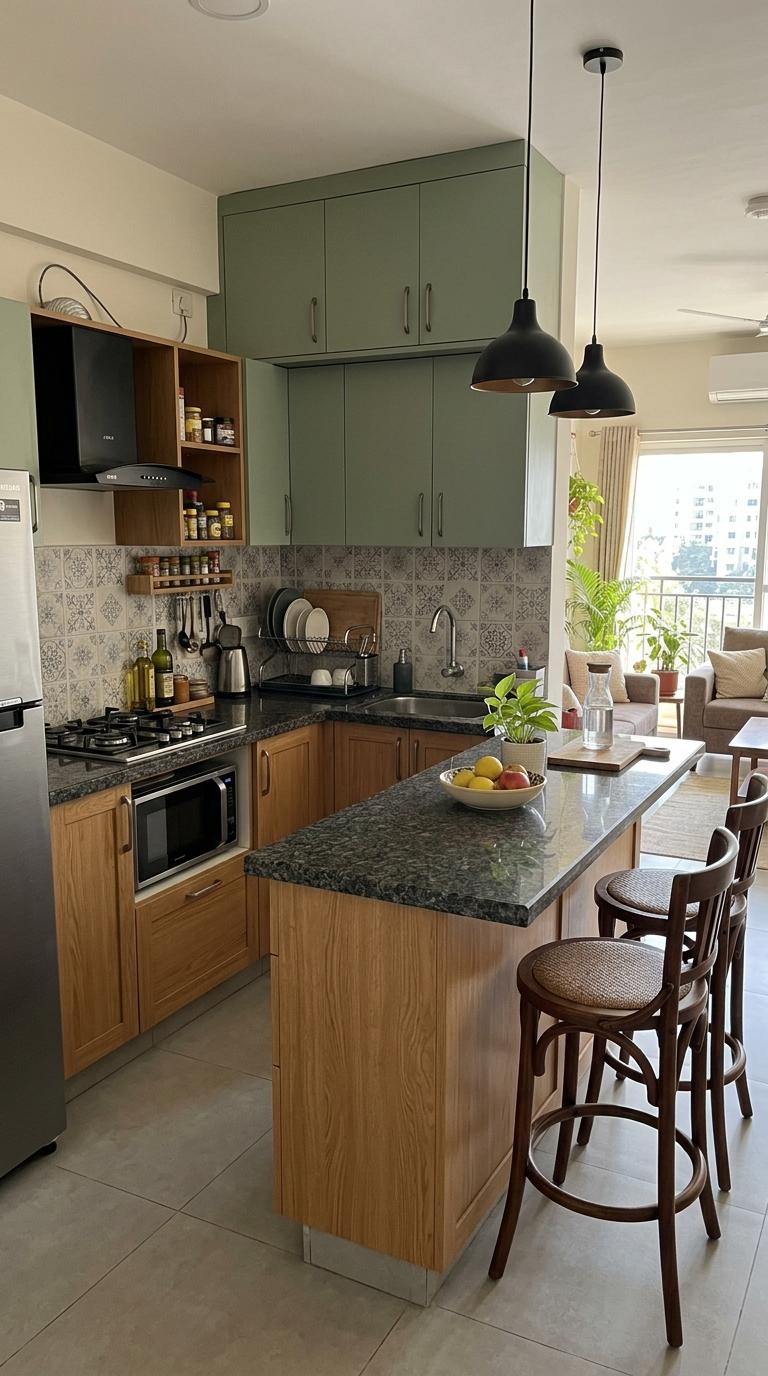
A peninsula, which is an island attached to the existing kitchen counter or wall at one end rather than freestanding on all four sides, provides much of the functional benefit of an island while consuming significantly less floor space. Because the peninsula is attached at one end, it requires aisle clearance on only two sides rather than three, which means it can be accommodated in kitchens that are too narrow for a freestanding island of equivalent size.
In a galley kitchen, where two runs of cabinets face each other across a narrow aisle, extending one of the runs outward perpendicular to the galley at the open end creates a peninsula that provides additional counter space, defines a casual dining area on the open side, and creates a visual anchor for the kitchen without reducing the aisle width of the working galley. This is one of the most effective and most space-efficient kitchen reconfigurations available for small Indian apartment kitchens with a galley layout.
The peninsulas that work best in compact Indian kitchens are those that serve multiple functions simultaneously. A peninsula with base cabinet storage beneath, a counter surface at working height, and an overhang on the dining side that provides knee clearance for bar seating combines preparation surface, storage, and dining function in a single installation that would otherwise require three separate pieces of furniture and significantly more floor space.
4. The Slim Console Island
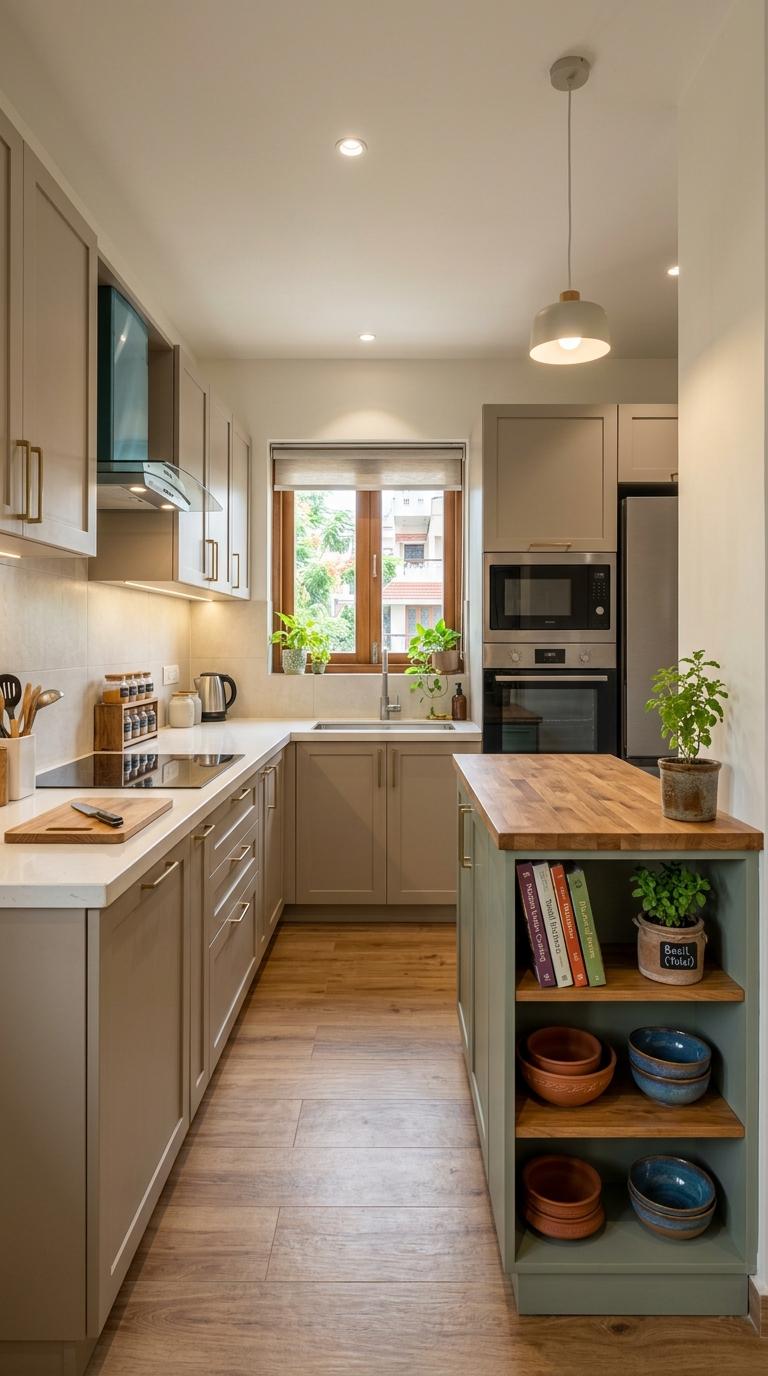
A slim console island, a narrow rectangular unit of eighty to one hundred centimeters in length and forty to fifty centimeters in depth, provides island functionality in a genuinely minimal footprint that makes it achievable in compact kitchens where even a rolling island of standard dimensions would create uncomfortable aisle clearances. At forty to fifty centimeters deep, a slim console island takes up approximately half the floor space of a standard island while still providing a meaningful additional preparation surface, a row of storage drawers or shelves, and a visual center point in the kitchen that the open floor alone cannot create.
The slim console island works particularly well in L-shaped and U-shaped compact kitchens where one leg of the L or U creates a natural position for the island without requiring it to sit in the middle of the primary aisle. Positioned at the end of one kitchen run rather than between two runs, the console island provides its surface and storage benefits while leaving the primary kitchen aisle completely unobstructed.
Styling a slim console island as a design feature rather than purely as a functional addition maximizes its contribution to the kitchen’s visual quality. A butcher block or marble top on a painted cabinet base, with open shelving below displaying a curated selection of cookbooks, ceramic bowls, and small kitchen plants, creates a console island that looks like a deliberate interior design choice rather than a spatial compromise.
5. Fold-Out and Drop-Leaf Island Extensions
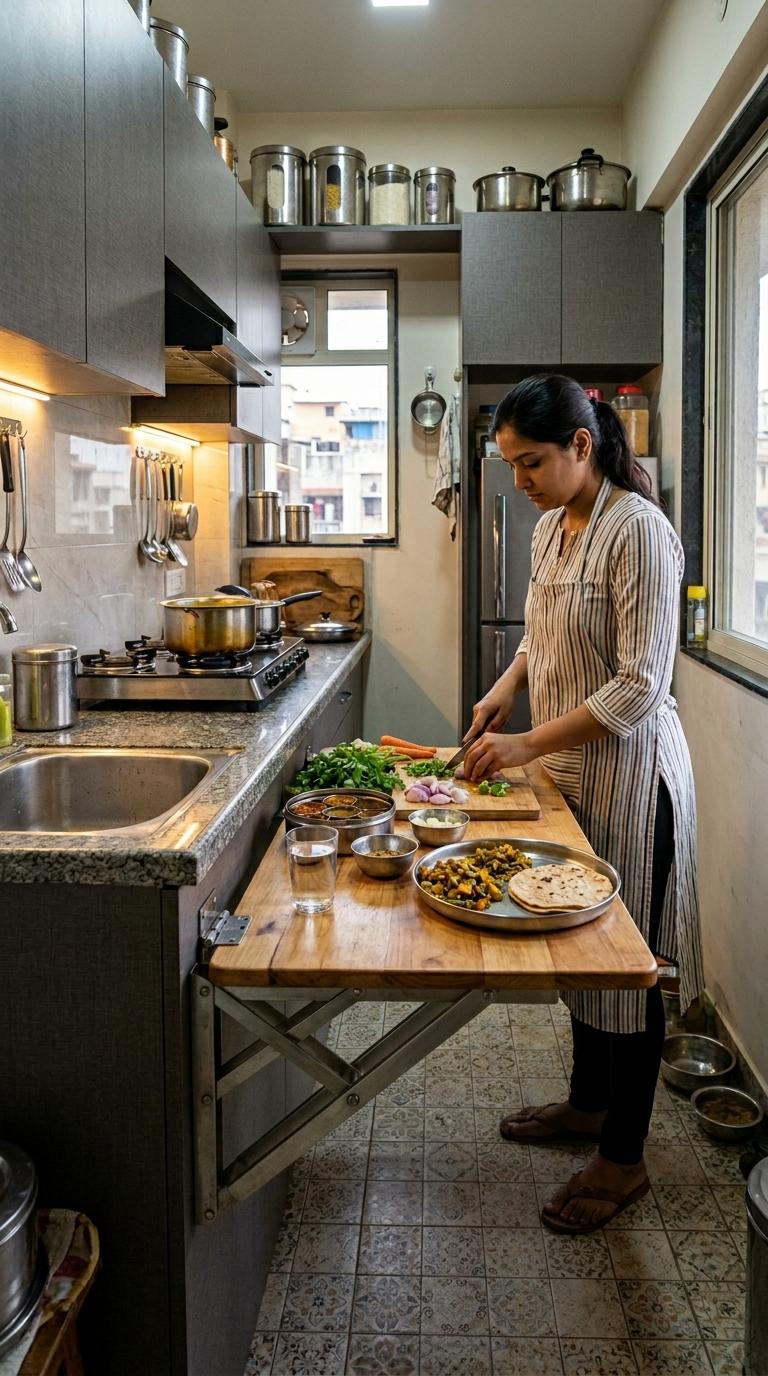
A fold-out island extension, which is a hinged counter surface attached to an existing kitchen cabinet or wall that folds down when not in use and extends outward to create an island-like additional work surface when needed, provides island functionality with a floor footprint of exactly zero when the surface is folded away. This makes it the only island configuration that is genuinely viable in kitchens too small for any freestanding or attached island solution.
The fold-out island extension is installed on the end wall of a galley kitchen, on the side of a base cabinet unit at the end of a kitchen run, or on a dedicated wall bracket that allows the surface to extend into the kitchen when needed and fold completely flat against the wall when not required. At its working position it provides a counter surface of sixty to ninety centimeters in depth that functions as a preparation area, a casual dining surface, or an extended staging area for plated dishes during meal service.
The structural requirements of a fold-out island extension are more demanding than those of a piece of freestanding furniture because the surface must support the weight of food, equipment, and potentially the person leaning on it from a cantilevered position without a support leg beneath it. Proper wall anchoring with appropriate fixings into wall studs or masonry is essential, and the folding mechanism must be robust enough to handle daily deployment and stowage without developing play or looseness over time.
6. Storage-First Island Design
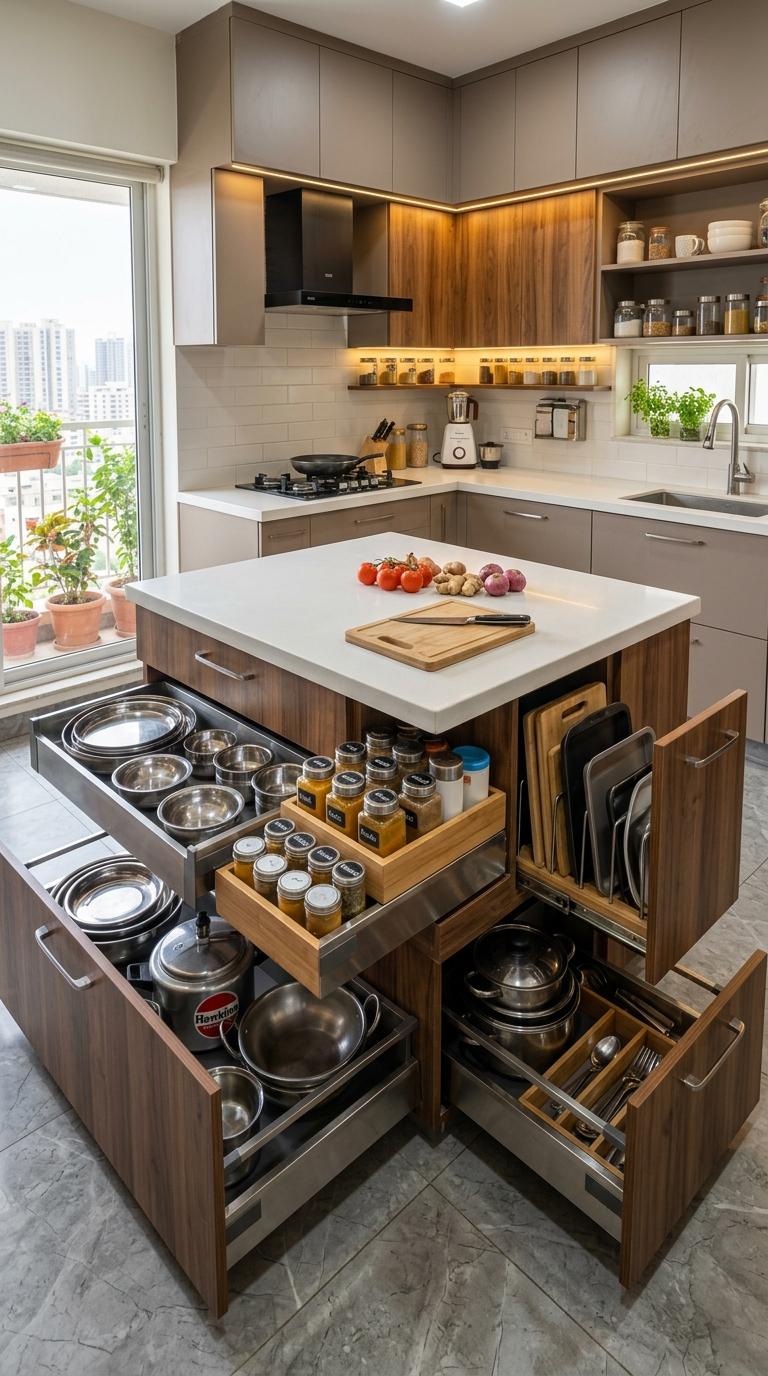
In a compact Indian kitchen where storage is consistently the most pressing functional challenge, an island that is designed primarily as a storage unit with a preparation surface on top delivers a higher functional return than one that prioritizes counter space over storage capacity. The base of the island, which in many island designs is either open shelving or a simple shelf below a drawer or two, can instead be configured as a dense storage system with deep drawers, pull-out shelving, vertical storage for baking sheets and chopping boards, and concealed compartments for items that need to be stored but not regularly accessed.
Deep drawer storage in an island base is one of the most storage-efficient configurations available in any kitchen because drawers provide full access to the entire depth of the storage space when pulled open, unlike cabinets where items at the back are difficult to reach and tend to be forgotten. In an Indian kitchen context where the range of vessels, equipment, and ingredients that need to be stored is particularly broad and diverse, deep island drawers configured to accommodate the specific items that the kitchen handles most frequently create a storage solution of extraordinary practicality.
The top surface of a storage-first island should be as clear and uncluttered as possible to maximize its function as a preparation surface. The discipline of keeping the island top free of permanent objects, storing everything that is not in active use in the drawers and shelves below, ensures that the island consistently delivers its full preparation surface benefit rather than becoming another horizontal surface for the accumulation of kitchen clutter.
7. Island with Integrated Dining Function
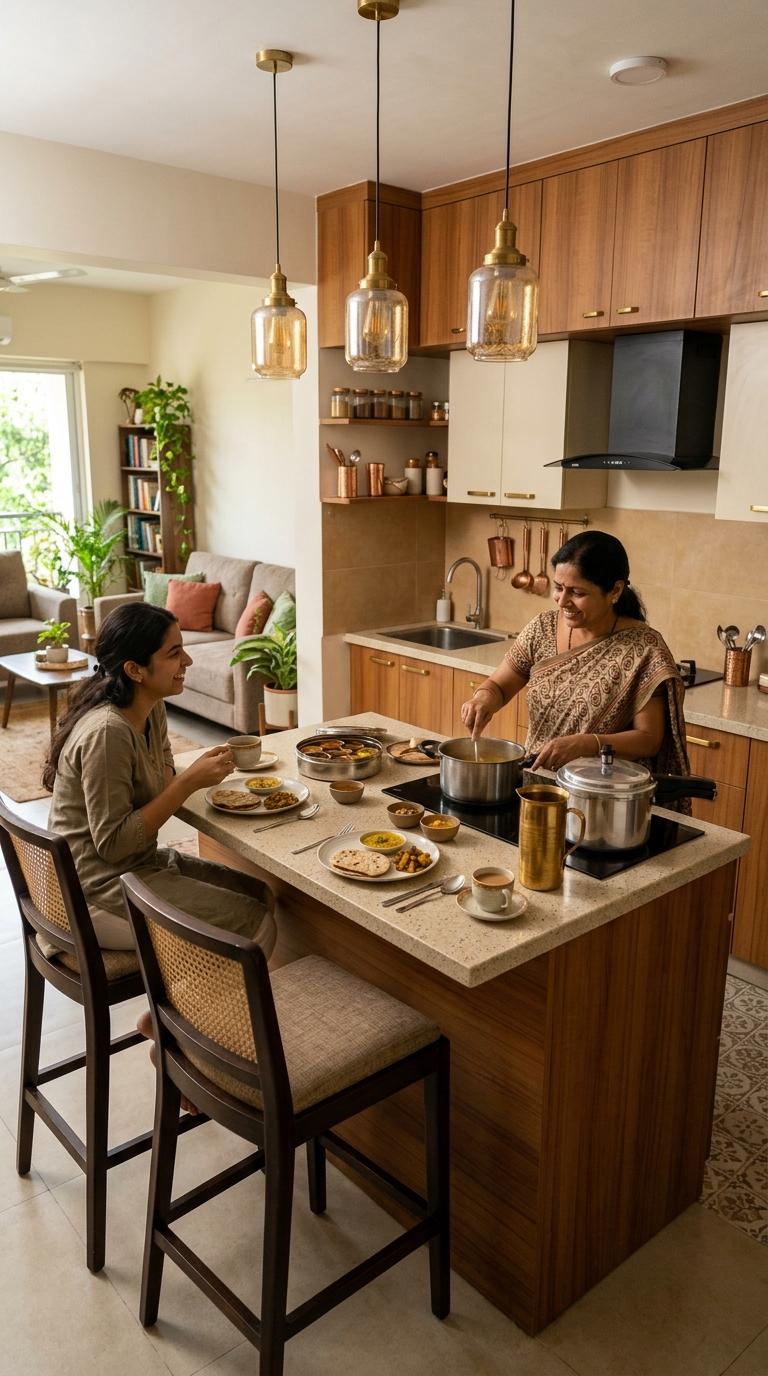
A kitchen island that incorporates a casual dining function eliminates the need for a separate dining table in a compact home where the kitchen and dining areas share the same open space. By extending the island counter on one side to provide an overhang of at least thirty to thirty five centimeters, enough depth for knee clearance when seated, and positioning bar stools at that overhang, the island becomes the household’s primary casual dining surface as well as its primary kitchen preparation surface.
This dual function is particularly valuable in compact Indian homes where the living, dining, and kitchen areas are often combined into a single open-plan space. A kitchen island with integrated bar seating creates a natural visual and functional boundary between the kitchen zone and the living zone while providing seating for everyday meals without the floor space penalty of a separate dining table and chairs. The high stool seating at bar height also creates a sociable kitchen dynamic, allowing family members or guests to sit at the island and interact with whoever is cooking, which changes the social quality of the kitchen experience in a way that a separate dining table in another room cannot replicate.
The choice of bar stools for an island with integrated dining function matters both functionally and aesthetically. Stools with footrests at a comfortable height, backs for support during longer meals, and a seat height appropriate to the counter overhang, typically between sixty and seventy five centimeters depending on the counter height, are the functional requirements. Aesthetically, stools in natural materials, cane seats with metal frames, solid wood with simple turned legs, or upholstered seats with brass base details, create a visual coherence between the island and the broader material palette of the kitchen and dining area.
8. Waterfall Edge and Design-Forward Island Surfaces
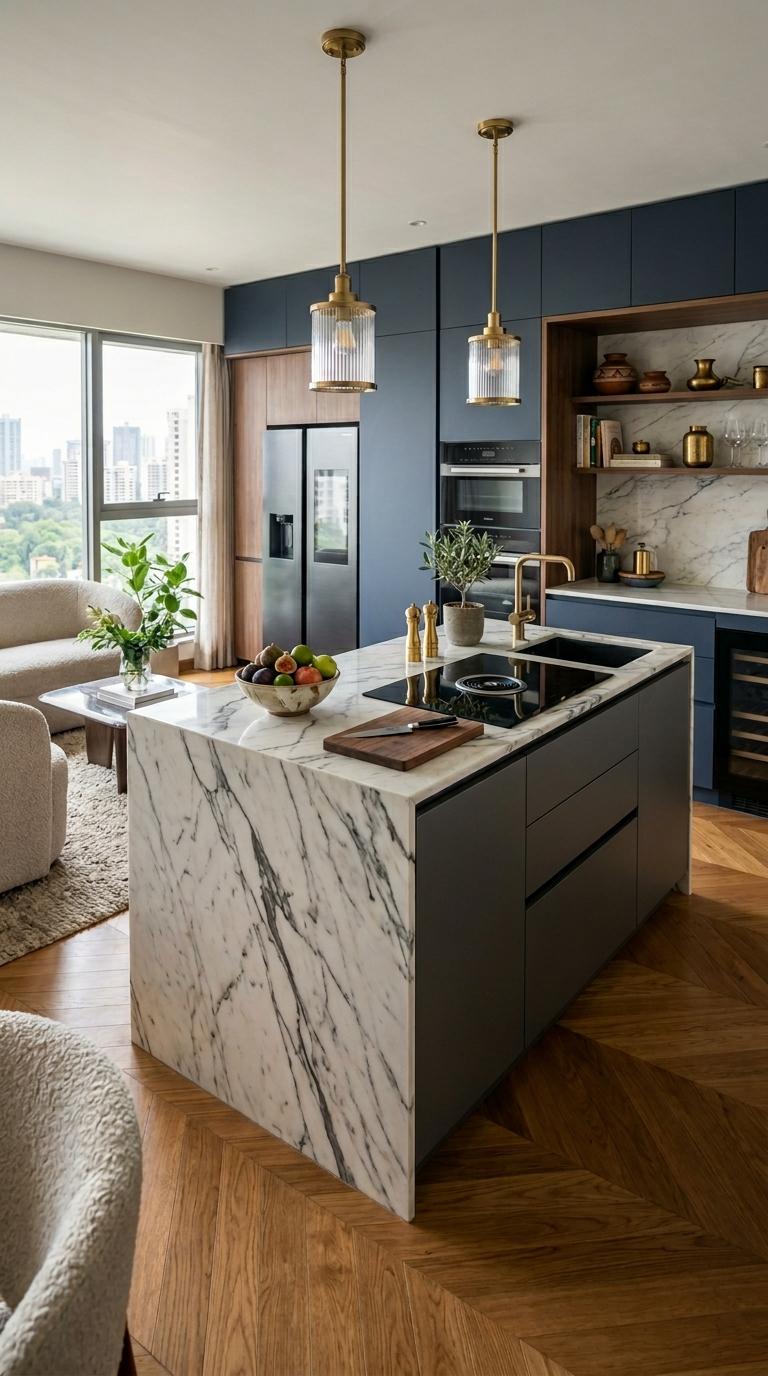
In a compact kitchen where the island is as much a design feature as a functional tool, the surface material and edge treatment of the island top have a design impact that goes beyond their functional contribution. A waterfall edge, where the counter material continues vertically down one or both ends of the island to the floor, creates one of the most architecturally striking counter details available in any kitchen at any scale, and it is particularly effective in a compact kitchen where the island is visible from the living area and needs to make a strong visual statement.
Waterfall edges work most effectively in natural stone, particularly marble and granite, where the continuation of the stone’s veining pattern from horizontal to vertical surface creates a visual continuity that makes the edge detail look inevitable rather than applied. In a compact Indian kitchen where a full marble counter might be expensive, a marble-top island with a waterfall edge over an otherwise more modest cabinet and counter configuration concentrates the design investment in the piece of the kitchen that receives the most visual attention and creates the strongest design statement.
Quartz surfaces in book-matched patterns, solid hardwood butcher block tops with beveled edges, and concrete effect microcement tops with polished edges are alternative island surface treatments that each create a strong and distinctive visual identity for the island while providing a durable and practical preparation surface.
9. Lighting the Kitchen Island
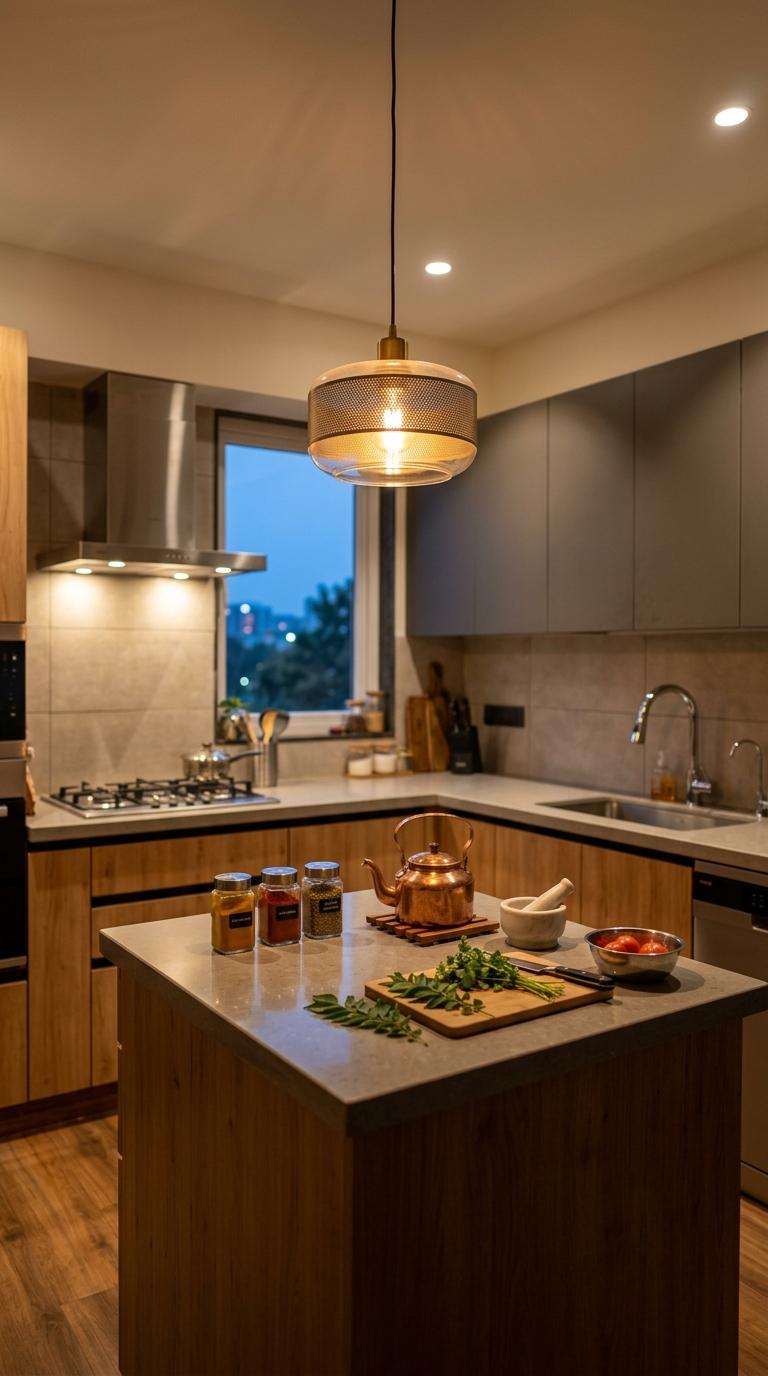
The lighting above a kitchen island is one of the most design-significant decisions in the entire kitchen because the island is the visual center of the kitchen and the light above it is the element that most directly frames and defines it as a feature. Pendant lights above the island, positioned at a height that provides focused task illumination for preparation work while creating an intimate, warm atmosphere at dining height, are the standard and most effective solution for island lighting in any kitchen regardless of its size.
In a compact kitchen, the pendant lights above the island should be scaled to the island’s dimensions rather than to the kitchen’s overall size. One large pendant centered above a small island creates a better visual proportion than two or three pendants that are individually too small for the space they occupy. The pendant style should reference the broader material palette of the kitchen, warm rattan or bamboo shades in a kitchen with natural material finishes, simple glass globes in a kitchen with a cleaner more contemporary aesthetic, or industrial metal shades in a kitchen with an urban loft character.
The pendant height above the island surface matters practically as well as aesthetically. Pendants hung at seventy to ninety centimeters above the counter surface provide focused task illumination without creating a visual obstruction across the island for people on opposite sides. Pendants hung higher than this lose their intimate connection to the island surface and begin to function more as general ambient lighting than as focused island illumination.
10. Color and Material Strategy for Islands in Small Kitchens
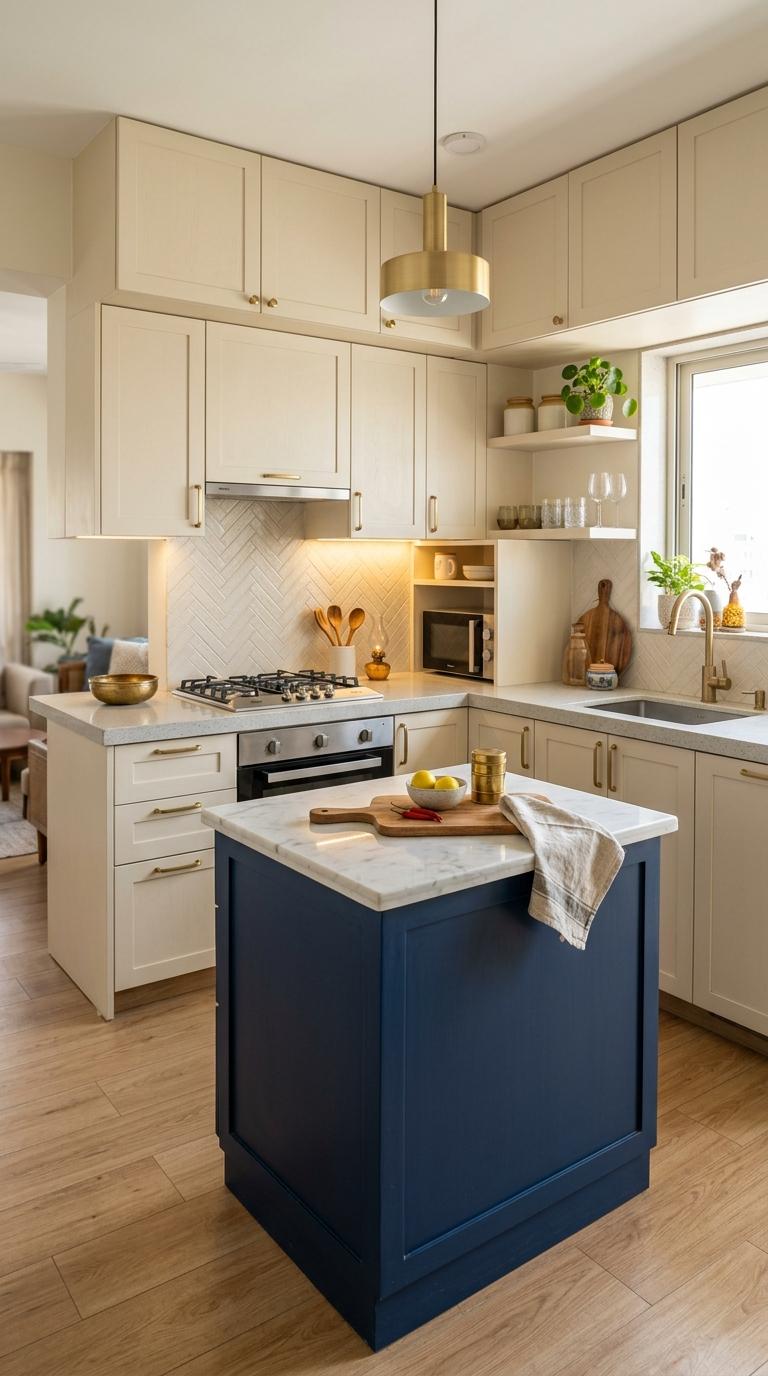
The color and material of the island relative to the surrounding kitchen cabinets and walls is a design decision that significantly affects whether the island integrates harmoniously into the compact kitchen or creates a visual tension that makes the space feel cluttered and confused. Two broad strategies work well in compact kitchens, and the choice between them is determined by the overall design approach of the kitchen.
The first strategy is contrast, where the island is finished in a color or material that is deliberately different from the surrounding cabinets, making it a distinct visual object in the kitchen rather than a continuation of the existing surfaces. A navy or forest green island in a kitchen with white or cream cabinets, a marble top island with a painted base in a kitchen with stone counters, or a natural wood island in a kitchen with painted cabinetry all use contrast to make the island the visual focal point of the kitchen and to give the compact space a design complexity that a uniform approach cannot achieve.
The second strategy is tonal continuity, where the island is finished in a color or material closely related to the surrounding cabinets, creating a more unified and less visually busy composition that suits compact kitchens where multiple competing visual elements would feel overwhelming. A slightly darker version of the cabinet color on the island base, a counter material that matches the existing counters, or natural wood tones that echo the warmth of existing wood elements in the kitchen all use tonal continuity to make the island feel like it belongs to the kitchen rather than being imposed upon it.
Making the Island Work for Your Specific Kitchen
The kitchen island, in whatever compact configuration suits a specific small kitchen, earns its place through the daily quality of the cooking experience it creates. Additional counter space for the complexity of Indian food preparation, extra storage for the extensive range of vessels and ingredients that Indian cooking requires, a casual dining surface that makes everyday meals more sociable, and a visual center point that makes the kitchen feel more considered and more designed than one without a focal feature, these are the returns on the investment of floor space and renovation budget that a well-configured compact kitchen island delivers. Getting the configuration right for the specific dimensions, layout, and functional requirements of a particular kitchen is the work that makes the difference between an island that transforms the cooking experience and one that simply makes the kitchen harder to use.