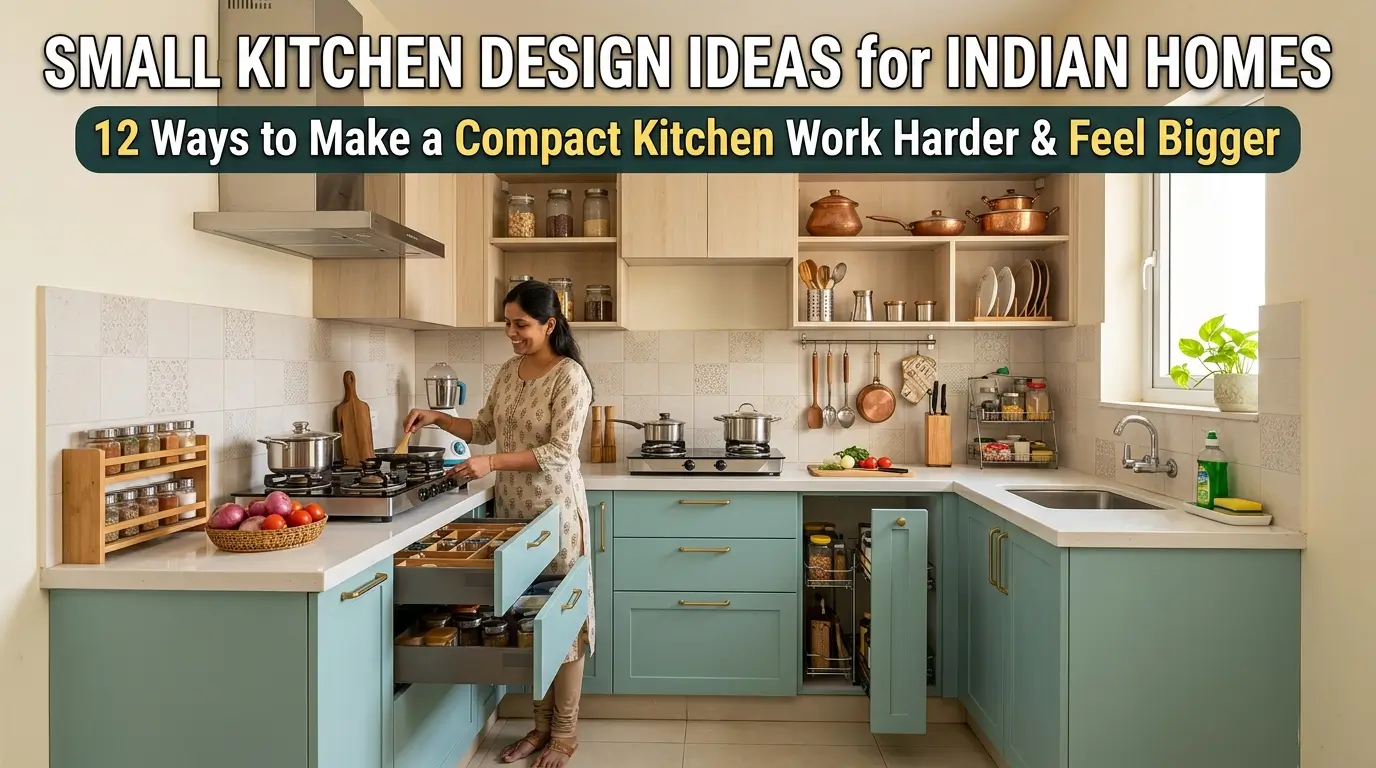
The small kitchen is the default condition of the Indian urban home. In cities where flat sizes have been shrinking steadily for two decades and construction costs have pushed developers toward smaller, more sellable units, the kitchen is almost always the room that loses space first. It is enclosed, often without a window, frequently without adequate ventilation, and expected to handle a style and volume of cooking that would challenge a kitchen twice its size.
The standard response is to treat the small kitchen as a problem to be managed rather than a space to be designed. Cram in as much storage as possible, choose the cheapest modular option available, and accept that the kitchen will always feel cramped and cluttered. This approach produces exactly the kitchen it deserves.
A small Indian kitchen, designed with genuine attention to how it is used and what it needs to do, can be a space that is calm, efficient, and genuinely pleasant to cook in. The constraints are real but they are not insurmountable. Every square foot of a small kitchen can be made to work. Every design decision, from the cabinet layout to the lighting to the colour on the walls, either adds to the sense of space or takes from it. Getting those decisions right is what separates a small kitchen that works from one that merely functions.
Here are 12 design ideas to make a small Indian kitchen work harder, feel bigger, and look more considered than its square footage might suggest.
Small Kitchen Design Ideas for Indian Homes
1. Choose the Layout Before Choosing the Cabinets
The single most impactful decision in a small Indian kitchen is the layout, and it needs to be made before any cabinet selection, any appliance choice, or any colour decision. A poorly planned layout makes even the most expensive kitchen feel cramped and inefficient. A well-planned layout makes a modest kitchen feel organised and easy to use.
For most small Indian kitchens, the choice is between three layouts. A single-wall layout, everything along one wall in a straight line, works best for narrow kitchens that open into a living space. A galley layout, counters along two parallel walls, works best for enclosed narrow rooms where both walls are available. An L-shaped layout, counters along two adjacent walls meeting at a corner, works best for kitchens with a corner available and enough width on both walls to be useful. Identify which layout fits the room before anything else. Every subsequent decision should serve that layout rather than compromise it.
2. Keep the Colour Palette Light and Consistent
Colour is one of the most powerful tools available in a small kitchen and one of the most frequently misused. The instinct in Indian modular kitchen design is toward contrast, two strong colours on upper and lower cabinets, bold hardware, and a dark granite countertop. In a small kitchen, this approach fragments the visual field and makes the space feel smaller than it is.
A light, consistent colour palette, warm white or off-white across both upper and lower cabinets, a countertop in a light neutral tone, and a backsplash in a similar or slightly contrasting light tone, creates visual continuity that allows the eye to travel across the kitchen without interruption. The kitchen reads as a single, unified surface rather than a collection of different coloured elements competing for attention. In a small space, this continuity of colour creates an impression of size that is disproportionate to the actual square footage.
3. Take Cabinets to the Full Ceiling Height
The gap between the top of the wall cabinets and the ceiling is one of the most common storage and design mistakes in Indian kitchens. A standard wall cabinet installed at standard height leaves 30 to 45 centimetres of unusable space between the cabinet top and the ceiling. In a small kitchen, this space accumulates dust, creates visual clutter, and represents a significant volume of storage that is simply being discarded.
Taking the wall cabinets to full ceiling height adds a meaningful amount of storage to a small kitchen without changing the floor area at all. The upper section of the extended cabinets, above comfortable reach height, stores items used infrequently. A small folding step stool kept in the kitchen handles access when needed. The full-height cabinet also creates a cleaner, more deliberate visual in the kitchen. The wall surface is either cabinet or wall, with no awkward gap between the two.
4. Use a Single Undermount Sink to Maximise Counter Space
The sink is the largest fixed element on the kitchen counter and its size and mounting method directly affect how much usable counter space remains on either side. A large double-bowl sink, top-mounted in the standard Indian kitchen configuration, consumes a significant width of counter and creates a visible rim around the sink bowl that interrupts the counter surface and makes cleaning more difficult.
An undermount single-bowl sink, set into the counter from below so the rim is not visible above the counter surface, creates a cleaner counter surface, makes wiping down easier, and typically allows a slightly narrower overall sink width that saves counter space on either side. In a small kitchen where every 10 centimetres of counter matters, the combination of a compact undermount sink and a wall-mounted tap rather than a deck-mounted mixer tap frees up the maximum possible prep surface.
5. Invest in a Good Chimney and Position It Correctly
Ventilation is a structural problem in many small Indian kitchens, particularly enclosed kitchens without a window above the cooktop. Poor ventilation fills the kitchen with smoke, steam, and cooking odours during heavy Indian cooking, makes the space unpleasant, and over time affects the surfaces, the cabinets, and the health of the people cooking in it.
A correctly specified and correctly positioned chimney is the most important single appliance investment in a small Indian kitchen. The chimney hood should be positioned directly above the cooktop at the manufacturer’s recommended height, typically 65 to 75 centimetres above the cooking surface for a standard Indian kitchen chimney. The extraction rate should be matched to the cooking intensity of the household. A chimney that is too small for the volume of cooking it is expected to handle provides inadequate ventilation regardless of how well everything else in the kitchen is designed.
6. Designate a Fixed Prep Zone and Protect It
In a small Indian kitchen, the counter fills up quickly during cooking. Spice jars come out, vessels accumulate, and the available prep surface shrinks progressively until there is nowhere left to chop, roll, or assemble. This is not a storage problem. It is a discipline problem, and the solution is to designate a fixed prep zone and treat it as protected space during cooking.
Identify a section of counter, ideally 60 to 75 centimetres wide, adjacent to the cooktop, and commit to keeping it clear at all times except during active food preparation. Nothing permanent lives on this surface. Appliances do not migrate onto it. Vessels placed there during cooking are moved back to their storage location between uses. A protected prep zone in a small kitchen does not require any additional space or investment. It requires a decision about how the counter is used and the discipline to maintain it.
7. Pull-Out Storage in Every Lower Cabinet
The deep lower cabinets of a standard Indian modular kitchen are among the least efficient storage spaces in the home. Items pushed to the back are invisible, inaccessible, and frequently forgotten. The result is storage space that is technically full but practically useless beyond the front third of each shelf.
Pull-out drawer inserts, either as part of the original modular kitchen specification or retrofitted into existing cabinets, transform the usable capacity of lower cabinets by bringing the full depth of the cabinet to the front when the drawer is opened. In a small kitchen where every storage location needs to work at full capacity, converting fixed lower cabinet shelves to pull-out drawers is one of the most impactful single improvements available. Specify pull-outs for pots and pans, for dry goods storage, and for the under-sink cabinet where cleaning supplies accumulate.
8. A Tall Pantry Unit for Dry Goods and Appliances
The tallest storage unit in a small Indian kitchen, a floor-to-ceiling pantry column with pull-out shelves, wire baskets, and dedicated zones for different categories of storage, consolidates the dry goods, appliances, and miscellaneous items that would otherwise spread across multiple cabinets and counter surfaces into a single, organised vertical unit.
A pantry unit 60 centimetres wide and floor-to-ceiling in height holds a remarkable volume of storage. Dry goods on pull-out shelves at eye level. Appliances on a pull-out tray at counter height with a power point inside the unit for in-cabinet use. Cleaning supplies and bulk storage at the bottom. The pantry unit functions as the storage backbone of the small kitchen, keeping the counter surfaces and the remaining cabinets focused on the items needed during active cooking rather than everything the kitchen needs to accommodate.
9. Under-Cabinet Lighting as a Standard Specification
Overhead lighting in a small Indian kitchen, a single fitting in the centre of the ceiling, creates shadows on the counter surface that make cooking and prep work more difficult than they need to be. The cook’s body blocks the overhead light at precisely the moment when counter visibility is most important.
Under-cabinet LED strip lighting, fitted to the underside of the wall cabinets and directed onto the counter surface below, eliminates counter shadows entirely and creates task lighting exactly where it is needed. In a small kitchen, under-cabinet lighting also makes the space feel larger and more considered by creating a secondary light level that separates the counter zone from the upper cabinet zone visually. The cost of adding under-cabinet LED strips during a kitchen installation is modest. The functional and aesthetic return makes it one of the most consistently worthwhile lighting investments in any kitchen regardless of size.
10. A Compact Breakfast Counter Instead of a Dining Table
Many small Indian kitchens open directly into the living or dining area, and the boundary between kitchen and living space is defined by whatever furniture happens to be near the kitchen entrance. A dining table positioned near the kitchen occupies a significant floor area, limits traffic flow between the kitchen and the living room, and is frequently underused during the week when meals are eaten standing at the counter or taken to the main room.
A compact breakfast counter, a narrow counter extension or a wall-mounted fold-down shelf at bar height along the kitchen-living boundary, provides a casual dining surface for everyday meals without the floor area commitment of a full dining table. Two or three bar stools tuck under the counter when not in use. The floor area of the living room remains unobstructed. For households where the dining table is used primarily for weekend meals and daily eating happens informally, the breakfast counter is a more honest design response to how the space is actually used.
11. Reflective Surfaces to Borrow Light and Space
A small kitchen without adequate natural light feels oppressive regardless of how well it is organised or how carefully the layout has been planned. Where natural light is limited or absent, reflective surfaces borrow what light is available and distribute it more effectively across the kitchen space.
A glossy or semi-glossy backsplash tile reflects light from the chimney fitting and the under-cabinet strips back into the kitchen. A light-coloured, slightly sheen countertop surface does the same. Cabinet doors in a satin rather than matte finish add a subtle reflective quality without the visual noise of a high-gloss surface. Mirror or glass used selectively, on one section of the backsplash or on the inside back panel of an open shelf unit, multiplies the apparent depth of the kitchen in a way that no other surface treatment can. In a small kitchen without a window, reflective surfaces are not a decorative choice. They are a functional tool for managing the limited light available.
12. Edit Ruthlessly and Store Intentionally
The most consistently undervalued design principle in a small Indian kitchen is also the one that costs nothing and requires no trades, no products, and no renovation. A small kitchen with less in it, stored intentionally and returned to its location consistently, will always perform better and feel better than a larger kitchen used carelessly.
Go through the kitchen and remove everything that is not used regularly. Appliances used less than once a month do not earn counter space. Duplicate utensils, excess vessels, and accumulated packaging all consume storage that is genuinely scarce in a small kitchen. What remains should have a fixed storage location and should return to that location after every use. This is not minimalism for aesthetic reasons. It is organisation for functional ones. In a small Indian kitchen, where the margin between a space that works and one that does not is measured in centimetres and in habits, editing and intention are the most powerful design tools available.
Design the Kitchen for the Way You Actually Cook
A small Indian kitchen designed around the reality of Indian cooking, the pressure cooker that needs a home, the masalas that need to be accessible, the chimney that needs to handle the tadka, and the counter that needs to survive the daily onslaught of vessels and spice jars, will always outperform one designed around a photograph of a Scandinavian kitchen that has never seen a dal.
Start with the layout. Fix the ventilation. Protect the prep zone. Take the cabinets to the ceiling. Light the counter. Edit the contents.
A small kitchen that does all of those things well is not a compromise. It is a kitchen.