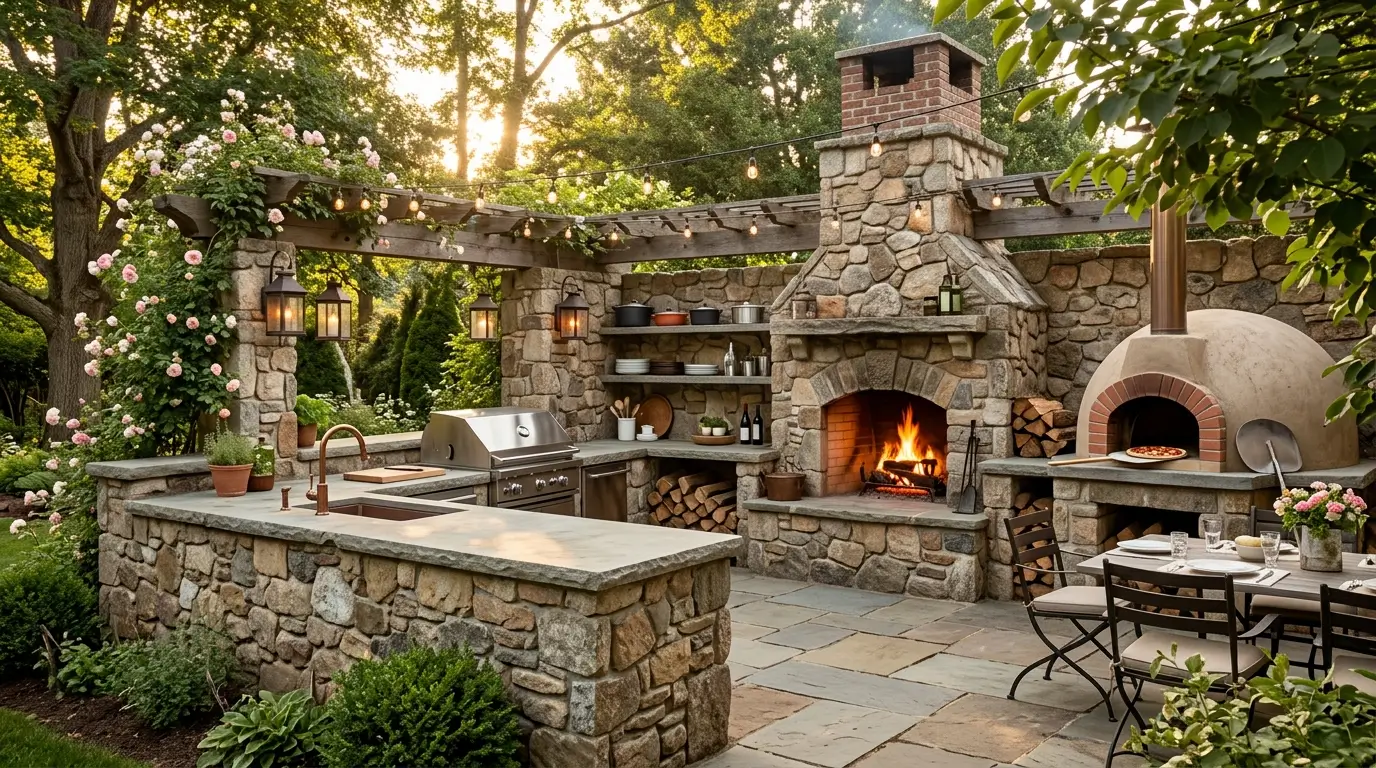
Some outdoor kitchens announce themselves. Stainless steel surfaces, powder-coated frames, integrated appliances with digital controls — they are impressive and they are clearly new. They belong to a particular moment in design and carry that moment visibly.
A rustic stone outdoor kitchen does the opposite. It settles into the garden as though it grew there. The materials are old, or look old. The surfaces are rough where they should be rough and worn where use has worn them. The fireplace draws people toward it in the way that fires always have. The pizza oven holds heat the way stone has always held heat. Nothing about it feels recent, and that is precisely the point.
This quality — the sense that a structure belongs to its place and has always belonged there — is one of the most difficult things to achieve in built design and one of the easiest to destroy by making the wrong material choices. A single stainless steel appliance panel in an otherwise stone outdoor kitchen breaks the spell entirely. A concrete countertop that is too smooth and too perfect does the same. Rustic stone design demands consistency and a willingness to let the materials do what they naturally do rather than forcing them into a precision that works against their character.
Here are 12 design ideas for building a rustic stone outdoor kitchen with a fireplace and pizza oven that feels genuinely rooted in its place rather than recently installed in it.
Rustic Stone Outdoor Kitchen with Fireplace and Pizza Oven Design Ideas
1. Choose One Stone and Use It Everywhere
The single most important decision in a rustic stone outdoor kitchen is the choice of primary stone, and the single most important discipline is using that stone consistently across every structural element of the project. The kitchen counter base, the fireplace surround, the pizza oven base, the boundary walls, the paving underfoot — all in the same stone, from the same source if possible.
Consistency of stone across the entire outdoor kitchen creates the impression of a structure that was built in one act from materials found nearby rather than assembled from a catalogue of options. In India, locally sourced fieldstone, black basalt, rough-cut granite, or Rajasthani sandstone all make excellent primary stones for a rustic outdoor kitchen. Choose the stone available closest to your location. Local stone looks like it belongs because it does belong — it comes from the same geology as the ground beneath the garden.
2. Build the Fireplace as the Structural and Visual Anchor
In a rustic outdoor kitchen, the fireplace is not an accessory added to a cooking setup. It is the reason the cooking setup exists. Everything else in the outdoor kitchen organises itself around the fireplace — the counters extend from it, the seating faces it, the pizza oven sits beside it, and the pergola above frames it.
Build the fireplace first, or at least design it first in full detail before any other element is finalised. Establish its height, its width, its depth, and the size of the firebox opening. Fix these dimensions and let the rest of the outdoor kitchen grow from them. A fireplace that is designed last and fitted into whatever space remains will always feel like an addition. One that is designed first and given the structural prominence it deserves will anchor the entire outdoor kitchen in a way that no other single element can.
3. Position the Pizza Oven Beside the Fireplace, Not Away From It
The natural placement for a pizza oven in a rustic stone outdoor kitchen is directly beside the fireplace, sharing the same base structure and the same chimney stack where the flue arrangement allows. The two elements are related in material, in heat, in use, and in the social dynamic they create. Keeping them adjacent amplifies all of those qualities.
A pizza oven and fireplace built as a single, integrated structure along one wall of the outdoor kitchen creates a cooking and social centrepiece of real architectural weight. The shared stone base reads as a single composition rather than two separate objects. The combined chimney stack rises as one element rather than two. The heat from both sources radiates into the same zone, making the area in front of this combined structure the warmest and most social part of the entire outdoor space. In cold evenings, nobody sits anywhere else.
4. Rough-Cut Stone Countertops Over Polished Alternatives
Polished granite and smooth quartz countertops belong in an indoor kitchen. In a rustic stone outdoor kitchen, a polished countertop surface is an immediate and jarring incongruity. The high sheen of a polished surface against rough stone walls and a wood-burning fireplace looks wrong in the way that a digital clock on an antique mantelpiece looks wrong.
Choose rough-cut or honed stone for the countertop surfaces. A thick slab of natural granite with a rough-sawn edge, a honed limestone counter with a hand-chiselled edge detail, or a poured concrete counter with a brushed finish all work with the rustic stone aesthetic rather than against it. The countertop should look like it was cut from the earth and placed on the counter base without excessive refinement. It should look heavy. It should look permanent. It should look like it has been there for a long time.
5. Use Reclaimed Timber for the Pergola Structure
A rustic stone covered by a pergola structure needs a pergola that matches the material register of the stone below it. Powder-coated aluminium and slim steel sections are the wrong choice. Reclaimed timber — old railway sleepers used as posts, salvaged hardwood beams for the overhead structure, rough-sawn timber slats for the roof — is the right one.
Reclaimed timber has the surface character that new timber takes decades to develop. The grain is dense and tight from years of growth. The colour has deepened and varied. The surface carries the marks of previous use. These qualities, placed above a rough stone outdoor kitchen, create a continuity of material age and character that makes the entire structure feel as though it has been standing for a generation. Source reclaimed timber from demolition salvage yards, old farm structures, or specialist reclaimed material suppliers.
6. A Dry-Stack Stone Section in the Counter Base
Mortar joints in stone walls are practical and structurally appropriate, but they read as constructed rather than found. Incorporating a section of dry-stack stone in the outdoor kitchen counter base, where individual stones are laid without visible mortar, introduces a texture and a quality of natural stone arrangement that mortar joints cannot replicate.
A dry-stack stone section in the counter base is best placed on the most visible face, typically the outer face of the counter run facing the seating area, where it will be seen and appreciated most. The upper sections of the counter base can be mortared for structural integrity while the visible face is dry-stacked for aesthetic effect. This approach captures the visual quality of dry-stone work without compromising the structural stability of the overall counter.
7. A Wood Storage Niche Built Into the Structure
A rustic outdoor kitchen that uses a wood-burning fireplace and a wood-fired pizza oven needs a significant and regular supply of firewood. Where that wood is stored determines whether the outdoor kitchen looks considered or cluttered.
A built-in wood storage niche, designed as a formal element of the stone counter structure or the fireplace surround, keeps firewood within immediate reach of both the fireplace and the pizza oven without requiring a separate storage solution elsewhere in the garden. Size the niche generously, line it with a simple steel shelf to keep the wood off the ground, and allow it to be visible from the seating area. A neatly stacked wood niche in a stone surround is a design element as much as a storage solution. It signals that this outdoor kitchen was designed for serious use with fire.
8. Natural Clay or Refractory Brick for the Pizza Oven Dome
The dome of the pizza oven is the most technically specific element in the rustic stone outdoor kitchen. It needs to be built from a material that holds and radiates heat efficiently, withstands repeated thermal cycling without cracking, and looks appropriate within the rustic stone aesthetic.
Traditional clay or refractory brick is the correct material for the pizza oven dome. Pre-cast refractory dome kits are available in India and provide a structurally reliable dome form that can be clad in stone, render, or insulating material on the outside. The interior dome surface should be left as bare refractory clay or brick. The exterior can be finished with a stone cladding that matches the rest of the outdoor kitchen. A pizza oven dome that is fully stone-clad on the outside and bare clay on the inside has both the correct aesthetic and the correct thermal performance.
9. Integrated Stone Seating Walls Around the Fire
The seating around a rustic outdoor fireplace does not need to be furniture in the conventional sense. Low stone walls, built from the same material as the outdoor kitchen structure and topped with a thick stone coping or a weathered timber board, create permanent seating that is as much a part of the architecture as the fireplace itself.
Stone seating walls around the fire area require no maintenance, withstand all weather conditions, accommodate a cushion when comfort is wanted and function without one when it is not, and age in exactly the same way as the structures around them. They become more beautiful as they weather. In an outdoor kitchen designed around the idea of permanence and rootedness, stone seating walls are the most honest seating solution available.
10. Herbs and Edible Planting in the Stone Gaps
Rustic stone structures accumulate planting naturally over time. Moss grows in the mortar joints. Self-seeded plants establish in gaps between stones. This natural colonisation of stone by plant life is one of the qualities that makes old stone structures feel alive and embedded in their landscape rather than imposed on it.
Encourage this process deliberately by planting low-growing herbs and creeping plants in selected gaps in the stone counter base, the fireplace surround, and the boundary walls of the outdoor kitchen. Thyme, oregano, and creeping rosemary establish well in stone gaps and produce usable herbs within arm’s reach of the cooking surface. Moss can be encouraged in shadier, damper gaps with a simple application of yoghurt and water to the stone surface. The goal is a stone outdoor kitchen that looks as though the garden has partially claimed it.
11. Terracotta and Earthenware as the Accessory Palette
Every accessory in the rustic stone outdoor kitchen should reinforce the material language established by the stone, timber, and clay of the main structure. Terracotta pots for herbs, earthenware vessels for utensils, hand-thrown ceramic plates and bowls for outdoor dining, and cast iron cookware hung on a simple iron wall rail all belong to the same material family as the structure they sit within.
Stainless steel accessories, plastic containers, and synthetic outdoor tableware are incongruous in a rustic stone outdoor kitchen in the same way that polished countertops are. The accessory palette is not a minor detail. It is the layer of the design that is seen most closely and most frequently, and it determines whether the rustic aesthetic holds together at the human scale or falls apart under inspection.
12. Let the Structure Age Without Intervention
The final and in some ways most important design principle for a rustic stone outdoor kitchen is the decision to let it age. Stone darkens. Mortar joints develop a patina. Timber weathers to silver-grey. Terracotta pots develop a salt bloom. The fireplace blackens above the firebox opening. The pizza oven dome darkens with smoke and heat.
All of these changes are improvements in a rustic stone outdoor kitchen. They are the evidence of use and time that give the structure its character and its sense of belonging. Resisting the urge to clean, repaint, reseal, and restore the outdoor kitchen to its day-one condition allows it to become something that a new structure cannot be. Old. Settled. Honest. Built to be used and marked by that use in ways that make it more interesting, not less.
Build for the Long Conversation Around the Fire
A rustic stone outdoor kitchen with a fireplace and pizza oven is not a weekend project or a seasonal installation. It is a multi-year investment in a particular quality of outdoor life. The fire that people gather around, the pizza that comes out of a wood-fired stone oven, the long evenings in a covered stone space that weathers into the garden over years rather than looking new and temporary.
Choose the stone carefully. Build the fireplace first. Position the pizza oven beside it. Use reclaimed timber overhead. Let the planting fill the gaps. Let the whole thing age without fighting it.
The outdoor kitchen that looks like it has always been there took years to look that way. Start building it now.