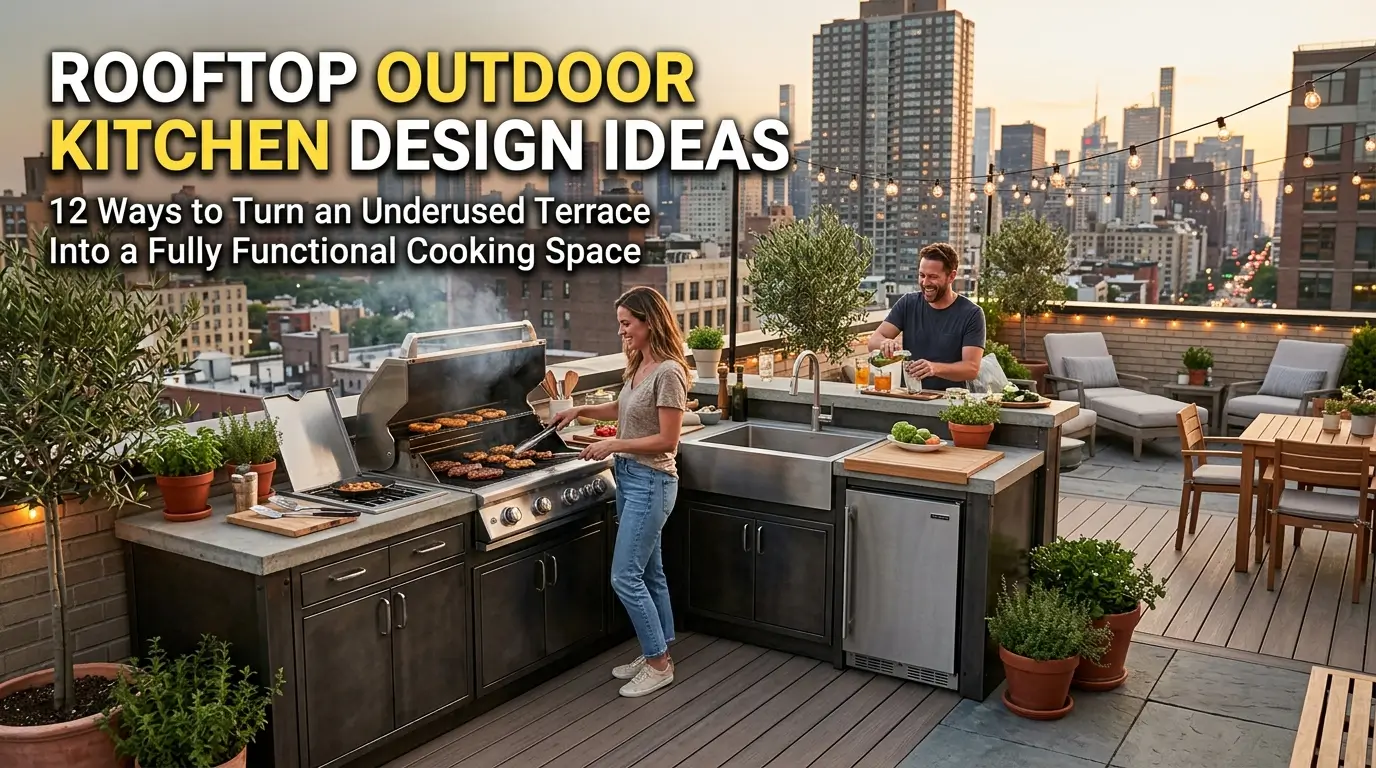
The rooftop is the most underused space in the Indian urban home. In cities where ground-level outdoor space is scarce or nonexistent, where gardens have been replaced by parking and courtyards have been built over, the rooftop terrace remains. Most of the time it holds a water tank, a few satellite dishes, some drying laundry, and a collection of items that have nowhere else to go.
This is a significant missed opportunity. A rooftop in an Indian city is not just outdoor space. It is elevated outdoor space, above the noise and density of the street, open to sky and breeze, with views that the ground floor never has. In the evening, after the heat of the day has passed, a well-designed rooftop is one of the most pleasant places an urban home can offer. The question is not whether it is worth developing. It is how to do it correctly given the specific constraints that a rooftop environment creates.
A rooftop outdoor kitchen is not simply an outdoor kitchen placed on a roof. The rooftop environment is more demanding than a ground-level garden in almost every respect. Wind is stronger and less predictable. Sun exposure is more intense and more sustained. Waterproofing is a structural requirement rather than a finish consideration. Load-bearing capacity is fixed and cannot be exceeded. Access for materials and services is more difficult. Each of these constraints shapes the design decisions that follow, and understanding them before starting is what separates a rooftop outdoor kitchen that works from one that creates problems for the building it sits on.
Here are 12 design ideas for a rooftop outdoor kitchen that addresses all of those constraints while making the most of everything a rooftop location uniquely offers.
Rooftop Outdoor Kitchen Design Ideas for Urban Homes
1. Structural Assessment Before Any Design Work Begins
A rooftop outdoor kitchen project begins not with a design sketch but with a structural assessment. The roof slab of an Indian urban building, typically a reinforced concrete flat roof, has a defined load-bearing capacity that was calculated at the time of construction for a specific set of loads. A permanent outdoor kitchen structure, a pergola, outdoor furniture, planted containers, and a group of people using the space simultaneously all add to that load. The total must remain within the capacity of the slab.
Commission a structural engineer to assess the rooftop slab before any design or construction work begins. The assessment will establish the maximum distributed load the slab can safely carry, identify any areas of the roof where load concentration should be avoided, and confirm whether the proposed outdoor kitchen structure requires any reinforcement of the slab or the supporting structure below it. This assessment is not optional. It is the foundation on which every subsequent design decision rests, and skipping it creates a structural risk that no outdoor kitchen is worth taking.
2. Waterproofing as a Non-Negotiable Structural Priority
A rooftop is the primary weather surface of the building. It is designed to shed rain, resist ponding, and keep the building below dry. Any outdoor kitchen construction on the rooftop that compromises the waterproofing membrane, blocks drainage channels, or creates new points of water ingress creates a problem that will damage the structure below and cost significantly more to repair than the outdoor kitchen cost to build.
Before any outdoor kitchen construction begins, inspect the existing roof waterproofing membrane. Repair any existing damage or deterioration. Design the outdoor kitchen structure so that no fixing penetrates the waterproofing membrane without a properly sealed flashing detail. Keep all drainage channels and roof outlets clear and accessible. Route any new service connections through waterproofed penetrations with appropriate sealant and flashing. The waterproofing of the roof slab is more important than any design decision about the outdoor kitchen that sits on top of it.
3. Lightweight Construction Throughout
The load constraint of the rooftop slab demands that the outdoor kitchen be built as lightly as possible without compromising function or durability. This means choosing lightweight materials over heavy ones at every decision point, even when the heavier material would be the more natural choice in a ground-level setting.
Powder-coated aluminium cabinet frames rather than concrete block bases. Lightweight concrete or fibre cement countertops rather than natural stone slabs. A steel pergola structure rather than a timber one. Lightweight ceramic tile cladding rather than natural stone. Compact, lightweight appliances rather than large, heavy commercial units. Each individual substitution saves a modest amount of weight. Across the full outdoor kitchen, the cumulative reduction in load can be significant and the difference between a project that the slab can safely support and one that it cannot.
4. Wind Management as a Design Priority
A rooftop is exposed to wind from all directions at a height where it is unobstructed by neighbouring buildings, trees, and garden walls. Wind on a rooftop outdoor kitchen creates several specific problems. It disrupts cooking flames on open burners. It makes dining uncomfortable. It moves lightweight furniture and accessories. It accelerates the weathering of materials. And at the extreme end, it creates structural loads on the pergola and shade structure that a ground-level installation would never experience.
Design the outdoor kitchen layout so that the cooking area is positioned on the most sheltered part of the rooftop, typically the side closest to the parapet wall or the adjacent building mass. Build a windbreak as part of the outdoor kitchen structure, a glass panel, a perforated metal screen, or a dense planted screen, on the most exposed side of the cooking area. Specify the pergola structure for wind loads appropriate to the rooftop exposure level. Anchor all lightweight furniture and accessories when the kitchen is not in use.
5. A Compact Built-In Kitchen Along the Parapet Wall
The parapet wall, the low boundary wall around the perimeter of the rooftop, is the most structurally appropriate location for the outdoor kitchen counter run. Building against the parapet distributes the load of the kitchen structure near the building perimeter where the slab is best supported, uses the parapet as the back wall of the kitchen without requiring a separate structure, and positions the cooking and exhaust on the rooftop boundary where smoke and heat disperse away from the living space rather than across it.
A compact, single-wall outdoor kitchen built against the parapet, with the counter run extending along the parapet length, keeps the central rooftop area free for dining, seating, and planting. It treats the parapet as the outdoor kitchen equivalent of the kitchen wall, performing the same structural and spatial function that a boundary wall performs in a ground-level outdoor kitchen.
6. A Freestanding Modular Setup for Flexibility
Where the structural assessment indicates that load concentration near the parapet is not advisable, or where the rooftop is used for multiple purposes and the outdoor kitchen needs to be repositionable, a freestanding modular outdoor kitchen setup on a lightweight aluminium frame distributes the load across a wider area of the slab and can be reconfigured or relocated as needed.
A freestanding modular setup on a rooftop has the additional advantage of portability. If the building is sold, if the tenancy ends, or if the rooftop use changes, the modular kitchen can be dismantled and moved without leaving any permanent marks on the roof surface. For rooftop outdoor kitchens in rented urban properties, the modular freestanding approach is the most appropriate combination of function and flexibility.
7. A Pergola With a Tensile Fabric Roof
A rooftop pergola faces higher wind loads, more intense UV exposure, and more direct rain than any ground-level shade structure. The roof covering needs to be specified for these conditions rather than for the more sheltered conditions a ground-level pergola experiences.
A tensile fabric roof, a high-quality outdoor fabric stretched across the pergola frame on stainless steel cables, handles rooftop conditions better than polycarbonate panels or timber slats in most respects. It is lightweight, which matters for the load-bearing slab below. It flexes under wind load rather than resisting it rigidly, which reduces the structural demand on the pergola frame. It provides UV protection and rain shelter when tensioned correctly. And it can be removed and stored during periods of extreme weather or when the rooftop is not in use, which extends its service life significantly in the demanding rooftop environment.
8. Raised Deck Platform to Protect the Waterproofing
A raised deck platform over the existing roof surface, built from composite decking boards or interlocking stone pavers on adjustable pedestals, provides a finished floor surface for the outdoor kitchen and seating area while protecting the waterproofing membrane below from foot traffic, furniture movement, and the general wear of regular use.
Adjustable pedestal systems, which support the deck boards or pavers on small plastic feet that sit on the membrane surface without penetrating it, are the most waterproofing-friendly deck solution available for a rooftop. The pedestals can be set to different heights to create a level deck surface over a sloped roof. The deck boards or pavers can be lifted individually for access to the membrane below for inspection or maintenance. The system adds negligible weight to the slab load while providing a surface that makes the rooftop feel like a designed outdoor room rather than a functional roof.
9. Container Planting for Greenery Without Ground Load
Planting is what transforms a rooftop from a hard, industrial surface into a living outdoor space. But in-ground planting is obviously not possible on a rooftop, and large planted containers add significant weight to the slab load if specified without regard for the structural constraints.
Use lightweight planters made from fibreglass, high-density foam, or thin-walled aluminium rather than terracotta, concrete, or stone containers. Fill them with a lightweight growing medium rather than standard garden soil. Group the containers near the parapet wall where the slab load capacity is greatest rather than in the centre of the span. Choose plants that handle the rooftop exposure conditions, full sun, wind, and reflected heat, without requiring constant attention. Ornamental grasses, dwarf bamboo, succulents, and hardy herbs all establish well in rooftop container conditions and provide year-round green without the weight penalty of larger specimen plants.
10. A Built-In Bench With Storage Along the Parapet
The parapet wall provides a natural backrest for built-in seating along the rooftop perimeter. A bench seat built against the inner face of the parapet, at standard seating height, uses the parapet as its structural back without requiring any additional supporting structure on the roof surface.
Build the bench seat from lightweight steel framing with a composite decking board top. Include under-seat storage accessed through lift-up lids for outdoor cushions, garden accessories, and the items that accumulate in any regularly used outdoor space. A built-in bench along the parapet creates seating that is structurally integrated into the existing building boundary, consumes no additional floor area of the rooftop, and naturally orients the people sitting on it toward the view and the sky rather than inward toward the kitchen structure.
11. LPG Safety on the Rooftop
LPG cylinder storage and gas supply management on a rooftop outdoor kitchen requires more careful attention than in a ground-level outdoor kitchen. LPG is heavier than air and will accumulate at the lowest available level if a leak occurs. On a rooftop with good natural ventilation this risk is lower than in an enclosed space, but it is not negligible and should be managed deliberately.
Store the LPG cylinder in a ventilated metal cabinet fixed to the parapet wall rather than in an enclosed under-counter space. Use a regulator with an automatic shut-off valve and a flexible hose rated for outdoor UV exposure. Install a gas detector near the cooking surface with an audible alarm. Inspect the flexible hose connection at the beginning of each cooking season and replace it on the manufacturer’s recommended schedule regardless of visible condition. These precautions cost very little and manage the primary safety risk of a rooftop LPG installation comprehensively.
12. Orient the Kitchen Toward the Best View
A rooftop outdoor kitchen has one advantage over every ground-level outdoor kitchen. The view. From a rooftop in an Indian city, even in a dense urban neighbourhood, the view looking outward across the rooftops of neighbouring buildings, toward open sky, toward a distant horizon, toward the sun setting over the city, is a genuine amenity that the kitchen design should be organised around rather than ignoring.
Orient the outdoor kitchen counter so the cook faces the best available view while cooking. Position the dining table and seating to capture the same view from a seated position. Design the pergola opening to frame the most interesting part of the skyline rather than closing it off. A rooftop outdoor kitchen where every element has been oriented toward the view, and where cooking, eating, and conversation all happen in relation to the sky and the city below, offers a quality of outdoor living that no ground-level garden, however well designed, can replicate.
Make the Roof Work as Hard as the Rest of the Home
The rooftop of an urban Indian home is too valuable to leave as storage space for water tanks and discarded furniture. It is outdoor space at a premium in cities where outdoor space is genuinely scarce, elevated above the noise and density of the street, open to sky and breeze in a way that no interior room can be.
A rooftop outdoor kitchen, designed with proper attention to the structural, waterproofing, wind, and safety constraints that a rooftop environment creates, makes that space genuinely productive and genuinely pleasurable. The structural assessment and the waterproofing work are not bureaucratic obstacles to the design. They are what makes the design safe to build and durable enough to justify the investment.
Get those fundamentals right. Build light. Manage the wind. Orient toward the view. Plant generously in lightweight containers. Light it for the evening.
The rooftop will do the rest.