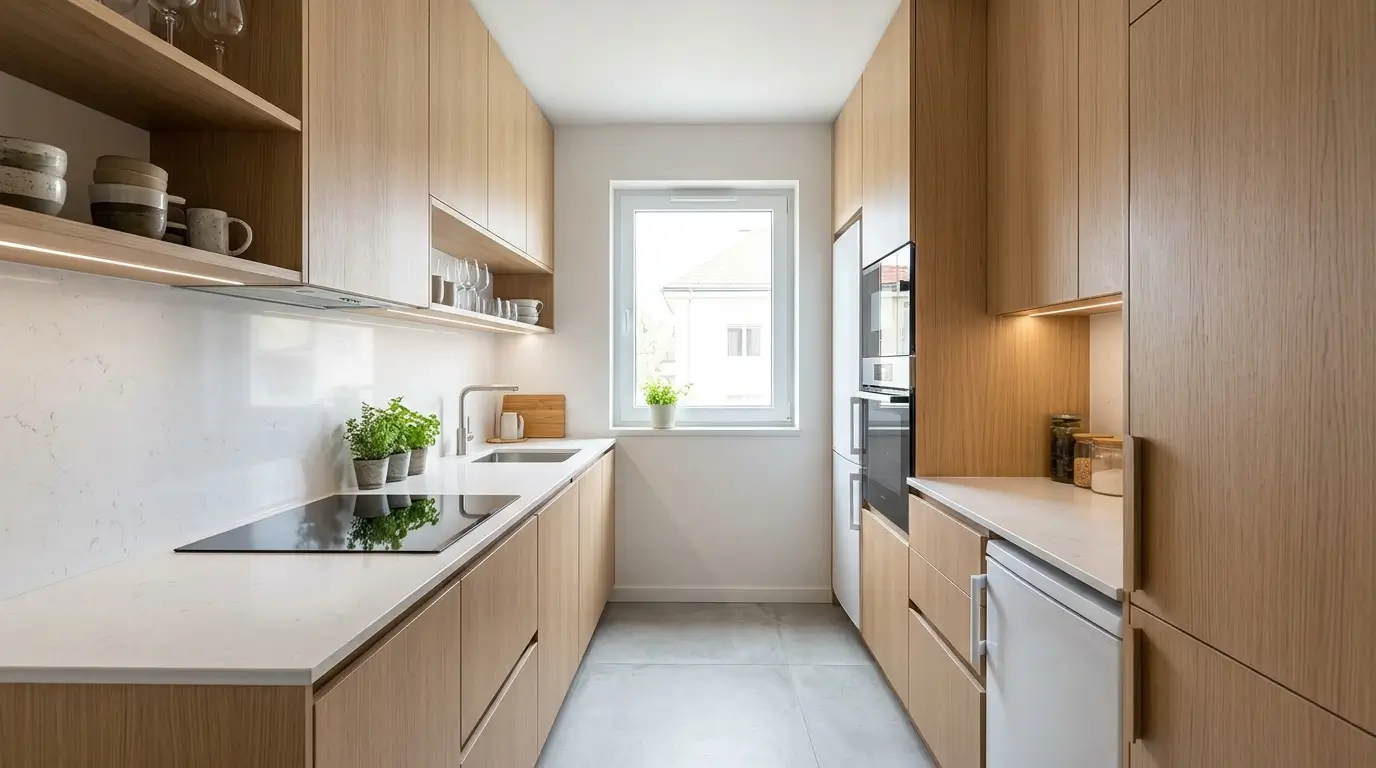
The parallel kitchen, two counters running along opposite walls with a working corridor between them, is the most efficient kitchen layout available for a long, narrow room. Everything the kitchen needs to do is distributed across two walls that face each other, the workflow runs back and forth across the corridor between them, and the cook has access to both counter runs without taking more than a single step sideways.
It is also the layout that Indian apartment kitchens most frequently have and most consistently underuse. The typical parallel kitchen in an Indian flat has the sink and prep counter on one wall, the cooktop and storage on the other, and a corridor between them that is either too narrow to move in comfortably or wide enough to work in but too wide to reach both sides without stepping across. The storage on both walls is rarely coordinated. The workflow between the two sides is rarely planned. And the result is a kitchen that has twice the counter and cabinet space of a single wall layout but does not feel twice as capable because the relationship between the two walls has not been thought through.
A parallel kitchen in a small space, designed with genuine attention to the corridor width, the functional assignment of the two walls, the storage configuration on both sides, and the workflow between them, is one of the most capable compact kitchen layouts available. The constraint of the narrow room becomes the advantage of having everything within immediate reach. The two walls that face each other create a kitchen that is compact, efficient, and, when the planning is done correctly, remarkably complete.
Here are 12 ideas for making a parallel kitchen in a small space work as well as the layout is capable of working.
Parallel Kitchen Design Ideas for Small Spaces
1. Get the Corridor Width Right Before Anything Else
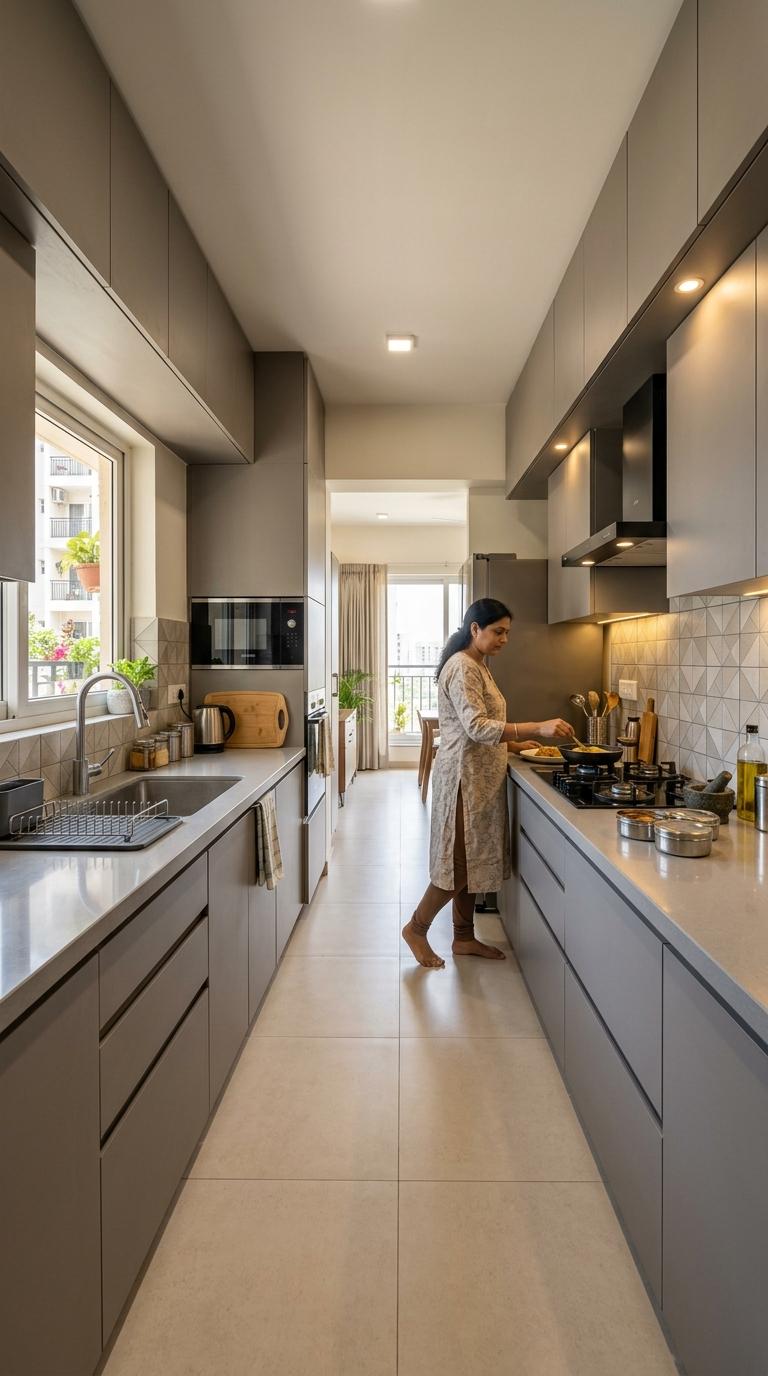
The corridor between the two counters of a parallel kitchen is the single most important dimension in the entire layout. Too narrow and the kitchen is physically uncomfortable to work in, the counter edges on both sides create a compressed working environment, and two people cannot occupy the kitchen simultaneously without constant interference. Too wide and the kitchen loses the efficiency advantage of the parallel layout, the reach between the two sides requires a full step across the corridor rather than a simple turn, and the kitchen starts to feel like two separate one wall kitchens facing each other rather than an integrated two-wall system.
The correct corridor width for a parallel kitchen is between 900 and 1200 millimetres. At 900 millimetres, a single cook can work efficiently and the reach from one counter to the other is comfortable. At 1200 millimetres, two people can occupy the corridor simultaneously without significant interference and the reach between sides is still manageable. Below 900 millimetres, the kitchen becomes genuinely uncomfortable for extended cooking sessions. Above 1200 millimetres in a small space, the parallel layout starts to lose its efficiency advantage. If the room width minus two counter depths produces a corridor outside this range, the counter depths need to be adjusted to bring the corridor back within it.
2. Assign the Two Walls by Function, Not by What Was Already There
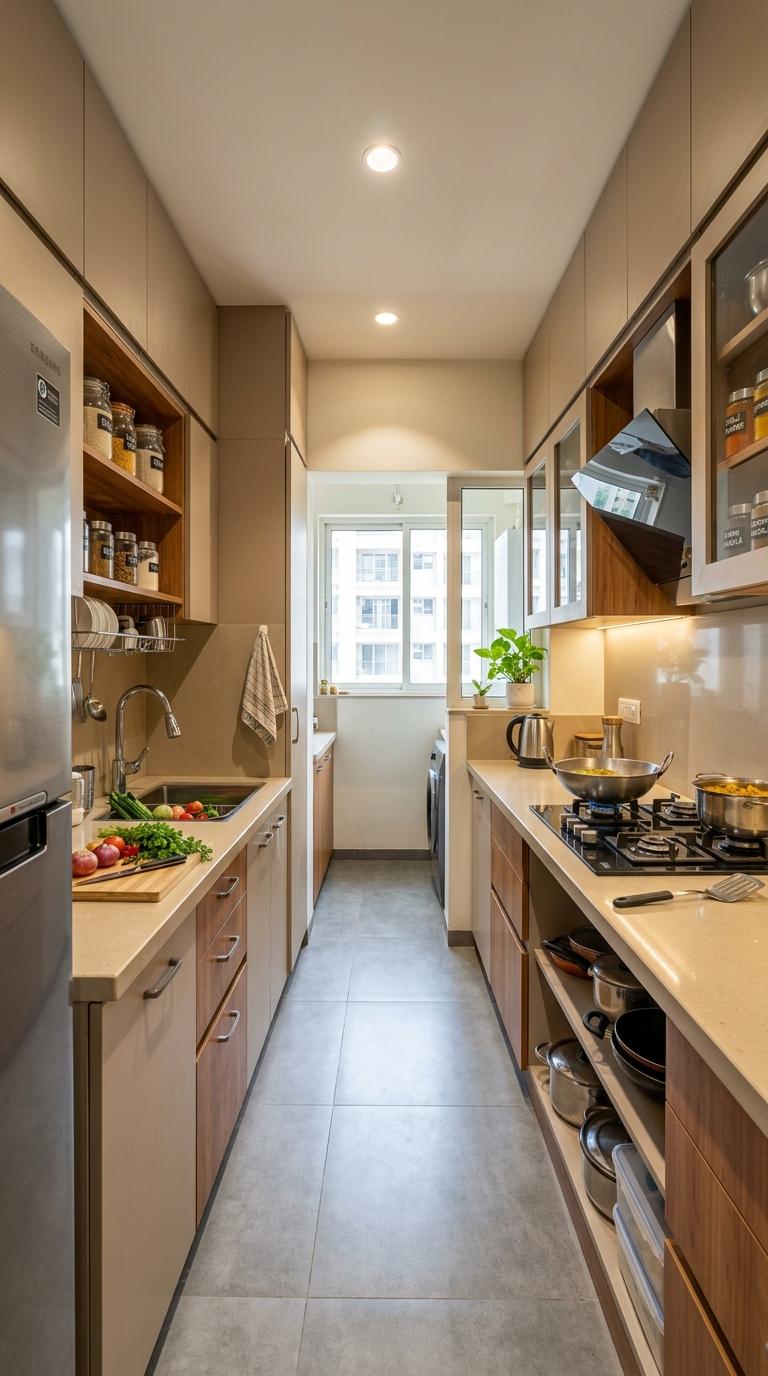
In most Indian apartment parallel kitchens, the functional assignment of the two walls was determined by where the plumbing stub-out happened to be installed during construction. The sink goes where the plumbing is. The cooktop goes on the other wall. Everything else fills in around those two fixed points without any further consideration of whether the resulting layout makes functional sense.
Where the plumbing allows any flexibility, or in a new installation where the plumbing can be planned from scratch, assign the two walls by function rather than by construction convenience. The cooking wall, the side with the cooktop, the chimney, and the vessel and spice storage, should be the wall that runs along the exterior of the building or the wall furthest from the kitchen entrance. The prep wall, the side with the sink, the refrigerator, and the dry goods storage, should be the wall nearest the kitchen entrance so ingredients move into the kitchen from the entrance directly to the prep zone without crossing the cooking zone. This functional assignment creates a parallel kitchen where the workflow moves logically from entrance to prep to cooking without doubling back across the corridor.
3. The Chimney Position Determines the Cooktop Position
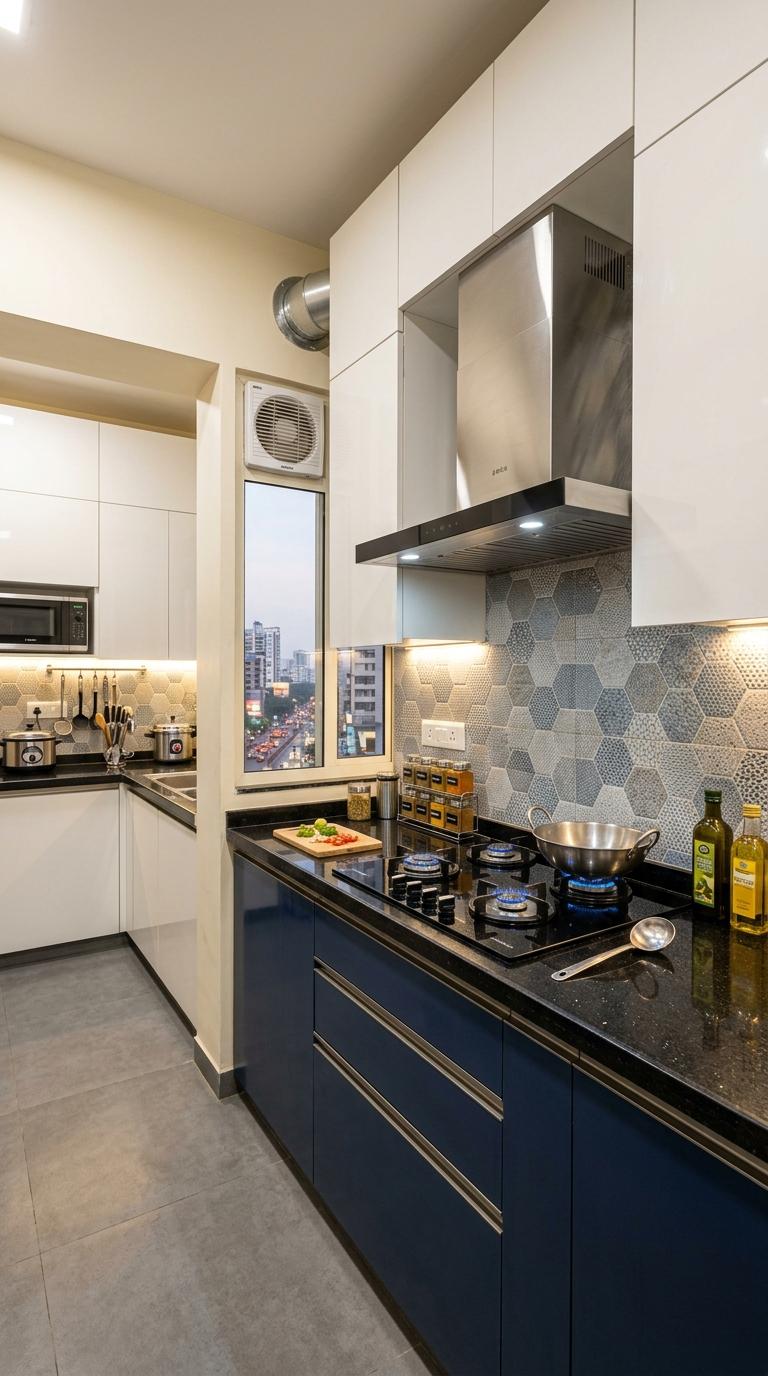
In a parallel kitchen, the chimney position is a structural decision that determines where the cooktop can go on the cooking wall and consequently where the counter zones on both walls are positioned relative to each other. A chimney can only be positioned where the flue can exit the building, typically through the exterior wall above the cooktop or through the ceiling to an external exhaust point. The cooktop must sit directly below the chimney for extraction to be effective.
Establish the chimney flue exit point before finalising the cooktop position. In most Indian apartment parallel kitchens, the exterior wall is the cooking wall and the chimney exits through the exterior wall directly above the cooktop. Where the cooking wall is an internal wall, a ceiling-exit chimney flue routed to an external point is the correct solution. The cooktop position on the cooking wall, fixed by the chimney flue exit, then determines the sequence of elements on both walls relative to the most active cooking position. Every other element in the parallel kitchen layout organises itself around this fixed point.
4. Mirror the Most Active Zones Across the Corridor
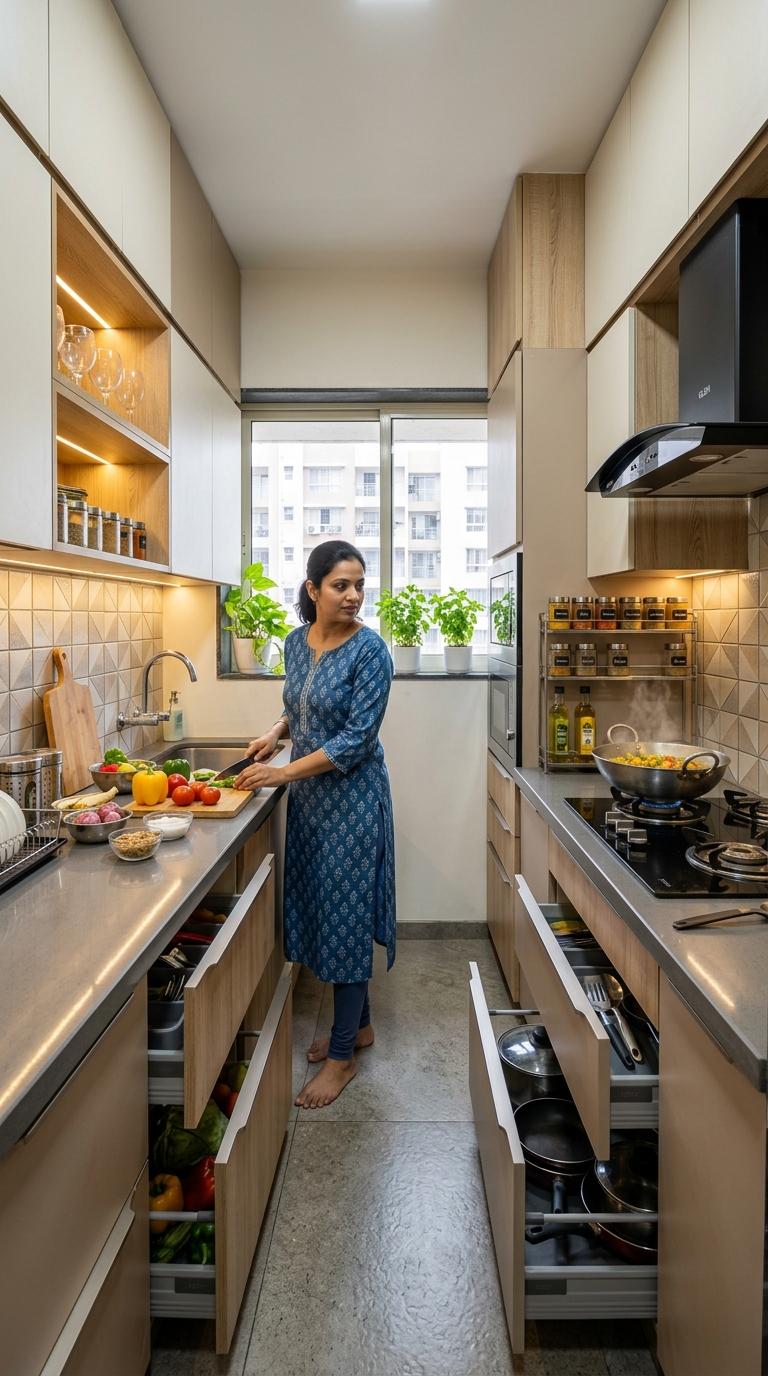
The efficiency of a parallel kitchen comes from the relationship between the two walls rather than from the individual performance of each wall in isolation. A parallel kitchen where the most active zone on the cooking wall, the cooktop and immediate cooking storage, faces the most active zone on the prep wall, the sink and prep counter, creates a workflow where the most frequent movement between the two sides is across the shortest and most direct path in the corridor.
Position the cooktop on the cooking wall to face the sink on the prep wall as directly as possible. This mirroring of the two most active zones means the cook turning from the cooktop to the sink, or carrying a vessel from the sink to the cooktop, crosses the corridor at its most functional point with the shortest movement. The zones used less frequently, the refrigerator, the dry goods storage, the cleaning supplies, sit at the ends of each wall where they do not interrupt the central cooking and prep workflow. Mirroring the active zones is a planning decision that costs nothing but produces a kitchen that feels significantly more efficient during actual cooking than one where the active zones are randomly positioned relative to each other.
5. Full-Height Storage at One End of Each Wall
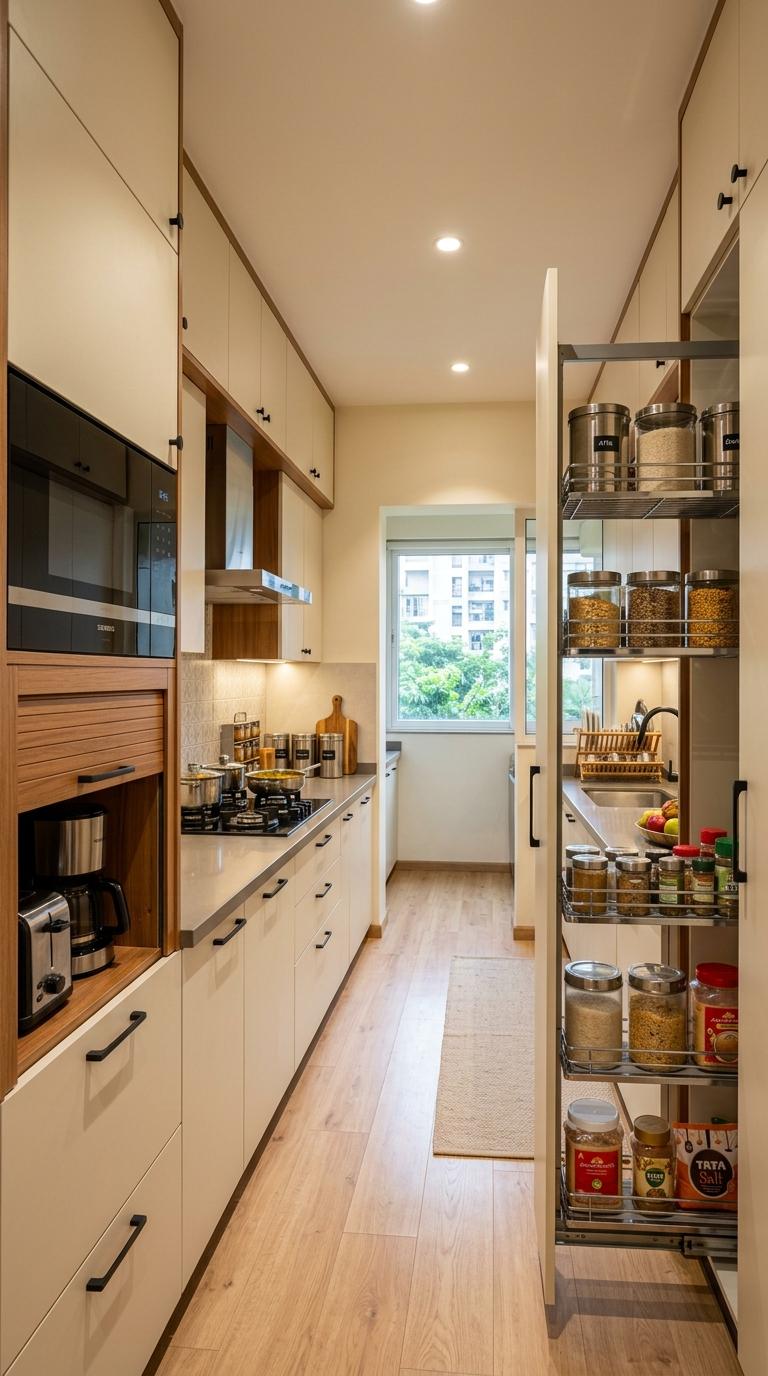
The ends of the two parallel walls in a small parallel kitchen are the natural positions for the tallest storage units in the layout. A full-height larder or pantry column at the end of the cooking wall and a full-height unit at the corresponding end of the prep wall add significant storage volume to the parallel kitchen without consuming counter length on either wall and without projecting into the corridor between them.
In an Indian parallel kitchen, the full-height unit at the end of the cooking wall typically houses the appliance garage for the microwave and toaster oven, with the appliances at eye level and storage above and below. The full-height unit at the end of the prep wall holds bulk dry goods on pull-out shelves. The two full-height units at opposite ends of the parallel kitchen frame the corridor visually, creating a defined entry and a sense of enclosure that makes the parallel kitchen feel like a purposeful room rather than a passageway with counters on both sides.
6. Pull-Out Drawers on Both Walls Without Exception
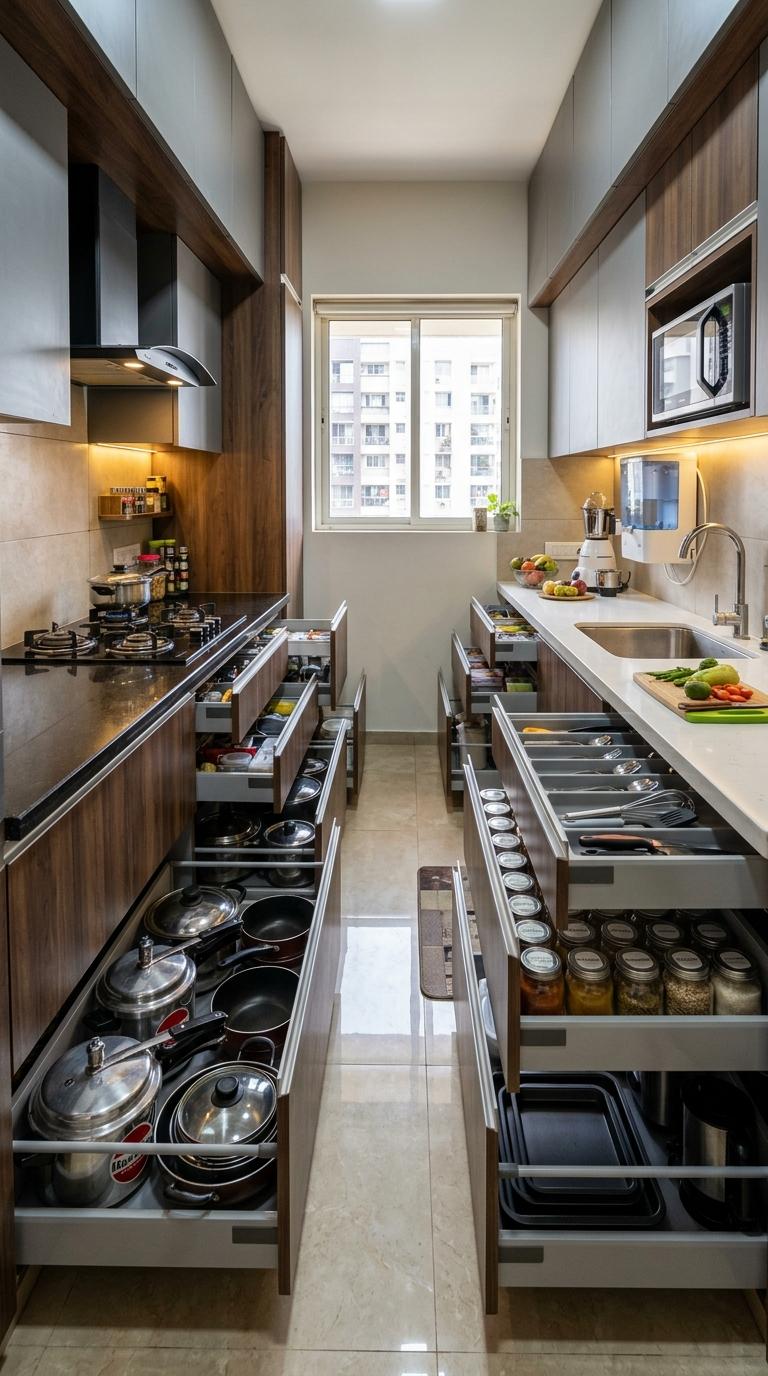
The base cabinet storage on both walls of a parallel kitchen needs to work at maximum capacity because the total storage requirement of an Indian kitchen does not reduce simply because the kitchen layout is parallel rather than L-shaped or single wall. A parallel kitchen in a small space typically has more total base cabinet length than an equivalent L-shaped kitchen in the same floor area, but that advantage is negated if the base cabinets are fitted with fixed shelves and hinged doors that make the back half of each cabinet inaccessible.
Pull-out drawer systems on both walls of the parallel kitchen, across every base cabinet position from the end of one wall to the end of the other, make the full depth of every lower cabinet accessible and the full contents of every drawer visible from above when open. The cooking wall base cabinets, fitted with deep pull-out drawers, hold vessels, pressure cookers, and heavy cooking equipment in accessible locations. The prep wall base cabinets, fitted with shallower pull-out drawers, hold containers, smaller equipment, and everyday cooking tools. Two full walls of base cabinets with pull-out drawers represent a total storage capacity that is more than adequate for even the most demanding Indian kitchen requirements.
7. A Continuous Countertop on Each Wall With a Junction at One End
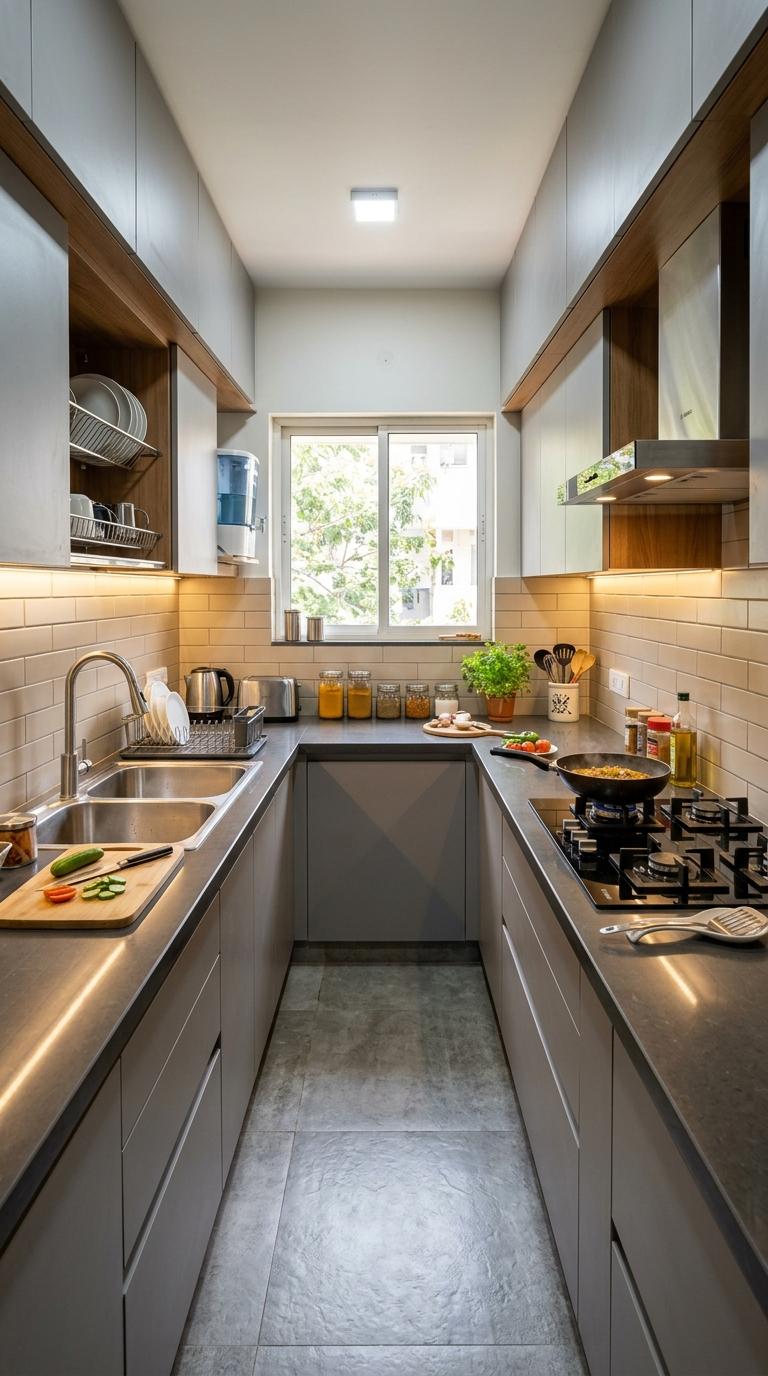
In a parallel kitchen with a closed end, where the two walls are connected by a short third wall at one end of the corridor, the counter on each wall can be joined at the closed end to create a continuous U-shaped counter run. The junction counter at the closed end provides additional prep and staging surface at the point where the two walls meet and creates a natural work zone that the cook can occupy with access to both parallel walls simultaneously.
In a small parallel kitchen where the junction counter at the closed end is narrow, 600 to 900 millimetres wide, it functions primarily as a staging and landing surface during cooking rather than as a primary prep area. Items move from the prep wall, across the junction counter if needed, and to the cooking wall in a natural circuit that uses all three counter surfaces in sequence. The continuous counter run that results from joining the two parallel walls at the closed end is a more capable cooking surface than two disconnected parallel counters that stop at the wall without connecting.
8. Wall Cabinets at Different Heights on the Two Walls
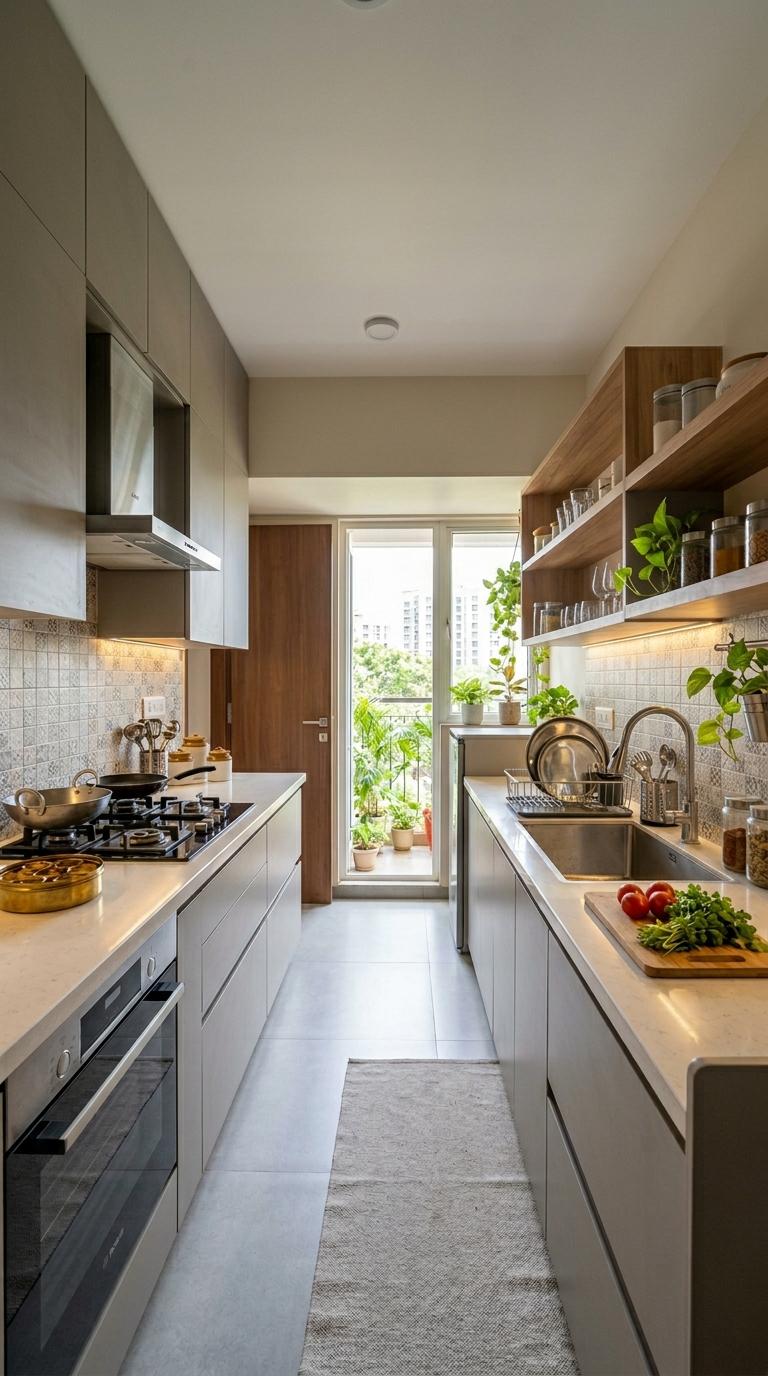
The wall cabinets on both walls of a parallel kitchen installed at the same height create a visual symmetry that makes the corridor between them feel narrow and enclosed. The two facing walls of cabinets at the same height create a channel effect that compresses the perceived width of the corridor and makes a small parallel kitchen feel more confined than its actual dimensions.
Installing wall cabinets at different heights on the two walls breaks this channel effect and makes the parallel kitchen feel more open. The cooking wall carries wall cabinets at standard height, sized to accommodate the chimney above the cooktop and the storage requirements of the cooking zone. The prep wall carries wall cabinets at a slightly lower height, or uses open shelving for part of the wall cabinet run, creating a visual asymmetry between the two walls that makes the corridor feel wider and the kitchen less enclosed. The functional difference between wall cabinets at slightly different heights is negligible. The perceptual difference in how the kitchen feels is significant.
9. Dedicated Spice Storage on the Cooking Wall
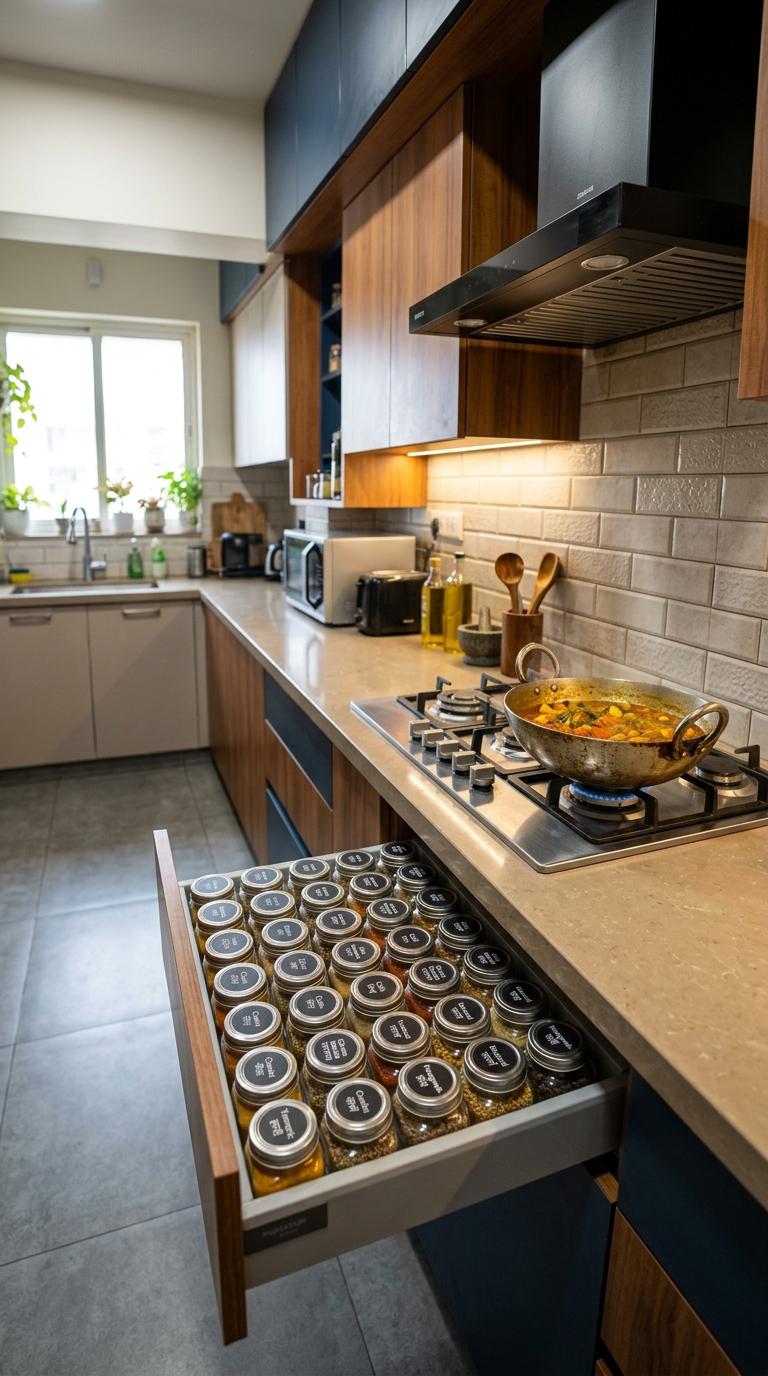
Spice storage in a parallel kitchen needs to be on the cooking wall, immediately adjacent to the cooktop, regardless of where the rest of the dry goods storage is located. In a parallel kitchen where the prep wall carries the majority of the dry goods storage, the instinct is sometimes to store spices with the other dry goods on the prep wall for organisational consistency. In practice, spices used during active cooking at the cooktop on the other wall need to be on the cooking wall where they are accessible without crossing the corridor.
A dedicated spice pull-out drawer, or a wall-mounted spice rack immediately beside the cooktop on the cooking wall, keeps the full spice collection at the cooking position where it is used. The pull-out drawer format, a narrow drawer fitted with a tiered insert that holds individual spice jars visible from above, is the most accessible and most space-efficient spice storage format for the cooking wall base cabinet. A wall-mounted magnetic spice rack on the backsplash wall immediately beside the cooktop, with matching labelled spice tins, is an alternative that keeps the spices visible and accessible without using any base cabinet space.
10. A Sliding Door or No Door at the Kitchen Opening
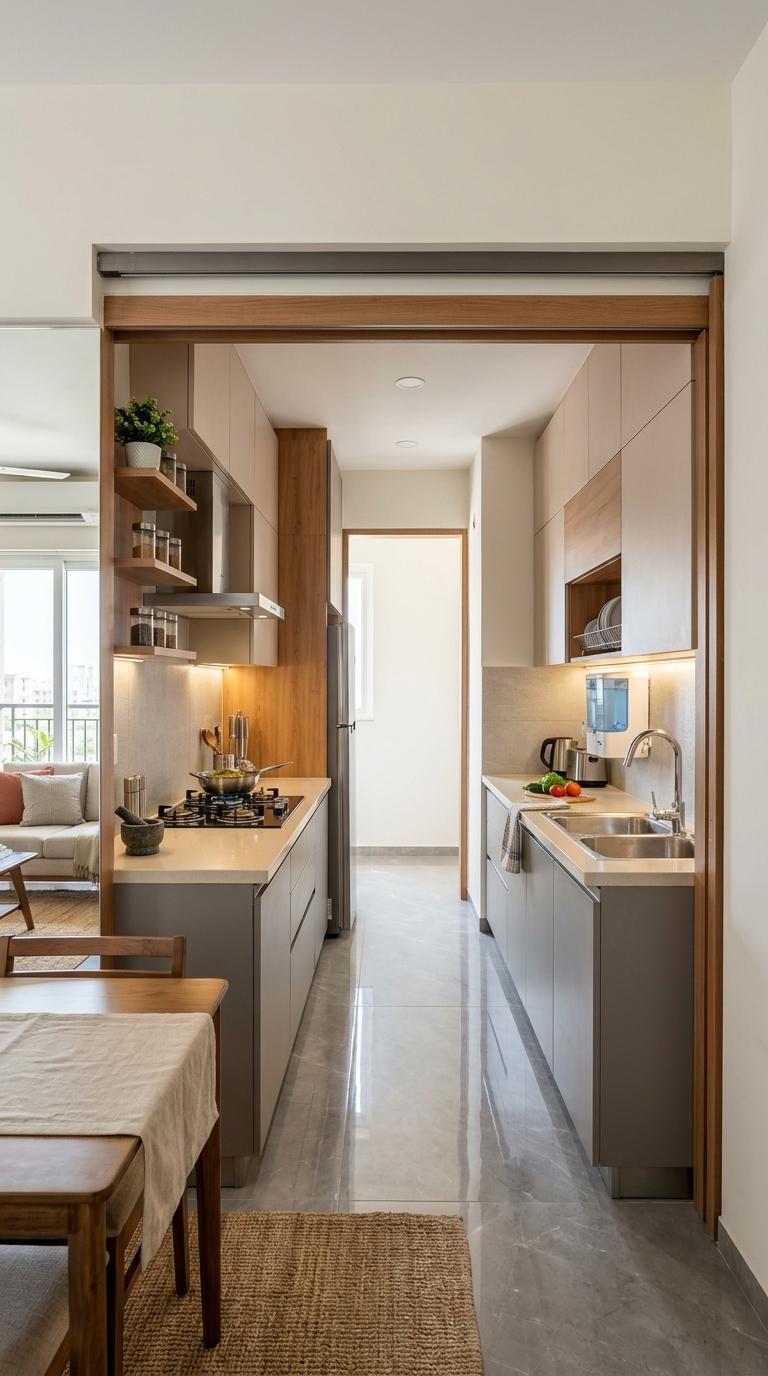
The door at the opening of a parallel kitchen determines how the kitchen connects to the rest of the flat and how the corridor at the kitchen entrance functions during cooking. A standard hinged door opening into the kitchen occupies the floor area of its swing arc inside the corridor, reducing the effective corridor length by the door swing radius whenever the door is open. In a small parallel kitchen where the corridor width is already at its minimum, a door opening into the corridor creates an obstruction at the kitchen entrance that makes moving in and out of the kitchen during cooking awkward and potentially hazardous near a hot cooktop.
A sliding door on a wall-mounted track, a pocket door that slides into a wall cavity, or simply the removal of the kitchen door entirely and the use of an open kitchen format where the parallel kitchen is visually connected to the adjacent room, all eliminate the hinged door swing problem without reducing the functionality of the kitchen opening. An open parallel kitchen in a small flat, where the kitchen connects directly to the living or dining area without a door, also makes the kitchen feel less enclosed and more integrated into the flat as a whole.
11. Lighting on Both Walls Independently Controlled
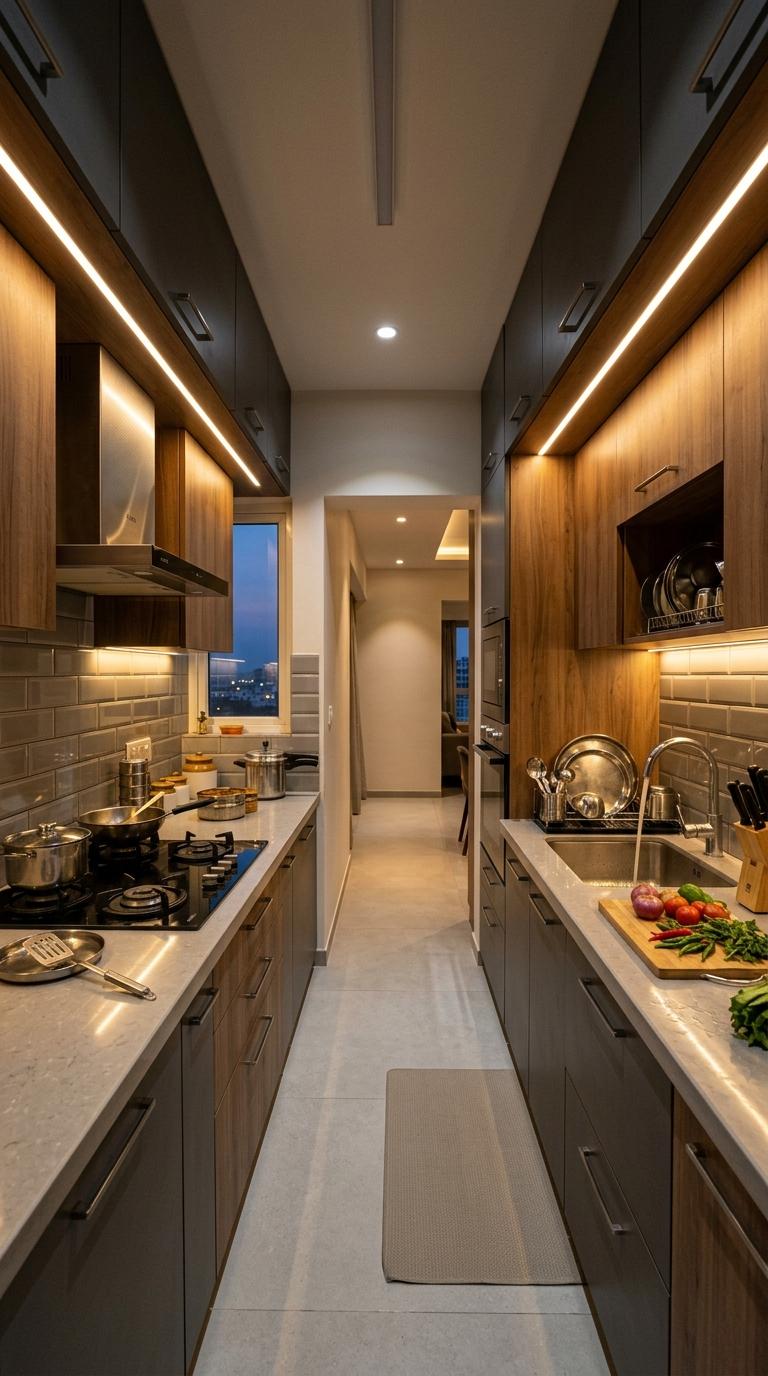
Lighting in a parallel kitchen needs to serve two distinct working positions on two opposite walls and should be controllable independently for each wall rather than operating as a single overhead system that illuminates the kitchen as a whole. An overhead light fitting in the centre of the ceiling of a parallel kitchen lights the corridor adequately but leaves both counter surfaces in partial shadow because the cook working at either counter stands between the overhead light and the counter surface.
Under-cabinet LED strips on both walls, independently controlled from a switch at the kitchen entrance, provide direct task lighting on both counter surfaces regardless of which wall the cook is working at. The cooking wall strip lights the cooktop and cooking counter. The prep wall strip lights the sink and prep counter. When only one wall is in active use, only the relevant strip needs to be on. When both walls are in use simultaneously, both strips operate together. Independently controlled under-cabinet lighting on both walls of a parallel kitchen is the correct lighting solution for a layout where two working surfaces face each other across a shared corridor.
12. A Visual Break in the Wall Cabinet Run on the Prep Wall
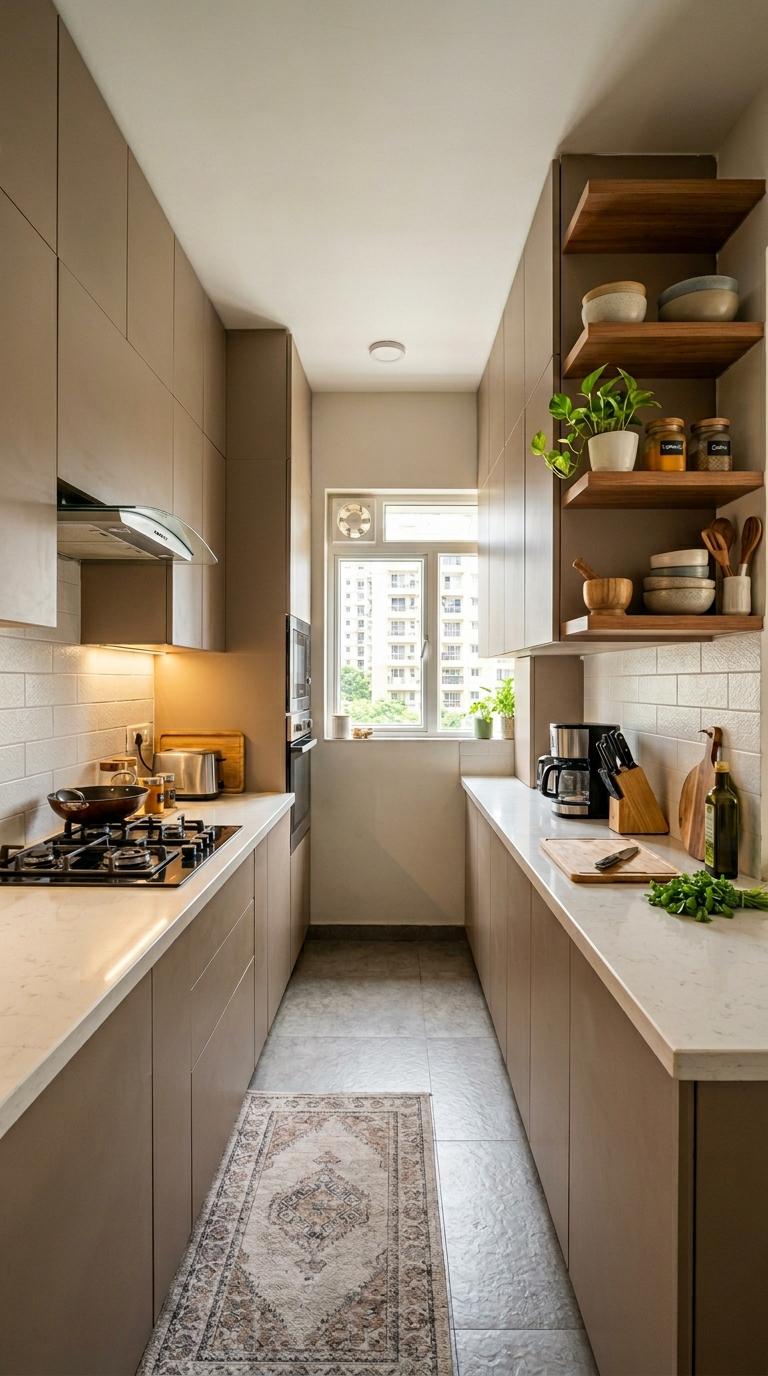
A parallel kitchen with wall cabinets running the full length of both walls without interruption creates an enclosed, corridor-like atmosphere that makes the cooking experience in a small parallel kitchen feel confined rather than efficient. The unbroken cabinet fronts on both walls, the closed doors facing each other across the narrow corridor, the absence of any visual relief in the upper half of the kitchen, all contribute to a kitchen that functions well but feels oppressive during extended cooking sessions.
Introducing a visual break in the wall cabinet run on the prep wall, replacing one wall cabinet unit with an open shelf section or leaving a section of the prep wall without cabinets to expose the wall surface behind it, creates a breathing space in the upper half of the parallel kitchen that makes the corridor feel less enclosed. The open section on the prep wall provides accessible storage for items used frequently during prep, creates a visual focal point on the wall that the cook faces during cooktop work, and introduces the perception of space that a fully cabineted wall cannot provide. One section of open shelving on the prep wall, curated and organised with the same care as any other visible storage in the kitchen, is the detail that makes the difference between a parallel kitchen that functions well and one that feels genuinely good to cook in.
Two Walls Working as One Kitchen
A parallel kitchen in a small space is not a compromise arrived at because the room was too narrow for anything else. It is a layout with a specific logic, a specific set of advantages, and a specific set of requirements that, when met, produces a kitchen that is more efficient per square metre than almost any other configuration.
Get the corridor width right. Assign the walls by function. Mirror the active zones. Pull out every base cabinet on both sides. Light both walls independently. Give the prep wall a visual break.
A parallel kitchen planned this carefully does not feel narrow. It feels tight in the way that a professional kitchen feels tight, where everything is within immediate reach and every movement has a purpose.
That is not a limitation. That is the whole point.