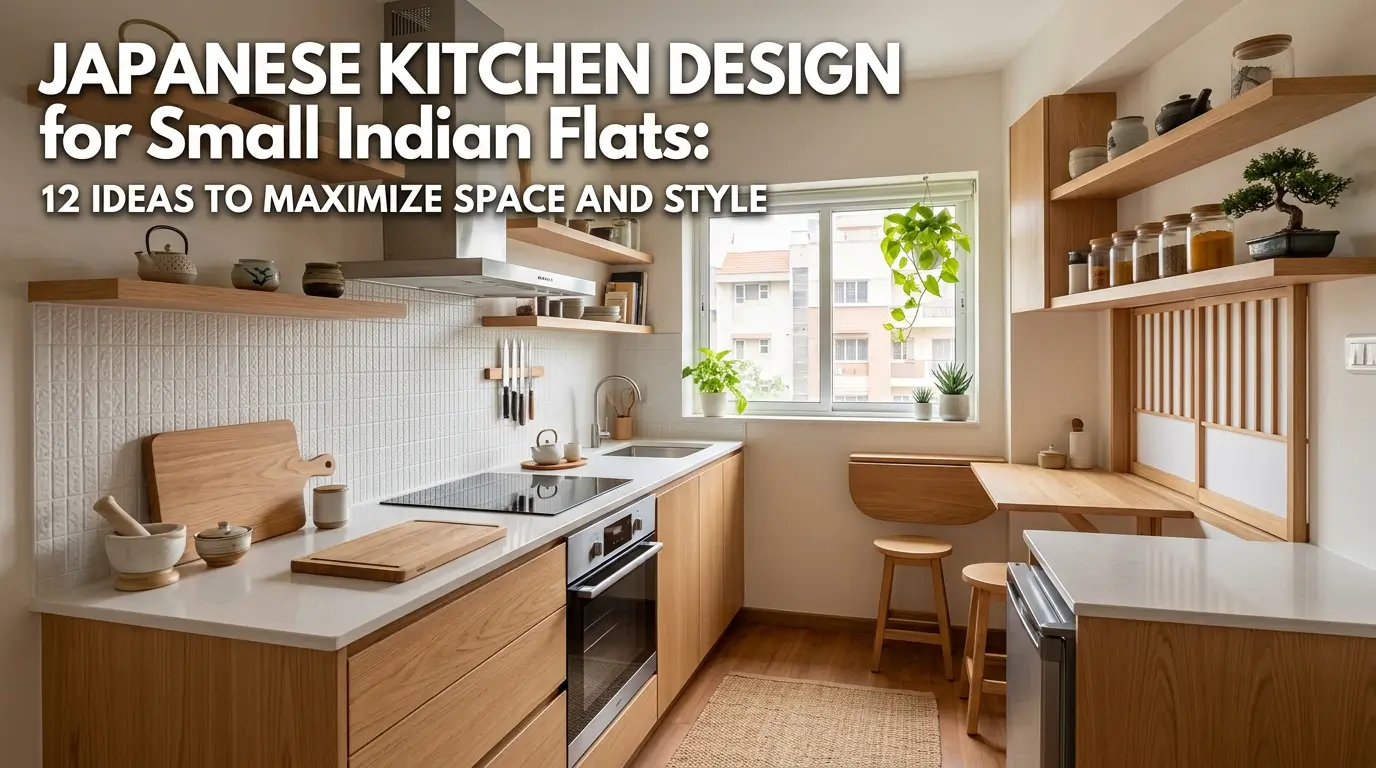
Japanese design has always been about doing more with less. In a country where urban apartments are famously compact, Japanese designers have spent decades refining the art of creating kitchens that are functional, calming, and beautiful — all within a very limited footprint.
For Indian homeowners living in 1BHK and 2BHK flats, this philosophy couldn’t be more relevant. Indian kitchens are often small, closed-off spaces that have to handle heavy-duty cooking — pressure cookers, tadkas, multiple burners going at once. The challenge is finding a design language that respects that reality while bringing in the clean, organized aesthetic that Japanese interiors are known for.
The good news is that Japanese kitchen design principles translate surprisingly well to small Indian flats. Here are 12 ideas to help you get started.
Japanese Kitchen Design Ideas for Small Indian Flats
1. Shaker-Style Flat Cabinet Fronts
Indian kitchens tend to use ornate cabinet designs with raised panels and decorative hardware. Japanese kitchens go the opposite direction — flat, handleless cabinet fronts in muted tones like off-white, ash grey, or pale wood.
Switching to flat-front cabinets instantly makes a small kitchen feel less cluttered. Without handles and decorative grooves collecting grease and dust, maintenance becomes easier too — a practical win for Indian cooking conditions.
2. Open Shelving with Restrained Styling
In Japanese interiors, open shelving is common but never overcrowded. A single shelf displaying a few ceramic bowls, a small plant, and neatly stacked steel dabbas can bring a lot of visual calm to a compact kitchen.
Open shelves also make the kitchen feel larger by breaking up solid wall coverage. Keep what’s on display intentional and organized. Everything else goes behind closed cabinets.
3. Light Wood Finishes
Japanese kitchens make extensive use of light-toned natural wood — hinoki, maple, and oak are popular choices. In Indian flats, you can achieve a similar look using plywood with a light veneer finish or laminates that mimic natural wood grain.
Light wood tones reflect more light than darker finishes, making a small kitchen feel more open and airy. Paired with white walls, this combination works particularly well in kitchens that don’t get much natural light.
4. Compact Modular Layouts
Japanese kitchen design often follows a single-wall or galley layout — everything in one straight line or along two parallel walls. This is ideal for the narrow, rectangular kitchens common in Indian urban flats.
A well-planned modular layout along a single wall — sink, prep area, cooktop, and storage in that order — keeps the workflow efficient without requiring extra square footage. Every inch is accounted for.
5. Hidden Appliance Storage
One of the defining features of a Japanese kitchen is that countertops are kept almost completely clear. Appliances like the mixer-grinder, toaster, and electric kettle are stored inside pull-out cabinets or appliance garages when not in use.
For Indian kitchens, this requires a bit more planning since appliances are heavier and used more frequently. Deep lower cabinets with pull-out trays can make this practical without making appliances feel inconvenient to access.
6. Integrated Chimney and Clean Exhaust Systems
Indian cooking generates a significant amount of smoke, steam, and oil. A sleek, integrated chimney that sits flush with the overhead cabinets — rather than a bulky, protruding hood — keeps the Japanese aesthetic intact while handling the practical demands of everyday Indian cooking.
Wall-mounted chimneys with a slim profile are widely available in India and work well with flat-front cabinetry. This single change can dramatically modernize the look of an older kitchen.
7. Neutral and Earthy Colour Palettes
Japanese interiors draw heavily from a palette of whites, warm greys, beiges, and soft greens — colours inspired by nature and designed to create a sense of calm. This is referred to in Japanese design philosophy as wabi-sabi — finding beauty in simplicity and imperfection.
For Indian flat kitchens, this means stepping away from bold two-tone cabinet combinations and instead opting for a single, muted base colour throughout. A warm white or natural stone laminate on both upper and lower cabinets creates visual continuity that makes the space feel larger.
8. Under-Cabinet Lighting
Japanese kitchen design uses lighting purposefully. Under-cabinet LED strips illuminate the countertop workspace directly, reducing the need for harsh overhead lighting and creating a warm, layered effect.
In Indian kitchens, this has a dual benefit — it improves visibility during food prep and adds a premium finish to the overall space. LED strips are inexpensive and easy to install during a kitchen renovation.
9. Minimal Hardware and Recessed Handles
Hardware — hinges, handles, and knobs — can add unnecessary visual noise to a small kitchen. Japanese kitchens typically use recessed J-pulls or push-to-open mechanisms that eliminate the need for visible handles altogether.
This keeps the cabinet fronts smooth and uninterrupted. For Indian kitchens with regular heavy use, push-to-open hinges may require a bit more maintenance, but recessed J-pull handles offer a great balance between the minimalist look and everyday practicality.
10. Tall Pantry Units for Vertical Storage
Japanese design makes full use of vertical space, particularly in small homes. A tall pantry unit running from floor to ceiling — fitted with pull-out shelves, wire baskets, and designated zones for dry goods — can hold an enormous amount of storage in a very small floor footprint.
This is especially useful in Indian kitchens where dry pantry items like lentils, flours, spices, and grains need to be stored in bulk. A well-organized tall unit keeps everything accessible without spreading across multiple surfaces.
11. Stone or Concrete-Look Countertops
Japanese kitchens frequently feature countertops in matte stone, polished concrete, or ceramic surfaces in neutral tones. These materials are easy to maintain, resistant to heat and staining, and visually clean.
For Indian cooking, where hot vessels are often placed directly on the counter, a heat-resistant quartz or ceramic countertop in a light stone finish works beautifully. It brings the Japanese aesthetic while standing up to the demands of daily Indian cooking.
12. A Dedicated Spice and Masala Zone
One of the practical challenges of applying Japanese minimalism to an Indian kitchen is spice storage. Indian cooking uses a large variety of whole spices, masala blends, and condiments that need to be within easy reach.
The solution is to design a dedicated, concealed spice zone — a narrow pull-out drawer or carousel unit positioned next to the cooktop. This keeps your masalas accessible and organized without cluttering the countertop, combining Japanese organization principles with the very real needs of Indian cooking.
Make Your Small Kitchen Work Harder and Look Better
Japanese kitchen design is not about stripping your kitchen of its character — it’s about creating a space where everything has a purpose and nothing is wasted. For small Indian flats where the kitchen often doubles as a gathering space, these principles can transform a cramped and cluttered room into one that feels calm, efficient, and considered.
Start with one or two changes — a neutral colour palette, better storage, or cleaner cabinet fronts — and build from there. The results are worth it.