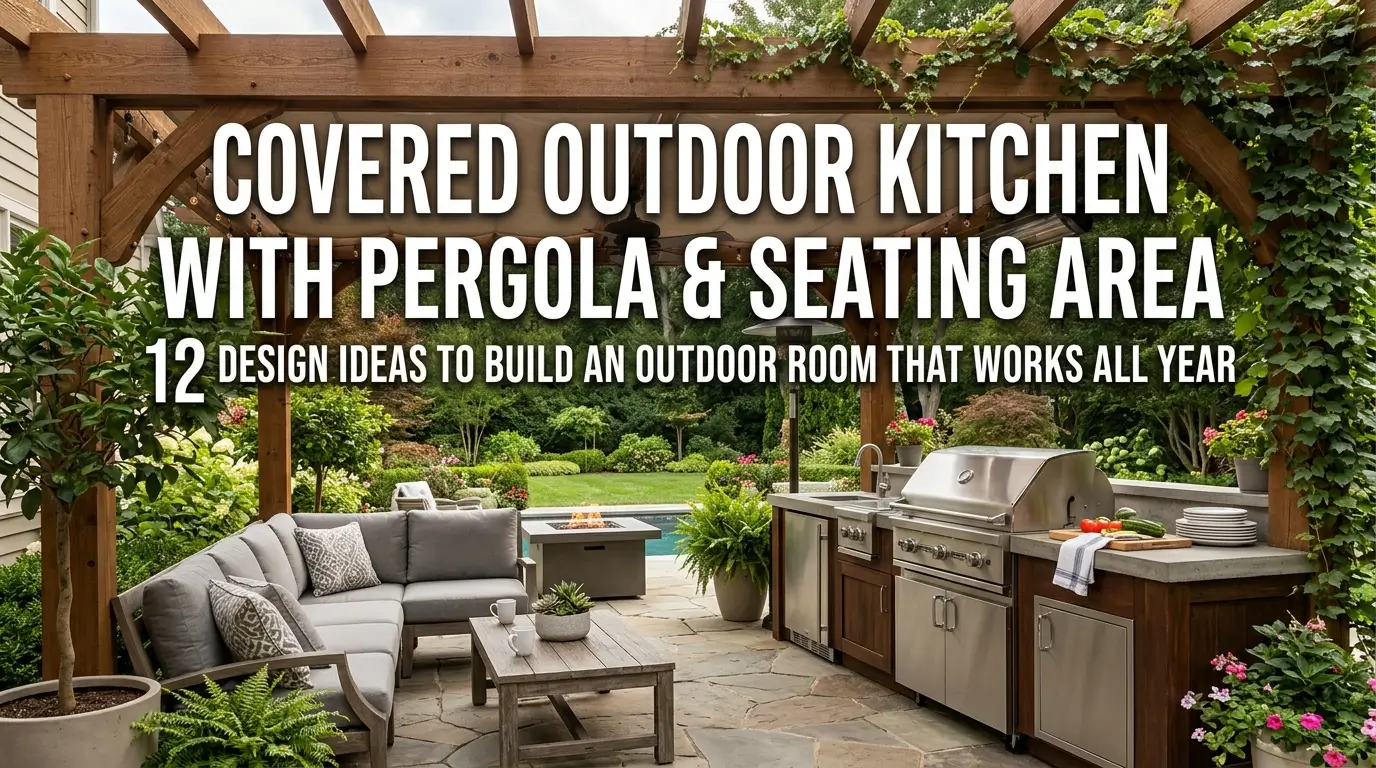
The covered outdoor kitchen is a different proposition from the open-air grill station or the casual backyard barbecue setup. When you add a pergola and a proper seating area to an outdoor kitchen, you stop building a cooking facility and start building a room. An outdoor room, with its own ceiling, its own light, its own furniture, and its own atmosphere, but a room nonetheless.
This distinction matters because it changes how the space is used. An uncovered outdoor kitchen is used when the weather cooperates. A covered outdoor kitchen with seating is used constantly because the weather is no longer the deciding factor. Rain does not stop the cooking. Afternoon sun does not drive everyone indoors. The pergola handles both, and the space underneath it becomes a genuine extension of the home rather than a seasonal bonus.
For Indian homes, this is a particularly meaningful shift. The climate in most Indian cities offers many months of genuinely beautiful outdoor weather, but also periods of intense heat, monsoon rain, and humidity that make uncovered outdoor spaces uncomfortable or unusable. A pergola-covered outdoor kitchen with seating solves this directly. It captures the good months fully and extends usability deep into the difficult ones.
Here are 12 design ideas for building a covered outdoor kitchen with a pergola and seating area that functions well, weathers honestly, and feels like a space worth spending time in.
Covered Outdoor Kitchen with Pergola and Seating Area Design Ideas
1. Design the Pergola Structure First, Not Last
The most common mistake in outdoor kitchen planning is treating the pergola as something added after the kitchen is built. The kitchen goes in, it works well enough, and then a shade structure is retrofitted above it because the afternoon sun makes cooking uncomfortable. The result is a pergola that does not quite fit the kitchen, posts that land in inconvenient positions, and a roof line that looks like it was added as an afterthought.
The pergola structure should be designed first, before the kitchen layout is finalised. The kitchen fits within the pergola. The posts define the boundaries of the outdoor room. The roof line determines the height and scale of everything below it. Starting with the structure gives the entire project a coherent logic that cannot be achieved by working in the opposite order.
2. Fix the Pergola to the House Wall on One Side
A pergola that is fixed to the exterior wall of the house on one side and supported by posts on the remaining sides is structurally more stable, less expensive to build, and visually more integrated with the home than a fully freestanding structure. It reads as an extension of the house rather than a separate garden object.
For the outdoor kitchen, fixing the pergola to the house wall also means the wall connection can carry services. The electricity supply for lighting and appliances runs through the wall junction cleanly. The extraction hood for the grill fixes to the house wall at the correct height. The water supply for the outdoor sink enters from the house wall without a long external pipe run. The structural and practical advantages of the wall-fixed pergola make it the correct default choice for most residential outdoor kitchen projects.
3. Specify the Roof Coverage Based on Indian Weather
A pergola roof for an Indian outdoor kitchen needs to be specified for monsoon rain and summer heat, not just for shade. An open timber slat pergola roof that looks beautiful in European garden photography is not appropriate for a climate that delivers sustained heavy rain for months at a time.
A solid polycarbonate sheet roof over the cooking and dining area provides full rain protection while allowing diffused natural light through. A retractable shade sail or louvred aluminium roof system handles both sun and rain and allows the roof to be opened during pleasant weather. Whichever system is chosen, the roof should cover the full footprint of the outdoor kitchen and seating area completely. Partial coverage that leaves the seating area exposed during rain defeats the purpose of building a covered outdoor room.
4. Separate the Cooking Zone and Seating Zone Within the Pergola
A covered outdoor kitchen with a seating area works best when the two functions are clearly separated within the pergola footprint rather than merged into a single undifferentiated space. The cooking zone needs hard, easy-clean surfaces, proximity to services, and adequate extraction above the cooking equipment. The seating zone needs comfortable furniture, soft lighting, and enough separation from the cooking heat and activity to feel relaxed.
Position the kitchen along one side or one end of the pergola. Place the dining or lounge seating in the remaining space, oriented toward the kitchen so the cook and the guests remain connected. A distance of 150 to 200 centimetres between the cooking counter and the nearest seating edge is enough to create separation without disconnection. The cook is present in the room. The guests are comfortable. Neither zone compromises the other.
5. Outdoor Kitchen Counter Oriented to Face the Seating
Within the covered outdoor room, the orientation of the outdoor kitchen counter matters as much as its layout. A counter that faces the wall puts the cook’s back to the seating area for the entire cooking period. A counter that faces inward toward the seating area keeps the cook in the room, part of the conversation, and able to serve directly across the counter to guests sitting on the other side.
Where the kitchen layout allows it, orienting the primary cooking counter to face the seating area transforms the dynamic of the outdoor room entirely. It is the difference between a cook who disappears into the kitchen and a host who never leaves the party. In a covered outdoor room where kitchen and seating occupy the same space, this orientation choice defines the entire social character of the space.
6. Built-In Seating Along the Pergola Perimeter
Built-in bench seating along the inner perimeter of the pergola, with under-seat storage, is one of the most space-efficient and visually clean seating solutions for a covered outdoor room. It uses the structural posts and the boundary walls of the pergola as the back support for the bench, eliminates the need for freestanding chairs that occupy floor space when not in use, and creates a continuous seating surface that can accommodate varying numbers of guests flexibly.
Build the bench from the same material as the outdoor kitchen base structure for consistency. Top it with a weatherproof cushion in an outdoor fabric for comfort. Add under-seat storage accessed through lift-up lids for outdoor cushions, garden tools, or the items that accumulate in any well-used outdoor room. Built-in bench seating defines the boundary of the outdoor room as clearly as a wall does, but leaves the space feeling open rather than enclosed.
7. A Dining Table Scaled to the Pergola, Not to Aspirations
Outdoor dining tables are frequently over-specified. The instinct is to buy or build the largest table the space can accommodate, on the assumption that larger gatherings will fill it regularly. In practice, a table that is too large for the daily use case dominates the outdoor room and makes intimate meals feel formal and under-populated.
Scale the dining table to the number of people who use the space regularly, not the number who use it occasionally. A table for four to six people in a compact pergola-covered outdoor room will be used constantly and will feel correct every time it is used. A table for ten will feel right twice a year and oversized the rest of the time. Choose a table with an extension leaf if larger gatherings are genuinely frequent. Otherwise, size for the everyday.
8. Layered Lighting Across Three Zones
Lighting in a covered outdoor room needs to handle three distinct jobs and should be designed as three separate layers rather than a single overhead fitting that tries to do everything.
Task lighting above the kitchen counter illuminates the cooking surface for practical work after dark. Ambient lighting across the pergola ceiling provides the general light level for dining and conversation. Accent lighting on the garden beyond the pergola edge draws the eye outward and prevents the covered space from feeling like a box at night. String lights along the pergola beams, a pendant above the dining table, and LED strip lights under the kitchen counter overhang together create a layered lighting environment that is both functional and genuinely atmospheric. All fittings should be rated for outdoor use at a minimum of IP44.
9. An Outdoor Fireplace or Fire Pit as the Social Anchor
In the cooler months, a covered outdoor room without a heat source becomes uncomfortable earlier in the evening and less used as the temperature drops. An outdoor fireplace built into the boundary wall of the pergola, or a freestanding fire pit positioned within the seating area, extends the usable season significantly and becomes the social anchor of the outdoor room during cooler weather.
A built-in fireplace in the boundary wall of the pergola is the most architecturally resolved solution. It adds heat, light, atmosphere, and a focal point to the seating area without consuming floor space. A freestanding fire pit is less permanent and less expensive but requires careful positioning within the covered space to ensure adequate ventilation and safe clearance from the pergola structure above. Either way, a fire source in the covered outdoor room transforms it from a fair-weather space into a year-round destination.
10. Greenery Integrated Into the Pergola Structure
A pergola without planting is a steel or timber frame. A pergola with climbing plants trained along its beams and posts is a garden structure. The distinction matters because climbing plants are what give a pergola warmth, softness, and the quality of belonging to the garden rather than sitting on top of it.
Train a climbing plant along each post and across the overhead beams. Bougainvillea, passionflower, jasmine, or a grapevine are all appropriate choices for Indian climates and provide either flowers, fragrance, fruit, or seasonal colour that changes the character of the outdoor room through the year. Plant into generous ground-level beds or large containers at the base of each post. The plants take a season or two to establish, but once they do, the pergola reads as something grown rather than built.
11. Flooring That Defines the Outdoor Room
The floor surface under the pergola is what physically defines the outdoor room as a distinct space within the garden. A consistent, considered floor material across the full pergola footprint creates a platform that the kitchen and the seating sit on as a unified composition rather than as separate objects placed on whatever surface happens to be there.
Large-format outdoor porcelain tiles, natural Kota stone, sandstone pavers, or a poured concrete floor all work well under a covered outdoor room in Indian conditions. Lay the flooring across the entire pergola footprint including under the kitchen counter base. Keep the same material running from the kitchen zone through the dining zone to the seating zone without a change in material or level. The uninterrupted floor surface is what makes the covered outdoor space read as a room.
12. A Service Connection That Treats the Outdoor Kitchen as Permanent
A covered outdoor kitchen with a pergola and seating area is a permanent installation and should be treated as one from the services perspective. Water supply, drainage, electricity, and gas connections should all be installed as permanent, properly specified services rather than as temporary connections improvised from indoor supplies.
A dedicated outdoor electrical circuit with a residual current device, a permanent water supply and drain connection for the outdoor sink, a fixed LPG supply line with an outdoor-rated regulator, and permanently installed weatherproof lighting circuits all make the outdoor kitchen genuinely independent of the indoor space for day-to-day use. The additional cost of proper service installation at the construction stage is small relative to the total project cost and significant relative to the long-term usability and safety of the outdoor room. An outdoor kitchen that requires extension cords and temporary gas hoses every time it is used will be used less and less frequently over time. One that is ready to cook the moment you walk into it will be used every single day.
Build a Room, Not a Feature
A covered outdoor kitchen with a pergola and seating area, designed and built with the care it deserves, stops being a garden feature and becomes one of the most used rooms in the home. It earns that status through the decisions made at the planning stage, the quality of the services installed, the consistency of the materials chosen, and the discipline of designing for how the space will actually be used rather than how it might look in a photograph.
Get the pergola structure right first. Orient the kitchen to face the people it is cooking for. Scale the seating to the real number of people who will use it. Light it for the evening. Plant the posts. Lay the floor across the full footprint.
Do all of that and the outdoor room will take care of the rest.