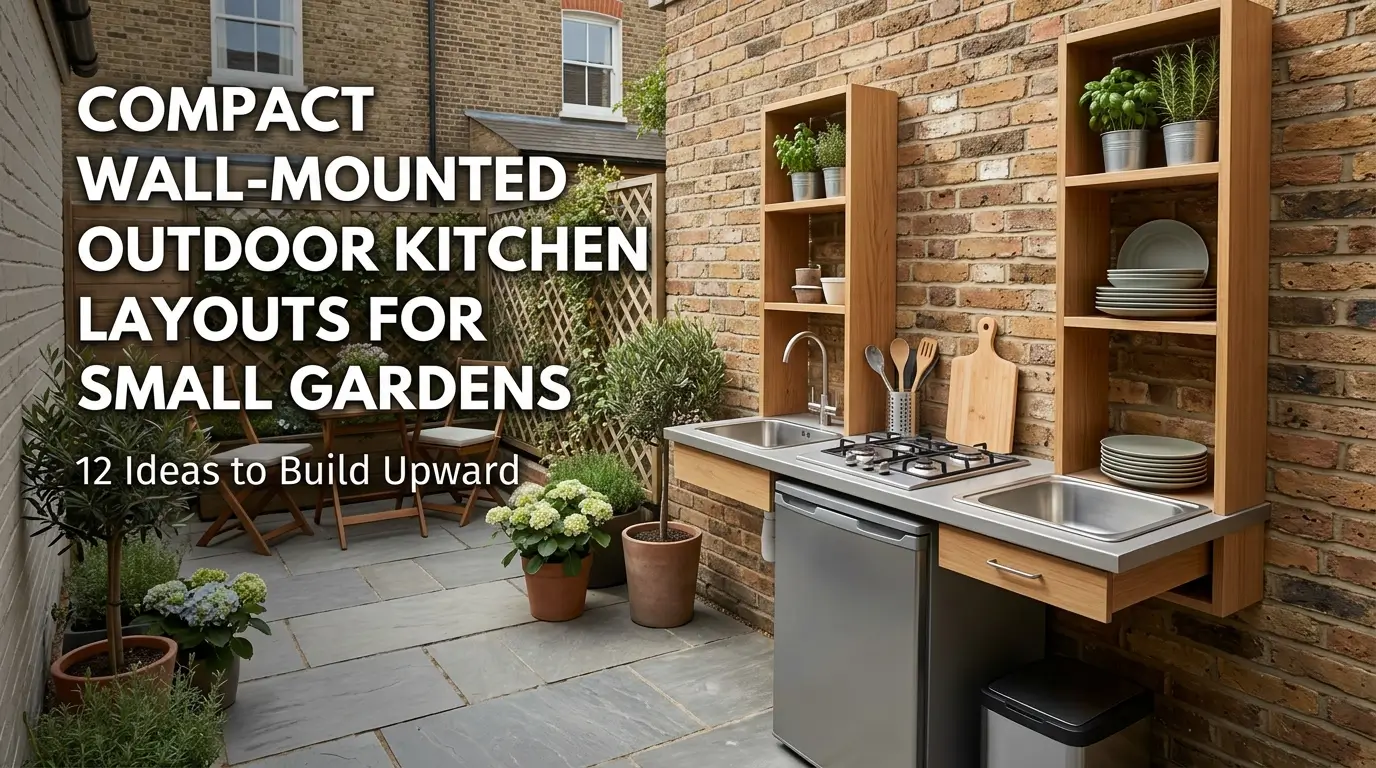
Small gardens have one problem that good design can almost always solve — the assumption that a functional outdoor kitchen requires floor space. It does not. The floor of a small garden is its most valuable asset. It is where people stand, where furniture sits, where children play, and where plants grow. An outdoor kitchen that consumes a significant portion of that floor area creates a space that is functional for cooking and uncomfortable for everything else.
The solution is to build upward. A wall-mounted outdoor kitchen — fixed to a boundary wall, a garden fence, or the exterior wall of the house — keeps the entire floor area of the garden free while delivering a complete outdoor cooking and preparation setup. It is the most space-efficient outdoor kitchen configuration available for a small garden, and when designed well, it is also among the most attractive.
Wall-mounted outdoor kitchens are common in European and Japanese small-space garden design, where the boundary between indoor and outdoor living is deliberately blurred and every surface is treated as usable. The principles translate directly to small Indian gardens, compact urban terraces, and narrow side passages that have more wall than floor to work with.
Here are 12 ideas for designing a compact wall-mounted outdoor kitchen that makes the most of vertical space without sacrificing style, function, or the limited floor area you have.
Compact Wall-Mounted Outdoor Kitchen Layout Ideas
1. A Fold-Down Counter Fixed to the Boundary Wall
The most space-efficient outdoor kitchen counter available for a small garden is one that does not exist when it is not needed. A fold-down counter — a solid timber, steel, or concrete board fixed to the wall on heavy-duty hinges — folds flat against the wall when not in use and drops to counter height when cooking or serving.
When folded up, it adds almost nothing to the garden footprint. When folded down, it provides a full-width prep and serving surface that handles everything from vegetable chopping to plating dishes. Support legs or a folding bracket hold the counter level during use. For small gardens where every square metre of floor space matters, a fold-down counter is the single most practical outdoor kitchen element available.
2. Wall-Mounted Burner Unit at Counter Height
A single high-output burner unit — the kind used in commercial outdoor cooking and increasingly available for residential use — mounted directly onto the boundary wall at counter height eliminates the need for a separate counter base entirely. The burner sits on a wall-fixed bracket, connects to an LPG supply via a flexible hose, and occupies only the depth of the unit itself against the wall.
Pair this with the fold-down counter described above and you have a complete outdoor cooking station in a wall-mounted format that uses almost no floor space. The burner bracket should be fabricated from stainless steel or hot-dip galvanised steel to handle outdoor conditions. Position the burner at the end of the counter run away from the fold-down surface so heat does not transfer to the counter during cooking.
3. Vertical Cabinet Tower Fixed to the Wall
Under-counter storage — the default in a floor-standing outdoor kitchen — is replaced in a wall-mounted layout by a vertical cabinet tower fixed directly to the wall. A slim, weatherproof cabinet column — 30 to 40 centimetres in depth, running from counter height to as high as comfortably reachable — provides shelving, enclosed storage for cookware, and a housing for the LPG cylinder behind a vented lower door.
Marine-grade plywood with an exterior paint finish, powder-coated aluminium, or stainless steel are all appropriate materials for a wall-mounted outdoor cabinet in Indian weather conditions. The vertical format maximises storage without any floor footprint. A single well-built cabinet tower beside the cooking surface handles the storage requirements of most outdoor cooking setups comfortably.
4. Wall-Hung Rail System for Utensils and Accessories
A stainless steel or powder-coated wall rail — fixed to the boundary wall above the counter — with a series of S-hooks and small hanging baskets keeps outdoor cooking utensils, condiments, herb pots, and small accessories off the counter surface and within immediate reach.
This is standard professional kitchen thinking applied to an outdoor setting. A wall rail above the cooking area means the counter surface stays clear during cooking — which in a compact outdoor kitchen, where counter space is already limited, is a significant functional advantage. Choose a rail system rated for outdoor use. Stainless steel requires the least maintenance in humid or coastal conditions.
5. Recessed Wall Niche for Spice and Condiment Storage
Where the boundary wall has sufficient depth — or where a new wall is being built as part of the outdoor kitchen project — a recessed niche cut or built into the wall surface provides shelving for spices, condiments, and small bottles without any projection into the garden space.
A recessed niche 15 to 20 centimetres deep, 60 to 90 centimetres wide, and two or three shelves high holds everything needed for active outdoor cooking within arm’s reach of the burner. Line the interior with tiles for easy cleaning and weather resistance. Fitted with a simple weatherproof door or a pull-down blind, the niche closes completely when the kitchen is not in use — keeping contents protected from rain, sun, and insects.
6. Wall-Mounted Fold-Out Dining Shelf
A dedicated dining surface in a small garden does not need to be a permanent table. A wall-mounted fold-out shelf — wider and lower than the cooking counter, fixed to the house wall or a side boundary wall — provides a standing dining or serving surface that folds completely flat when not needed.
For gardens where the outdoor kitchen is used primarily for casual meals rather than formal dining, a fold-out shelf at bar height — 100 to 105 centimetres — with a pair of tall stools stored beside the wall creates a complete outdoor dining setup in a footprint that is essentially zero when not deployed. This approach keeps the garden feeling like a garden rather than a permanent outdoor room.
7. Overhead Wall-Fixed Pergola as Weather Protection
A wall-mounted outdoor kitchen needs weather protection — particularly in Indian conditions where monsoon rain and summer heat make unprotected outdoor cooking genuinely uncomfortable for months of the year. An overhead pergola structure fixed to the house wall at one end and supported by a single post at the outer edge — rather than a freestanding four-post structure — minimises the floor footprint of the shelter while providing adequate coverage over the cooking and counter area.
A wall-fixed pergola requires only one ground fixing rather than four, which in a small garden is a meaningful difference. Cover it with a polycarbonate sheet for rain protection, a shade sail for sun control, or climbing plants for a natural, living roof that develops over time. The wall-fixed format also means the pergola reads as part of the house rather than a separate garden structure — which suits small gardens where too many separate elements create visual clutter.
8. Tiled Splashback Wall Behind the Cooking Surface
The wall directly behind the outdoor cooktop takes heat, grease, and cooking residue during active use. Tiling this section of wall — floor to ceiling or counter height to pergola height — protects the surface, makes cleaning straightforward, and creates a finished, intentional backdrop that elevates the entire outdoor kitchen.
Choose outdoor-rated ceramic or porcelain tiles in a muted tone — grey, off-white, or a subtle natural stone pattern — that works with the garden materials and does not compete with the planting. Large-format tiles with minimal grout lines are easier to keep clean outdoors than smaller tiles with more grout. A tiled splashback wall is one of the most practical and most visually effective investments in a wall-mounted outdoor kitchen.
9. Integrated Outdoor Sink Set Into a Wall-Mounted Counter Slab
A wall-mounted counter slab — a single piece of stone, concrete, or compressed fibre cement fixed to the boundary wall on heavy-duty steel brackets — with a compact sink cut directly into it creates a permanent prep and washing surface that projects only 50 to 60 centimetres from the wall.
The brackets do the structural work, eliminating the need for a cabinet base below the counter. The space under the counter slab remains completely open — which in a small garden makes the entire cooking area feel lighter and less obstructive. Connect the sink to an outdoor tap supply and route the drain to the nearest gully. A wall-mounted counter slab with an integrated sink is the most architecturally clean outdoor kitchen solution available for a small garden.
10. Living Wall Panel Beside the Kitchen
The wall space beside the outdoor kitchen — not behind the cooktop where heat and grease are a concern, but to one side — is an opportunity for a vertical living wall panel that brings greenery into the cooking area without using any floor space.
A simple wall-fixed planter system — tiered terracotta pots on a wall-mounted frame, a modular pocket planter, or a wire mesh panel with clipped-on containers — growing culinary herbs and edible plants makes the outdoor kitchen genuinely productive. Curry leaves, coriander, mint, basil, and green chillies in a living wall beside the cooking surface means fresh ingredients within arm’s reach and a green, living backdrop that makes the outdoor kitchen feel embedded in the garden rather than imposed on it.
11. Weatherproof Outdoor Power Point and Lighting Fixed to the Wall
Electrical infrastructure — power points for small appliances and lighting for evening use — should be fixed to the wall as part of the outdoor kitchen installation rather than added as an afterthought with extension cords and temporary fittings.
A weatherproof outdoor power point — IP44 rated minimum for Indian outdoor conditions — fixed to the wall at counter height handles the mixer-grinder, electric kettle, or any other appliance used occasionally in the outdoor kitchen. Wall-fixed outdoor lighting above the counter and beside the dining area means the kitchen is fully functional after dark without relying on indoor lighting that barely reaches the garden. Both installations should be handled by a qualified electrician and connected through a residual current device for safety.
12. A Compact BBQ or Tandoor Shelf Built Into the Wall Structure
Where the boundary wall is being built or rebuilt as part of the outdoor kitchen project, incorporating a built-in shelf or alcove for a compact BBQ unit or a small clay tandoor into the wall structure itself creates the most integrated and space-efficient cooking setup possible.
A shelf built into the wall at counter height — 60 centimetres deep, 80 centimetres wide, with a tiled interior and a stainless steel heat shield at the back — houses a compact kettle BBQ or a pre-made clay tandoor within the wall plane rather than projecting into the garden. The BBQ or tandoor sits in the alcove during use and can be covered with a simple weatherproof panel when not in use. It is the most permanent and most considered solution available — and the one that makes the outdoor kitchen feel most like it was always meant to be there.
Use the Wall and Free the Garden
The instinct in a small garden is to keep things away from the walls — to leave the boundaries clear and fill the centre. For planting and seating, this makes sense. For an outdoor kitchen, it is exactly backwards.
A well-designed wall-mounted outdoor kitchen uses the boundary as its foundation, its storage system, its weather shelter, and its backdrop — and returns every square metre of floor area to the garden where it belongs. The cooking happens at the wall. The living happens in the space the wall has freed.
Start with the fold-down counter and a single wall-mounted burner. Add the rail system and the weatherproof cabinet. Build the pergola when the budget allows. Each addition improves the setup without consuming the garden further. The result is an outdoor kitchen that functions as well as any floor-standing alternative — and a garden that still feels like one.