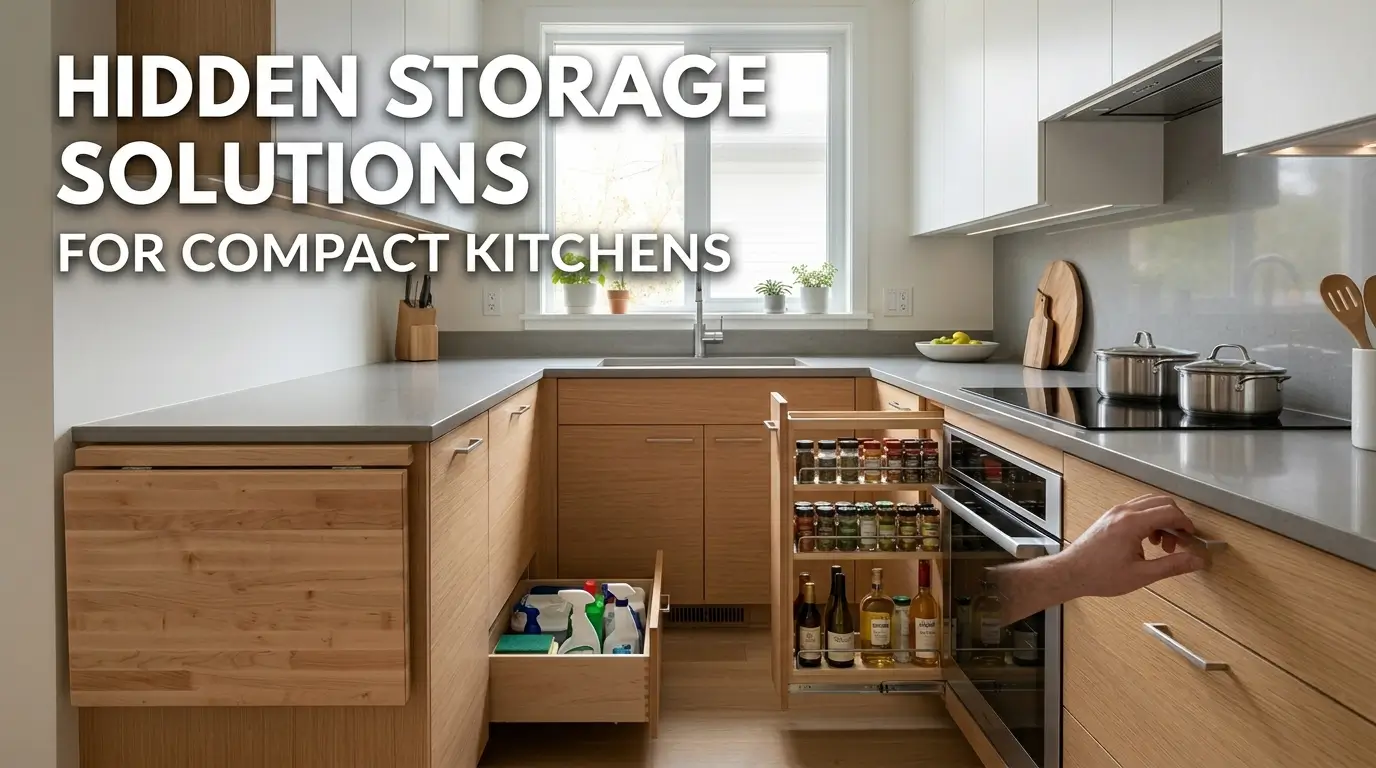
There are two ways to approach storage in a compact kitchen. The first is to make storage visible, open shelves, pegboards, rail systems, magnetic spice racks, utensil crocks on the counter. Everything is accessible, everything is on display, and the kitchen communicates its storage capacity through the visible presence of what it holds. This approach works well when the items being stored are attractive, consistent, and curated well enough to be worth looking at.
The second approach is to hide everything. Every storage location is behind a door, inside a drawer, concealed within a surface, or folded into a structure that reveals nothing of what it contains when the kitchen is not in active use. The counter is clear. The walls are uninterrupted. The cabinets show nothing but their faces. The kitchen looks, at rest, like a room that has nothing in it. Then the drawers open, the panels lift, the pull-outs extend, and the full storage capacity of the kitchen reveals itself all at once.
The second approach is harder to design and harder to execute. It requires more precise planning, more deliberate cabinet specification, and a greater willingness to treat the kitchen as an architectural object rather than a collection of functional components. But in a compact kitchen, particularly in an Indian flat where the volume and variety of what needs to be stored is genuinely large, hidden storage produces a result that the visible storage approach cannot. A compact kitchen where everything is concealed does not look like a small kitchen struggling with its storage problem. It looks like a kitchen that has already solved it.
Here are 12 ideas for designing and building hidden storage into a compact kitchen that keeps every surface clear and every centimetre of storage working.
Compact Kitchen Design With Hidden Storage Ideas
1. Handleless Cabinets With Push-to-Open Mechanisms
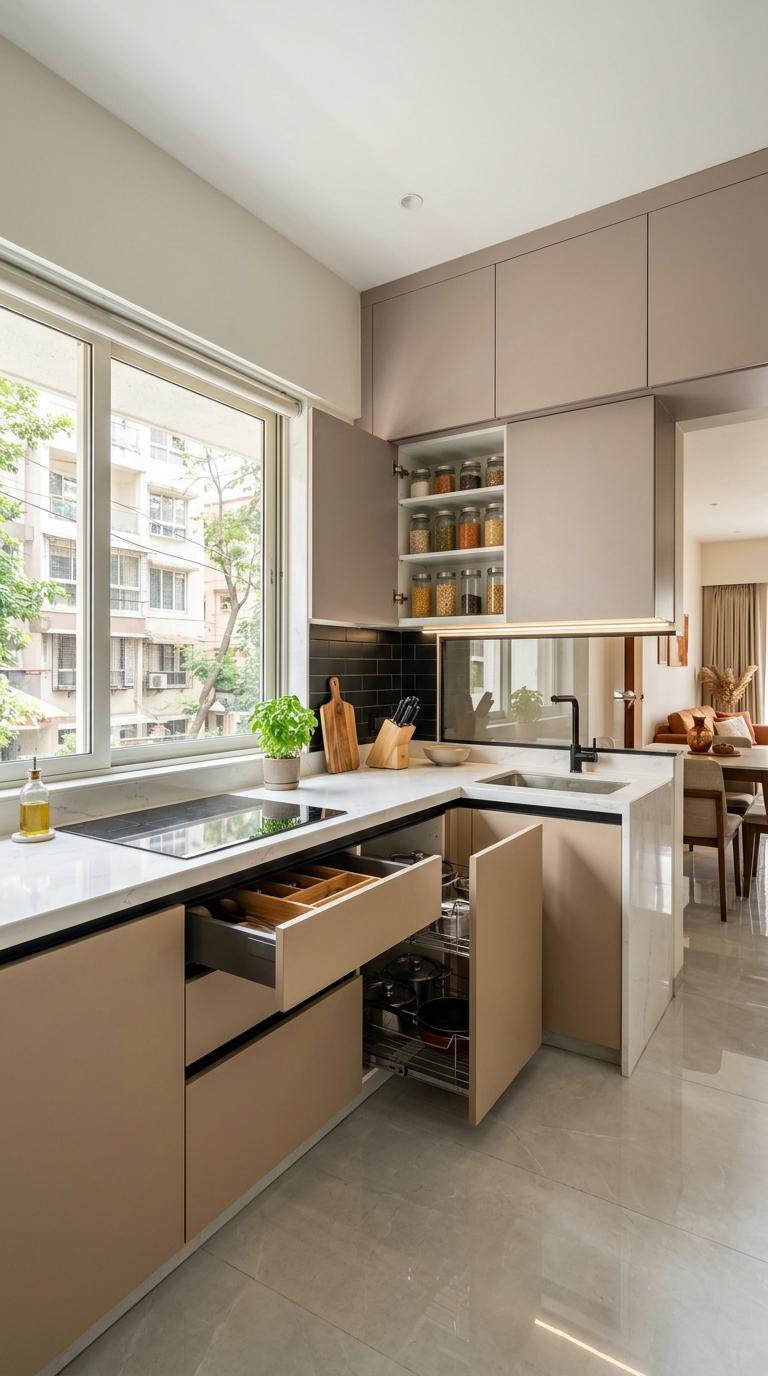
The most visible element of any kitchen cabinet is its hardware. Handles and knobs identify every cabinet and drawer as a storage unit, signal the presence of storage behind every surface, and collectively create a visual busyness that makes even a well-planned kitchen feel cluttered with storage hardware across every door and drawer front. Removing the hardware removes the visual signal of storage entirely.
Handleless cabinets with push-to-open or tip-on mechanisms, where pressing the cabinet face causes it to spring open without any visible handle, create a cabinet face that reads as a flat, uninterrupted surface rather than a row of storage units. The kitchen wall becomes a composition of flat planes rather than a display of cabinet hardware. Each plane conceals storage behind it but reveals nothing of what it contains until it is opened. In a compact kitchen where the cabinet faces are the dominant visual element, handleless push-to-open cabinets are the single most effective change available for creating the appearance of a kitchen that has resolved its storage problem invisibly.
2. A Flush-Fit Appliance Wall Behind a Single Panel
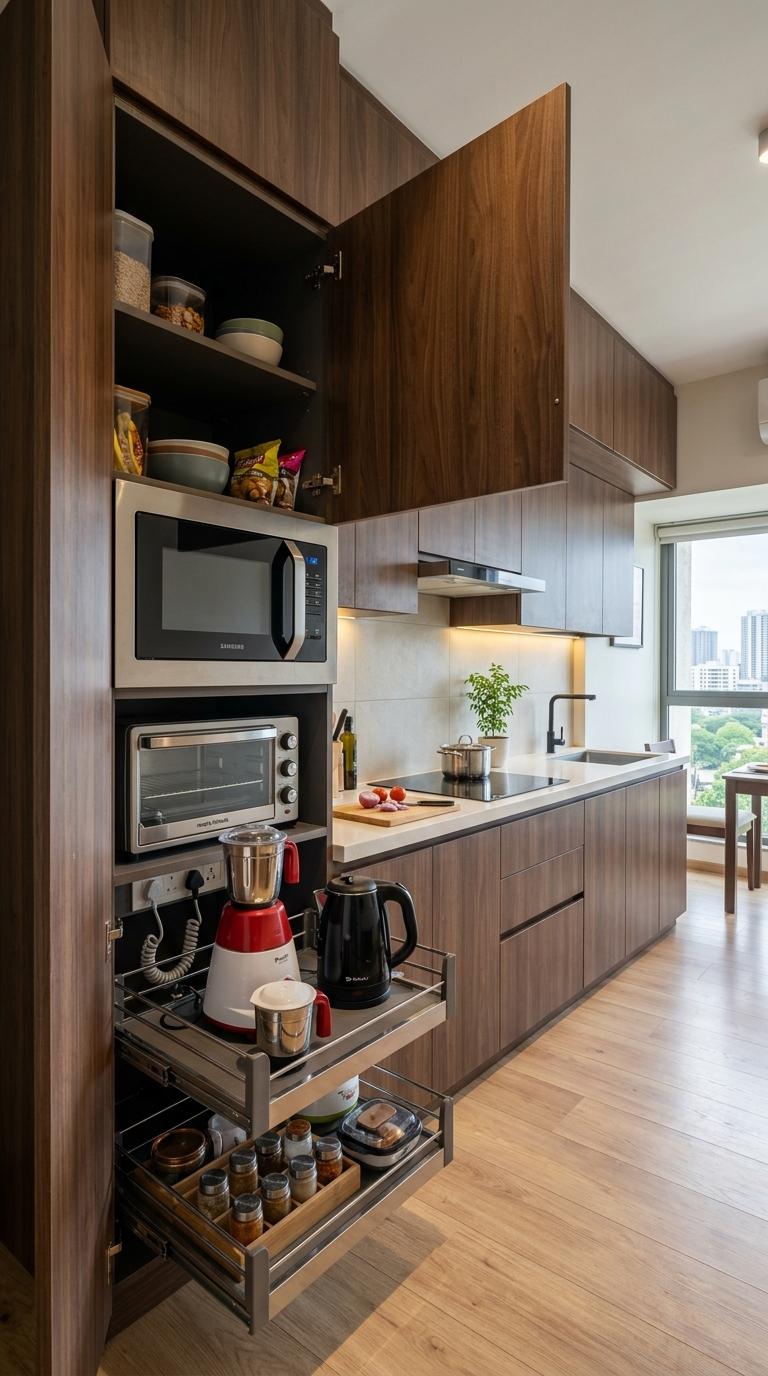
The appliances in a compact Indian kitchen, the microwave, the toaster oven, the mixer-grinder when not in use, the electric kettle, represent a collection of objects with different heights, different widths, and different visual characters that resist organisation into a coherent visual composition when they sit on the counter or in open shelving. Hiding them behind a single panel that opens to reveal a fully fitted appliance wall turns a collection of mismatched objects into a single, hidden, organised storage system.
A floor-to-ceiling cabinet panel with push-to-open or a simple recessed finger pull, opening to reveal a fitted interior with the microwave at eye level, the toaster oven below it, pull-out shelves for the mixer-grinder and kettle at counter height with internal power points for in-cabinet use, and additional shelving above and below, conceals the entire appliance collection behind one surface. When the panel is closed, the kitchen has one fewer visual element competing for attention. When it is open, every appliance is accessible, connected, and in its designated location within a single organised system.
3. A Concealed Pantry Behind a Full-Height Door Panel
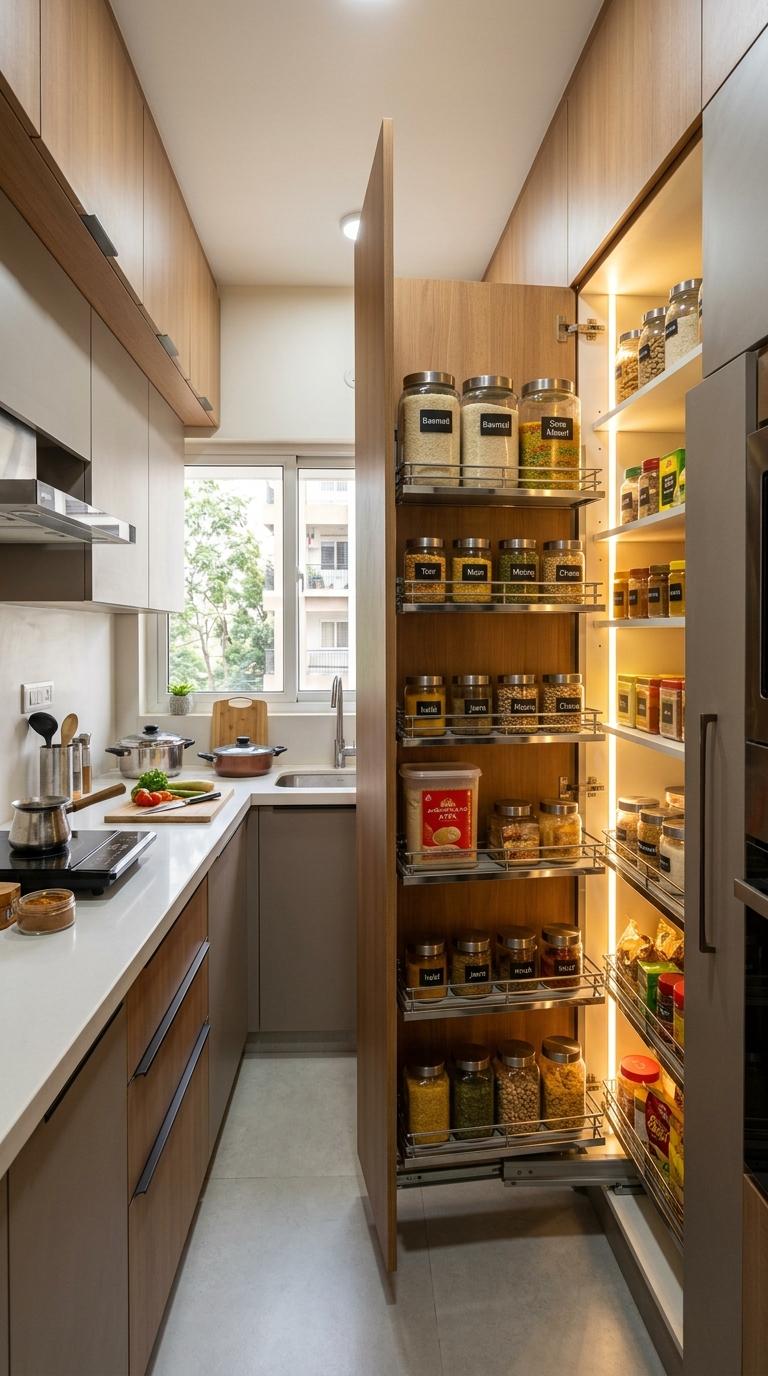
Dry goods storage in an Indian kitchen is a volume requirement that standard modular cabinets do not naturally accommodate within a compact footprint. The instinct is to add more cabinets. The hidden storage approach is to consolidate all dry goods behind a single full-height door panel that opens to reveal a complete pantry system without advertising its presence when closed.
A full-height door panel matching the surrounding cabinet finish, fitted on concealed hinges and flush with the surrounding surfaces, opens to reveal a pull-out pantry system with multiple tiers of shelving for rice, dal, atta, and the full range of Indian dry goods storage requirements. The pull-out shelves extend fully when the door is open, presenting the entire pantry contents at once rather than in sequential layers that require reaching to the back. When the door is closed, the pantry disappears into the cabinet wall and the kitchen retains its uninterrupted surface quality.
4. Toe-Kick Drawers Concealed Behind the Kickboard
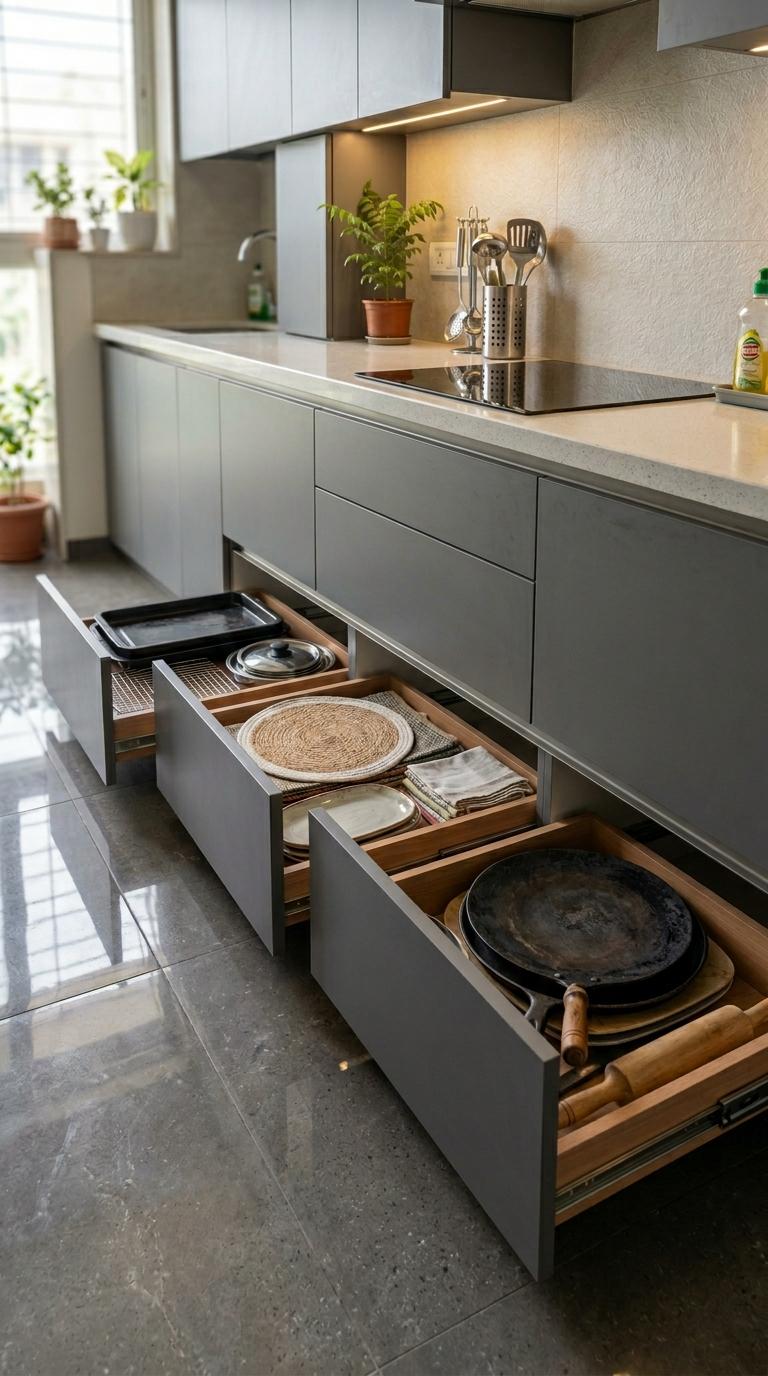
The kickboard panel at the base of every lower cabinet run conceals a void between 100 and 150 millimetres high that runs the full length of the cabinet. In a standard kitchen, this void is sealed behind a fixed kickboard panel and never used. In a compact kitchen with hidden storage, it becomes a storage zone that is invisible from standing height and accessible by crouching or using a toe press mechanism that pops the drawer open.
Toe-kick drawers fitted with a push-to-open mechanism across the full length of the lower cabinet run add a hidden storage layer at floor level that is genuinely surprising in its capacity. The full length of the counter run, at a depth of the cabinet and a height of 100 to 150 millimetres, holds a significant volume of flat, rarely used items. Large serving trays, flat baking sheets, spare placemats, the larger tawa that comes out once a month, all stored in a location that is invisible from every angle until the drawer is deliberately opened. The toe-kick drawer is the most hidden storage in the compact kitchen and the storage solution that most consistently surprises people when they discover it.
5. A Recessed Spice Niche in the Splashback Wall
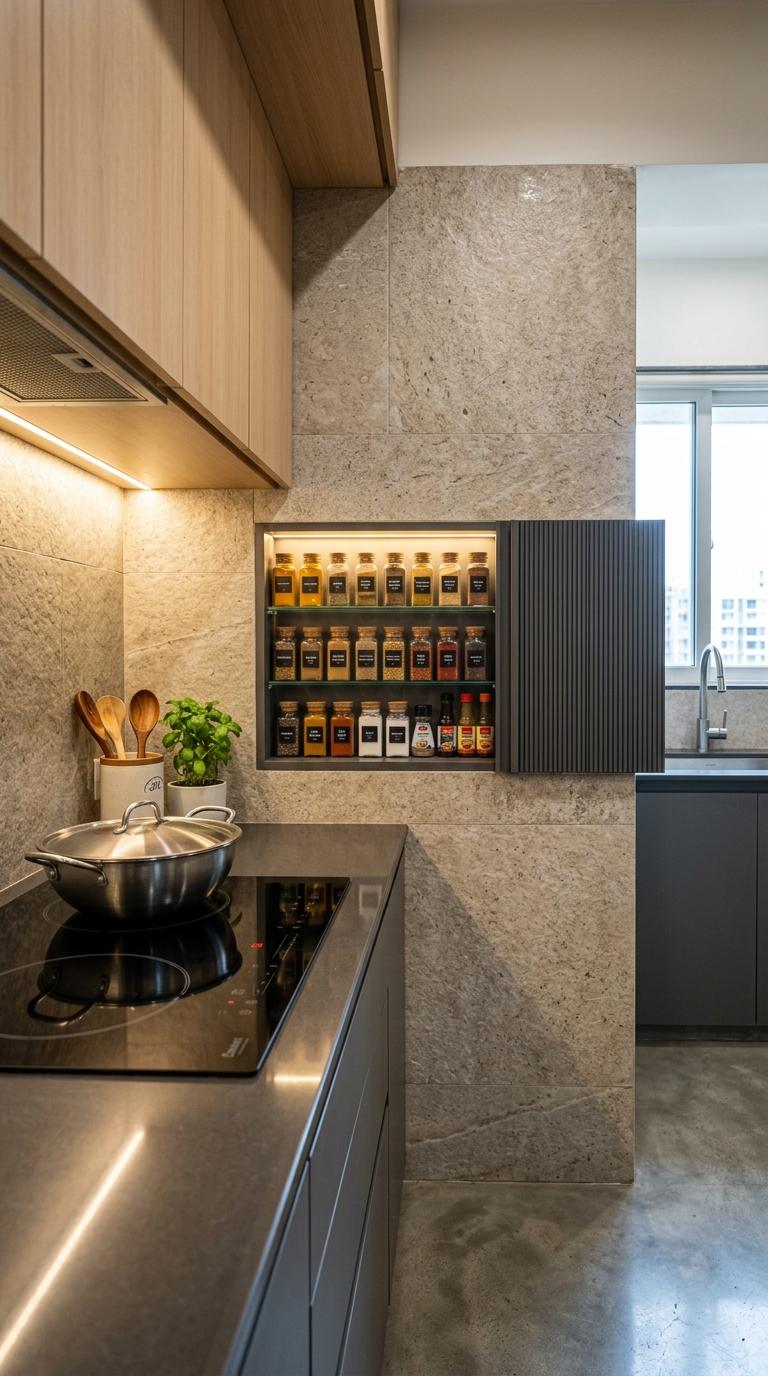
The splashback wall in a compact kitchen, the surface between the counter and the wall cabinets above it, is typically tiled and decorative. In a hidden storage kitchen, it can also be functional. A recessed niche built into the splashback wall, a shallow recess 100 to 150 millimetres deep cut into the wall between the counter level and the wall cabinet above it, provides shelving for spices and small condiment bottles within immediate reach of the cooktop without projecting any surface forward from the wall.
A recessed spice niche is flush with the surrounding wall surface when viewed from the side, making it invisible until you are directly in front of it. Fitted with a slim sliding door or a pull-down blind that closes over the niche when not in use, the recessed niche disappears entirely into the splashback wall. The spices are there. They are accessible. They are exactly where they need to be relative to the cooktop. But from the kitchen entrance, the splashback wall reads as a flat, uninterrupted surface.
6. A Hidden Waste and Recycling System
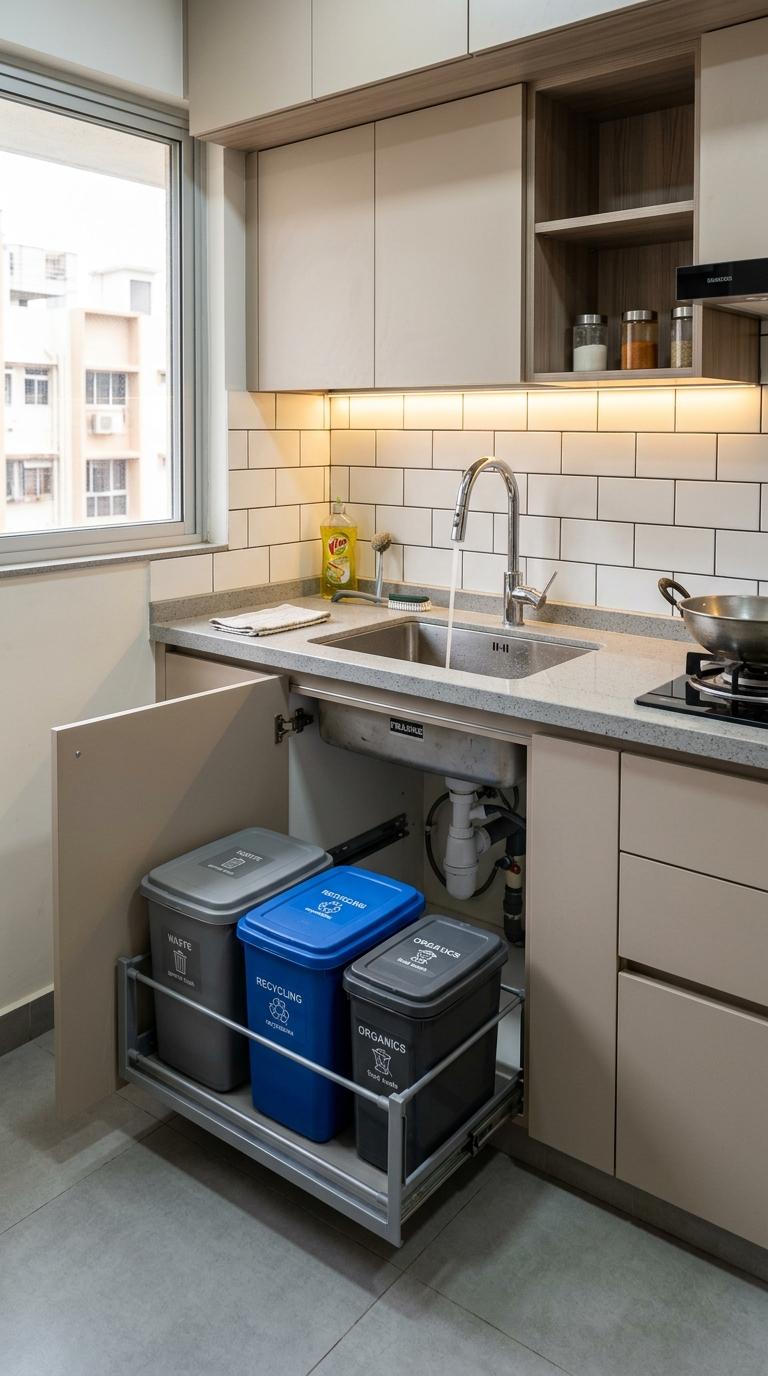
The waste bin is one of the most consistently problematic objects in a compact kitchen. Too large to hide easily, too necessary to eliminate, and visually incompatible with any kitchen aesthetic regardless of how carefully it is designed. In a compact kitchen with hidden storage, the waste bin is a built-in pull-out system concealed inside a base cabinet, typically under the sink where the plumbing already reduces the shelving capacity of the cabinet to a point where a built-in waste system is the most efficient use of the remaining space.
A pull-out waste cabinet, a base cabinet unit fitted with two or three compartment bins on a sliding frame that extends when the cabinet door is opened, conceals the entire waste and recycling system behind a cabinet face that matches every other cabinet in the kitchen. The bins are sorted, accessible, and contained within the cabinet structure. When the door is closed, the waste system is completely hidden. No bin visible on the floor. No odour escaping from an uncovered container. No visual disruption in the kitchen from an object that the standard compact kitchen simply leaves standing beside the counter without any attempt at concealment.
7. Under-Counter Refrigerator Integration
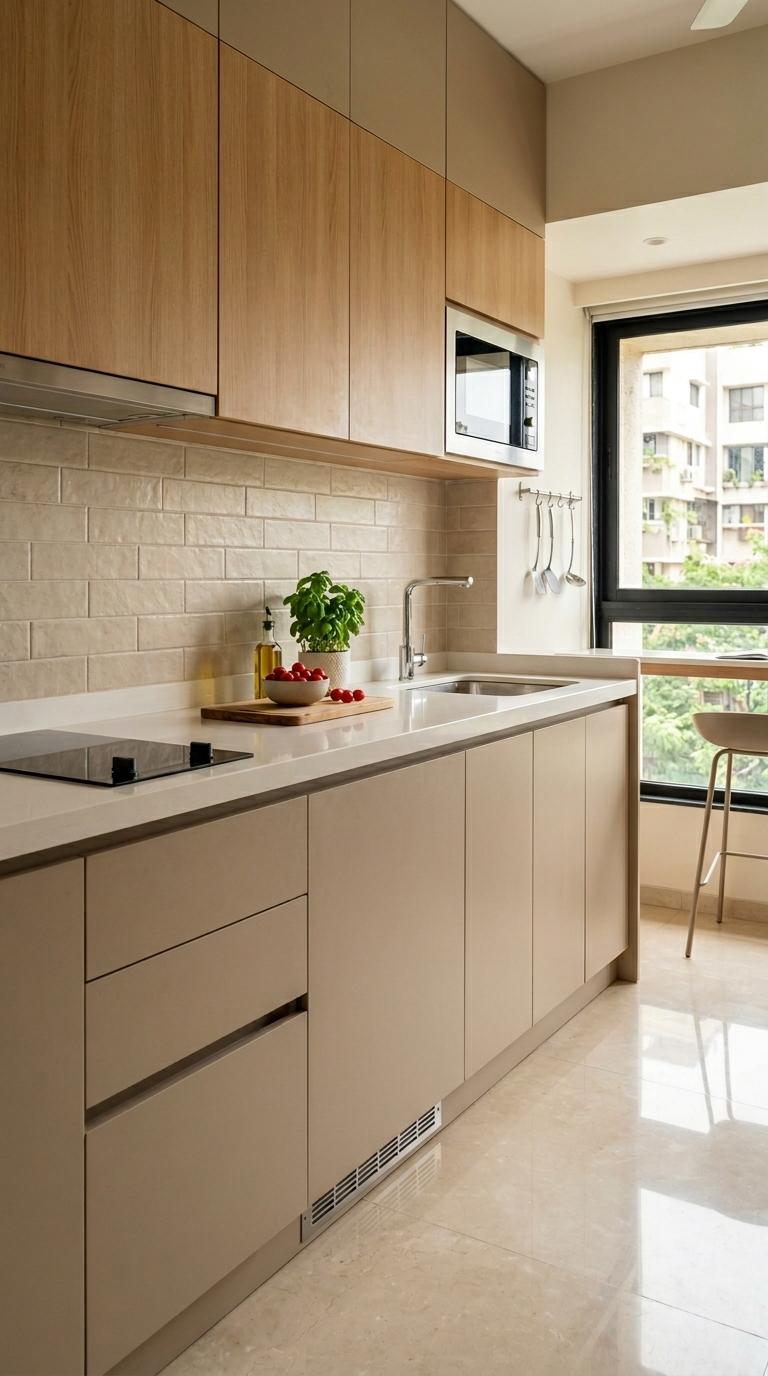
The standard refrigerator in an Indian compact kitchen is a full-height unit that stands independently at the end of the counter run, finished in a colour and material that rarely matches the surrounding cabinets and always reads as a separate appliance rather than an integrated element of the kitchen. In a hidden storage compact kitchen, the refrigerator is replaced with an under-counter unit housed within the base cabinet run, fitted with a door panel that matches the surrounding cabinet faces, and effectively invisible when the kitchen is viewed as a whole.
An under-counter refrigerator integrated into the base cabinet run with a matching cabinet panel door is a significant departure from the standard Indian kitchen refrigerator format and requires careful planning at the layout stage. The refrigerator capacity is lower than a full-height unit, which requires a corresponding adjustment in how dry goods and fresh ingredients are stored and rotated. For a compact kitchen in a small flat occupied by one or two people, an under-counter integrated refrigerator is a practical and visually resolving solution. For a larger household with greater fresh food storage requirements, a full-height refrigerator with a matching panel door on a fixed track is a less space-efficient but more capacity-appropriate alternative.
8. A Pull-Out Breakfast Counter Concealed in the Cabinet End Panel
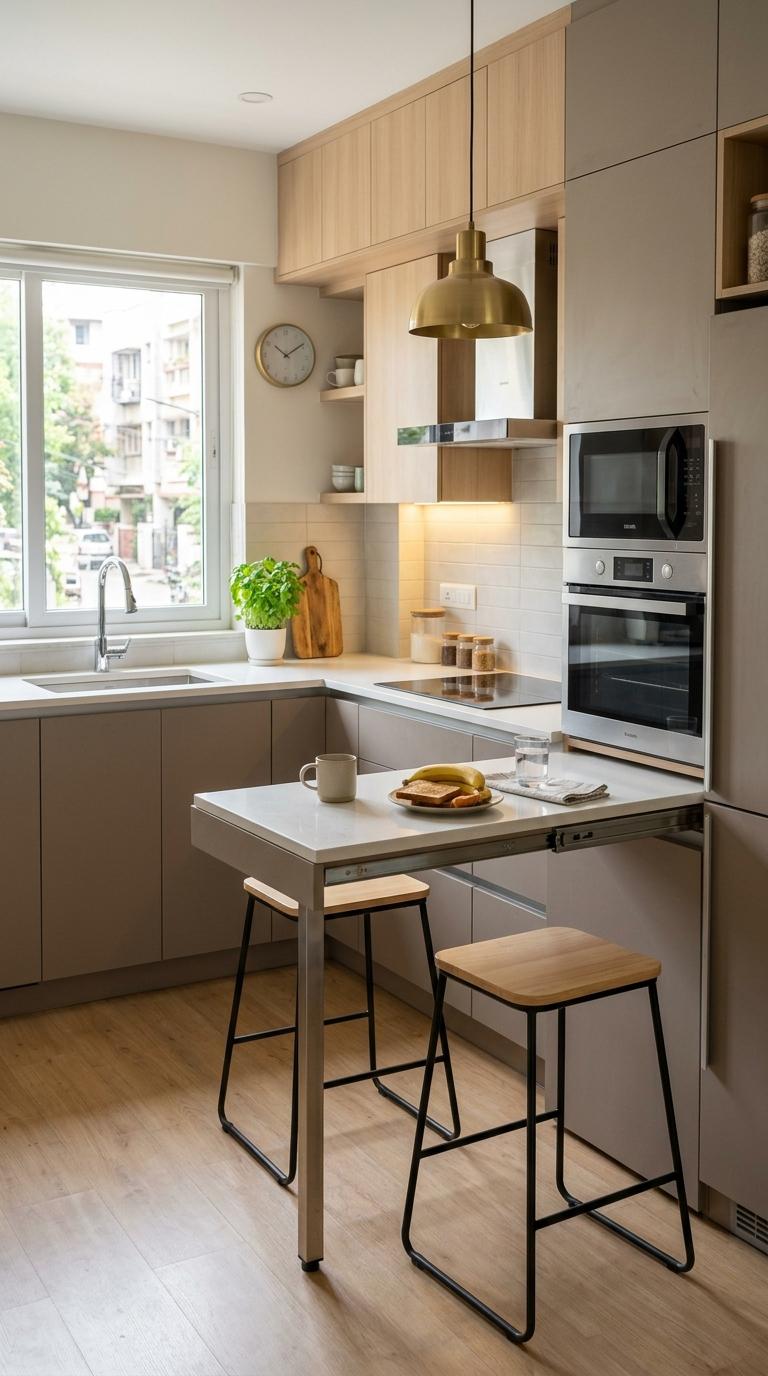
The end panel of the base cabinet run in a compact kitchen, the vertical face that terminates the counter run against the wall or at the room opening, is typically a flat decorative panel with no function beyond closing the end of the cabinet. In a hidden storage kitchen, this end panel can conceal a pull-out breakfast counter that extends to provide a dining surface for one or two people and retracts completely into the cabinet end when not in use.
A pull-out breakfast counter built into the end panel of the base cabinet run uses full-extension slides to support a counter surface that is roughly 600 to 700 millimetres wide and as deep as the cabinet, extending perpendicular to the main counter run when deployed and retracting to sit flush with the end panel when stored. The surface is completely invisible when retracted. When extended, it provides a dining position for two people at counter height. In a compact flat kitchen where a permanent dining surface is not feasible, the hidden pull-out breakfast counter is the most space-efficient dining solution available.
9. Concealed Charging and Electrical Infrastructure
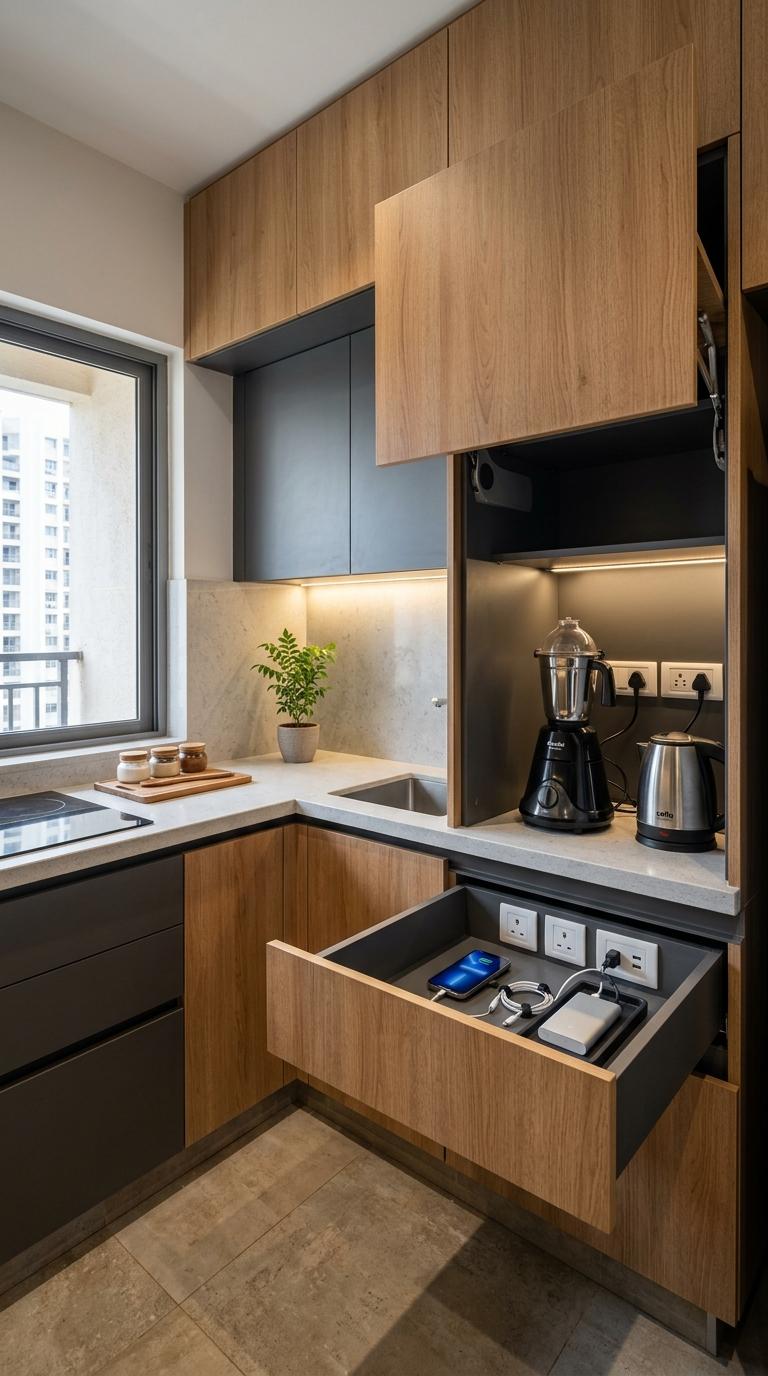
Power points, USB charging points, and the electrical infrastructure of a compact kitchen are typically surface-mounted on the wall or the backsplash at visible locations. In a hidden storage kitchen, the electrical infrastructure is concealed within the cabinet structure rather than mounted on visible wall surfaces.
Power points installed inside the appliance garage cabinet, accessible when the panel is open and invisible when it is closed. A charging drawer, a base cabinet drawer fitted with internal USB points and standard sockets for charging devices, that conceals all device charging within the cabinet run. Cable management channels routed through the cabinet structure rather than on the wall surface. A compact kitchen where every electrical connection, every cable, and every charging point is hidden within the cabinet structure reads as a finished, resolved space rather than one where the practical requirements of modern domestic life are visibly superimposed on the kitchen surface.
10. A Fold-Away Prep Station Inside a Full-Height Cabinet
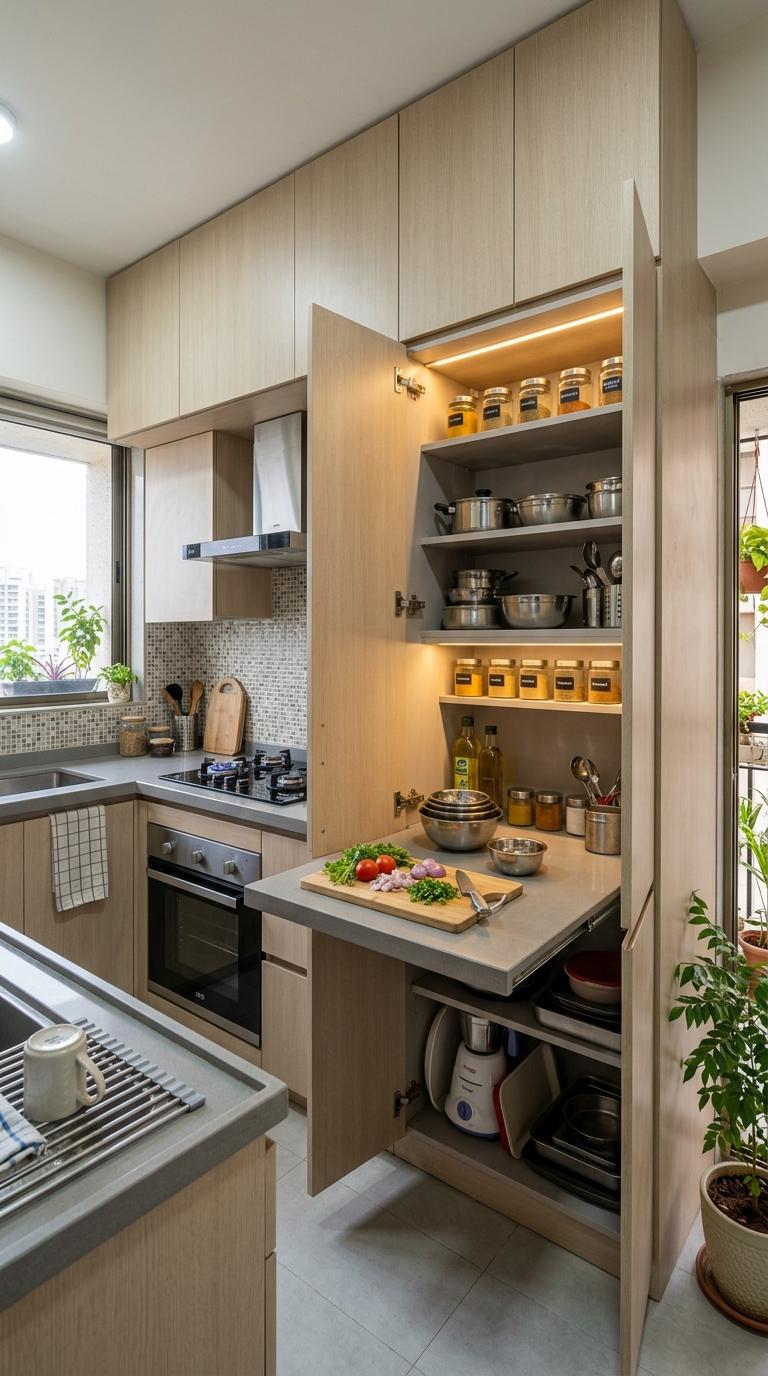
In a compact kitchen where the counter length is insufficient for the prep work that Indian cooking requires, a fold-away prep station concealed inside a full-height cabinet provides additional work surface that is completely hidden when not in use. The cabinet opens to reveal a fold-down work surface on the inside face of the door or on a pull-out frame within the cabinet body, extending to a full work position at counter height and folding back inside the cabinet when the prep is complete.
A fold-away prep station inside a full-height cabinet is a more architecturally resolved version of the fold-down wall shelf, because the preparation surface is housed within the cabinet structure rather than mounted separately on the wall. When the cabinet is closed, the prep station is invisible. When it is open, the work surface extends from within the cabinet structure and the cabinet interior, which can also hold prep-related storage above and beside the fold-away surface, provides an organised prep zone that concentrates all prep-related functions in a single concealed location.
11. Integrated Sink Cover as an Additional Counter Surface
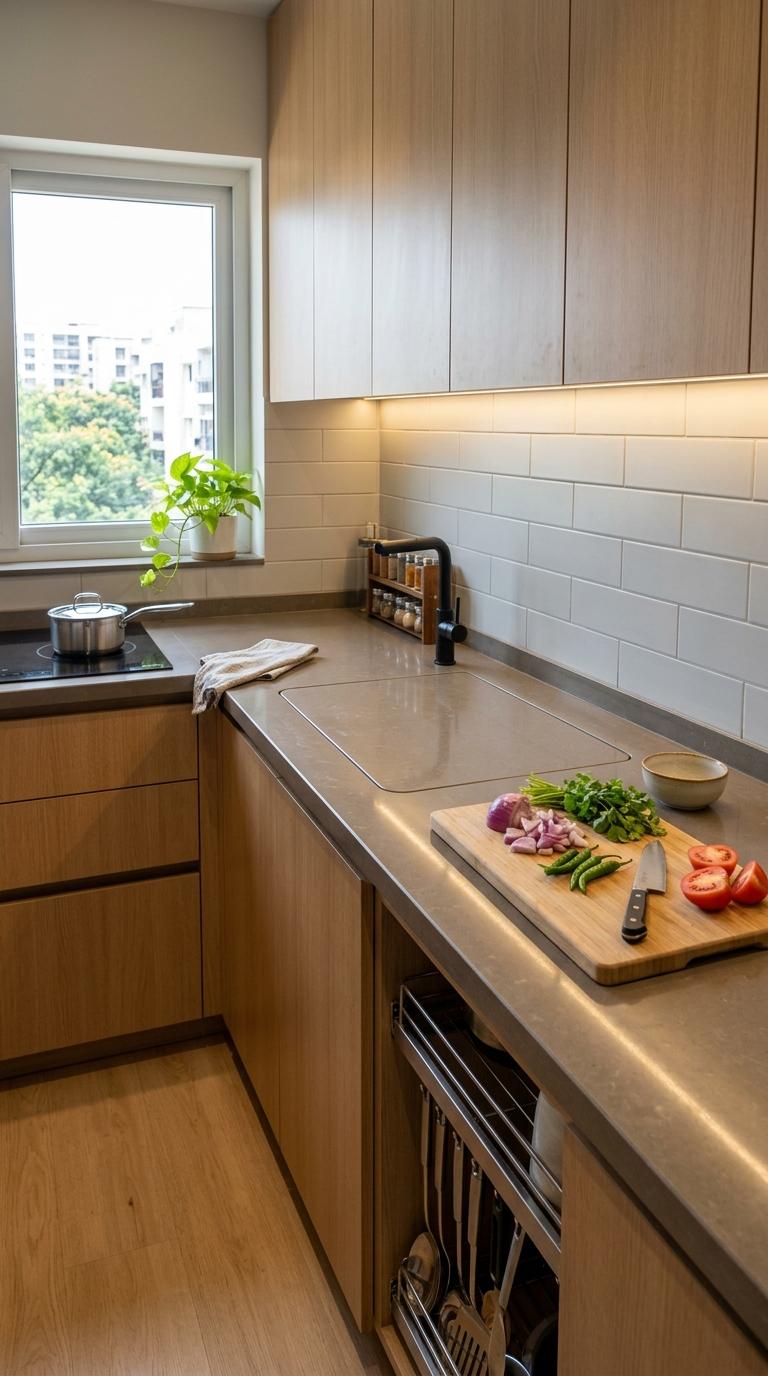
The sink in a compact kitchen occupies counter space that the kitchen cannot easily afford to lose. During the periods when the sink is not in use, the bowl sits empty and the space above it is unavailable for any other purpose. A custom-fitted sink cover, a cutting board or a solid surface panel sized to sit flush over the sink bowl, converts the sink zone from a single-function area into a multi-function surface that serves as prep counter when the sink is not needed for washing.
A sink cover that fits precisely over the sink bowl and sits flush with the surrounding counter surface is invisible as a separate element when in place. The counter reads as a continuous, uninterrupted surface. The sink is there, fully accessible when the cover is removed, but hidden beneath a functional counter surface when the washing up is done. In a compact kitchen where every centimetre of counter is valuable, a fitted sink cover effectively adds the area of the sink bowl to the available counter surface during the periods when the sink is not in active use.
12. A Concealed Cleaning Supply Zone
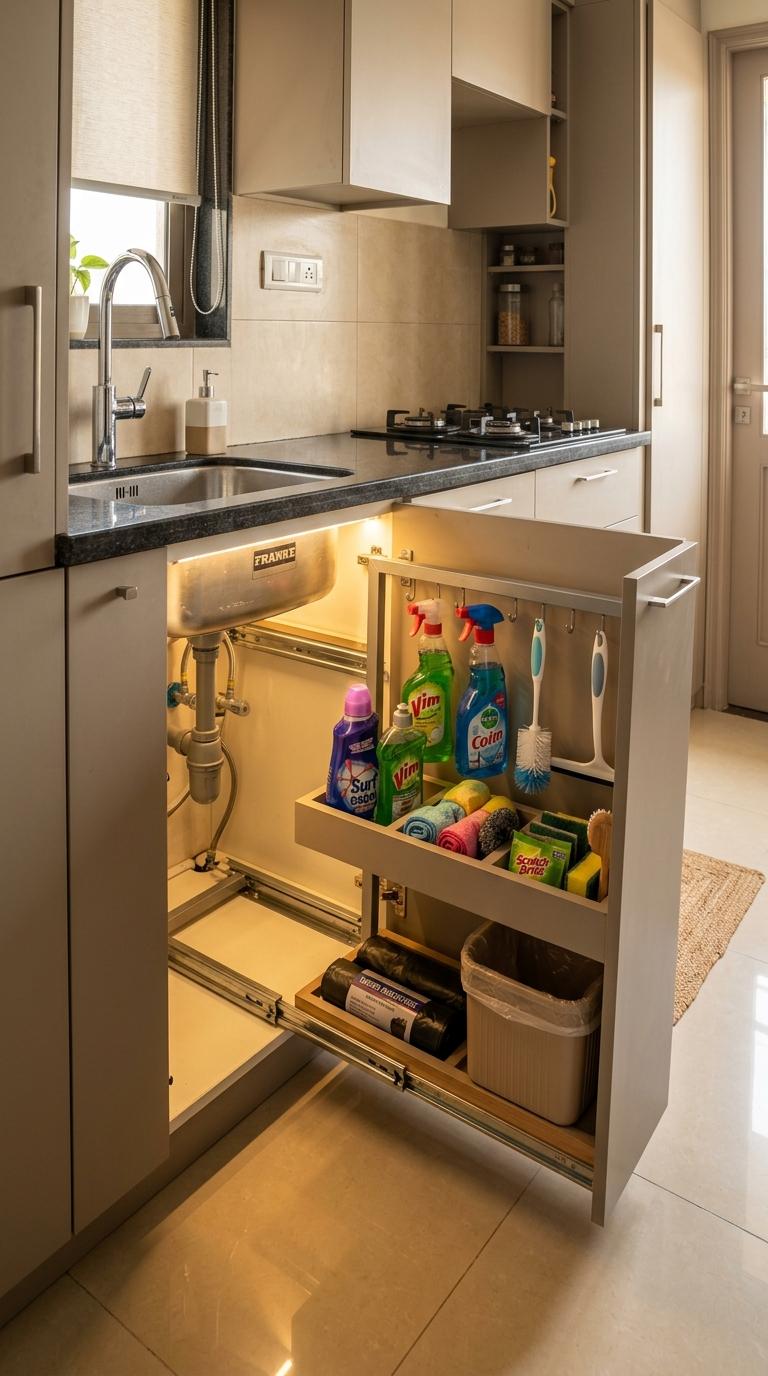
Cleaning supplies, the dish soap, the scrubbers, the spray bottles, the extra bin bags and the miscellaneous cleaning products that accumulate in every kitchen, are typically stored under the sink in an unorganised collection that makes the under-sink cabinet one of the least functional storage spaces in the kitchen. In a hidden storage compact kitchen, the under-sink zone is designed as a dedicated, organised cleaning supply system that conceals its contents completely when the cabinet is closed.
A pull-out cleaning caddy, a single unit on full-extension slides that holds all cleaning supplies in a single organised frame, fills the under-sink space with a storage system that presents all its contents at once when the cabinet is opened and conceals them completely when it is closed. Spray bottles hang on a rail across the back of the caddy. Dish soap and scrubbers sit in the front compartment at a height that makes them accessible without reaching. Spare bin bags and cleaning cloths sit in the lower compartment behind the caddy. Everything related to kitchen cleaning is in one place, organised, accessible, and invisible until needed.
A Kitchen That Hides Its Work
A compact kitchen with hidden storage does not look like a compact kitchen managing a storage problem. It looks like a kitchen where the storage problem has been solved so completely that the problem is no longer visible. The counter is clear because the appliances are behind a panel. The walls are uninterrupted because the spices are in a recessed niche. The floor is clear because the waste is in a pull-out cabinet and the toe-kick space is a drawer. The kitchen at rest looks like very little is stored there. The kitchen in use reveals that everything needed is exactly where it should be.
This is the correct ambition for a compact kitchen with hidden storage. Not to make the kitchen look bigger than it is, but to make it look more resolved than it is. A kitchen where the storage challenge has been met so completely that the challenge itself has become invisible.
Start with the handleless cabinets. Conceal the appliances. Build the pantry behind the panel. Add the toe-kick drawers. Hide the waste system. Each addition removes one more visible storage element from the kitchen surface and places it behind a face that reveals nothing until it is deliberately opened.
The result is a compact kitchen that keeps every surface clear, every storage location working, and every centimetre of the room doing its job without showing the effort it took to make that possible.